


Recovery is usually described in physical terms. Range of motion. Weight-bearing status. Wound checks. Weeks until you can drive again. Those things matter, and your appointments are built around them.
What goes unmeasured is everything happening in your head while your body does its work. Whether you sleep. Whether you trust the leg. Whether you can face the exercises on a Tuesday morning when nothing feels better than it did on Monday.
This is not a claim that thinking positively heals tissue. It is a more practical point: mental state changes behavior, and behavior is most of what determines whether a rehabilitation plan works. Someone who has not slept in four nights feels more pain from the same injury. Someone convinced that bending the knee will tear something will not bend the knee.
| What you might notice | What it can affect | Where to start |
| Constant checking of symptoms | Willingness to move and load the area | Ask for clear rules on what is safe |
| Flat mood, no motivation | Attendance, exercise consistency | Tell your provider, treat it as clinical |
| Broken or shallow sleep | Pain tolerance, energy, concentration | Address pain timing and sleep routine |
| Avoiding certain movements | Strength, balance, confidence | Graded return with your rehab team |
| Withdrawing from people | Motivation and follow-through | Ask for specific, limited help |
Anxiety Can Make Recovery Feel More Difficult
Anxiety during recovery is rarely irrational. You have limited information, a body behaving differently, and no reliable way to tell a normal healing sensation from a warning sign. So you watch. You test the area. You search symptoms at two in the morning.
The problem is what that watchfulness does next. Attention amplifies sensation: the more closely you monitor a joint, the more of what you notice feels significant. The practical response to worry is usually to do less, and doing less is what slows the return of strength, mobility and confidence.
Dr. Ari Hoschander, Head Plastic Surgeon at NYC Mommy Makeover Center, notes, “Anxiety can keep your attention focused on physical sensations. You may notice every ache or unusual feeling and immediately worry that something has gone wrong. Some symptoms may deserve medical attention, but constantly monitoring your body can make recovery feel overwhelming.
The most useful thing to take away from an appointment is not reassurance but rules. Vague comfort fades by the time you reach the car. Specific boundaries hold up at home. Before you leave, try to get answers to these:
- How much discomfort is acceptable during an exercise, ideally as a number on a zero to ten scale, and how quickly it should settle afterward
- Whether soreness the next morning means you overdid it or is a normal training response
- Which specific movements or loads are off limits, and until what date
- What would count as a real problem, described in plain terms rather than “if it feels wrong”
- Who to call between appointments
Some symptoms are not anxiety and should never be talked yourself out of. After surgery in particular, calf pain or swelling on one side, sudden shortness of breath, chest pain, fever, spreading redness or discharge from a wound, or a sudden change in the color or temperature of a limb all need urgent assessment. Anxiety and a genuine complication can feel similar from the inside, which is exactly why the answer is to get it checked rather than to talk yourself down.
Your Mood Can Affect Your Motivation
Rehabilitation asks for repetition without much visible reward. The exercises are dull, progress arrives in increments too small to feel, and you give up things you liked for a length of time nobody can quite specify. That combination flattens most people’s mood at some point, and for some it becomes something heavier.
“Depression can reduce energy and motivation. You may know that physiotherapy or daily movement could help, yet still struggle to get started. You might also withdraw from family and friends or lose interest in activities that previously gave you enjoyment,” says Dr. Tan Sok Chuen, from Hip & Knee Orthopaedics.
This is not a character problem, and treating it as one wastes time. A meta-analysis in Archives of Internal Medicine found that depressed patients are roughly three times more likely to be noncompliant with medical treatment recommendations than patients who are not depressed. During recovery, noncompliance is not an abstraction. It is the missed appointment, the exercises that stopped happening, the medication left on the counter.
Knowing the difference between ordinary frustration and something that needs treating matters here. The National Institute of Mental Health’s overview of depression is a reasonable place to check your own experience against clinical criteria.
| Ordinary recovery frustration | Worth raising with your provider |
| Bad days that lift within a day or two | Low or empty mood most of the day, nearly every day, for two weeks or more |
| Annoyance at slow progress | Loss of interest in things you would normally enjoy, including outside recovery |
| Tiredness that improves after rest | Fatigue that rest does not touch |
| Wanting a day off from exercises | Weeks of not being able to start them at all |
If you recognize the right-hand column, shrink the task rather than push harder. Agree with your therapist on a minimum version of your program, the one you could manage on your worst day, and treat that as the target. Consistency at low volume beats an ambitious plan that collapses after a week. Then tell your provider what is happening, because treating the mood problem often makes the physical program possible again.
Poor Sleep Can Slow Your Recovery
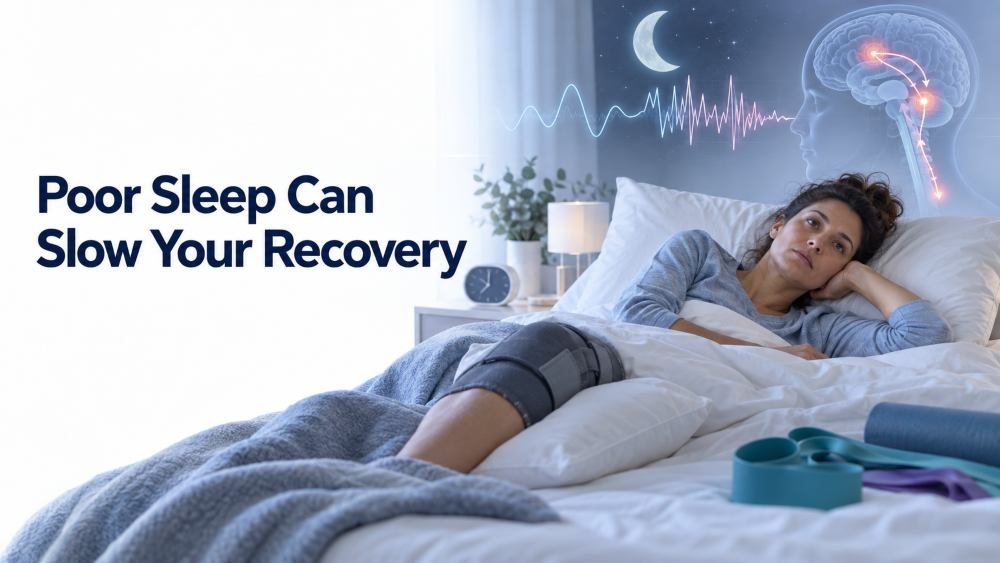
Sleep during recovery is a loop that runs the wrong way. Pain interrupts sleep, and the lost sleep then lowers your pain threshold the following day, so the same injury hurts more and the next night is worse.
This is measurable, not just a feeling. Researchers at the University of California, Berkeley used brain imaging to show that a night without sleep amplifies activity in pain-sensing regions of the brain while blunting the areas that normally dampen pain signals. Participants reported discomfort at lower temperatures than after a full night’s rest. The stimulus was identical. The experience of it was not.
“Talk to your healthcare provider if pain or emotional distress is regularly keeping you awake,” shares Sade Savage, PA-C, DMSc, CAQ-psych, Board-Certified Psychiatric Physician Assistant at Zellig Psychiatry. “Depending on the cause, your treatment team may recommend changes to your routine, pain management strategies, physical adjustments, or further evaluation. Persistent sleep problems should not simply be accepted as an unavoidable part of recovery.”
Practical things worth raising or trying:
- Ask whether the timing of your pain medication can be adjusted so that coverage lines up with the hours you are trying to sleep
- Keep a consistent wake time even after a bad night, since that does more for your body clock than an early bedtime
- Keep daytime naps short and early, because long afternoon sleep makes the following night worse
- Ask about cognitive behavioral therapy for insomnia, the recommended first-line treatment for ongoing insomnia
- Do not use alcohol to get to sleep, and check with your provider before adding any over-the-counter sleep aid, since interactions with pain medication are common
Stress Can Affect How You Handle Physical Symptoms
Recovery brings stressors that have nothing to do with the injury itself. Income interrupted. Work piling up. Depending on other people for lifts, meals, or help washing. Insurance paperwork. Childcare you can no longer manage the way you did.
Sustained stress makes physical symptoms harder to sit with. Muscles stay guarded, sleep gets worse, and the routines that support recovery are the first to go. There is also evidence that stress affects the biology of healing directly. A well-known Lancet study found that caregivers under long-term stress took significantly longer to heal a small standardized skin wound than matched controls. A later review of this research summarized the mechanisms by which psychological stress modulates wound repair, including effects on immune signaling and on health behaviors such as sleep, eating and smoking.
Two things need saying alongside that. This does not mean stress caused your injury, or that reducing stress will fix a structural problem. And being told that stress affects symptoms is not the same as being told the pain is imaginary. Pain amplified by stress is still pain, and it deserves the same treatment as any other.
Useful during recovery:
- Protect one fixed anchor in the day, such as a set wake time, one walk, or one meal eaten properly, and let the rest of the schedule flex
- Use slow breathing or a brief relaxation routine before rehabilitation sessions, not only at night, since it lowers guarding during the work itself
- Set a limit on symptom searching, keeping questions in a note for your next appointment instead of researching at midnight
- Ask for a psychology or social work referral if the pressure is financial or practical rather than emotional
Fear Of Reinjury Can Change How You Move
Fear outlasts tissue healing. This is one of the most consistent findings in rehabilitation research, and it explains much of why two people with identical scans end up with very different outcomes.
The clearest data comes from sports medicine. In a study of patients following anterior cruciate ligament reconstruction, psychological readiness rather than physical recovery predicted who returned to their preinjury level of sport, with up to two-thirds of athletes not back at their previous level twelve months after surgery despite being physically recovered. The knee was ready. The person was not.
You do not need to be an athlete for this to apply. It shows up as putting less weight through one leg on the stairs, holding a shoulder slightly still while reaching, avoiding the pavement where you fell, or quietly dropping an activity without ever deciding to.
Dr. Bronwyn Holmes, MD, FAARFM, Expert in Regenerative and Longevity Medicine, Bioidentical Hormone Therapy, and Pediatric Precision Health at Regenerated, adds, “Recovery is a gradual process, and rebuilding trust in your body is an important part of it. Once you’re cleared to increase activity, gradually using the affected area can help restore strength and confidence. Your rehabilitation team can help you understand how to progress safely without pushing beyond what your body is ready for.”
Rebuilding confidence works best when it is planned rather than attempted spontaneously:
- Write down the specific movements you are avoiding, because most people cannot name them until asked
- Attempt the frightening movement first in a supervised session, then repeat it at home the same week
- Agree in advance on how much soreness afterward is acceptable
- Track what you did rather than how it felt, since fear distorts your memory of your own progress
- Do not test your limits alone at home to prove something, particularly with weight-bearing after surgery
Caution has a legitimate place. Restrictions with dates attached exist for structural reasons and are not the same thing as fear. The problem is caution that continues for months after clearance because nobody helped you cross back over.
Social Support Can Help You Stay Engaged
Recovery isolates people quietly. You cancel plans because getting there is difficult, friends stop asking after the second no, and your world narrows to the house, the appointments and the exercises. The narrowing itself lowers your mood.
The relationship between social connection and health outcomes is large and well established. A meta-analysis covering 148 studies and more than 300,000 participants found that people with stronger social relationships had around a 50 percent greater likelihood of survival over follow-up periods, an effect comparable to well-recognized risk factors. In treatment specifically, practical and emotional support from family is associated with better adherence to medical recommendations.
Support works better when it is specific. Most people offering help mean it, and most people recovering find “let me know if you need anything” impossible to act on. Naming a concrete task solves that on both sides:
- Ask for a lift to a particular appointment on a particular date rather than help with transport in general
- Ask someone to text you on the days you tend to skip exercises, and tell them which days those are
- Accept help with tasks that are genuinely unsafe right now, such as heavy lifting or ladders
- Consider a condition-specific support group if you want to talk to people who already understand the timeline
There is a limit worth naming: too much help slows recovery. If someone carries everything and stops you attempting anything, you lose the ordinary daily loading and problem-solving that rebuilds function. Tell the people helping you which tasks you intend to keep doing yourself, even if they take longer and look awkward.
Treating Your Mental Health Can Support Physical Recovery

The point is not to add another item to your recovery to-do list. It is that mental health during recovery is treatable, and treating it usually makes the physical work easier rather than competing with it for time.
In an interview, Christopher DiViaio, LCSW of Eleve Behavioral Health, said, “Mental health can have a practical effect on how well you manage recovery. When anxiety, low mood, or poor sleep starts getting in the way, even simple tasks like attending appointments or following a rehabilitation plan can feel harder. Addressing those concerns early can help you stay engaged with the rest of your care.”
What is available depends on your situation and where you are, but the common options are worth knowing before you need them:
- Cognitive behavioral therapy, which is widely used for anxiety and depression and has a specific version for insomnia
- Acceptance and commitment therapy, often used where limitation is likely to persist for a while
- Pain psychology or a multidisciplinary pain service, if pain has continued well beyond the expected timeline
- Graded exposure work with your physical therapist, which treats movement fear directly
- Medication, where appropriate, discussed with a prescriber who can see your full medication list
Two limitations are worth being clear about. Mental health care does not replace medical assessment when something has changed physically, and a new or worsening symptom should be checked rather than attributed to stress by default. Treating anxiety or depression will also not always change the pain itself. It changes what you can do while the pain is there, which is usually what determines the outcome.
Conclusion
Bodies and minds do not recover on separate tracks. Poor sleep raises the volume on pain, low mood cuts the number of sessions you complete, fear changes how you move long after the tissue has healed, and stress makes all of it harder to carry. None of that is unusual, and none of it means you are handling recovery badly.
What helps is tracking a few things as closely as your clinicians track your body: how you are sleeping, how your mood is holding, whether you are still moving normally, whether you are still seeing people. When any of those slips for more than a couple of weeks, say so at your next appointment rather than waiting for it to become obvious. Recovery goes better when both halves of it are being treated.
Medical Disclaimer
This article is general information and is not medical or mental health advice. It cannot account for your diagnosis, procedure, medications or restrictions, and it should not be used in place of guidance from your own treating team. Follow the specific instructions given by your surgeon, physician or therapist. Seek urgent medical care for symptoms such as chest pain, shortness of breath, fever, calf pain or swelling, or signs of wound infection. If you are having thoughts of harming yourself, treat that as an emergency: in the United States call or text 988, and elsewhere contact your local emergency number or crisis service.
References
- Ardern, C. L., Taylor, N. F., Feller, J. A., Whitehead, T. S., & Webster, K. E. (2013). Psychological responses matter in returning to preinjury level of sport after anterior cruciate ligament reconstruction surgery. The American Journal of Sports Medicine, 41(7), 1549–1558. https://doi.org/10.1177/0363546513489284
- Ardern, C. L., Taylor, N. F., Feller, J. A., & Webster, K. E. (2014). Fifty-five per cent return to competitive sport following anterior cruciate ligament reconstruction surgery: a systematic review and meta-analysis including aspects of physical functioning and contextual factors. British Journal of Sports Medicine, 48(21), 1543–1552. https://doi.org/10.1136/bjsports-2013-093398
- DiMatteo, M. R. (2004). Social support and patient adherence to medical treatment: a meta-analysis. Health Psychology, 23(2), 207–218. https://doi.org/10.1037/0278-6133.23.2.207
- DiMatteo, M. R., Lepper, H. S., & Croghan, T. W. (2000). Depression is a risk factor for noncompliance with medical treatment: meta-analysis of the effects of anxiety and depression on patient adherence. Archives of Internal Medicine, 160(14), 2101–2107. https://doi.org/10.1001/archinte.160.14.2101
- Gouin, J.-P., & Kiecolt-Glaser, J. K. (2011). The impact of psychological stress on wound healing: methods and mechanisms. Immunology and Allergy Clinics of North America, 31(1), 81–93. https://doi.org/10.1016/j.iac.2010.09.010
- Holt-Lunstad, J., Smith, T. B., & Layton, J. B. (2010). Social relationships and mortality risk: a meta-analytic review. PLoS Medicine, 7(7), e1000316. https://doi.org/10.1371/journal.pmed.1000316
- Kiecolt-Glaser, J. K., Marucha, P. T., Malarkey, W. B., Mercado, A. M., & Glaser, R. (1995). Slowing of wound healing by psychological stress. The Lancet, 346(8984), 1194–1196. https://doi.org/10.1016/s0140-6736(95)92899-5
- Krause, A. J., Prather, A. A., Wager, T. D., Lindquist, M. A., & Walker, M. P. (2019). The pain of sleep loss: a brain characterization in humans. The Journal of Neuroscience, 39(12), 2291–2300. https://doi.org/10.1523/JNEUROSCI.2408-18.2018
- National Institute of Mental Health. (2024). Depression. National Institutes of Health, Bethesda, MD. Available at: https://www.nimh.nih.gov/health/topics/depression (accessed September 2026).