


Prior authorization is a health plan’s requirement that a provider get approval before delivering certain tests, procedures or medications, and for most practices it has become one of the biggest drivers of delayed and denied payment. It sits at the front of the revenue cycle, but its cost shows up at the back: in claims that cannot be paid because an approval was missing, late or attached to the wrong code.
How Much Time Does Prior Authorization Take?
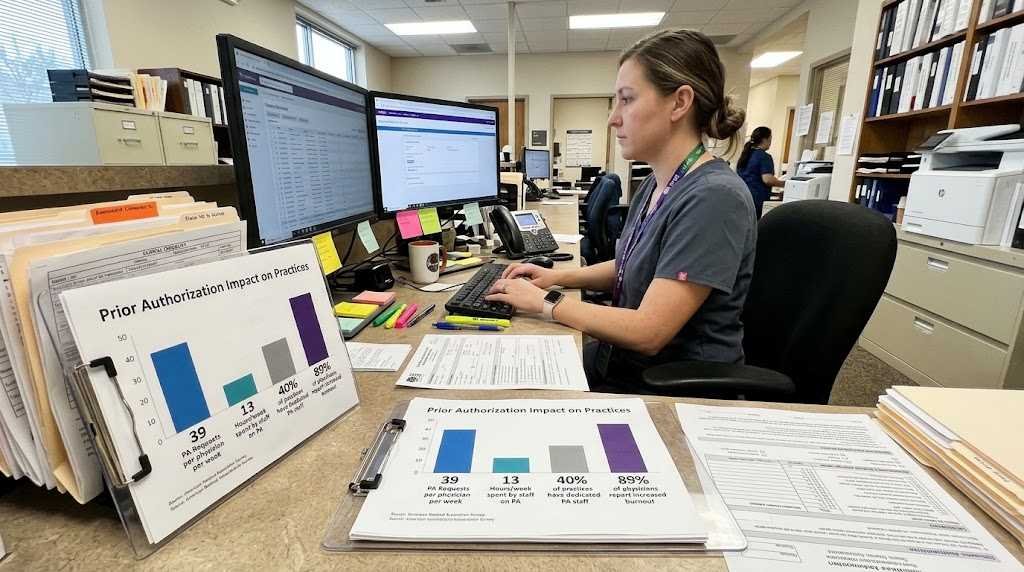
More than most practices budget for. The American Medical Association’s 2024 survey of 1,000 physicians found practices complete an average of 39 prior authorization requests per physician each week, and physicians and their staff spend 13 hours a week on them (AMA, April 2025).
The same survey found 40% of physicians have staff who work exclusively on prior authorizations, and 89% said the process somewhat or significantly increases physician burnout. For a three-physician practice, that is well over 100 requests a week and close to a full-time role’s worth of hours, whether or not anyone holds that title.
How Does Prior Authorization Turn Into Denied Claims?
A missing approval is one of the clearest reasons a payer can refuse to pay. In KFF’s analysis of 2023 claims data from HealthCare.gov insurers, 9% of denied in-network claims were for lack of prior authorization or referral, and 21% were for administrative reasons (KFF, January 2025, updated March 2026). Both categories are about paperwork, not care.
The failure points are predictable:
- The service needed authorization and nobody checked.
- Authorization was approved, but for a different CPT code than the one billed.
- The approval expired before the date of service, or covered fewer visits than were delivered.
- The request was submitted, the payer asked for more documentation, and the request sat.
Each one produces a claim that was correct clinically and unpayable administratively. Recovering it, if possible at all, means rework, appeals and weeks of delay.
What Is Changing in 2026 and 2027?
Some relief is on the way. Under the CMS Interoperability and Prior Authorization Final Rule (CMS-0057-F), Medicare Advantage plans, Medicaid and CHIP programs must now decide standard prior authorization requests within seven calendar days and urgent requests within 72 hours. The rule took effect on January 1, 2026, and also requires a specific reason for every denial. By January 1, 2027, those payers must offer a Prior Authorization API that shows documentation requirements up front (CMS fact sheet).
Faster answers help. They do not remove the work. Someone still has to know which services need approval, assemble the clinical documentation, track each request and match the approval to the claim. Commercial plans outside the rule keep their own processes.
What Does a Working Prior Authorization Process Look Like?
Practices that keep prior authorization from leaking into denials tend to run it as a defined workflow.
- Check requirements at scheduling, not at check-in. The earlier a requirement is spotted, the more time there is to get the approval before the visit.
- Keep one authorization log. For every request: payer, CPT code, date submitted, status, approval number, approved units and expiry date. A spreadsheet works if it is the only one.
- Match approvals to claims before submission. The billed code, units and date of service should match the authorization exactly. This single check prevents the most frustrating denials.
- Set a follow-up clock. Pending requests get a status check on a fixed cadence, so a request for more documentation does not sit for two weeks.
- Review denials by reason each month. If authorization-related denials cluster around one payer or one service, fix that step in the workflow.
Who Should Own Prior Authorization?

This is where most practices struggle. Prior authorization usually lands on whoever has a spare minute: a medical assistant between patients, the front desk, sometimes the physician. Shared ownership means no ownership, and the log goes stale.
The fix is a named owner with dedicated hours, connected to billing so approvals and claims are checked against each other. Some practices hire for the role in house. Others add remote specialists through managed staffing providers. myMedCrew, for example, places pre-vetted billing and prior authorization specialists who work inside the practice’s own EHR and payer portals. Either way, the practice should keep the clinical and financial decisions, such as whether to appeal a denial or reschedule a procedure, while the specialist runs the process.
A Note on Patient Data
Prior authorization requests carry diagnoses, clinical notes and patient identifiers. Whoever handles them, on site or remote, should work under the same four controls: multi-factor authentication, encrypted access, role-based access limited to what the role needs, and audit logging.
Disclaimer: This article is for informational purposes only and does not constitute legal, financial, or medical advice. Healthcare practices should verify applicable payer requirements and regulatory obligations with qualified professionals.