

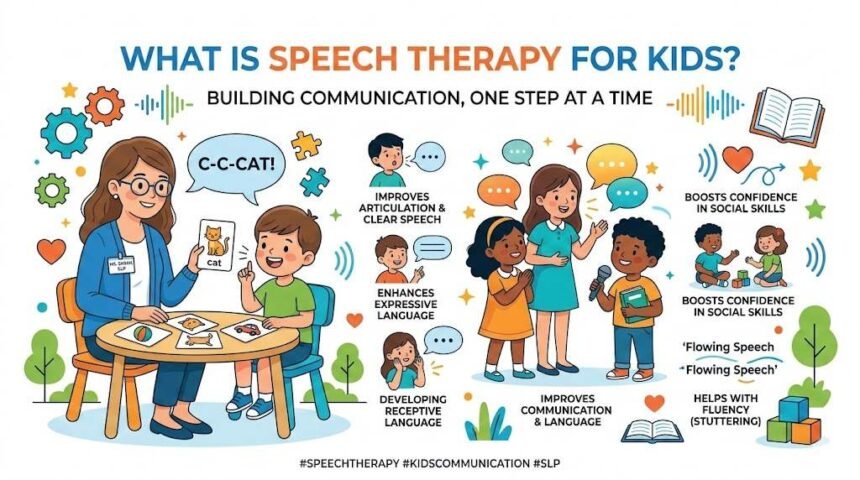
Communication is one of the most fundamental skills a child develops. It shapes how they learn, form friendships, express emotions, and navigate the world around them. When a child struggles with speech sounds, language comprehension, or social communication, the impact reaches far beyond the words they speak. It affects their confidence, their classroom experience, and their ability to connect with the people they love. In some cases, these challenges may even result from birth-related injuries, which families can address with guidance from resources like childbirthinjuries.com.
Speech therapy for kids is a specialized service designed to address exactly these challenges. Through evaluation, individualized treatment, and consistent support, a licensed speech-language pathologist helps children build the communication skills they need to thrive at every stage of development.
What Speech Therapy for Kids Actually Involves
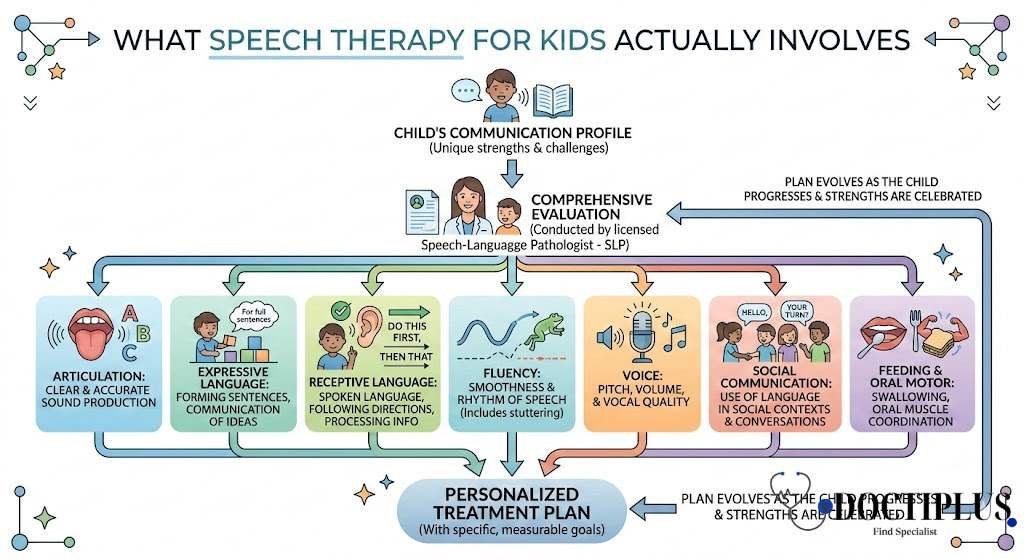
At its core, speech therapy focuses on improving a child’s speech, language comprehension, and language use. It is not a single approach or a one-size-fits-all program. Every child who walks through the door has a different profile of strengths and challenges, and therapy is built entirely around that profile.
A licensed speech-language pathologist, commonly referred to as an SLP, begins by conducting a comprehensive evaluation. This assessment looks at multiple dimensions of communication, including:
- Articulation, which is how clearly and accurately a child produces speech sounds
- Expressive language, which covers how a child forms sentences, builds vocabulary, and communicates ideas
- Receptive language, which is how well a child understands spoken language, follows directions, and processes information.
- Fluency, which relates to the smoothness and rhythm of speech, including stuttering patterns
- Voice, including pitch, volume, and vocal quality
- Social communication, which involves using language appropriately in social contexts such as conversations, group settings, and peer interactions
- Feeding and oral motor skills for children who have difficulty with chewing, swallowing, or oral muscle coordination
Once the evaluation is complete, the SLP designs a personalized treatment plan with specific, measurable goals. That plan evolves as the child progresses, new goals are introduced, and areas of strength are celebrated.
Areas Speech Therapy Addresses in Children
Speech therapy is not limited to helping children pronounce words more clearly. It spans a wide range of communication and related skills, each of which plays a critical role in a child’s daily life.
Articulation and Phonological Disorders
Articulation therapy helps children who substitute, omit, distort, or add sounds when speaking. A child who says “wabbit” instead of “rabbit” or “tat” instead of “cat” may have an articulation delay. Phonological disorders involve patterns of sound errors that affect multiple sounds at once. Both are highly treatable, especially when intervention begins early.
Common signs that a child may need articulation support include:
- Strangers frequently cannot understand what the child is saying past age three
- The child consistently substitutes one sound for another across many words
- Other children or adults frequently ask the child to repeat themselves
- The child becomes visibly frustrated when they are not understood
Expressive and Receptive Language Delays
Language therapy supports children who have difficulty forming sentences, building vocabulary, answering questions, retelling stories, or explaining their thoughts. These are expressive language challenges.
Receptive language challenges involve difficulty understanding what others say, following multi-step directions, answering questions accurately, or processing spoken information in real time.
Children with language delays may show signs such as:
- Using significantly fewer words than their peers of the same age
- Struggling to follow two or three-step directions consistently
- Having difficulty understanding or answering who, what, where, when, and why questions
- Telling stories or explaining events in a disorganized or unclear way
- Appearing to zone out or not respond when spoken to in noisy environments
Fluency Disorders and Stuttering
Fluency therapy helps children who stutter develop smoother speech patterns and, equally importantly, a healthier relationship with speaking itself. Stuttering involves involuntary repetitions, prolongations, or blocks in speech. It affects approximately 1 in 20 children and is more common in boys than in girls.
Fluency therapy does not aim to eliminate all disfluency overnight. Instead, it focuses on:
- Teaching techniques that reduce the physical tension associated with stuttering
- Building the child’s confidence and willingness to speak in different situations
- Helping families understand how to respond supportively at home
- Reducing avoidance behaviors that can develop when a child feels ashamed or anxious about speaking
Social Communication and Pragmatic Language
Some children understand language and speak clearly, but struggle with the social rules of communication. This is called pragmatic language difficulty, and it is particularly common in children with autism spectrum disorder, ADHD, or social anxiety.
Social communication therapy addresses skills such as:
- Taking turns in conversation without interrupting or dominating
- Maintaining appropriate eye contact and body proximity
- Reading facial expressions and body language accurately
- Understanding sarcasm, humor, idioms, and indirect language
- Adjusting communication style depending on the listener and context
- Initiating and ending conversations appropriately
Voice Disorders
Voice therapy helps children with concerns related to pitch, volume, resonance, or vocal quality. Hoarseness, vocal nodules from chronic yelling, or a voice that sounds nasal or strained can all be addressed through voice therapy, coordinated with an ear, nose, and throat specialist when needed.
Feeding and Oral Motor Therapy
Some children receive feeding therapy as part of their speech therapy program. This area addresses difficulties with chewing, swallowing, food textures, oral hypersensitivity, or the muscle coordination needed for safe and comfortable eating. Feeding challenges are particularly common in children born prematurely, children with sensory processing differences, and those with neurological conditions.
How Speech Therapy Sessions Are Structured
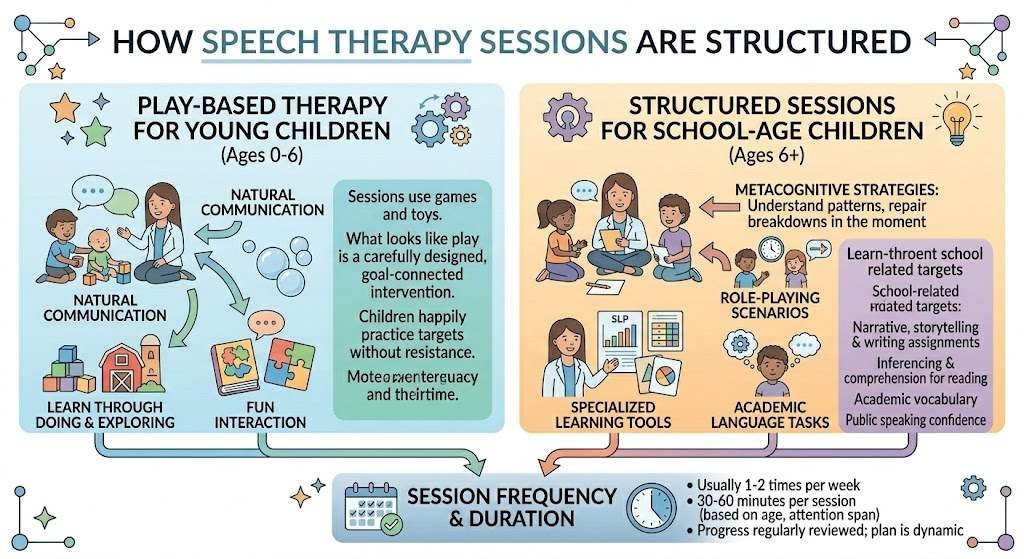
The structure of a speech therapy session varies significantly depending on the child’s age, goals, and learning style.
Play-Based Therapy for Young Children
For children under six, therapy is almost always play-based. Sessions use games, toys, books, bubbles, puzzles, and interactive activities to encourage communication naturally and engagingly. What looks like play from the outside is a carefully designed intervention on the inside. Every game, every activity, and every interaction is intentionally connected to the child’s specific goals.
Play-based therapy works because young children learn through doing, exploring, and interacting. A child who might resist sitting at a table and repeating words will happily practice target sounds while playing with a toy farm or building blocks with their therapist.
Structured Sessions for School-Age Children
As children get older, sessions incorporate more structured activities, role-playing scenarios, academic language tasks, and metacognitive strategies. Older children are often taught to understand their own communication patterns, recognize when a breakdown is happening, and apply techniques to repair it in the moment.
Sessions may also target the specific language demands of school, including:
- Narrative language for telling stories and writing assignments
- Inferencing and comprehension skills for reading
- Vocabulary development for academic subjects
- Presentation and public speaking confidence
Session Frequency and Duration
Most children attend speech therapy once or twice per week, with sessions typically lasting 30 to 60 minutes, depending on age and attention span. Some children with more complex needs attend more frequently. Progress is reviewed regularly, and the treatment plan is updated as goals are met.
Who Can Benefit From Speech Therapy
Speech therapy benefits a wide range of children across many different diagnoses and circumstances. It is not reserved for children with severe delays. Many children with mild or moderate challenges benefit enormously from early, targeted support.
Children who commonly benefit from speech therapy include those with:
- Speech sound disorders or articulation delays
- Expressive or receptive language delays
- Stuttering or other fluency disorders
- Autism spectrum disorder affects communication and social skills
- Developmental delays of any kind
- Hearing loss or auditory processing disorder
- Down syndrome or other chromosomal conditions
- Cerebral palsy or other neurological conditions affecting motor speech
- ADHD with associated language and executive function challenges
- Cleft palate or other structural differences affecting speech
- Traumatic brain injury or illness affecting communication
- Selective mutism or anxiety-related communication difficulties
- Feeding and swallowing difficulties
It is also worth noting that speech therapy is not exclusively for children with diagnosed conditions. Some children develop certain skills later than their peers without any underlying diagnosis, and targeted therapy can give them exactly the boost they need.
Role of Parents and Caregivers in Speech Therapy
Parental involvement is not just encouraged in speech therapy; it is essential. It is one of the strongest predictors of a child’s progress and outcome.
What Parents Can Expect From the Therapy Process
Parents are typically invited to observe sessions, receive regular progress updates, and learn specific strategies to reinforce skills at home. A therapist who works with your child for 60 minutes per week has far less total influence than a parent who applies those same strategies across hundreds of daily interactions.
Home Practice and Carryover Activities
SLPs provide home practice activities tailored to the child’s current goals. These are usually simple, practical, and designed to fit into existing routines such as mealtimes, bath time, car rides, or bedtime reading. Consistency between the therapy room and the home environment is what allows children to generalize new skills into real-world communication.
How to Support Your Child at Home
- Follow the specific strategies your SLP recommends for your child’s goals.
- Create low-pressure opportunities for your child to practice target sounds or language skills during everyday activities.
- Respond to your child’s communication attempts with patience and encouragement rather than correction.
- Read aloud together daily, as shared reading is one of the most powerful ways to build vocabulary and language comprehension.
- Avoid finishing your child’s sentences or speaking on their behalf when they can communicate independently.
- Celebrate effort and progress rather than focusing on errors.
When to Seek a Speech Therapy Evaluation
Many parents wonder whether their child’s communication development falls within the typical range or warrants a professional evaluation. When in doubt, an evaluation is always the right choice. Early identification leads to earlier support, and earlier support leads to better outcomes.
Consider seeking an evaluation if your child:
- Is not babbling or using gestures by 12 months
- Is not saying single words by 16 months
- Is not combining two words by 24 months
- Has lost previously acquired speech or language skills at any age
- It is difficult for unfamiliar adults after the age of three.
- Struggles significantly to follow age-appropriate directions
- Avoids speaking or becomes extremely frustrated during communication
- Shows signs of stuttering that persist beyond six months or cause distress
- Has difficulty participating in classroom activities due to communication challenges
- Is showing signs of feeding difficulties, excessive gagging, or discomfort while eating
Pediatricians screen for communication milestones at well-child visits, but parents who have concerns between appointments should not wait for the next scheduled visit to raise them. Trust your instincts. You know your child better than anyone.
What to Expect From Speech Therapy in Your Community
Families seeking speech therapy for their child can access services in several settings, depending on the child’s age, needs, and location.
Early Intervention Programs
Children under age 3 with developmental delays may qualify for early intervention services through their state or local government program. These services are often provided at no cost to the family and can be delivered in the home or a community setting.
School-Based Speech Therapy
Children ages three and older who qualify under the Individuals with Disabilities Education Act may receive speech therapy as part of their Individualized Education Program through their school district. School-based services focus on communication skills related to academic and social participation in the school environment.
Private Practice Speech Therapy
Private speech therapy clinics offer evaluations and treatment for children of all ages. Services are typically more flexible in terms of scheduling, approach, and focus areas. Many private practices accept insurance, and some offer sliding scale fees for families with financial need. Families seeking speech therapy in Zionsville and surrounding communities will find private practices offering comprehensive evaluations and individualized care plans tailored to each child’s unique communication profile.
Teletherapy
Online speech therapy has become increasingly available and is a legitimate, evidence-based option for many children and families. It offers flexibility for families with transportation challenges, busy schedules, or limited access to local specialists.
Importance of Early Intervention
Research consistently shows that the earlier a child receives speech therapy, the better the outcome. The brain is most flexible and responsive to language learning during the first five years of life. This does not mean that older children cannot make meaningful progress. They absolutely can. But early identification and early intervention give children the greatest advantage.
Early therapy can:
- Prevent secondary challenges such as reading difficulties, academic struggles, and social isolation that often develop when communication delays go unaddressed.
- Reduce the total therapy time needed throughout the child’s development.
- Support the development of strong pre-literacy skills that form the foundation for reading and writing.
- Build confidence and positive communication experiences before frustration and avoidance patterns become established.
If you suspect your child may have a communication delay, the most valuable thing you can do is act now rather than wait and see.
Building Confidence Through Communication
One of the most meaningful outcomes of speech therapy is not measurable on a standardized test. It is the moment a child who once whispered or stayed silent begins to raise their hand in class, make a new friend on the playground, or tell a story at the dinner table with ease and joy.
Communication challenges can lead to frustration, withdrawal, reluctance to participate in school, and difficulty forming peer relationships. Children who struggle to be understood or to understand others often internalize that struggle in ways that affect their self-image long after the specific skill gap has closed.
Speech therapy addresses the whole child. Therapists build not only skills but also the confidence, resilience, and willingness to communicate that make those skills useful in real life. As a child’s abilities improve, so does their sense of themselves as a capable, connected, and valued communicator.
Conclusion
Speech therapy for kids is about far more than correcting sounds or completing language exercises. It is about giving children the tools they need to share their ideas, connect with their peers, succeed academically, and participate fully in the world around them.
Every child deserves to be heard and understood. With early identification, individualized care, and consistent support both in the therapy room and at home, children facing communication challenges can build a strong foundation that serves them for life.
If you have concerns about your child’s speech or language development, do not wait. Reach out to a licensed speech-language pathologist in your area for an evaluation. The earlier a child receives support, the greater the impact that support can have.
Disclaimer
The information provided in this article is intended for general educational purposes only and does not constitute medical advice, diagnosis, or treatment. Every child is unique, and communication development varies across individuals. If you have concerns about your child’s speech, language, feeding, or related development, please consult a licensed speech-language pathologist or your child’s pediatrician for a professional evaluation and personalized guidance. Do not disregard or delay seeking professional advice based on information you have read here.