

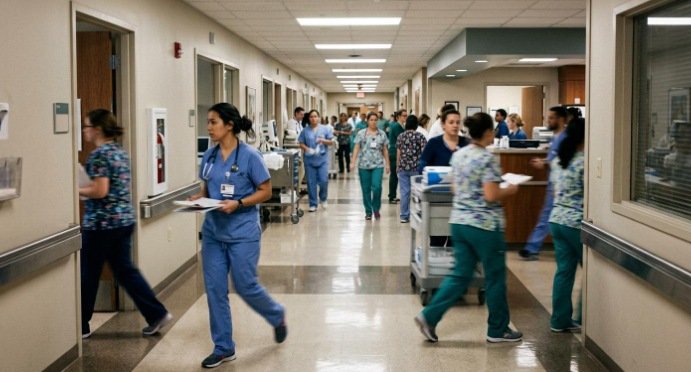
A single understaffed nursing shift doesn’t just inconvenience a charge nurse. It raises patient-to-staff ratios, increases medication error risk, and puts real pressure on the nurses who do show up. Multiply that by a few shifts per week across an entire unit, and the math gets uncomfortable fast.
The U.S. nursing shortage isn’t a seasonal dip that corrects itself in a few months. It’s structurally driven by an aging workforce, rising patient demand, and decades of underinvestment in nursing education capacity. Facilities that treat it like a temporary recruitment problem keep getting caught flat-footed.
Per diem nursing, paired with the right technology, is one of the most practical tools hospital administrators and staffing managers have available right now. It won’t rebuild the nursing pipeline on its own, but it gives facilities a real mechanism to stay covered while longer-term solutions are still in progress.
What Per Diem Nursing Is – and Why Facilities Rely on It

Per diem – Latin for “per day” – refers to nurses who work as-needed shifts without a long-term employment contract. They’re not travel nurses (who sign multi-week assignments and often relocate). They’re not the facility’s internal PRN pool either, which is typically limited to nurses already employed by that one hospital. Per diem nurses are credentialed professionals who pick up open shifts across one or more facilities based on their own availability.
The distinction matters for facilities. A per diem staffing platform connects credentialed local nurses with open shifts in real time – replacing the old system of phone trees, staffing agency middlemen, and last-minute scrambles. A shift opens at 5 a.m., it gets posted, and nurses in the local pool see it immediately.
The scale of reliance on this model has grown sharply. A 2025 PRN Funding analysis found that 62% of healthcare facilities report ongoing dependence on external staffing to maintain minimum safe ratios, and per diem demand rose 18% from 2023 to 2025, driven largely by hospital census volatility. It’s not a supplemental strategy anymore for most facilities. It’s a core part of workforce coverage.
Who works per diem? CNAs, LPNs, RNs, and nurse practitioners all fill per diem shifts. Medical-surgical nursing holds the largest share of per diem demand – around 41.66% according to 2025 market analysis – though ICU, ED, and specialty units are catching up as float pool shortages deepen.
The American Nurses Association outlines per diem nursing as a legitimate and growing workforce category, not a workaround. That framing matters when you’re making the case to a board or CFO who still associates “per diem” with “expensive and unreliable.”
Nursing Shortage Is a Patient Care Problem – Not Just an HR Problem
The numbers are not getting better. The AACN Nursing Shortage Fact Sheet, citing a 2022 HRSA analysis, projects a deficit of 78,610 full-time RNs in the U.S. by 2025. The Bureau of Labor Statistics projects roughly 194,000 RN job openings per year through 2032, as the workforce grows from 3.1 million in 2022 to a projected 3.3 million in 2032 – but that growth still won’t cover demand.
The workforce itself is aging out faster than it’s being replaced. Over 1 million RNs are projected to retire by 2030. As of 2022, 52% of nurses were considering leaving their current positions, and 60% of acute care nurses reported burnout, according to an American Nurses Foundation/ANA COVID survey cited by AACN.
When a facility can’t staff a unit adequately, the consequences aren’t abstract. Patients in understaffed units experience higher rates of complications, longer stays, and worse outcomes on failure-to-rescue metrics. Some facilities respond by limiting admissions or closing units temporarily – choices that affect patient access, not just operations.
Understanding the role of new nurses in patient care helps frame why per diem coverage matters even when facilities do manage to hire. Fresh graduates and newer nurses need adequate staffing density around them. They can’t provide safe, effective care when they’re chronically stretched across ratios that even experienced staff would find difficult.
The workforce gap won’t close through recruitment alone. The pipeline can’t respond fast enough.
How a Per Diem Staffing Platform Changes the Math for Facilities

The technology angle here is real and worth understanding. Traditional per diem staffing – even when it worked – was slow. A shift opens unexpectedly, someone calls the agency, the agency calls through a list of nurses, and by the time a confirmation comes back, the floor has already improvised a solution or gone without.
Modern staffing platforms change that cycle entirely. Shifts get posted automatically. Nurses in the verified local pool receive notifications based on their credentials, availability, and location. Built-in compliance checks mean credential expiration doesn’t slip through. Matches happen in minutes rather than hours.
The adoption curve is steep. A 2025 Market.us Media analysis found that 57% of staffing agencies had adopted digital credentialing tools by 2025, and 46% were using AI-assisted scheduling or matching algorithms. This isn’t experimental anymore – it’s becoming standard infrastructure.
The cost argument is straightforward. Facilities that use local per diem platforms to source nurses can save up to $300 per shift compared to travel nurse contracts, according to 2025 industry data. Travel nurses still serve a function for extended coverage gaps, but for day-to-day census fluctuations, per diem is a better economic fit.
The Grand View Research per diem nurse staffing market report puts the U.S. per diem market at $9.54 billion in 2024, growing to an estimated $10.14 billion in 2025 and projected to reach $13.59 billion by 2030 at a 6.07% CAGR. The market is growing because it’s working – facilities keep investing in it because the alternative (understaffing or travel nurse dependency) costs more.
Why Nurses Choose Per Diem – Across Every Career Stage
Facilities benefit from per diem access. But nurses choose it for their own reasons, and understanding those reasons helps facilities attract and retain a strong local per diem pool.
Pay is a major factor. Per diem RNs typically earn 20-30% above standard staff rates, and per diem RN compensation rose 13% between 2023 and 2025, according to PRN Funding’s 2025 analysis. For a nurse with family caregiving responsibilities or one approaching retirement who doesn’t want to leave the field entirely, that pay premium combined with schedule control is genuinely attractive.
Schedule autonomy is the other main draw. Per diem nurses set their availability upfront and accept shifts that fit. No forced overtime. No mandatory call. That level of control has a real effect on burnout, which is significant given how many nurses leave full-time staff positions specifically because of scheduling pressure.
Clinical diversity is a benefit that shows up most clearly mid-career. Working across different facilities, units, and patient populations builds adaptability that a single-facility career doesn’t easily replicate. Nurses who want to develop a broad clinical range find that building clinical skills through flexible roles is a real career advantage – something a fixed single-facility schedule rarely offers.
There are genuine tradeoffs, and it’s worth being honest about them. Most per diem arrangements don’t include employer-paid health insurance, retirement contributions, or paid time off. Income can be unpredictable during low-census periods. Nurses considering this path should account for those gaps – and many who pursue it do so after building financial stability through staff positions first.
What Facilities Should Actually Look For in a Staffing Solution
Not every platform delivers the same results, and this is worth being direct about. A few things matter more than the rest.
Credential verification built into the platform – not as an afterthought or a manual process – is non-negotiable. Nurses showing up to shifts with expired certifications create liability, not coverage. The platform needs to handle this automatically and flag issues before a shift is accepted.
Local pool depth is the practical question that most marketing materials dodge. Can the platform actually fill shifts in your specific market? A platform with a strong national database but thin local representation won’t solve your 5 a.m. problem. Ask about active nurses within a realistic commute distance, not total registered users.
Speed matters. How quickly does an open shift get filled after posting? For predictable gaps – planned absences, known low-census days – lead time is manageable. For unexpected callouts, hours matter.
Pricing transparency is also worth scrutinizing. Some platforms bundle in agency fees that erode the cost advantage over travel contracts. Know what the nurse earns per shift and what the facility pays. The HRSA Bureau of Health Workforce continues to project nursing shortages persisting through the late 2020s – facilities that build strong staffing infrastructure now won’t be scrambling as the shortage deepens.
For nurses thinking about where per diem fits in a longer career arc, online nursing advancement programs offer a way to keep moving professionally while maintaining schedule flexibility. Per diem and graduate education are more compatible than a traditional staff schedule often allows.
Finally, look at integration. A platform that connects to your existing scheduling or EHR system reduces administrative friction. One that requires a parallel manual process will get underused exactly when you need it most.
Conclusion
The nursing shortage isn’t a problem that resolves itself. HRSA projects the deficit persisting well beyond this year, and with over a million RNs expected to retire by 2030, the structural pressure on facilities isn’t easing anytime soon.
Per diem nursing doesn’t fix the pipeline. It won’t suddenly produce more nursing graduates or reverse decades of workforce dynamics. What it does is give facilities a functional, scalable mechanism to stay covered during the gap, and it gives nurses a legitimate path to higher pay and schedule autonomy that many genuinely prefer.
The market reflects real adoption, not hype: $10.14 billion in 2025 and projected to hit $13.59 billion by 2030. Facilities that build this infrastructure thoughtfully, with the right platform, the right local pool, and the right processes, are better positioned than those still managing per diem coverage through spreadsheets and agency calls. The staffing gap is structural. The response needs to be, too.