

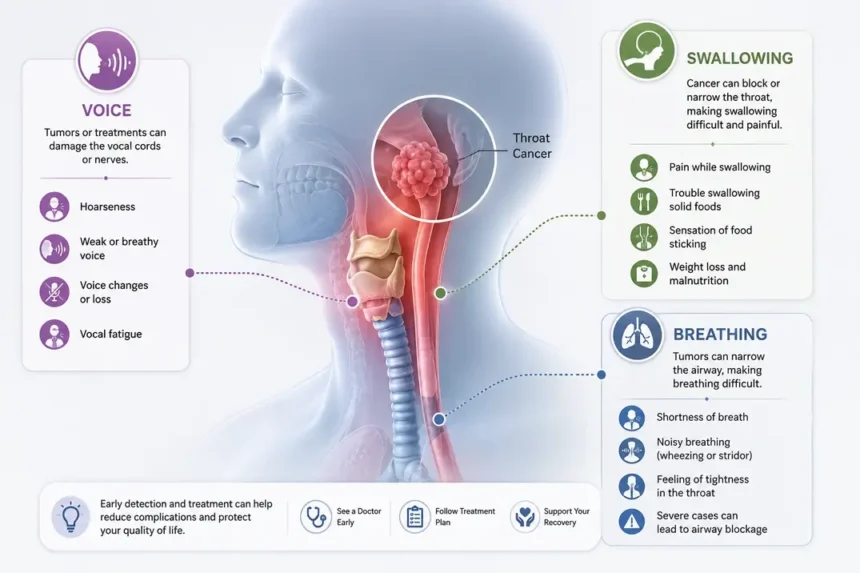
Almost everything the throat does when something is wrong, it has already done to you harmlessly. A voice that turns to gravel after a wedding. A sore throat that outstays its welcome. A swallow that catches on a piece of roti. An ear that aches on one side for no reason you can name.
That overlap is the entire difficulty. The throat has a small vocabulary for distress and it uses the same words for a viral laryngitis as it does for a tumour sitting on a vocal cord. The distinguishing feature is almost never the symptom itself. It is duration, direction of travel, and whether anything actually explains it.
Why The Voice Usually Speaks First
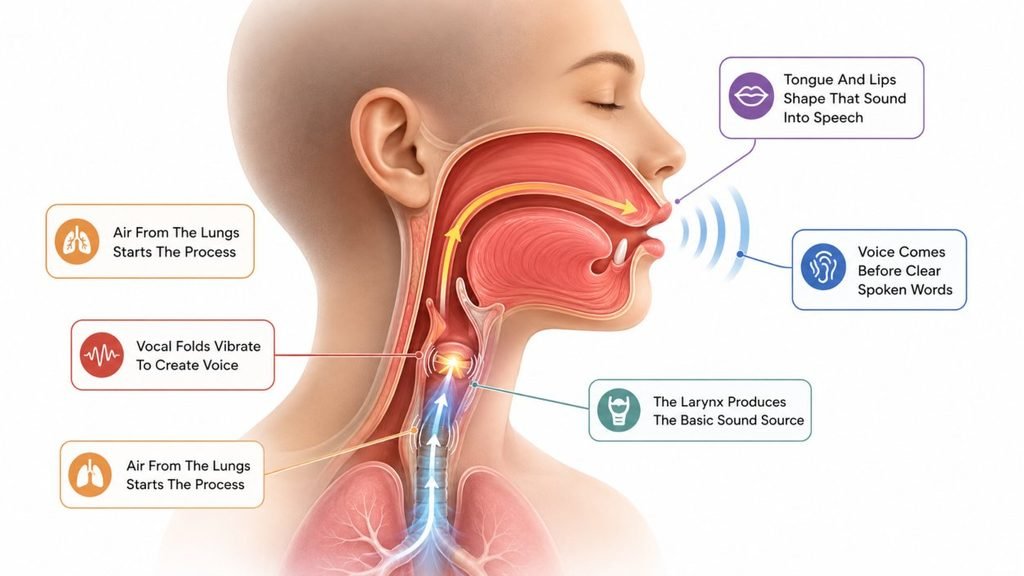
The larynx is a valve that learned to sing. Inside it sit two folds of tissue that close to protect the airway, open to let air through, and vibrate a few hundred times a second to make sound. That vibration is exquisitely sensitive to mass. Add a millimetre of abnormal tissue to the free edge of a vocal fold and the fold no longer vibrates evenly. The voice changes long before anything is large enough to block anything.
This is why the anatomy matters more than most patient guides admit. Cancers that begin on the vocal cords themselves announce their presence early and loudly, which is why they are often found while still small and highly treatable. Cancers that begin a few centimetres above, in the supraglottis, or below, in the subglottis, sit outside the vibrating surface. They can grow quietly for months, and the first thing the person notices may be a lump in the neck or difficulty swallowing rather than any change in voice at all.
So a persistently altered voice is a useful signal, but a normal voice is not a clearance certificate.
What A Worrying Voice Change Actually Sounds Like
Clinicians look for a specific pattern rather than hoarseness in the abstract.
The key word is constant. Post-viral hoarseness fluctuates. It is worse in the evening, better after sleep, better on a quiet day, and it drifts back towards normal over two or three weeks. Hoarseness that warrants attention never fully returns to normal, not for an hour, not on a good day. It may also be progressive, getting steadily rougher, weaker or more effortful rather than settling.
The other feature is absence of explanation. Hoarseness after shouting at a cricket match explains itself. Hoarseness that simply began, in someone who has not been ill or straining their voice, does not.
Around three weeks is the practical threshold most health systems use, and the NHS advice on laryngeal cancer symptoms uses that same window. Cancer Research UK’s explanation of when a hoarse voice should be checked sets out the reasoning in plain terms. Different guidelines set different age thresholds, and because virus-driven throat cancers are appearing in younger non-smokers, age alone is a poor reason to wait.
There is an uncomfortable finding buried in the clinical literature on this. The American Academy of Otolaryngology’s clinical practice guideline on hoarseness notes that roughly half of patients eventually diagnosed with cancer of the vocal fold had assumed their voice change was harmless and delayed seeking help because of it. The symptom did its job. The interpretation failed.
When Swallowing Turns Into Work
Swallowing looks effortless and is not. It is a rapid sequence of muscular events that has to move food backwards while sealing the airway shut, and it has almost no tolerance for anything occupying space in the wrong place.
The pattern that matters is mechanical and progressive. Solid food becomes difficult before liquids do. Food seems to stop at a consistent point rather than a different place each time. Swallowing may hurt, which is a different complaint from a sore throat and usually more localised. Meals start taking longer, then portions shrink, then softer foods quietly replace harder ones, and weight comes off without any decision having been made about it.
Coughing or choking during meals deserves separate weight. That suggests the airway is no longer being sealed reliably during the swallow, which is a functional problem rather than a nuisance.
One reassurance is worth stating plainly, because it saves a great deal of anxiety. The sensation of a lump or something stuck in the throat when swallowing is otherwise completely normal, known as globus, is common and is usually not cancer. Reflux is a far more frequent culprit. The concerning version involves food genuinely obstructing, not the feeling of obstruction with unimpaired swallowing.
The Ear Pain That Has Nothing To Do With Your Ear
This is the sign most people, and a fair number of clinicians, miss.
The ear and the throat are wired together. Sensation from the external ear canal, the eardrum and the surrounding structures arrives via several cranial nerves, and two of them, the glossopharyngeal and the vagus, also supply the tonsil, the base of the tongue, the pharynx and the larynx. When a tumour irritates a nerve ending deep in the throat, the signal travels up a shared pathway and the brain, which has no independent way of locating the origin, attributes the pain to the ear.
The result is a patient with a genuinely painful ear, a completely normal ear examination, and a problem several centimetres away. Clinicians call this referred otalgia, and there is a well-established structured approach to diagnosing referred ear pain built around exactly this anatomy.
The combination worth acting on is persistent one-sided ear pain, a normal ear on examination, and any throat symptom at all, even a mild one. On its own that trio is not proof of anything. It is simply a pattern that should not be treated with repeated courses of ear drops.
Breathing Symptoms Are A Different Category
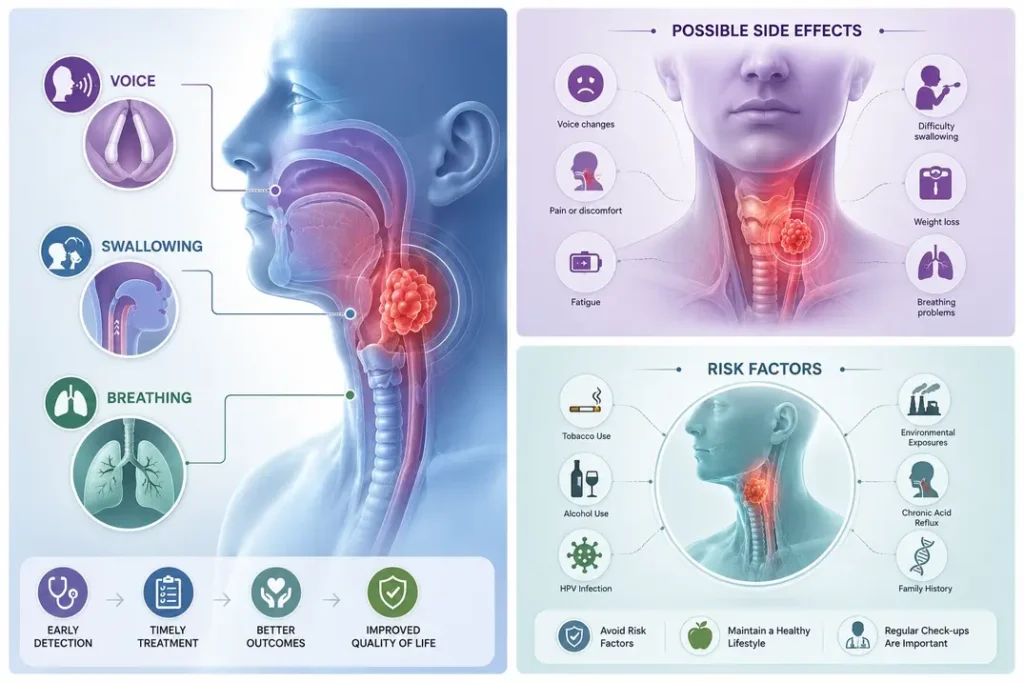
Everything above is a reason to make an appointment. Breathing is not.
A tumour large enough to narrow the airway produces breathlessness, a sense that air is not moving freely, and sometimes stridor, a high-pitched noise on breathing in that is distinct from a wheeze. Difficulty breathing when lying flat can appear as the narrowing worsens.
Severe, rapidly worsening or sudden breathing difficulty is an emergency. It should be assessed the same day, in an emergency department, not slotted into next week’s clinic list. Airway compromise does not follow a polite timeline.
The Lump That Turns Up On Its Own
A firm, painless, enlarging lump in the neck in an adult is a symptom in its own right and is one of the most reliable single signs of a head and neck cancer.
It has also become more important because of a genuine change in the disease. Cancers of the oropharynx driven by human papillomavirus behave differently from the classical tobacco-related tumours. They occur in younger people, often with no smoking or drinking history, and the primary tumour can be very small while the first noticeable sign is a lymph node in the neck. A review of the epidemiology and clinical management of HPV-associated oropharyngeal cancer describes exactly this problem: the disease is frequently detected at an advanced stage precisely because the early phase is so quiet.
A neck lump that has been present for more than three weeks and is not obviously an infected node needs examining. Being young, fit and a lifelong non-smoker is not a reason to postpone it.
Risk Is Not Evenly Distributed, Especially In India
Throat and mouth cancers are not rare here, and the reasons are specific rather than mysterious.
Tobacco in chewed form does most of the damage. A meta-analysis of tobacco use and cancer incidence across Indian populations found that smoked and smokeless tobacco carried broadly similar overall cancer risk, which undercuts a common local assumption that chewing is the safer habit.
Areca nut compounds it, and it is worth being blunt about this because supari is widely treated as harmless. The International Agency for Research on Cancer classifies areca nut as a Group 1 human carcinogen, with or without tobacco added. IARC’s analysis of how much of the global oral cancer burden is attributable to smokeless tobacco and areca nut put the figure at roughly one case in three worldwide, with the overwhelming majority occurring in South-Central Asia.
Alcohol multiplies rather than adds to tobacco risk. Prolonged reflux, poor oral health and, for oropharyngeal disease, HPV all contribute. None of these make cancer certain. They shift the threshold at which a persistent symptom deserves investigation rather than a wait-and-see approach.
What Assessment Actually Involves
The sequence is more straightforward than most people fear.
It begins with history and examination of the mouth, throat and neck. The most informative step is usually flexible nasendoscopy: a thin camera passed through the nostril and down to give a direct view of the larynx and pharynx. It is done awake, in the clinic, with local anaesthetic spray, and takes a few minutes. It is uncomfortable rather than painful, and it is the single test that most often settles the question.
If something abnormal is seen, imaging with CT or MRI maps its extent and checks the neck nodes. A biopsy provides the definitive answer, because nothing is confirmed as cancer without tissue. Many people go through this pathway and are told they have reflux, a benign vocal cord nodule, or nothing at all.
Where cancer is confirmed, treatment is built around the site, the stage, the person’s overall health and the functions at stake. Early disease confined to the vocal cord can often be treated with radiotherapy or transoral laser surgery with the voice preserved. More advanced disease usually needs some combination of surgery, radiotherapy and systemic therapy, planned jointly by surgeons, radiation oncologists, medical oncologists, speech and swallowing therapists and dietitians. A throat cancer specialist in Pune working within a multidisciplinary team is planning for how you will speak and eat afterwards, not only for tumour control. For a fuller clinical picture, including causes and treatment pathways, this guide to throat cancer symptoms covers the ground in more detail.
Why The Delay Is The Thing Worth Fixing
The evidence on how these cancers present in general practice is instructive. A large case-control study on recognising laryngeal cancer in primary care found that individual symptoms carry fairly low predictive value on their own, but that combinations, and above all symptoms that fail to resolve, carry considerably more. Hoarseness alongside difficulty swallowing, or throat pain radiating to the ear, is a meaningfully different presentation from any one of those in isolation.
There is also a language problem. A scoping review of the nomenclature used for head and neck cancer symptoms found striking inconsistency in the terms used across the literature, which helps explain why patients often struggle to convey what they are experiencing and why the same complaint can be recorded five different ways.
The practical translation of all of this is unglamorous. Most people with these symptoms do not have cancer. The ones who do tend to have had the symptom for a while, to have had it explained away once or twice, and to have accepted the explanation because it was plausible. Stage at diagnosis determines not only survival but whether the voice can be kept, whether eating stays normal, and how intensive the treatment has to be.
Three weeks is not a magic number. It is simply long enough for ordinary causes to have resolved and short enough that acting on it still leaves every option open.
Disclaimer
This article is intended for general information and public awareness only. It is not medical advice, does not constitute a diagnosis, and is not a substitute for assessment by a qualified healthcare professional who can examine you and review your history.
The symptoms described here are far more commonly caused by benign conditions such as viral infections, laryngopharyngeal reflux, vocal strain, allergies and benign vocal cord lesions than by cancer. Nothing in this article can distinguish between those possibilities in an individual case, and no symptom list should be used to rule cancer in or out.
If you have persistent, recurring or worsening symptoms affecting your voice, swallowing or breathing, or an unexplained lump in the neck, arrange assessment with a doctor rather than self-managing. Severe, sudden or rapidly worsening difficulty breathing, or noisy high-pitched breathing, requires emergency medical attention immediately.
Referral thresholds, screening guidance and treatment protocols vary between countries and are periodically revised. Readers should follow the guidance applicable in their own health system and confirm current recommendations with their treating clinician.
References
- Shephard EA, Parkinson MAL, Hamilton WT. Recognising laryngeal cancer in primary care: a large case-control study using electronic records. British Journal of General Practice. 2019;69(679):e127-e133. doi:10.3399/bjgp19X700997
- Stachler RJ, Francis DO, Schwartz SR, et al. Clinical practice guideline: hoarseness (dysphonia) (update). Otolaryngology-Head and Neck Surgery. 2018;158(1_suppl):S1-S42. doi:10.1177/0194599817751030
- Scarbrough TJ, Day TA, Williams TE, Hardin JH, Aguero EG, Thomas CR Jr. Referred otalgia in head and neck cancer: a unifying schema. American Journal of Clinical Oncology. 2003;26(5):e157-e162. doi:10.1097/01.coc.0000091357.08692.86
- Charlett SD, Coatesworth AP. Referred otalgia: a structured approach to diagnosis and treatment. International Journal of Clinical Practice. 2007;61(6):1015-1021. doi:10.1111/j.1742-1241.2006.00932.x
- Lechner M, Liu J, Masterson L, Fenton TR. HPV-associated oropharyngeal cancer: epidemiology, molecular biology and clinical management. Nature Reviews Clinical Oncology. 2022;19(5):306-327. doi:10.1038/s41571-022-00603-7
- Rumgay H, Nethan ST, Shah R, et al. Global burden of oral cancer in 2022 attributable to smokeless tobacco and areca nut consumption: a population attributable fraction analysis. The Lancet Oncology. 2024;25(11):1413-1423. doi:10.1016/S1470-2045(24)00458-3
- Kulothungan V, Ramamoorthy T, Sarveswaran G, Jadhav SY, Mathur P. Association of tobacco use and cancer incidence in India: a systematic review and meta-analysis. JCO Global Oncology. 2024;10:e2400152. doi:10.1200/GO.24.00152
- Muttagi SS, Chaturvedi P, Gaikwad R, Singh B, Pawar P. Head and neck squamous cell carcinoma in chronic areca nut chewing Indian women: case series and review of literature. Indian Journal of Medical and Paediatric Oncology. 2012;33(1):32-35. doi:10.4103/0971-5851.96966
- Bradley PT, Lee YK, Albutt A, et al. Nomenclature of the symptoms of head and neck cancer: a systematic scoping review. Frontiers in Oncology. 2024;14:1404860. doi:10.3389/fonc.2024.1404860