

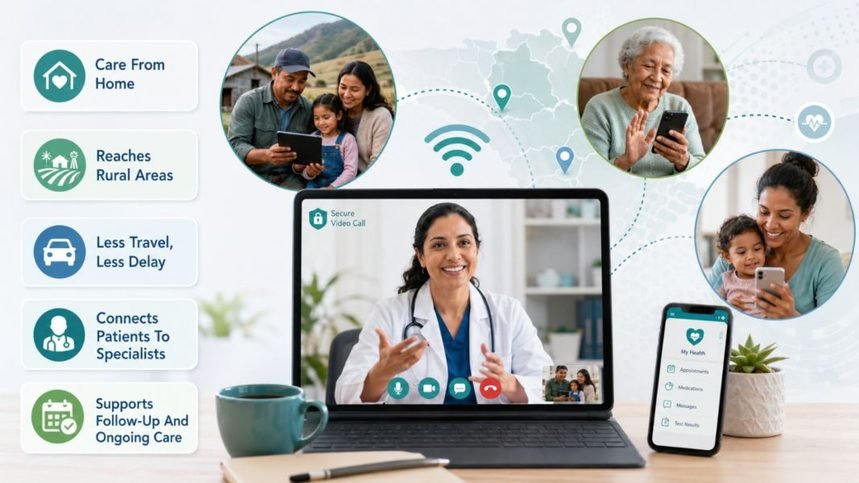
There is a particular calculation that people in small towns learn to do without thinking about it. A symptom appears. Something that is probably nothing. Getting it looked at means a two hundred kilometre round trip, a day of lost wages, gas money, and someone to watch the kids. So you weigh the probability that it is nothing against the certain cost of finding out, and most of the time you decide to wait and see.
Virtual care exists to break that calculation. When the appointment costs twenty minutes instead of a day, the arithmetic changes, and people stop deferring. That is the whole argument, and it is a good one.
It is also incomplete in ways that matter, and the incomplete version has become the standard telling. Worth doing properly.
What Changes When the Drive Disappears

Distance is the barrier people name first, and removing it does real work.
For someone managing diabetes, hypertension, or heart failure, the value is not in any single appointment. It is in frequency. Chronic disease is managed through small, regular adjustments: a medication titration, a question about a new symptom, a check on whether the last change helped. When each of those touchpoints requires a half-day of travel, they get skipped, and the condition drifts between crises. When they require a phone call, they happen.
The same logic applies to mobility. A patient recovering from surgery, an older adult who no longer drives, someone using a wheelchair in a town without accessible transit: for these people, the clinic was never far in kilometres. It was far in effort. Follow-ups, medication reviews, and results conversations rarely require physical examination, and moving them to a screen or a phone line removes a barrier that had nothing to do with clinical need.
Specialist access follows a similar pattern. Specialists cluster in cities because that is where the referral volume is. Virtual consultation lets a rheumatologist in Halifax advise on a patient in rural Cape Breton. It lets the family physician and the specialist confer directly rather than passing the patient between them across months. Patient experience data collected by Canada Health Infoway suggests this generally works: 85 percent of Canadians who used virtual care said their health concern was addressed during their most recent virtual visit.
So far, so promising. Here is where the standard account stops, and where it should not.
Gap Virtual Care Is Being Asked to Fill
Canada does not have a shortage of enthusiasm for primary care. It has a shortage of primary care.
According to the Canadian Institute for Health Information, 5.7 million Canadian adults did not have a regular health care provider in 2024. Closing that gap at current demand would require an estimated 49 percent increase in family physicians. Instead, the supply of family physicians per capita has gone the other way, slipping from 11.8 per 10,000 population in 2020 to 11.5 in 2024.
The downstream effects show up in emergency departments. CIHI’s analysis of access to primary care found that 17 percent of Canadian adults have no regular provider, 74 percent could not get a same-day or next-day appointment, and a substantial share of emergency visits are for conditions that primary care should have handled. More than half of those visits, by CIHI’s assessment, could potentially have been managed virtually.
That last figure is the strongest case anyone has made for virtual care in Canada. It is not a claim about convenience. It is a claim that a meaningful volume of care is currently being delivered in the most expensive, least appropriate setting available, because nothing cheaper was reachable in time.
Uncomfortable Finding in the Data

If virtual care primarily served the underserved, you would expect uptake to be highest among people with the least access to conventional care: lower income, less formal education, more rural.
That is not what the national data shows.
Statistics Canada’s analysis of virtual care use, published in Health Reports in November 2025, drew on the 2023 Canadian Social Survey. It found that having a university degree was associated with virtual care use, alongside having no regular health care provider and living with multiple chronic conditions. Overall, 57.5 percent of health care users had in-person appointments only, 5.3 percent had virtual appointments only, and 37.2 percent had both.
The two middle findings are encouraging: people without a regular provider and people with complex needs are reaching for virtual care, which is exactly the intended effect. The education finding is the problem. It is the signature of what health researchers call the inverse care law, restated for the digital era. A service designed to widen access has been taken up most readily by the people who were already best positioned to navigate the system.
This does not mean virtual care fails underserved communities. It means that access to a service and the capacity to use it are different things, and only the first one gets built by default.
Connectivity Is the Second Barrier, and It Sits Exactly Where the First One Does
The reason is not mysterious. A virtual appointment requires a connection, a device, a private place to talk, and enough comfort with the technology to book and join a call. Underserved communities are, definitionally, the places where those inputs are thinnest.
Canada has made real progress here. The CRTC’s 2026 Canadian Telecommunications Market Report notes that public connectivity investments totalling roughly $1.4 billion have extended broadband coverage to more than 80 percent of the rural population, a 30 percentage point increase since 2020. That is a substantial improvement over a short period.
But the baseline it improved from was low, and the gaps that remain are concentrated. The Office of the Auditor General’s audit of connectivity in rural and remote areas found that as of 2021, while 90.9 percent of Canadian households overall had access to the federal 50/10 Mbps target, only 59.5 percent of rural and remote households did, and only 42.9 percent of households on First Nations reserves. The audit also made a point that gets overlooked: both the CRTC and the responsible department measured affordability by price alone, without reference to household income. A connection that exists but costs more than a family can pay is not access.
Put the two findings together, and the shape of the problem is clear. The communities with the least primary care are substantially the same communities with the least reliable connectivity. Virtual care is being offered as the solution to a gap in precisely the places least equipped to receive it.
Telephone Deserves More Credit Than It Gets
There is a practical response to this, and it is unglamorous.
Most virtual care in Canada is delivered by phone, not video. This is often framed as a shortfall, a sign that the technology has not matured. Research on rural providers during the early pandemic found that most used telephone consultations even while believing video offered a better visit, with poor internet bandwidth among the main constraints.
But an audio call needs no broadband, no smartphone, no app, and no digital literacy beyond answering a ringing phone. For a low-income household, an older patient, or a community at the thin end of the connectivity map, telephone care is not a degraded version of virtual care. It is the version that actually reaches them.
Systems that fund and design for video-first delivery, and treat phone visits as a lesser category to be reimbursed at a lower rate or phased out, will systematically deliver less care to the populations they claim to be prioritizing. Where equity is the goal, the low-tech channel is frequently the high-impact one.
Access to Care Is Not the Same as Financial Security

There is one more gap that virtual care does not touch, and it is worth naming because it is routinely folded into discussions of health access as though the same tools address it.
Canada’s public system covers medically necessary physician and hospital services. It does not replace income. For households already stretched, and particularly for the self-employed, gig workers, seasonal workers, caregivers, and anyone without employer benefits, a serious diagnosis arrives as two separate shocks. Virtual care can compress the clinical one by catching a problem earlier. It does nothing about the financial one.
This is not a healthcare question, and it should not be handled inside a clinical appointment. It belongs to household planning, and it is worth doing deliberately rather than in the middle of a crisis. The Financial Consumer Agency of Canada publishes an impartial guide to assessing life insurance needs that explains how coverage works and what to weigh before buying, which is a sensible starting point precisely because it is not selling anything. From there, options range from workplace group coverage to individual policies from providers such as life insurance carriers offering term and critical illness products. The comparison worth making is between what a household would lose and what a policy would cover, not between advertised premiums.
The connection to the rest of this article is straightforward: the populations with the least access to primary care are largely the same ones without workplace benefits. Fixing the first gap does not touch the second.
What Would Actually Make This Work
None of the above is an argument against virtual care. The CIHI emergency department finding alone justifies expanding it. The argument is against the assumption that expansion produces equity on its own.
The WHO’s European regional office published findings in March 2026 on persistent digital health equity gaps that name the same pattern internationally. Their framing is useful: digital innovation does not operate in isolation, and equity has to be designed in rather than hoped for, or digital tools reinforce inequities instead of reducing them. The report also notes that most existing regulation examines bias in terms of ethnicity and gender while paying far less attention to language, income, location, and disability status, which are the axes that determine whether a rural, low-income, or older patient can actually use a virtual service.
In practice, equity by design means a short list of unglamorous commitments. Fund telephone visits at parity with video. Treat broadband and device access as health infrastructure rather than telecom policy. Build interpretation into virtual platforms rather than bolting it on. Support community access points, because a private, connected room at a band office, library, or community health centre solves the problem for people who have neither the bandwidth nor the privacy at home. Measure uptake by income, education, geography, and language, not just by total volume, so that a rising usage curve does not disguise a widening gap.
The town where somebody is doing that mental arithmetic about whether a symptom is worth a two hundred kilometre drive is real, and virtual care can change the answer. Whether it does depends less on the technology than on whether the systems around it were built for the people who need it most, or for the people who were always going to find their way to care regardless.
Closing Note and Disclaimer
This article is provided for general information and educational purposes only. It is not medical advice, financial advice, or insurance advice, and it is not a substitute for guidance from a qualified professional who knows your circumstances.
If you have a health concern, contact a licensed health care provider. Virtual care is appropriate for many situations, but not all; conditions requiring physical examination, diagnostic imaging, or urgent intervention need in-person assessment. In a medical emergency, call 911 or go to your nearest emergency department.
Insurance products, eligibility criteria, coverage terms, exclusions, and premiums vary by provider, province, and individual circumstances. Nothing here constitutes a recommendation to purchase any specific policy or product. Review policy documents in full and consult a licensed insurance advisor before making a decision.
Health system data, connectivity statistics, and program details cited here reflect the sources and reporting periods named in the references and may have changed since publication. Provincial coverage rules for virtual care differ across Canada. Verify current information for your province or territory.
References
- Canadian Institute for Health Information. The State of the Health Workforce in Canada, 2024. Ottawa, ON: CIHI, December 2025. https://www.cihi.ca/en/the-state-of-the-health-workforce-in-canada-2024
- Canadian Institute for Health Information. Access to Primary Care: Many Canadians Face Challenges. Primary and Virtual Care Access series. Ottawa, ON: CIHI, December 2024. Data sources include the National Ambulatory Care Reporting System 2023–2024, Canadian Community Health Survey 2023, and the 2023 Commonwealth Fund survey. https://www.cihi.ca/en/primary-and-virtual-care-access-emergency-department-visits-for-primary-care-conditions/access-to-primary-care-many-canadians-face-challenges
- Statistics Canada. Virtual Care Use in Canada: Variation Across Sociodemographic and Health-Related Factors. Health Reports, Vol. 36, No. 11. Catalogue no. 82-003-X. Ottawa, ON: Statistics Canada, November 19, 2025. Based on the 2023 Canadian Social Survey – Quality of Life, Virtual Health Care and Trust. https://www150.statcan.gc.ca/n1/daily-quotidien/251119/dq251119b-eng.htm
- Canadian Radio-television and Telecommunications Commission. Canadian Telecommunications Market Report 2026. Ottawa, ON: CRTC, February 2026. https://crtc.gc.ca/eng/publications/reports/policymonitoring/2026/ctmr.htm
- Office of the Auditor General of Canada. Report 2: Connectivity in Rural and Remote Areas. Reports of the Auditor General of Canada to the Parliament of Canada, March 2023. https://www.canada.ca/en/auditor-general/our-work/audit-reports/parl-oag-202303-02-e.html
- Canada Health Infoway. Virtual Care. Toronto, ON: Canada Health Infoway. Patient experience figures drawn from the Canadian Digital Health Survey: What Canadians Think, 2023. https://www.infoway-inforoute.ca/en/what-we-do/other-initiatives/virtual-care
- World Health Organization Regional Office for Europe. Digital Health Equity Gaps Remain, but Solutions Are Becoming Clearer, New Report Shows. Copenhagen: WHO/Europe, March 17, 2026. https://www.who.int/europe/news/item/17-03-2026-digital-health-equity-gaps-remain–but-solutions-are-becoming-clearer–new-report-shows
- Financial Consumer Agency of Canada. Life Insurance. Ottawa, ON: Government of Canada. https://www.canada.ca/en/financial-consumer-agency/services/insurance/life.html
- Blue Cross Life Insurance Company of Canada. Affordable Canadian Term Life Insurance and Critical Illness Coverage. Individual term life and critical illness products underwritten by Blue Cross Life and distributed by PolicyMe Corp. https://www.bluecross.ca/life/.