


There is a particular moment a lot of people have had recently. You are packing for a trip, or clearing out a cupboard, or trying to find somewhere to put a thing you bought eight months ago and have used twice. And you notice that owning it costs you more than using it gives you.
That moment is quietly reshaping what people buy.
For most of the last century, size did useful signalling work. A heavier appliance implied better components. A bigger box implied more inside. That shorthand has not disappeared, but it has stopped matching how most people actually live. The constraint people feel now is rarely capability. It is space, attention, and the number of objects already competing for both.
What follows is not an argument for minimalism as a look. It is a practical account of how the calculation changed, what compact and modular design genuinely solves, and where both brands and buyers still get it wrong.
Why “Bigger Is Better” Is Losing Its Appeal

The old assumption was reasonable when it formed. Materials were heavier, components were larger, and physical bulk correlated with what a product could do. Miniaturisation has broken that link in category after category, to the point where a small format now often signals newer engineering rather than compromised engineering.
Meanwhile, the living conditions changed. Homes in many urban markets got smaller and more expensive per square foot. Hybrid work turned a spare corner into an office. People move more often and rent for longer. Each of those trends raises the running cost of owning something bulky, and none of them shows up on a spec sheet.
The result is a different question at the point of purchase. Not “how much can this do” but “how much of my life does this take up in exchange?” A stand mixer with impressive specifications loses to a hand mixer if it lives in a cupboard you have to empty to reach.
There is a real limit to this, though, and it is worth naming early. Compact is not automatically better. Plenty of small products are small because they cost less to manufacture and ship, not because anyone thought hard about the user. The rest of this piece is largely about telling those two things apart.
Rise Of The Portable Lifestyle
Portability has moved from being a feature you paid extra for to being the default expectation, with the fixed version increasingly framed as the specialist choice. Laptops displaced desktops for ordinary work. Wireless earbuds displaced headphones and cables for ordinary listening. Power banks turned the wall socket from a requirement into a preference.
The pattern repeats well outside technology. Travel-size cosmetics, e-readers, single-serve coffee systems, folding kettles, collapsible water bottles, and small personal-care devices all assume a life that is not conducted in one room.
What changed is subtler than “things got smaller.” The expectation now is that a familiar function should follow you. Compactness stopped being about reducing dimensions and became about increasing the number of situations in which a product is available at all. A device you use in three places is worth more than a better device you use in one.
Why Modular Products Are Becoming More Popular
Modular design answers a different frustration: the sense that replacing one worn or exhausted part should not require replacing the whole system.
The pattern is already everywhere. Coffee machines take capsules. Cameras take lenses. Electric toothbrushes take heads. Printers take cartridges. Cordless tool platforms share one battery across a drill, a sander, and a strimmer, which is why people buy their fourth tool from the brand that sold them the first.
The consumer logic is straightforward. You do not always need a new product. Sometimes you need one component changed, and a well-designed modular system lets you do that without acquiring another full device to store.
Two things are worth understanding before you commit to a platform, though, because the sales pitch rarely covers them.
The first is the economics. Many modular systems are priced on the razor-and-blades model: the durable core sells cheap, sometimes near cost, and the margin lives in the consumables you will buy for years. That is not inherently a bad deal, but it does mean the sticker price tells you very little about lifetime cost. Work out what a year of refills costs before you judge whether the machine is good value.
The second is that modularity is drifting from a market preference into a legal expectation, at least in Europe. The EU’s Directive on the repair of goods, which member states must apply from 31 July 2026, obliges manufacturers of covered products to offer repair beyond the legal guarantee period. It sits alongside the Ecodesign framework, which sets the underlying requirements on repair-friendly design and spare-part availability. Products designed to come apart are becoming the baseline rather than the exception, and manufacturers who built businesses on sealed units have a deadline.
One Device, Different Experiences
Modularity also delivers variety without requiring you to own several near-identical products. A smartwatch changes character with a different strap. A camera moves from portraits to landscapes with a different lens. Controllers take interchangeable sticks and pads. Refillable cosmetic packaging lets you swap the formula while keeping the case.
Cartridge design in particular has spread well past printers. You will find it in refillable beauty systems, in fragrance, in vaporiser hardware, and in age-restricted adult categories such as THCA vape cartridges. The engineering pattern is identical each time: a durable device, a consumable insert, and a compatibility standard joining the two.
What differs enormously is the regulatory weight the format carries. A lipstick refill and an inhalable cannabinoid cartridge share a design language, and almost nothing else, and in the United States the federal definition of hemp is scheduled to narrow in November 2026 in a way that reaches THCA directly. State rules already vary widely and in some cases prohibit these products outright. Anyone writing about, selling into, or buying from an age-restricted cartridge category should treat its legal status as a live variable rather than a settled fact.
The wider design principle survives all of that. Keeping the main device constant while changing a small component gives you range without multiplying the number of complete objects you own.
Why Compact Design Is Also A Marketing Advantage
For brands, smaller dimensions communicate more than dimensions. Compact products get positioned around mobility, flexibility, and simplicity, which are lifestyle claims dressed as engineering ones.
A smaller format tends to be:
- easier to carry and store
- simpler and cheaper to display at retail
- visually associated with considered, minimal design
- straightforward to slot into travel and commuting routines
- anchored to one clearly defined use case
- perceived as low-disruption to a life already in progress
It is worth being honest that several of these benefit the seller before they benefit the buyer. Compact products cost less to ship, occupy less shelf space, and carry lower warehousing costs. Those are real commercial advantages that frequently get narrated to consumers as freedom and flexibility.
That does not make the lifestyle claim false. It does mean a buyer should ask whether the smallness was designed for their bag or for a pallet.
Consumers Want Products That Fit Existing Routines
Adoption gets much easier when a product slots into behaviour someone already has. People will happily improve their morning coffee, their charging habits, their commute, or their skincare step. They will rarely reorganise a day around a new device, however good it is.
This is a large part of why compact and modular products land well. They tend to substitute rather than add. A power bank goes into a bag that already exists. Earbuds replace an audio device already in use. A small coffee system takes the place already occupied by a different small coffee system.
The most useful test before buying is simple: what is this replacing? If the honest answer is “nothing, it is additional,” the product needs to work considerably harder to justify the space, because it is arriving as a net increase in the number of things you own.
Successful products rarely create a routine. They occupy one that was already there.
Small Products Still Need To Communicate Value
Compact design creates its own marketing problem. People do read size as a proxy for value, particularly when comparing items at similar prices, and a smaller object can look like less product for the same money.
Closing that gap means being specific rather than atmospheric. Materials, engineering, compatibility, expected lifespan, what is actually in the box, and what problem the format solves all carry more weight than adjectives. The difficulty sharpens when several compact products look nearly identical in a listing photograph but serve genuinely different purposes.
Good product communication explains what is included, why this format exists, and what it replaces. Small dimensions become persuasive at the point where a buyer can connect them to something concrete.
From the buyer’s side, the same principle runs in reverse. If a listing cannot tell you why the product is small beyond the word “portable,” you are probably looking at cost reduction with a lifestyle caption.
Problem With Too Many Accessories
Compactness does not automatically produce simplicity, and this is where a lot of well-reviewed products quietly fail their owners.
A small device that needs its own adapter, a proprietary cable, a separate case, an incompatible charger, and a specific replacement part has not reduced your clutter. It has redistributed it into smaller pieces that are easier to lose. The cable drawer is the physical evidence of this failure mode, and most households have one.
The scale of the problem is measurable. The UN’s Global E-waste Monitor recorded 62 million tonnes of electronic waste generated in 2022, of which only 22.3% was documented as properly collected and recycled. The same research found e-waste generation rising roughly five times faster than documented recycling. Chargers alone were a meaningful slice of it. Before the EU standardised on USB-C, the European Parliament estimated that discarded and unused chargers accounted for around 11,000 tonnes of e-waste a year and roughly €250 million in unnecessary purchases.
That directive is now in force. USB-C has been mandatory for phones, tablets, cameras, headphones and handheld consoles sold in the EU since 28 December 2024, with laptops following in April 2026. Because manufacturers generally build one product line for global sale, the effect shows up well outside Europe.
There is a related trap on the consumables side. Some brands imply, without quite saying, that using a third-party refill will void your warranty. In the United States, the Magnuson-Moss Warranty Act prohibits conditioning a warranty on the use of branded parts unless the manufacturer provides them free or has an FTC waiver. A manufacturer can deny a specific claim if it can show a third-party part caused the failure, but it cannot void the warranty simply because you bought a cheaper cartridge. That distinction is worth knowing before a platform’s refill pricing feels non-negotiable.
The strongest ecosystems reduce the number of components you have to think about. Shared chargers, common connectors, interchangeable batteries, and clear compatibility labelling lower the mental load as much as the physical one.
What Makes A Compact Product Actually Useful?
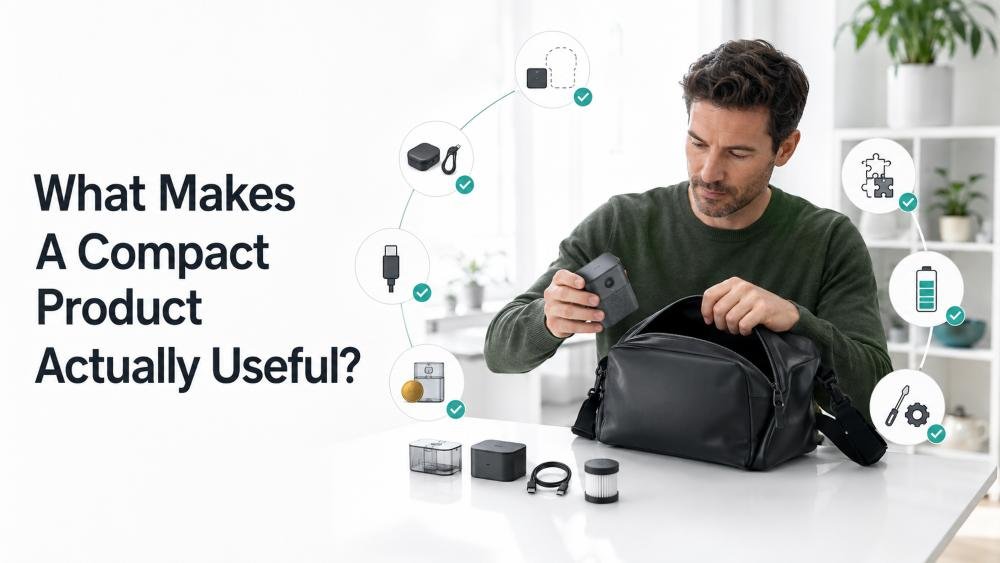
Useful compact design makes a product easier to own, not merely cheaper to manufacture. Before buying into a small or modular system, these are the questions that reliably separate the two.
- What does it replace? If nothing, be sceptical.
- What else do I need to buy for it to work? Count the adapters, cases and cables, then decide whether the total is still compact.
- What do refills or components cost per year? Compare that against the device price, not instead of it.
- Are the consumables proprietary, and is a third-party option available? Sole-source refills are where lock-in lives.
- Is compatibility easy to verify? If you cannot tell from the packaging or listing which parts fit, that is a warning rather than a detail.
- Is the battery replaceable, and by whom? In sealed devices, the battery is usually what dies first, and it often determines the product’s real lifespan.
- How long will spare parts be available? For EU buyers this is increasingly a legal question rather than a hopeful one.
- Does it do enough to justify retiring the larger thing? A compact product that leaves you keeping the big one has solved nothing.
Answering six of those eight before purchase will spare you most of the regret this category produces.
Future May Be Smaller, Not Bigger
Consumer products have historically differentiated by adding features. The next round of differentiation looks more likely to come from delivering familiar results with fewer physical components, less space, and less effort demanded from the owner.
That is not the same as accepting less capability. The proposition that actually persuades people is equivalent or better function in a format that takes up less of their life, for brands, that reframes compactness and modularity as strategic decisions rather than secondary specifications.
One tension is worth watching honestly, because it cuts against the optimistic version of this story. Miniaturisation and repairability often pull in opposite directions. Making something smaller frequently means gluing it shut, soldering the battery, and eliminating the screws that would let anyone open it. A product can be admirably compact and quietly disposable at the same time, and the sustainability case for compact design collapses if the device cannot be opened, repaired, or recycled at the end of a short life.
The products worth paying for are the ones that resolve that tension rather than hiding it: small, genuinely serviceable, honest about what the refills cost, and designed to fit a life that was already full before they arrived. People increasingly value solutions that take up less room, and not only the physical kind.
Disclaimer
This article is for general information only. It is not legal, financial, medical, or professional advice, and it does not account for individual circumstances. Regulatory references reflect the position as of September 2026 and are subject to change; the EU and US measures described here have differing scopes, transition dates, and national implementations. Rules governing age-restricted product categories, including hemp-derived and cannabinoid products, vary significantly by country and by state, are currently in flux, and may prohibit products that are lawfully sold elsewhere. Readers should verify the current status of any regulated product in their own jurisdiction and consult a qualified professional where their situation calls for advice.
References
- United Nations Institute for Training and Research and International Telecommunication Union. The Global E-waste Monitor 2024. Geneva and Bonn, March 2024. https://www.itu.int/en/ITU-D/Environment/Pages/Publications/The-Global-E-waste-Monitor-2024.aspx
- UNITAR. Global E-waste Monitor 2024: Electronic Waste Rising Five Times Faster than Documented E-waste Recycling. Press release, 20 March 2024. https://unitar.org/about/news-stories/press/global-e-waste-monitor-2024-electronic-waste-rising-five-times-faster-documented-e-waste-recycling
- European Parliament. Long-Awaited Common Charger for Mobile Devices Will Be a Reality in 2024. Press release, 4 October 2022. https://www.europarl.europa.eu/news/en/press-room/20220930IPR41928/long-awaited-common-charger-for-mobile-devices-will-be-a-reality-in-2024
- Council of the European Union. A Common Charger for Your Electronic Devices. Directive (EU) 2022/2380 amending Directive 2014/53/EU. https://www.consilium.europa.eu/en/infographics/2022-06-07-common-charger-directive/
- European Commission. Directive on the Repair of Goods. Directive (EU) 2024/1799 of 13 June 2024, applicable from 31 July 2026. https://commission.europa.eu/law/law-topic/consumer-protection-law/directive-repair-goods_en
- EUR-Lex. Common Rules Promoting the Repair of Goods and Amending Related EU Legislation. Summary of Directive (EU) 2024/1799 and Regulation (EU) 2024/1781 (Ecodesign for Sustainable Products Regulation). https://eur-lex.europa.eu/EN/legal-content/summary/common-rules-promoting-the-repair-of-goods-and-amending-related-eu-legislation.html
- Federal Trade Commission. Final Action Concerning Review of Interpretations of the Magnuson-Moss Warranty Act. 80 Fed. Reg. 42710 (20 July 2015). https://www.federalregister.gov/documents/2015/07/20/2015-14065/final-action-concerning-review-of-interpretations-of-magnuson-moss-warranty-act-rule-governing
- Congressional Research Service. Change to Federal Definition of Hemp and Implications for Federal Enforcement. Insight IN12620, Library of Congress. https://www.congress.gov/crs-product/IN12620