

Standing in a pharmacy aisle comparing a bottle of plain ascorbic acid against a liposomal sachet costing four or five times as much is a genuinely confusing moment. One promises the same nutrient; the other promises to deliver it properly. Neither label explains what “properly” means, or whether you needed the extra delivery in the first place.
The honest answer is that liposomal vitamin C does appear to raise blood levels more than standard vitamin C. It is also true that higher blood levels have not yet been shown to make people healthier, and that most people asking this question do not have a vitamin C absorption problem at all. Both of those things can be true at once, and understanding why is more useful than picking a side.
What Your Body Does With Vitamin C, And Why It Limits Itself
Humans cannot make vitamin C. We lost that ability somewhere in our evolutionary past, which is why it has to come from food or supplements every day.
Once absorbed, it does a handful of jobs that matter enormously. It is required for building collagen, which is why deficiency shows up as bleeding gums, poor wound healing and fragile capillaries. It supports carnitine and neurotransmitter production, which is part of why early deficiency feels like fatigue. It works as an antioxidant in the watery parts of the body, and it dramatically improves absorption of non-haem iron from plant foods, which matters a great deal in diets built around lentils, spinach and wholegrains.
Here is the part most articles skip. Your gut does not absorb vitamin C passively in unlimited amounts. It uses a specific transporter that becomes saturated. According to the NIH Office of Dietary Supplements, roughly 70 to 90 percent of vitamin C is absorbed at moderate intakes of 30 to 180 mg per day, but above 1 gram per day absorption falls below 50 percent, and the surplus that does get in is passed out in urine.
The classic depletion and repletion work by Mark Levine’s team at the National Institutes of Health mapped this precisely. Their pharmacokinetic study in healthy volunteers found that white blood cells reach saturation at around 100 mg a day, and that plasma levels barely move once daily intake passes 200 mg. Modelling suggests that even 3 grams taken every four hours would top out at a plasma concentration of about 220 micromoles per litre.
That ceiling is the whole reason liposomal formulations exist. It is also the reason their benefit is smaller than the marketing suggests.
What “Liposomal” Actually Means
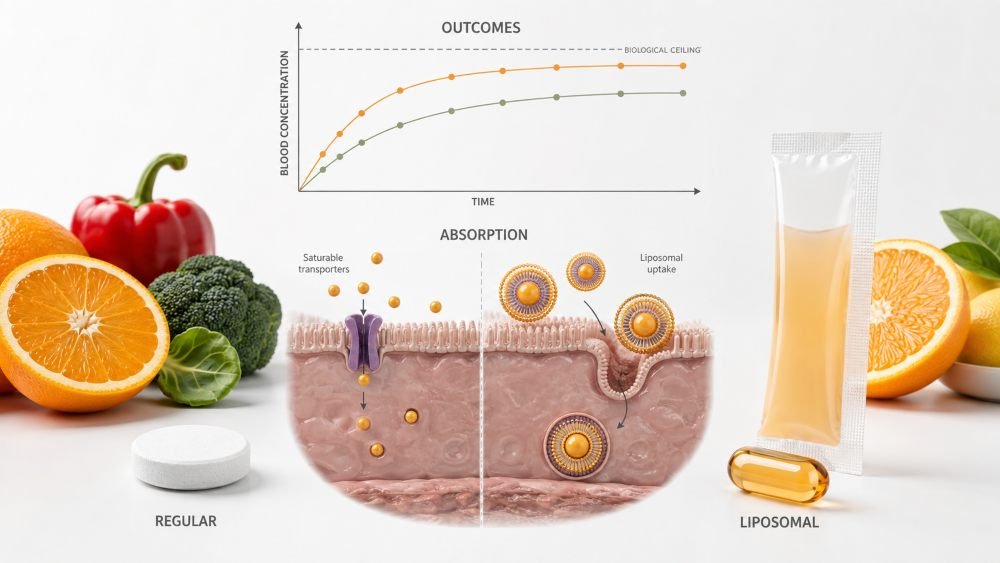
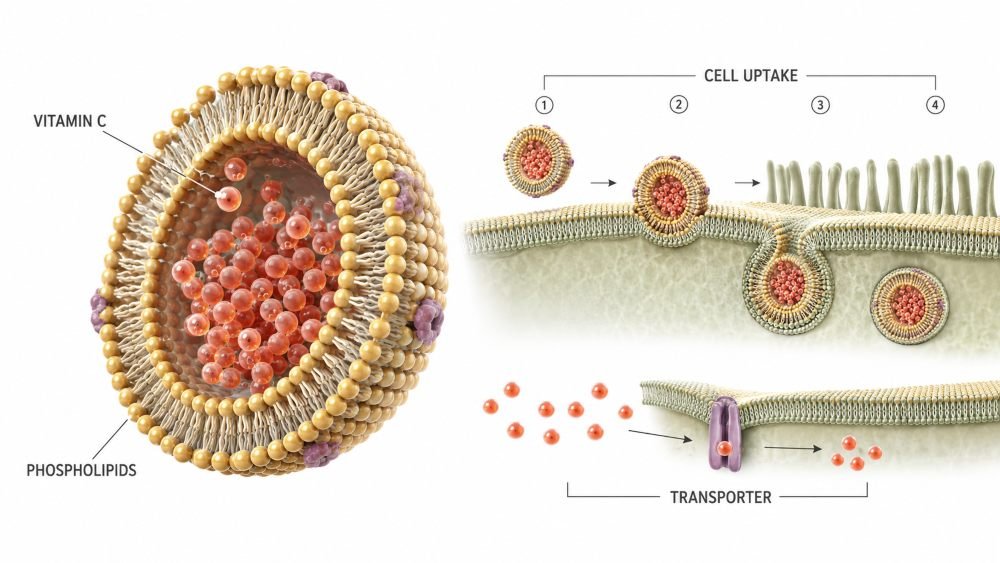
A liposome is a tiny sphere made of phospholipids, the same class of fatty molecules that form the membranes of your own cells. Vitamin C sits inside the sphere rather than floating freely in the gut.
The theory is that this sidesteps the saturable transporter entirely. Instead of queuing for a limited number of doorways, the vesicle is taken into the intestinal cell whole, through processes such as endocytosis. In practice, these vesicles vary enormously in size, from around 20 nanometres up to more than a micrometre, and that variation is one reason study results differ so much.
It is worth being clear about what this is not. Liposomal delivery is not the same as an intravenous drip, which bypasses the gut altogether and can produce plasma concentrations dozens of times higher than any oral dose. Nothing you swallow gets close to that.
What The Research Actually Shows
This is where the source material for most online articles goes wrong, usually by claiming that studies uniformly prove superior absorption.
The most rigorous assessment to date is a 2025 scoping review by Anitra Carr at the University of Otago, which screened 321 papers and found only ten human studies comparing liposomal against non-liposomal vitamin C. Nine of those ten did show higher bioavailability from the liposomal form. Peak blood concentrations ran 1.2 to 5.4 times higher, and total exposure over time ran 1.3 to 7.2 times higher.
That spread is enormous, and it tells you something important: the word “liposomal” describes a category, not a standard. A randomized, double-masked trial in 27 healthy adults giving 500 mg found the liposomal form produced roughly a quarter higher peak plasma concentration than standard vitamin C. A smaller crossover trial using 1 gram of a powdered liposomal formulation found only a 1.2-fold difference in peak levels. Same claim on the box, very different results.
Three limitations run through nearly all of this work. The trials are small, often ten to thirty people. They mostly measure a single dose over a few hours rather than what happens with daily use over months. And critically, almost none of them measured whether participants started deficient, which matters because someone already at saturation has very little room to absorb more of anything.
Higher Blood Levels Are Not The Same As Better Health
This is the point worth sitting with. Every study above measures a blood concentration, not an outcome.
No trial has yet shown that liposomal vitamin C reduces infections, speeds healing or improves any clinical endpoint compared with the ordinary kind. That evidence does not exist yet, and the reviewers calling for it are the same researchers who documented the absorption advantage.
For context, the Cochrane review on vitamin C and the common cold found that regular supplementation does not reduce how often people in the general population catch colds. It shortens them modestly, by around 8 percent in adults and 14 percent in children. The one group that saw a real effect was people under extreme physical stress, such as marathon runners and soldiers in cold conditions, where cold risk roughly halved. Starting vitamin C after symptoms appear showed no consistent benefit at all.
So if a product’s implied promise is fewer illnesses, the delivery system is not the limiting factor. The underlying effect is what it is.
When Liposomal Is A Reasonable Choice
There are situations where paying more is defensible:
- You get stomach upset from ordinary vitamin C at higher doses. Diarrhoea and cramping from unabsorbed ascorbic acid in the gut are the most common complaints at high intakes. A form that gets absorbed rather than sitting in the bowel may genuinely be easier to tolerate. Worth noting first, though, that buffered mineral ascorbates such as sodium or calcium ascorbate are far cheaper and often solve the same problem, even if the Linus Pauling Institute notes that hard evidence for their gentleness is thin.
- A clinician has advised you to take larger doses for a specific reason, and you are struggling to tolerate them.
- You have a documented low vitamin C status, confirmed by testing rather than assumed.
When It Probably Is Not Worth The Money
If you are a generally healthy adult eating some fruit and vegetables most days, your cells are likely already saturated or close to it. Improving delivery of a nutrient you have enough of does not accomplish anything measurable. The surplus leaves in your urine either way, just via a more expensive route.
The same logic applies to megadoses. Beyond a few hundred milligrams a day, you are mostly paying to manufacture costly urine.
Label Problem Almost Nobody Mentions
Here is something you will not hear from most multivitamin supplement brands: “liposomal” is not a regulated term on a supplement label.
In 2021, the UK’s Advertising Standards Authority ruled against a vitamin C brand after a complaint that its heavily marketed liposomal product could not be shown to contain liposomes. The evidence was reviewed by the Laboratory of the Government Chemist, and the regulator concluded the claim was unsubstantiated and misleading. Independent laboratory analyses of other products on the market have reported similar findings, with some formulations turning out to be ordinary emulsions or simple dispersions containing phospholipids rather than true vesicles.
If you do decide liposomal is right for you, a few things separate a real product from a marketing exercise:
- The label names an actual phospholipid source, usually phosphatidylcholine from sunflower or soy lecithin, rather than just the word “liposomal”.
- The manufacturer can supply characterization data such as particle size or electron microscopy, not only a certificate of vitamin C content.
- The claims are believable. Genuine studies show gains in the range of tens of percent to a ffew-fold Anything advertising “ten times absorption” or comparing itself to an IV drip is not describing published science.
- The price is plausible. Producing real liposomes needs specialized equipment, so a liposomal product priced identically to plain ascorbic acid deserves suspicion.
How Much Do You Actually Need
The recommended daily intake is 90 mg for adult men and 75 mg for adult women, rising to 85 mg in pregnancy and 120 mg while breastfeeding. People who smoke need an extra 35 mg per day because smoking increases oxidative turnover of the vitamin.
The tolerable upper limit for adults is 2,000 mg a day from all sources combined. It is considerably lower for children: 400 mg for ages one to three, 650 mg for four to eight, 1,200 mg for nine to thirteen and 1,800 mg for teenagers.
For most people, everyday multivitamin supplements supply vitamin C in the range that actually matters, alongside other nutrients that are often thinner in the diet. Doses far above this are not more effective for general health, and there is no established benefit to routinely exceeding the recommended intake in healthy people.
Food Is Doing More Work Than You Think
Five varied servings of fruit and vegetables a day can provide over 200 mg of vitamin C, which comfortably exceeds the point where cells saturate.
That said, deficiency is not a purely historical problem in this part of the world. A population study across north and south India found vitamin C deficiency in 73.9 percent and 45.7 percent of adults aged 60 and over, respectively, with only a small minority reaching adequate levels. Low intake of fresh produce and prolonged cooking were among the contributing factors.
That last point is practical. Vitamin C is water-soluble and destroyed by heat, so slow-simmered vegetables lose a great deal of it. Steaming or brief microwaving preserves more. Guava, amla, citrus, raw bell peppers, tomatoes and strawberries are all strong sources, and the ones eaten raw retain the most.
If your diet genuinely lacks fresh produce, that is a bigger lever than any delivery technology.
Safety And Who Should Be Careful
Vitamin C has low toxicity, and serious harm from high intakes is uncommon. Still, a few situations warrant caution:
- Kidney stones. High doses increase urinary oxalate and uric acid excretion. The evidence for actual stone formation is mixed, but is strongest in people with existing hyperoxaluria or kidney disease.
- Iron overload. Because vitamin C markedly increases iron absorption, people with haemochromatosis or other iron overload conditions can worsen tissue damage with chronic high doses.
- Cancer treatment. Whether antioxidant supplements interfere with chemotherapy or radiotherapy remains genuinely unresolved. Anyone in treatment should ask their oncologist before taking vitamin C, particularly at high doses.
- Statin and niacin therapy. Antioxidant combinations including vitamin C may blunt the HDL response to combined niacin and simvastatin treatment.
None of these concerns disappear with a liposomal product. If anything, a formulation that raises blood levels more effectively is the one where dose discipline matters more, not less.
A Simple Way To Decide
Ask yourself three questions in order.
Are you eating fruit and vegetables most days? If yes, you probably need no supplement at all, and certainly not a premium one.
If you do supplement, does plain vitamin C upset your stomach at the dose you take? If not, ordinary ascorbic acid at a sensible dose is doing everything a liposomal product would do, for a fraction of the price.
If it does upset your stomach, try a lower dose, split doses or a buffered mineral ascorbate first. If those fail and you still need higher intakes, a well-documented liposomal product is a reasonable next step, with clear eyes about what it buys you.
Bottom Line
Liposomal vitamin C is a real technology with real, measurable effects on blood levels. It is not a myth, and the studies supporting it are not fabricated.
It is also solving a problem that most people do not have, at a price most people do not need to pay, with no evidence yet that the extra absorption translates into feeling or functioning better. The gap between “absorbs better” and “works better” is where most of the marketing lives.
Get enough vitamin C. Get it mostly from food. If you supplement, a modest daily dose in a form your stomach tolerates covers nearly every situation the science can currently speak to.
This article is for general information and is not medical advice. Vitamin C requirements and safe upper limits vary with age, pregnancy, smoking status and medical conditions. If you have kidney disease, an iron overload disorder, are undergoing cancer treatment or take regular medication, speak to a doctor or pharmacist before starting a supplement.
References
- National Institutes of Health, Office of Dietary Supplements. Vitamin C: Fact Sheet for Health Professionals. Updated 31 July 2025. https://ods.od.nih.gov/factsheets/VitaminC-HealthProfessional/
- Levine M, Conry-Cantilena C, Wang Y, et al. Vitamin C pharmacokinetics in healthy volunteers: evidence for a recommended dietary allowance. Proceedings of the National Academy of Sciences USA. 1996;93(8):3704-3709. https://pubmed.ncbi.nlm.nih.gov/8623000/
- Carr AC. Do liposomal vitamin C formulations have improved bioavailability? A scoping review identifying future research directions. Basic & Clinical Pharmacology & Toxicology. 2025;137(1):e70067. DOI: 10.1111/bcpt.70067
- Purpura M, Jäger R, Godavarthi A, Bhaskarachar D, Tinsley GM. Liposomal delivery enhances absorption of vitamin C into plasma and leukocytes: a double-masked, placebo-controlled, randomized trial. European Journal of Nutrition. 2024. DOI: 10.1007/s00394-024-03487-8
- Linus Pauling Institute, Oregon State University. Vitamin C: Supplemental Forms. Micronutrient Information Center. Updated 13 January 2025. https://lpi.oregonstate.edu/mic/vitamins/vitamin-C/supplemental-forms
- Hemilä H, Chalker E. Vitamin C for preventing and treating the common cold. Cochrane Database of Systematic Reviews. 2013;(1):CD000980. DOI: 10.1002/14651858.CD000980.pub4
- Advertising Standards Authority. ASA Ruling on YourZooki Ltd, A20-1083951. Published 3 November 2021. https://www.asa.org.uk/rulings/yourzooki-ltd-a20-1083951-yourzooki-ltd.html
- Ravindran RD, Vashist P, Gupta SK, et al. Prevalence and risk factors for vitamin C deficiency in north and south India: a two centre population based study in people aged 60 years and over. PLOS ONE. 2011;6(12):e28588. DOI: 10.1371/journal.pone.0028588