

Choosing a wellness chair shouldn’t feel complicated, especially when your health is the priority. Yet many people get stuck comparing long spec sheets, flashy deals, and unclear claims. The real decision often comes down to a manual recovery chair or an AI-powered therapy chair.
Each supports different needs, from daily relaxation to managing muscle pain and stress. The problem is, most guides miss what truly impacts your well-being. This guide keeps things clear and practical, helping you compare your options and choose the right therapeutic chair that supports your health routine with confidence.
Manual Massage Chairs: Underrated, Reliable, and Still Genuinely Effective
There’s a tendency in the wellness tech space to dismiss manual chairs as outdated. That framing is too simplistic and, frankly, costs buyers money.
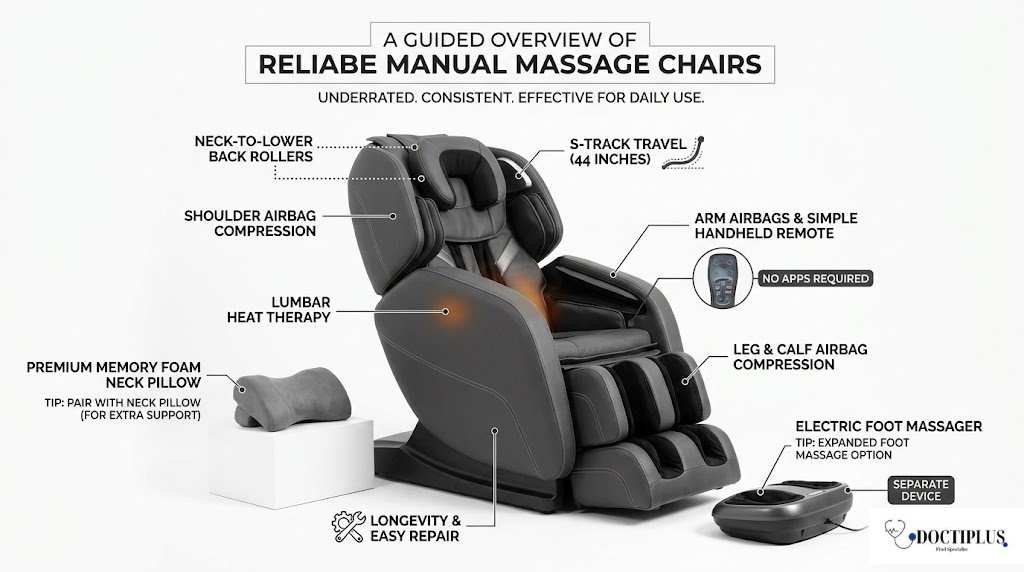
A well-built manual chair covers neck-to-lower-back roller travel, airbag compression across shoulders and calves, and dedicated lumbar heat. Nothing glamorous, but consistently effective for daily tension management. If you’re browsing massage chairs for sale near you, don’t overlook these models; they often deliver the most reliable, no-fuss performance. Users without technical backgrounds tend to rank reliable heat and steady pressure above every smart feature combined.
Manual chairs are best suited for people who dislike apps, firmware updates, or anything that requires a tutorial. They’re also the smarter starting point for buyers stepping up from handheld massagers or heated back cushions.
If longevity and easy repair rank higher than innovation on your list, a quality manual chair will likely serve you well for eight to ten years with minimal maintenance.
One practical tip: pair your manual chair with a good neck pillow and a separate foot massager to extend coverage without the premium price tag. Using it consistently, 15 to 20 minutes before bed or post-workout, produces more noticeable benefits than occasional long sessions.
Manual vs Smart Massage Chair: What You Notice on Day One
Sit in both chair types back-to-back, and the difference becomes obvious immediately. This isn’t just a price gap; it’s a fundamentally different design philosophy.
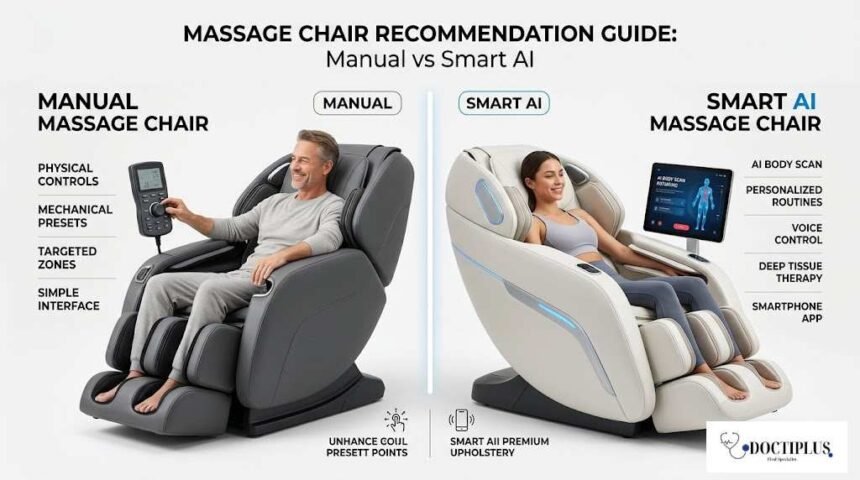
Manual chairs run fixed programs, use basic remotes, and ask nothing of your Wi-Fi network. Smart AI chairs bring body-scanning sensors, adaptive algorithms, app control, and sometimes voice integration.
Manual models are quieter, cheaper to maintain, and easier to repair. Smart chairs offer a level of personalization that manual models cannot replicate.
| Feature | Manual Chair | Smart AI Chair |
| Setup complexity | Low | Moderate–High |
| Body scanning | No | Yes |
| App/voice control | No | Yes |
| Noise level | Lower | Moderate |
| Repair simplicity | Easier | Requires service |
| Price range | $ – $$ | $$$ – $$$$ |
| Learning curve | Minimal | Moderate |
At the mechanical level, manual chairs typically run 2D or 3D rollers on standard S-tracks. Smart AI models step up to 4D or 5D intelligent rollers on full SL or dual-track systems that follow the spine from the base of your neck all the way down to your hamstrings.
Controls evolve from a simple button pad into full touchscreens, smartphone apps, and voice commands, for real-world users, which translates to better shoulder coverage, more precise lumbar targeting, and noticeably deeper relief in the hips and calves.
Frequently Asked Questions
Before you evaluate any specific chair, step back. The right decision lives in your answers to these questions, not in a feature list.
| Question | Key Consideration |
|---|---|
| How frequently will you use this chair? | Daily users with chronic lower-back pain need a fundamentally different chair than occasional users. Base your choice on your real routine, not ideal intentions. |
| Who else shares your household? | Households with users of different heights (e.g., 5’2″ vs 6’4″) need a wider body scan range. Multiple users require multiple adjustable profiles. |
| How much space can you realistically dedicate? | Zero-gravity recline needs about 12–18 inches of wall clearance. Zero-wall models save space but are more expensive. Always measure your area first. |
| What’s your honest budget ceiling? | Entry-level: $500–$1,500. Mid-range: $1,500–$3,500. Premium AI chairs: $4,000–$8,000+. Consider warranty and service costs for long-term value. |
Smart AI Massage Chairs: What the Technology Actually Does (and What It Doesn’t)
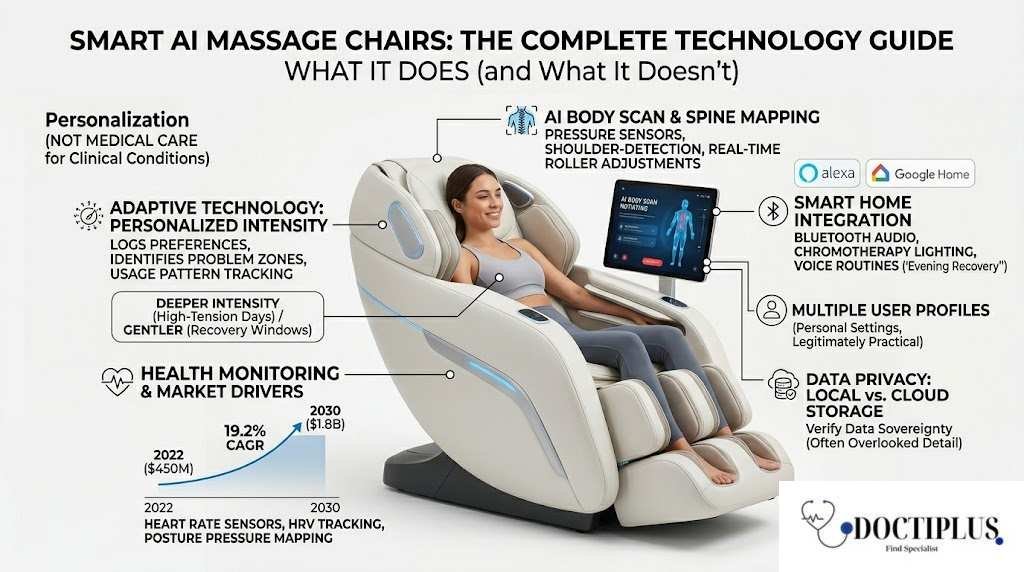
Modern AI body scanning works through pressure sensors and shoulder-detection hardware that map your spine curvature and body dimensions before each session begins. Roller width, depth, and path adjust in real time based on that data.
It’s genuinely useful personalization, though it’s worth stating clearly that no chair replaces medical care for clinical conditions.
What happens after the initial scan is where adaptive technology earns its price tag. Smart chairs log your preferred pressure levels, identify recurring problem zones, and recognize usage patterns over time.
After a few weeks, the chair delivers deeper intensity on high-tension days and gentler sessions during recovery windows. Multiple user profiles let different family members maintain their own settings, a legitimately practical feature for shared households.
Health monitoring is another growing differentiator. The global AI-integrated massage equipment market was valued at $450 million in 2022 and is projected to reach $1.8 billion by 2030 at a CAGR of 19.2%.
That growth is being driven partly by heart rate sensors, HRV tracking, and posture pressure mapping appearing in more chairs each product cycle. Before purchasing, verify whether your data stays stored locally or syncs to a cloud platform, an often-overlooked detail with real privacy implications.
Many smart chairs now integrate with Alexa and Google Home, support Bluetooth audio, and include chromotherapy lighting. Voice routines such as “Evening Recovery” linked to your home lighting are genuinely useful for building consistent habits. Scent diffusers, meanwhile, sit firmly in the novelty category for most buyers.
Smart Massage Chair Buying Guide: Matching Features to Real Needs
Knowing your pain points is powerful, but evaluating AI claims requires additional scrutiny. Red flags include chairs marketed as “AI-powered” that only scan shoulder height.
Legitimate AI performs full-body pressure mapping and adapts roller behavior throughout the session. Ask retailers directly: What exactly changes during a session based on AI input? Can I override it manually? How many user profiles does the chair support?
For specific pain zones, here’s a quick reference:
- Neck and upper-back tension: Prioritize taller track coverage, adjustable neck positioning, and precise upper-roller depth control.
- Lower-back and hip pain: Look for strong lumbar heat, SL-track design, and hip airbags with adjustable intensity.
- Leg and foot fatigue: Dedicated calf rollers and foot reflexology plates matter more than any AI feature.
Warranty terms deserve the same scrutiny you’d give to the spec sheet. Smart chairs carry motherboards, sensors, and electronics that manual chairs don’t; they need stronger post-purchase support to match.
Seek in-home service coverage, not parts-only mail-in programs. Look for brands that hold American Chiropractic Association endorsement and offer in-home service, which represent the standard worth holding other brands against.
To sidestep unreliable resellers and misleading promotional pricing, it’s worth searching for massage chairs for sale near you through authorized brand dealer directories rather than relying on open marketplace listings.
Best Massage Chairs 2026: Recommendations by User Type
First-time buyers should target chairs under $2,000 with reliable heat, basic 3D rollers, and intuitive recline. Confirm consistent daily use before committing to a premium tier.
Athletes and active users benefit most from deep-tissue 4D rollers, dedicated stretching programs, and smart adaptation to post-training muscle tightness. Schedule sessions within two hours of training for optimal recovery.
Work-from-home and desk-bound professionals accumulate upper-back and neck tension in predictable patterns. Shoulder-hugging airbags and quick 10–15 minute micro-break modes deliver the most practical return for this group.
Seniors and low-tech households need simplicity above all. Large controls, one-touch programs, and slow, controlled recline are non-negotiable. Surprisingly, voice control in smart chairs can reduce menu complexity for some users, but manual models remain the most accessible starting point.
Long-Term Ownership: Protecting Your Investment
Sessions of 15–20 minutes, once or twice daily, produce consistent results for most healthy adults. Combine your routine with light stretching and proper hydration to amplify muscle recovery benefits.
Maintenance is straightforward but important. Wipe upholstery weekly with a microfiber cloth, avoid pet and child damage to mechanical components, and inspect smart chair cables every few months. Firmware updates and sensor recalibration on AI models aren’t optional; skipping them causes accuracy drift that undermines the personalization you paid for.
When evaluating future-proofing, prioritize brands with modular components, updatable software architectures, and established US service networks. A chair labeled “2026 technology” built on 2022-era internals with refreshed marketing is easy to spot. Request the hardware specification sheet before committing to anything.
Making the Final Call
Here’s the honest summary: manual chairs offer dependable comfort and straightforward value at a lower total cost. Smart AI chairs deliver adaptive, evolving sessions that grow more accurate over time, and justify their price for the right user profile.
The best chair isn’t the most impressive one on paper. It’s the one you’ll actually use, in a space that works, at a price that doesn’t produce regret six months later. Define your needs first, test in person before purchasing, and let warranty quality and service access carry more weight than headline features. That’s the decision framework that holds up.
References
- Field, T. (2014). Massage therapy research review. Complementary Therapies in Clinical Practice, 20(4), 224–229.
- Weerapong, P., Hume, P. A., & Kolt, G. S. (2005). The mechanisms of massage and effects on performance, muscle recovery and injury prevention. Sports Medicine, 35(3), 235–256.
- Moraska, A. F., et al. (2010). Physiological adjustments to stress measures following massage therapy: A review. Evidence-Based Complementary and Alternative Medicine, 7(4), 409–418.
- Best, T. M., Hunter, R., Wilcox, A., & Haq, F. (2008). Effectiveness of sports massage for recovery of skeletal muscle from strenuous exercise. Clinical Journal of Sport Medicine, 18(5), 446–460.
- Crawford, C., Boyd, C., Paat, C. F., et al. (2016). The impact of massage therapy on function in pain populations—A systematic review and meta-analysis. Pain Medicine, 17(7), 1353–1375.
- Bervoets, D. C., Luijsterburg, P. A., Alessie, J. J., et al. (2015). Massage therapy has short-term benefits for people with common musculoskeletal disorders. Journal of Physiotherapy, 61(3), 106–116.
- Rapaport, M. H., Schettler, P., & Bresee, C. (2010). A preliminary study of the effects of repeated massage on hypothalamic–pituitary–adrenal and immune function. Journal of Alternative and Complementary Medicine, 16(10), 1079–1088.
- Nelson, N. L. (2015). Massage therapy: Understanding the mechanisms of action on blood flow and muscle recovery. Journal of Bodywork and Movement Therapies, 19(3), 478–483.