


By the time most people sit down for a consultation about Preparing For Lower Eyelid Surgery their under-eye bags, they have already tried the usual fixes. More sleep. Cold spoons in the morning. A concealer that works under office lighting and gives up by mid-afternoon. When the puffiness keeps returning no matter what, surgery starts to feel like a fair question to ask.
Lower eyelid surgery, known medically as lower blepharoplasty, can make a real difference for the right person. But the outcome depends heavily on what happens before the operation: whether surgery is the right tool for your particular concern, how carefully your eyes are assessed, and how well you prepare your body, your schedule, and your home for recovery. This guide walks through each stage, including the parts that brochures tend to skip.
Is It Really Eye Bags? Check This Before You Book

“Eye bags” is a catch-all phrase for several different things, and they do not all respond to the same treatment.
True bags usually come from the fat that cushions the eye, moving forward as the tissues holding it in place weaken. Genetics play a large part, which is why some people notice bags in their twenties. This kind of puffiness stays put whether you slept eight hours or four.
Puffiness that comes and goes is a different story. Mayo Clinic’s overview of under-eye bags explains that fluid retention (especially on waking or after a salty meal), poor sleep, allergies, and smoking can all make the area look swollen, and that some medical conditions, including thyroid eye disease and kidney disease, can contribute too. A doctor may want to rule these out before surgery is discussed.
A simple exercise helps. For a week or two, photograph your face each morning and evening in the same light. If the bags look much the same in every photo, that points towards structural fat. If they swing dramatically with sleep, salt, or allergy season, mention that pattern at your consultation.
It also pays to be precise about what bothers you. Dark circles from pigmentation, a hollow groove beneath the eye (the tear trough), crepey skin, and puffy bags are separate issues. A 2021 review on preventing eyelid malposition after blepharoplasty points out that whether a patient is most troubled by wrinkles, the tear trough, or the bags themselves changes how the surgery should be approached. Removing too much fat can leave the area hollow, which is why the diagnosis matters as much as the operation.
What The Operation Actually Involves
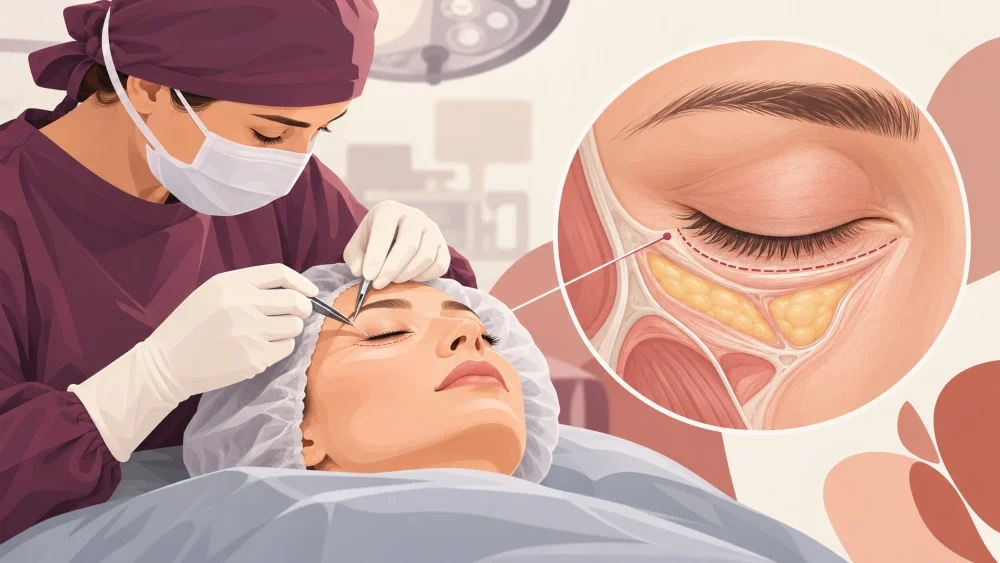
In broad terms, lower eyelid surgery deals with three things: fat, skin, and the support of the lid itself. The American Academy of Ophthalmology’s guide to eyelid surgery describes how surgeons may remove excess lid skin and, at the same time, remove extra fat or tighten the surrounding muscle and tissue.
There are two main ways in, and the choice shapes your recovery.
- Transconjunctival approach. The incision sits on the inside of the lower lid, so there is no visible scar on the skin. It generally suits people whose main issue is protruding fat without much loose skin, which often means younger patients.
- Transcutaneous (subciliary) approach. The incision runs just below the lash line, allowing the surgeon to remove or tighten excess skin as well as address the fat. The scar usually settles into the natural crease and fades with time.
A 2020 review in the Indian Journal of Ophthalmology describes this same division and highlights a shift in thinking. Rather than simply cutting fat away, many surgeons now reposition some of it to smooth the hollow between the lower lid and the cheek, because preserving volume tends to look more natural than aggressive removal.
The procedure is usually performed as day surgery, commonly under local anaesthetic and sometimes with sedation. Ask which applies to you, because it affects your fasting instructions and how you get home.
Your Consultation: Appointment That Shapes Everything

A good consultation should feel like a careful examination and a two-way conversation, not a sales pitch.
What Your Surgeon Should Check
Expect your surgeon to look closely at your skin, the fat pads, the position of the lid, and how firmly it sits against the eye. A common test involves gently pulling the lower lid away from the eye and watching how quickly it springs back. A loose lid is more likely to be dragged downwards as it heals, so if laxity is found, your surgeon may suggest tightening the outer corner of the lid (a canthopexy or canthoplasty) during the same operation.
Existing asymmetry deserves attention too. In one analysis of 204 patients, 90.2% had some degree of lower eyelid asymmetry before surgery. If your surgeon points out that one side already sits differently, you are far less likely to blame the operation for it later.
What You Should Tell Them
Be thorough about your health history, including:
- Dry eye, glaucoma, previous eye surgery (laser vision correction included), and contact lens use
- Thyroid problems, diabetes, circulation problems and allergies
- Every medication, vitamin, and supplement you take, including traditional or herbal remedies, which are easy to forget but can affect bleeding.
- Smoking and alcohol use
If you have thyroid eye disease that is still in its active phase, surgery is generally postponed until it settles.
Questions Worth Asking
- Which approach do you recommend for my eyes, and why?
- Will my fat be removed, repositioned, or both?
- Does my lower lid need extra support?
- What kind of anaesthesia will I have?
- Realistically, how long will I look bruised with this technique?
- Who do I contact after hours if something worries me?
- If I need a revision, how is that handled and what would it cost?
Weeks Before Surgery
Review Medications With Your Doctor, Not On Your Own
Mayo Clinic’s blepharoplasty guidance notes that patients are usually asked to pause blood thinners, aspirin, ibuprofen, naproxen, and herbal supplements that increase bleeding before surgery, for a period set by their care team. The important part is who makes that call. If you take a blood thinner for a heart or clotting condition, never stop it until your prescribing doctor and your surgeon have agreed on a plan together.
Give Yourself A Real Break From Smoking
Eyelid tissue is thin and relies on good blood flow to heal. The World Health Organization reports that people who stop smoking roughly four weeks or more before surgery have fewer complications, with each additional smoke-free week after that improving outcomes by around 19%. If quitting feels daunting, raise it with your surgeon or GP as early as possible and ask what support is available. The sooner you start, the more you gain.
Sort Out Your Eyewear
Contact lenses are typically off-limits for about two weeks after surgery, so check that your glasses prescription is current. Wraparound sunglasses are worth buying beforehand as well, given how bright Singapore can be even on overcast days.
Plan Time Off Around Your Life, Not Just Your Leave
Bruising and swelling generally ease over about 10 to 14 days, which is when many people feel comfortable being seen in public again. Patients having the inside approach often bounce back sooner, while those who have skin removed may need longer. Build in a buffer, particularly if your work is public-facing, and avoid scheduling surgery a few weeks before a wedding, a major presentation, or a holiday where you will be photographed. Subtle swelling can linger for weeks after the bruises have gone.
Get Your Home Ready
Before the day, set up:
- Extra pillows so you can sleep with your head raised above your chest for the first few days
- Cold compresses or gel packs, plus clean gauze or soft cloths
- Your prescribed eye drops or ointment, with the instructions written down
- Simple, lower-salt meals, since salty food can worsen puffiness
- Podcasts or audiobooks, because ointment blurs vision and screens may feel tiring at first
- A lift home, and another adult to stay with you on the first night
On The Day Itself
Follow your fasting instructions to the letter. Arrive without makeup or contact lenses, and wear a top that fastens at the front so nothing has to be pulled over your face afterwards. Your surgeon will usually mark the planned incisions while you sit upright, confirm the plan, and answer any final questions.
The operation typically takes between one and two hours, depending on the technique. Afterwards, you will rest in a recovery area while staff monitor you, and most people go home the same day.
Why The First Night Matters
One complication deserves a clear, calm explanation because it is time-sensitive: bleeding behind the eye, known as orbital haemorrhage. It is rare. A large survey of oculoplastic surgeons covering 269,433 blepharoplasty cases recorded 149 orbital haemorrhages (about one in 1,800) and 12 cases of permanent vision loss (roughly one in 22,000). Most of the bleeding began within three hours of surgery, and the risk fell sharply after the first 24 hours.
That is why resting, keeping your head raised, and avoiding any straining on the first day matter so much, and why having someone with you that first night is a genuine safety measure rather than a formality.
Seek urgent medical attention if you notice:
- Severe or rapidly worsening pain in or around the eye
- Swelling that suddenly increases, especially on one side, or an eye that looks pushed forward
- Bleeding that does not stop
- Any change in or loss of vision
- Shortness of breath, chest pain or an unusual heartbeat
Call your surgeon’s emergency line straight away. If you cannot reach them or the symptoms are severe, call 995 or go to the nearest emergency department.
What Recovery Usually Looks Like
Everyone heals at their own pace, and your surgeon’s instructions always come before any general timeline. Knowing the typical pattern, though, helps you tell normal from not normal.
First Few Days
Expect swelling, bruising that can resemble a pair of black eyes, tightness, and watering. Your vision may be blurry from protective ointment, and your eyes may feel sensitive to light. Swelling often looks worse on the second or third day before it starts to improve, which can be unsettling if nobody warned you.
Cold compresses help during this period. Clinics differ on the exact routine, and some switch to warm compresses after a few days, so follow the schedule you are given.
First Two Weeks
Bruising fades gradually, often through yellow and green, before disappearing. If you have stitches that need removing, this usually happens within about a week. During this stretch, avoid heavy lifting, swimming, jogging, and other strenuous exercise; don’t rub your eyes, and leave contact lenses out. Check with your surgeon before taking any over-the-counter painkiller, as anti-inflammatories such as ibuprofen can increase bleeding.
Following Months
The last traces of swelling take time to resolve, and scars from any skin incision can take months to fade fully. Protect the area from the sun with sunglasses and a wide-brimmed hat. It is normal for the lids to feel slightly tight or dry for a while.
One thing to flag early rather than late: if your lower lid seems to be pulling down or away from the eye, tell your surgeon promptly instead of waiting for the next routine review. Mild lid pulling that is caught early can sometimes be managed with massage, whereas waiting tends to narrow the options.
Keeping Expectations Honest
Lower eyelid surgery can soften bags and help you look more rested, and many patients are very pleased with the change. It does not stop ageing, and it has limits worth knowing now rather than later.
It will not reliably erase fine lines or crepey texture, and it does not treat dark circles caused by pigmentation. Those may need other treatments, such as laser resurfacing or peels, alongside or instead of surgery. For some people the results last many years; for others, some laxity returns with time.
Like any operation, it carries risks. Mayo Clinic lists infection, bleeding, dry or irritated eyes, difficulty closing the eyes, noticeable scarring, skin discolouration, injury to the eye muscles, temporarily blurred vision (and, rarely, loss of vision) and the possibility of needing further surgery. With lower lid surgery in particular, the lid can occasionally sit lower or turn outwards (ectropion) after healing, which is one reason lid support is assessed so carefully beforehand.
Finally, be kind to yourself in the first week. Looking in the mirror at a bruised, swollen face is hard, and a wobble of doubt is a normal response to that, not a verdict on your result.
Choosing The Right Surgeon In Singapore
The single most important preparation step is choosing who operates on you. In Singapore, every practising doctor must be registered with the Singapore Medical Council, and anyone practising as a specialist must first be accredited by the Specialists Accreditation Board and added to the Register of Specialists. You can search the Singapore Medical Council’s register of doctors to confirm a surgeon’s registration and specialty.
Beyond credentials, look for a surgeon who performs eyelid surgery regularly, shows you before-and-after photos of patients whose eyes resemble yours, explains why a particular technique suits your anatomy, and talks openly about risks and revisions. You should never feel rushed into booking, and seeing more than one surgeon is perfectly reasonable.
If you are exploring lower eyelid surgery in Singapore, Astrid Plastic Surgery, headed by Dr Jonah Kua and Dr Chia Hui Ling, is one clinic where you can have your lower eyelids assessed and talk through whether surgery, and which approach, makes sense for you.
A Quick Pre-Surgery Checklist
- Morning and evening photos of your under-eye area in consistent light
- A written list of every medication, supplement and herbal remedy you take
- A clear, agreed plan from your doctors on any blood thinners
- Smoking stopped at least four weeks beforehand, where possible
- Up-to-date glasses and good sunglasses
- Enough time off to cover around two weeks of visible bruising
- Pillows, compresses, drops and easy meals ready at home
- A lift home and an adult staying with you overnight
- Your surgeon’s after-hours number saved in your phone
Good preparation will not make recovery painless, but it does make it predictable, and predictable is far less stressful. The better you understand your own anatomy, your surgeon’s plan and the warning signs to watch for, the better placed you are to make a decision you feel settled about, whether that means going ahead or deciding that surgery is not right for you just now.
Disclaimer
This article is for general information only and does not replace personalised medical advice. Suitability, technique, preparation and recovery vary from person to person, so please discuss your individual circumstances with a qualified, registered doctor before making any decision about surgery.