


Here’s something most people overlook: the rooms where you spend your time aren’t passive backdrops. They’re active participants in your mental health story. Think about it, your office, bedroom, even that coffee shop where you work, each space remotely influences your emotional state in profound, measurable ways.
We’re talking about real neurological responses triggered by ceiling height, wall color, lighting quality, and dozens of other factors you might dismiss as “just decoration.” But understanding how physical spaces shape psychological wellness? That’s not optional anymore if you genuinely care about protecting your mental health.
Science Behind Environmental Psychology and Mental Health
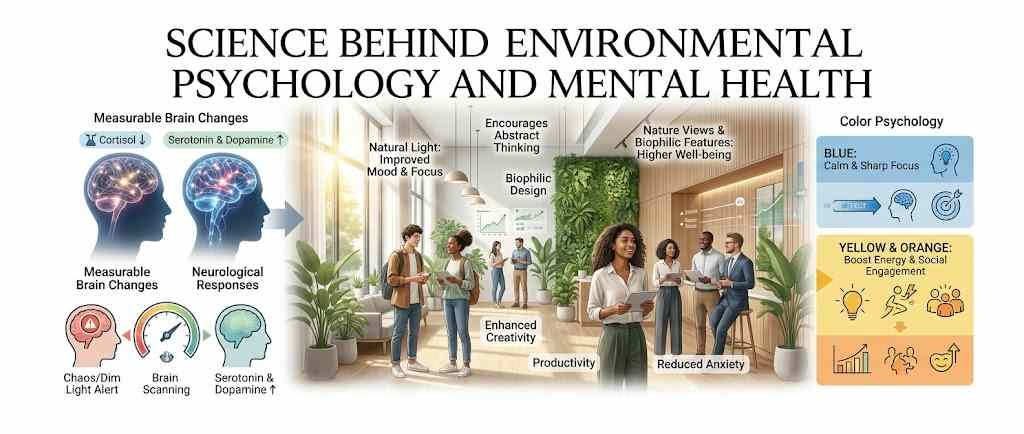
Researchers can now measure exactly what happens inside your brain when you walk into different environments. This isn’t abstract philosophy. Environmental psychology has evolved into a rigorous field documenting precisely how architectural choices alter human behavior and emotional response patterns.
Consider natural light. Studies have found that exposure to natural light in residential spaces is associated with improved mood, increased productivity, and reduced symptoms of depression and anxiety. Your mood improves. You concentrate better. Anxiety decreases. These aren’t placebo effects; neuroscience shows distinct brain activity patterns depending on the spatial characteristics surrounding you.
Neurological Responses to Spatial Design
Your brain never stops scanning your environment. Even right now, subconscious processing is happening. Thoughtfully designed spaces prompt your nervous system to release serotonin and dopamine while simultaneously dialing down cortisol production. Here’s a fascinating example: high ceilings actually encourage abstract thinking and creative problem-solving, whereas lower ceilings push your brain toward detail-focused work.
The impact of design on mental health reaches deep into neural pathways controlling stress reactions. Walk into a chaotic, dimly lit room and watch what happens. Your amygdala activates, essentially keeping you on low-grade alert status without you consciously realizing it.
Biophilic Design and Mental Wellness
Bringing nature indoors isn’t some trendy aesthetic choice. Your psychology requires it. Biophilic design has demonstrated extraordinary results in medical facilities, where environmental design and well-being overlap most critically.
Young people dealing with mental health struggles particularly benefit from therapeutic spaces incorporating natural elements, especially when these environments complement professional interventions like mental health referrals that connect adolescents with specialized clinicians.
Indoor plants, natural wood, and nature views consistently lower anxiety biomarkers and speed recovery.
One corporate study found offices with biophilic features reported 15% higher well-being scores than standard designs.
Color Psychology and Emotional States
Color wavelengths literally change your brain chemistry. Blue activates your parasympathetic nervous system, creating calm and sharpening focus. Warm yellows and oranges? They boost energy and encourage social engagement.
The psychology of space and well-being recognizes color as a functional, not merely decorative, tool for regulating your emotional states.
Cultural background matters for some color interpretations, yet certain physiological reactions appear consistent across populations worldwide.
How the Environment Affects Mental Health Across Different Settings
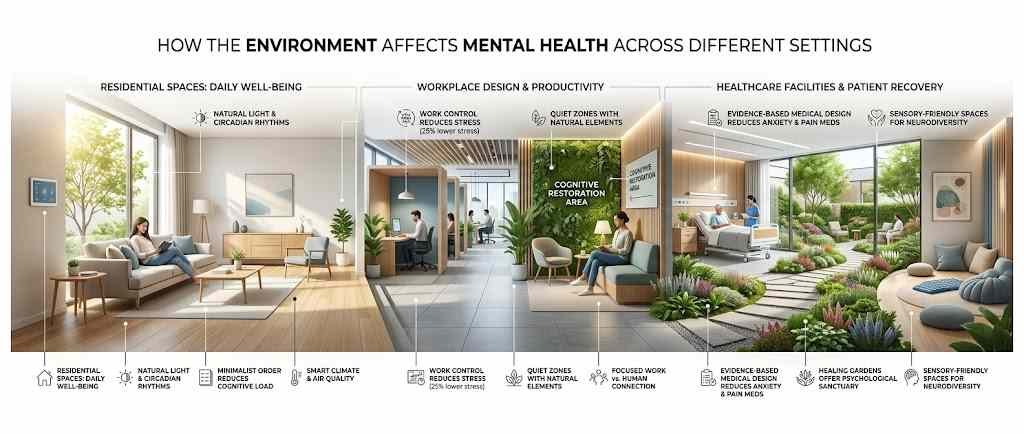
Understanding how the environment affects mental health means examining where you actually spend your hours. Each environment category requires distinct design strategies for optimal psychological support.
Residential Spaces and Daily Well-Being
Your home establishes your mental baseline. Layout affects everything, reducing daily frustrations and minimizing family tensions. Natural light governs circadian rhythms that control sleep quality and mood stability. The results indicate that adverse environmental conditions, especially poor air quality, noise, ergonomic conditions, and lack of privacy, may affect worker satisfaction and mental health.
Minimalist principles reduce cognitive load. Less visual clutter means your brain processes fewer stimuli, freeing mental bandwidth for what actually matters. Modern smart systems can even monitor conditions and automatically adjust lighting, temperature, and air quality.
Workplace Design and Productivity
Open offices encourage collaboration at a cost. They sacrifice psychological safety and concentration. Research reveals something striking: employees without workspace control experience stress hormones that increase by up to 25%.
The hybrid work revolution demands we completely rethink office design for both focused work and human connection. Break areas designed for cognitive restoration, quiet zones featuring natural s elements, allow employees to recover from mental exhaustion during the workday.
Healthcare Facilities and Patient Recovery
Evidence-based medical design reduces patient anxiety and pain medication needs. Healing gardens offer psychological sanctuary during challenging treatments. Families searching for comprehensive adolescent care find that facilities prioritizing therapeutic environmental design create atmospheres where professional treatment achieves better effectiveness.
Sensory-friendly spaces accommodate neurodivergent patients who find conventional clinical environments overwhelming.
Key Design Elements That Shape Mental States
Certain fundamental components consistently influence psychological wellness across every environmental type.
Spatial Configuration
Room proportions determine whether you feel trapped or liberated. Transitional zones, entryways, and hallways function as psychological buffers, helping your brain transition between mental modes. Ceiling height measurably impacts creative versus analytical thought patterns.
Sensory Design Integration
Look beyond visual design. Acoustic quality profoundly influences stress. Persistent background noise elevates cortisol, while strategic sound absorption generates psychological calm. Olfactory design taps scent-memory connections; lavender reliably reduces anxiety markers; citrus scents boost alertness.
Tactile materials matter too. Natural textures like wood and stone activate different neural pathways compared to plastic or metal.
Light Quality and Mental Health
Poor lighting disrupts circadian rhythms, contributing to depression and anxiety disorders. Dynamic systems mimicking natural daylight support your biological rhythms. Seasonal affective disorder responds remarkably to architectural strategies maximizing winter light.
Thermal Comfort
Temperature affects cognitive performance more dramatically than you’d expect. Just 2°C deviation from your comfort zone cuts productivity by 20%. Personal thermal control supports mental autonomy and minimizes stress responses.
Practical Implementation for Better Mental Health
Complete renovations aren’t necessary for applying these principles effectively.
Residential Modifications
Start with light maximization, remove heavy window treatments, position mirrors to reflect daylight, and select lighter furnishings. Declutter methodically to decrease visual cognitive demands. Add plants for air quality and psychological benefits. Rearrange furniture, creating clear pathways and distinct activity zones.
Workplace Improvements
Push for environmental audits assessing lighting, acoustics, and air quality. Request personal environmental controls wherever feasible. Establish informal break zones incorporating natural elements. Even minor interventions like desk plants and task lighting produce measurable results.
When to Seek Professional Help
Environmental design powerfully supports mental wellness, but it complements, rather than replaces, professional mental health treatment. When design improvements don’t relieve persistent depression, anxiety, or other mental health symptoms, clinical support becomes essential for comprehensive care.
Common Questions About Environmental Design and Mental Health
How quickly can environmental changes improve my mental state?
- Some benefits appear immediately; improved lighting lifts mood within minutes. Longer-term advantages like better sleep from circadian-friendly design typically surface within 2-4 weeks of consistent exposure.
Can environmental design replace therapy or medication?
- Absolutely not. Design modifications support mental health but never substitute clinical treatment. They function best alongside professional care when necessary. View design as preventive maintenance rather than primary intervention for diagnosed conditions.
What’s the single most impactful change for mental wellness?
- Natural light exposure consistently tops research findings. Maximizing daylight where you spend most of your time delivers the broadest psychological benefits with minimal investment or complexity.
Creating Spaces That Support Mental Wellness
Your environments aren’t neutral territory; they’re either bolstering or sabotaging your psychological health every single moment. Understanding how specific design elements trigger neurological and emotional responses lets you make deliberate choices promoting mental wellness.
Whether optimizing your home, advocating for better workplace conditions, or simply developing environmental awareness, these evidence-based principles provide practical routes toward improved mental health. Begin with small, achievable modifications and observe how your mood and stress respond. Your surroundings actively shape your mental state. Ensure they’re working for you rather than against you.
References
- American Psychological Association. (2020). The impact of light on outcomes in healthcare settings. Washington, DC: APA. Retrieved from https://www.apa.org
- Boubekri, M., Cheung, I. N., Reid, K. J., Wang, C. H., & Zee, P. C. (2014). Impact of windows and daylight exposure on overall health and sleep quality of office workers: A case-control pilot study. Journal of Clinical Sleep Medicine, 10(6), 603–611. https://doi.org/10.5664/jcsm.3780
- Bringslimark, T., Hartig, T., & Patil, G. G. (2009). The psychological benefits of indoor plants: A critical review of the experimental literature. Journal of Environmental Psychology, 29(4), 422–433. https://doi.org/10.1016/j.jenvp.2009.05.001
- Kellert, S. R., Heerwagen, J. H., & Mador, M. L. (2011). Biophilic design: The theory, science, and practice of bringing buildings to life. Hoboken, NJ: Wiley
- Ulrich, R. S. (1984). View through a window may influence recovery from surgery. Science, 224(4647), 420–421. https://doi.org/10.1126/science.6143402
- World Health Organization. (2018). Housing and health guidelines. Geneva: WHO. Retrieved from https://www.who.int
- Evans, G. W., & McCoy, J. M. (1998). When buildings don’t work: The role of architecture in human health. Journal of Environmental Psychology, 18(1), 85–94. https://doi.org/10.1006/jevp.1998.0089
- Heschong, L. (2002). Daylighting and human performance. ASHRAE Journal, 44(6), 65–67
- Heerwagen, J. H. (2000). Green buildings, organizational success, and occupant productivity. Building Research & Information, 28(5–6), 353–367. https://doi.org/10.1080/096132100418500
- Leather, P., Pyrgas, M., Beale, D., & Lawrence, C. (1998). Windows in the workplace: Sunlight, view, and occupational stress. Environment and Behavior, 30(6), 739–762. https://doi.org/10.1177/001391659803000601
- Mayo Clinic Staff. (2021). Seasonal affective disorder (SAD). Mayo Foundation for Medical Education and Research. Retrieved from https://www.mayoclinic.org
- Centers for Disease Control and Prevention. (2022). Workplace health model. Atlanta, GA: CDC. Retrieved from https://www.cdc.gov