

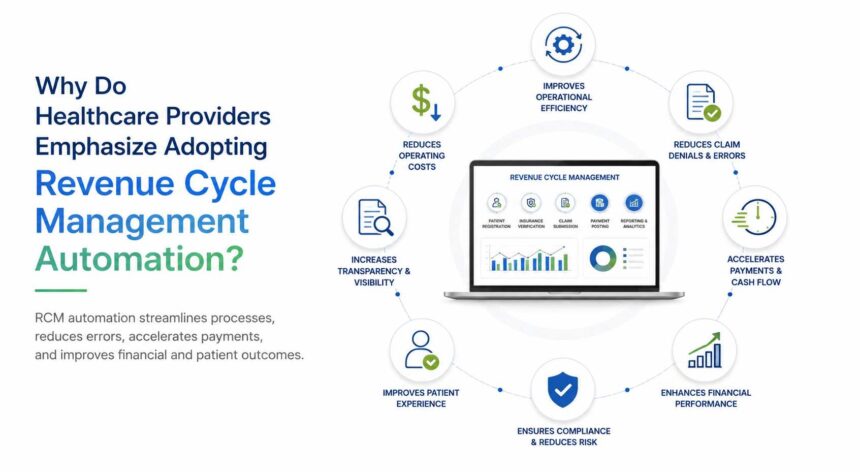
Managing healthcare finances is not just about keeping records but also about ensuring the entire revenue cycle runs smoothly. Yet manual systems create fragmented workflows and incur high costs. Healthcare revenue cycle management software is a smart approach to handling the entire RCM process. Revenue cycle management automation replaces slow processes with faster reimbursements and eliminates recurring denial issues, which drives healthcare organizations to adopt the technology.
Real Impacts of Automation in Improving RCM Efficiency
Revenue cycle management in healthcare is shifting from basic task-based rules to AI-driven processes to keep the work end-to-end encrypted. The transformation is powered by technology to reduce providers’ administrative burden, allowing them to deliver quality care. Automation improves RCM efficiency by
- Reducing the denial rate and making claim submission efficient in one go.
- Transparency in financial performance.
- Customized solutions according to billing system needs.
- Faster submission and reimbursement.
In addition, partnering with a revenue cycle management company is a beneficial step for better revenue. Challenges can be tracked and overcome using advanced algorithms to stay up to date with the latest medical billing trends. Furthermore, developed automation improves efficiency in healthcare revenue cycle management and empowers teams to operate each step with more accuracy.
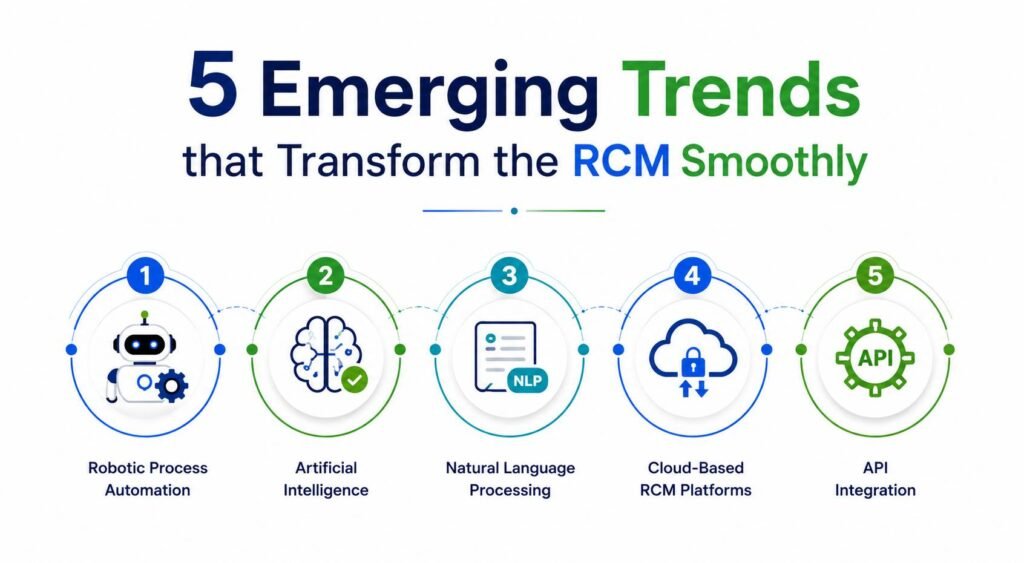
5 Emerging Trends that Transform the RCM Smoothly
Automated medical revenue cycle management accelerates data processing and streamlines the RCM process. Pairing automation with RCM from the initial step, scheduling, to the final payment speeds up cash flow and overall operational efficiency.
The transformation of modern RCM is driven by 5 key AI tools that are trending to automate revenue cycle management in healthcare.
Robotic Process Automation
Robotic healthcare management revenue cycle handles basic tasks like extracting information, tracking claim progress, and handling EOBs. It mimics human actions and acts like a digital assistant that handles repetitive tasks.
Artificial Intelligence
AI learns patterns and predicts denials and suggests improvements before sending them to the payer system.
Natural Language Processing
NLP converts treatment details into a structured, understandable format. Claims have NLP that includes codes to explain the overall process to streamline the workflow.
Cloud-Based RCM Platforms
Cloud-based RCM expands access to the system from anywhere, at any time, accelerating reimbursements. Physician credentialing and patient insurance eligibility checks play a crucial part in the reimbursement process. The physician credentialing services and insurance verification are also done electronically from cloud-based platforms.
API Integration
API integration connects software to exchange data for faster RCM without human intervention.
Revolution of Automation That Strengthens the RCM Process
Healthcare revenue cycle management automation addresses errors in the billing process and connects clinical care to reimbursement, enhancing the overall net collection rate. Manual RCM often leads to errors that can result in significant revenue loss. The healthcare revenue cycle management process strengthens the whole process with a 90% accuracy rate.
Front-end Tasks and Scheduling
AI automation enhances the front-end tasks, particularly patient data entry and verification. Revenue cycle management automation schedules appointments, streamlines initial operational tasks, and reduces the risk of claim denial.
Insurance Verification
Old methods can take days, but automation not only reduces verification time but also automatically checks deductibles and co-pays with a single click.
Prior Authorization For Patients
Prior authorization requires document analysis and validation, which are lengthy, manual processes. Automated healthcare revenue cycle management systems hasten the authorization process and ensure patient care is not delayed.
Charge Capture and Coding
Automation ensures that the bill uses the correct NLP for the claims. Medical codes with required modifiers ensure compliance with complex billing guidelines, reducing undercoding and overcoding.
Claim Submission
Revenue cycle management automation also submits claims in accordance with specific payer rules. It complies with all regulators’ requirements regarding timely filing.
Denial Management
Once a claim is submitted, it can be accepted or rejected. The automated revenue cycle management denials automatically sends appeals and highlights errors, prompting replacement with accurate data and resubmission.
Patient Statement
AI software generates patient statements with calculated costs that are the patient’s responsibility. It streamlines patient intake and ensures transparency, providing patients with a trusted service.
Analytics and Reporting
AI generates final reports by performance indicators, KPI, and metrics. It helps providers understand their financial condition to take action to close loopholes.
These steps in healthcare revenue cycle management can now be handled more efficiently through automation. Benefits of automation in RCM yield measurable results that support accuracy and compliant coding.
6 Key Benefits of Automated RCM in Healthcare
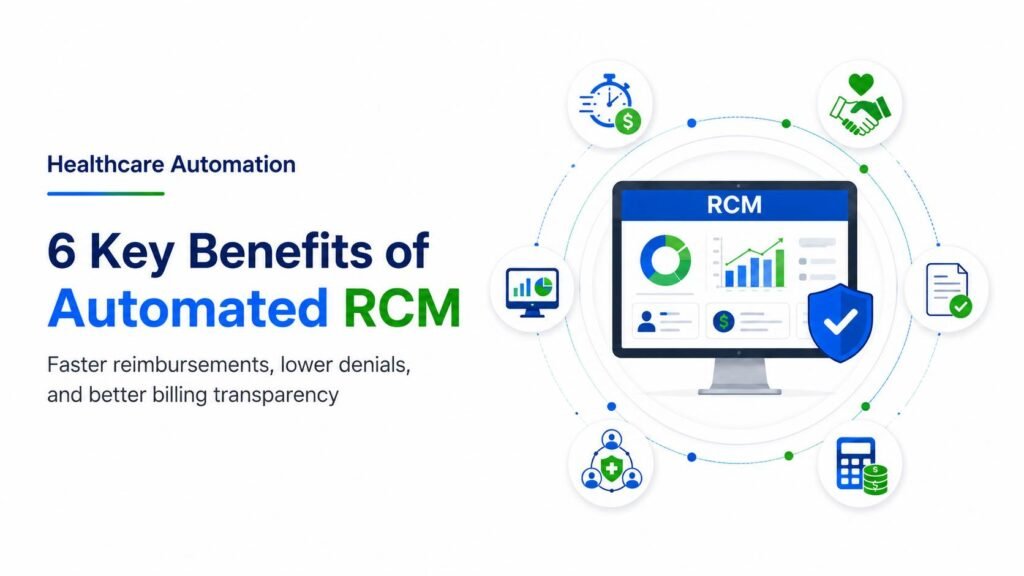
RCM is the backbone of healthcare billing, and an efficient system strengthens it. Electronic optimization of revenue strategies protects organizational margins and reduces traditional errors. Integrating AI-driven automation revenue cycle management benefits the finances and care services in the long term.
- Faster claim reimbursement allows providers to receive payment for their rendered services promptly.
- Automation offers practical financial solutions that build trust between entities, thereby attracting more patients.
- Healthcare revenue cycle management analytics bring transparency to the overall billing system.
- The denial claim rate is reduced, which means less rework cost.
- Claim complexities involving multiple payers or providers are addressed based on prior data.
- Cost-effective compared to manual staffing, operational space, and continuous training expenses.
Multiple Pain Points of Reimbursement that Automated Revenue Cycle Management Handles
Organizations may encounter challenges in adopting automated medical billing in 2026. Healthcare providers should also consider the cons before implementing electronic healthcare revenue cycle management solutions. These challenges are not new, but intensified and demand attention to perform better.
- Advanced automation in revenue cycle management requires a license, implementation costs, and vendor assistance that are difficult for small providers to afford.
- Without proper integration, the billing system collapses, which is why providers have to install a complete system, which is costly, especially for small practitioners.
- Without trained staff, advanced tools can fall short in creating an effective billing network.
- Cybersecurity and data breach issues arise that need to be tackled.
5 Practical Strategies That Commit to Long-Term Profits
Strategies are followed according to the roadmap for effective RCM implementation. Organizations adopt best practices for automating revenue cycle management in healthcare according to the challenges they face. Here are some strategies that can work for all providers.
| Step | Description |
|---|---|
| Integrate According to the System | No provider can deny the importance of revenue cycle management in healthcare. Before integrating automation, evaluate vendor technologies to ensure they align with your system requirements and operational needs. |
| Monitor and Test Before Setup | Start with low-risk programs, such as testing automation on a single claim. Monitor performance and results, and expand implementation only if it improves efficiency and profitability. |
| Create Clear Policies | Ensure the billing system is organized and managed according to standard policies. Clear processes help maintain data accuracy, consistency, and reliable revenue cycle operations. |
| Train Employees | Implementing automation in healthcare revenue cycle management requires hands-on employee training and clear communication to create a productive and effective work environment. |
| Conduct Audit | Review existing billing processes and revenue collections to identify gaps, errors, and weaknesses. Use audit findings to apply automation solutions and improve decision-making quality. |
Future of Revenue Cycle Management Automation
The impact of automation will be clearly visible in the upcoming years. Its adoption rapidly increased after the COVID-19 outbreak. Medical billing became more complex after the pandemic. Automated systems in medical RCM deliver transparent, valuable outcomes, such as customized solutions, error-free billing, and data-driven financial decisions to build a financially healthier future.
Disclaimer
“The article holds educational and informative content, not a substitute for medical billing expert consultation. Each organization implements automated RCM in accordance with its billing requirements. As a clinical care provider or as an organization, if you are losing revenue and facing difficulty in decisions to recover from financial strain, then consult an expert medical billing company for customized solutions for your care programs.”