

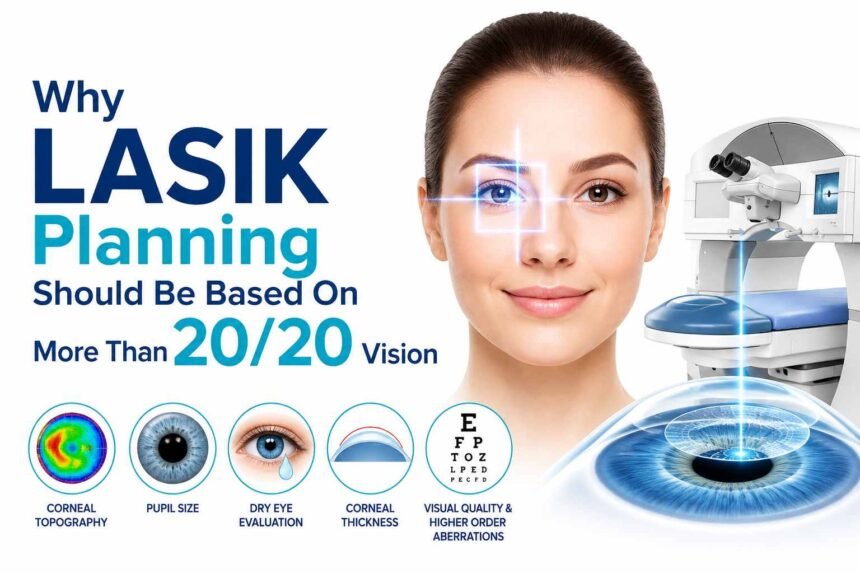
Patients often describe their goal for laser vision correction in one simple phrase: they want 20/20 vision. That is understandable. A clear eye chart result is easy to measure, easy to explain, and easy to imagine.
But LASIK planning should look beyond that single number.
For people researching LASIK eye surgery in Houston, the more important question is not only whether LASIK can reduce dependence on glasses or contacts. It is whether the procedure can be planned around the full optical profile of the eye. Amjad Khokhar, M.D., F.A.A.O., from Houston LASIK & Eye, explains that modern refractive surgery planning should consider not just the standard prescription, but also corneal shape, tear film, pupil behavior, and subtle optical imperfections that may affect visual quality.
That is where wavefront-guided LASIK enters the conversation. It uses detailed measurements of how light travels through the eye to guide a more individualized laser treatment plan. Still, “individualized” does not mean automatic, risk-free, or right for every patient. The best LASIK plan starts with careful testing and realistic expectations.
Clear Vision And Quality Vision Are Not Always The Same
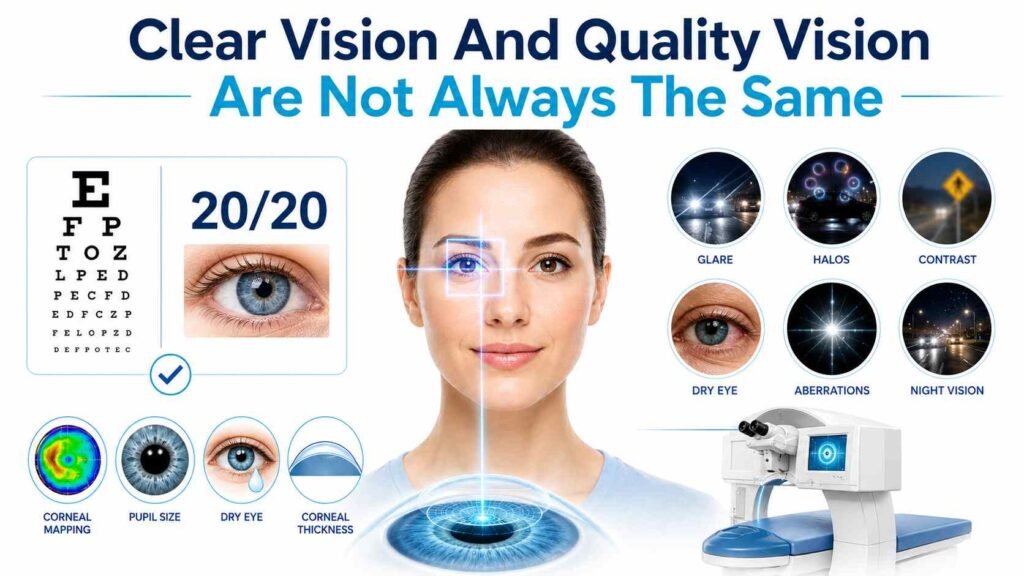
A standard vision test measures how well a person can read letters at a set distance. That is useful, but it does not capture every part of how vision feels in daily life.
Someone may read 20/20 on an eye chart and still notice glare around headlights, halos at night, reduced contrast in dim rooms, or visual fatigue after long screen use. Many factors, including dry eye, pupil size, corneal irregularity, lens changes, and optical aberrations, can influence these symptoms. The FDA’s LASIK checklist specifically asks patients to understand possible visual symptoms such as glare, halos, starbursts, difficulty driving at night, and reduced contrast sensitivity before surgery.
The FDA explains that refractive errors happen when the shape of the cornea and the eye does not focus light correctly on the retina. LASIK changes the focusing power of the cornea by removing corneal tissue with a laser. That means the laser plan should be based on accurate measurements of the eye’s optics and anatomy.
Traditional prescriptions mainly describe lower-order refractive errors: nearsightedness, farsightedness, and astigmatism. Those are the familiar numbers in glasses or contact lens prescriptions. They matter, but they are not the whole visual story.
Visual quality also depends on how cleanly light focuses after those basic refractive errors are addressed. This is why a patient can have “clear enough” vision in bright daylight but still struggle with night-driving quality, glare, or contrast. For LASIK planning, the goal is not simply to chase a line on a chart. It is to understand what may affect the way the patient sees in real conditions.
That distinction matters because patients often judge success by their day-to-day experience, not just by the number recorded after surgery.
What Higher-Order Aberrations Can Reveal About The Eye
Higher-order aberrations are subtle optical imperfections that are not usually addressed by an ordinary glasses prescription. They can affect how light bends as it passes through the eye, especially in low-light conditions when the pupil becomes larger.
Common examples include coma, trefoil, and spherical aberration. Patients do not need to memorize those names, but they should understand the concept. These irregularities may be part of the visual-quality discussion when a patient reports glare, halos, starbursts, reduced contrast, or less crisp vision in certain lighting conditions.
Wavefront measurement helps identify these imperfections by analyzing how light travels through the eye, not just how well someone reads an eye chart. Instead of only measuring the standard prescription, the scan creates a more detailed map of visual distortions. That map can then be used to help guide a customized laser treatment plan.
This does not mean every higher-order aberration can be perfectly removed. It also does not mean wavefront-guided LASIK is automatically superior for every patient. Healing, tear-film stability, corneal regularity, laser alignment, and patient selection all matter.
A 2021 article in Eye noted that wavefront-guided laser vision correction adds an individualized element by targeting measured higher-order aberrations before surgery. It also emphasized that evidence comparing wavefront-guided and wavefront-compensated approaches can be difficult to interpret because laser platforms, optical zones, tracking, and treatment planning have changed over time. In other words, optical quality is measurable, but it is not controlled by one technology alone.
That is why higher-order aberration testing should be viewed as part of a larger evaluation, not as a marketing label.
How Wavefront-Guided Treatment Uses Detailed Measurements
Wavefront-guided LASIK begins with diagnostic mapping. A wavefront system measures how light passes through the eye and compares that pattern with the way light would move through an ideal optical system. The difference between those patterns helps reveal subtle distortions.
This information can be used to create an individualized ablation profile. “Ablation” means the precise laser removal of corneal tissue. In standard terms, LASIK reshapes the cornea to improve how light focuses on the retina. In wavefront-guided treatment, the laser plan can be informed by the patient’s measured optical pattern, not only by the glasses prescription.
That approach may matter for patients whose visual complaints include more than blur. Someone with night-driving difficulty may have a different planning discussion than someone whose main concern is daytime distance vision. A patient with a high prescription, large pupils, dry eye, or irregular corneal findings may need a more cautious evaluation before LASIK is recommended at all.
The key point is that wavefront-guided LASIK is not just a more technical name for ordinary LASIK. It is a planning approach that uses a more detailed visual profile. That profile can help the surgeon understand how the eye behaves optically before choosing the treatment pattern.
Still, the technology depends on good data. If the eye surface is dry or unstable, measurements may be less reliable. If the cornea is too thin or irregular, LASIK may not be the right option. If the prescription is changing, surgery may need to wait.
Better measurement can improve planning, but it also helps identify when a different option should be considered.
Why The Best LASIK Plan Starts With A Complete Evaluation
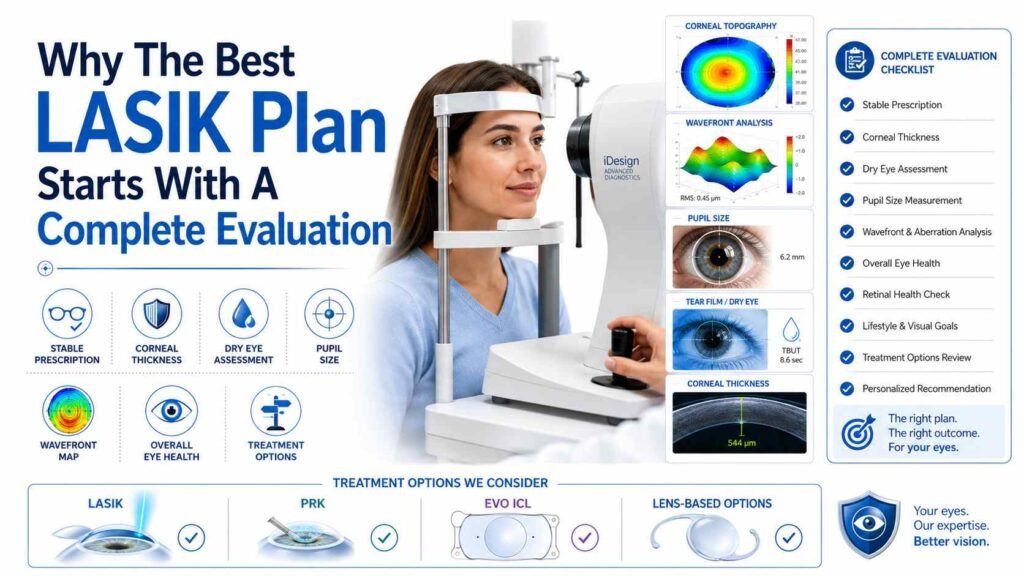
A complete LASIK evaluation should be more thorough than a routine vision exam. The FDA’s LASIK checklist asks patients to consider stable refraction, high or low refractive error, pupil size, corneal thickness, tear production, medical conditions, eye conditions, and recovery expectations before surgery. These are not minor details. They help determine whether LASIK is appropriate and how the treatment should be planned.
For wavefront-guided LASIK, the evaluation should also confirm that the measurements are consistent and useful. The clinical team may review corneal mapping, wavefront analysis, tear-film status, pupil behavior, prescription stability, and overall eye health. If dry eye is present, it may need treatment before final measurements are trusted. If corneal mapping shows irregularity, the recommendation may change.
This is especially important because not every person seeking LASIK is best served by LASIK. Some patients may be better candidates for PRK, EVO ICL, refractive lens exchange, or another approach depending on anatomy, prescription, and eye health. A customized plan should include that possibility.
For readers considering laser vision correction, useful questions include:
- What does my wavefront map show beyond my glasses prescription?
- Are my measurements stable and repeatable?
- Do I have dry eye that should be treated first?
- Is my cornea thick and regular enough for LASIK?
- Would PRK, EVO ICL, or another procedure be safer or more appropriate?
- What visual symptoms could still occur after surgery?
At Houston LASIK & Eye, the practice describes an iLASIK planning approach that uses blade-free flap creation, wavefront mapping, iris registration, and eye-tracking technology to support a customized treatment plan. Its refractive decision pathway may also include LASIK, PRK, EVO ICL, refractive lens exchange, or laser cataract surgery, depending on corneal thickness, prescription range, lifestyle, and ocular surface health.
That type of planning matters because 20/20 vision is only one part of the goal. Patients also care about night driving, contrast, comfort, visual stability, and whether the procedure chosen truly fits their eyes.
Medical disclaimer: This article is for educational purposes only and does not replace a medical examination, diagnosis, or individualized surgical advice from an ophthalmologist or qualified eye care professional. Anyone considering LASIK or another refractive procedure should have a full eye evaluation and discuss personal risks, benefits, and alternatives with their doctor.