


If you are naturally thin, people often say you are lucky. You can eat more, stay slim, and never worry about fat gain. But when your goal is muscle growth, being lean can feel like a constant struggle.
You train hard, eat more than before, and still look the same. This article explains why lean people can’t build muscle easily and what actually works based on real experience, not gym myths.
Why Lean People Can’t Build Muscle Easily
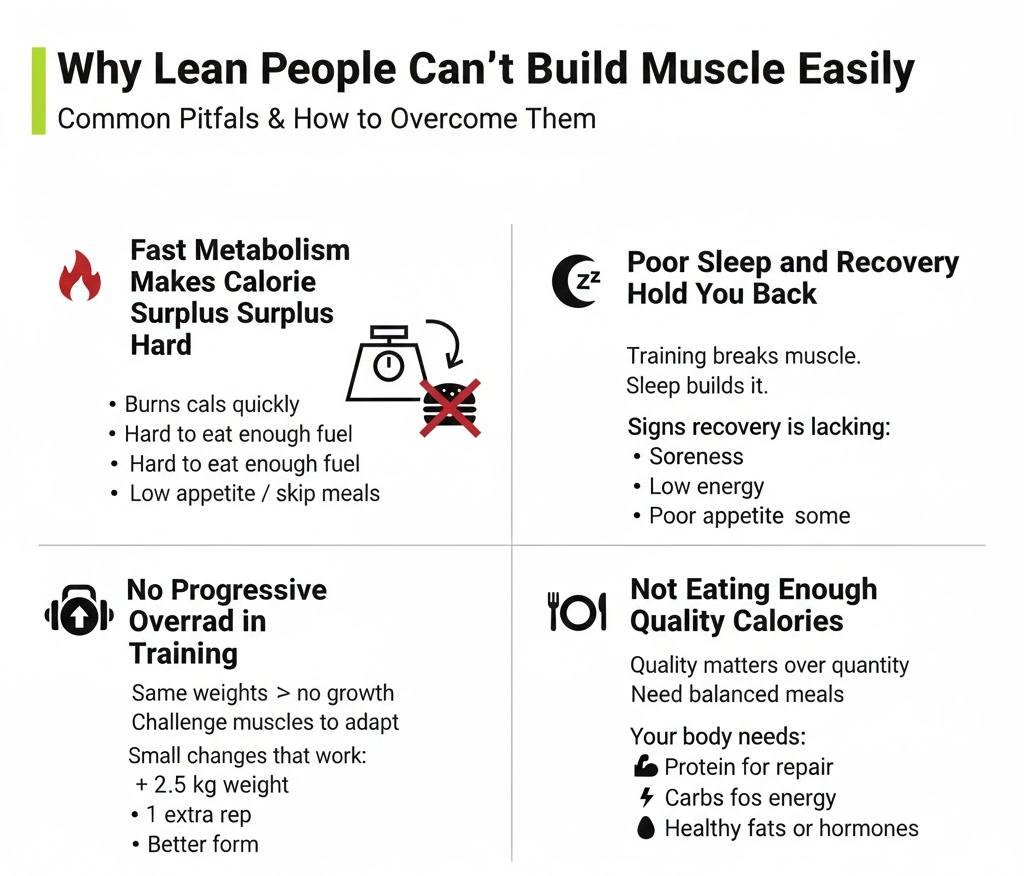
Fast Metabolism Makes Calorie Surplus Hard
One primary reason lean people can’t build muscle is a fast metabolism. Your body burns calories quickly, even when you are resting. That makes it challenging to stay in a calorie surplus, which is essential for muscle growth.
Many lean people think they eat enough, but once calories are tracked, they are often eating less than needed. Appetite tends to be lower, and missing meals happens more often than they realize.
If your weight stays the same for weeks, your body is not getting enough fuel to grow.
Poor Sleep and Recovery Hold You Back
Training breaks muscle. Recovery builds it. If recovery is poor, muscle growth stops.
Lean people often train hard but sleep less. Late nights, phone use before bed, or stress keep the body from fully recovering. Over time, this leads to fatigue and even weight loss.
Some people find that ZMA supplements help improve sleep quality and recovery, especially if they struggle with restlessness at night. While supplements are not mandatory, better sleep almost always leads to better muscle gains.
Signs recovery is lacking:
- Constant soreness
- Low energy during workouts
- Poor appetite
No Progressive Overload in Training
Another big reason lean people can’t build muscle is repeating the same workout with the same weights.
Your muscles only grow when they are challenged. Lifting the same weight for months gives your body no reason to adapt.
Progressive overload can be simple:
- Add 2.5 kg to a lift
- Do one extra rep
- Improve form and control
Minor improvements add up over time.
Not Eating Enough Quality Calories
Calories matter, but food quality matters too. Lean people sometimes rely on random snacks or skip balanced meals.
To build muscle, your body needs:
- Protein for repair
- Carbohydrates for training energy
- Healthy fats for hormones
Without these, your body uses calories to function, not to grow muscle.
What Actually Works for Lean People
Lift Heavier With Focus
Strength training is essential. Cardio alone will not help lean people gain muscle.
Focus on compound exercises:
- Squats
- Deadlifts
- Bench press
- Rows
- Pull ups
- Overhead press
These exercises activate more muscle fibers and create a stronger growth signal.
If a weight feels easy for more than 12 reps, it is likely too light for muscle gain.
Eat More Without Forcing Huge Meals
When lean people can’t build muscle, eating more often works better than eating large meals.
Instead of 2 or 3 meals, aim for 4 or 5 smaller meals spaced throughout the day.
Helpful habits:
- Eat every 3 hours
- Add calories to meals you already eat
- Drink calories when solid food feels heavy
Smoothies are a great option because they are easy to consume and digest.
Increase Calorie Density the Smart Way
You do not need to eat massive portions. You need more calories.
Adding calorie-dense foods helps you eat more without feeling uncomfortable.
Good options include:
- Nut butters
- Oats
- Paneer
- Rice
- Olive oil
If eating enough food feels difficult, weight gain powder can help bridge the gap. It works best when used alongside meals, not as a replacement for real food.
Train Less, Recover More
Many lean people think training every day will speed up muscle growth. In reality, it often slows it down.
A better approach:
- Train 3 to 4 days per week
- Rest for at least one day between intense sessions
- Focus on quality sets, not exhaustion
Muscle grows when you recover, not when you are constantly sore.
Track Progress and Adjust
When lean people can’t build muscle, guessing does not work. Tracking does.
Track:
- Body weight weekly
- Strength numbers
- Energy levels
- Sleep quality
If your weight is not increasing by around 0.25 to 0.5 kg per week, you likely need more calories.
Example
A naturally lean client trained for nearly two years with little progress. He believed genetics was the problem.
We made three changes:
- Increased daily calories
- Reduced training days
- Focused on progressive overload
In four months, he gained visible muscle and strength. Nothing magical changed. The approach did.
Common Mistakes Lean People Make
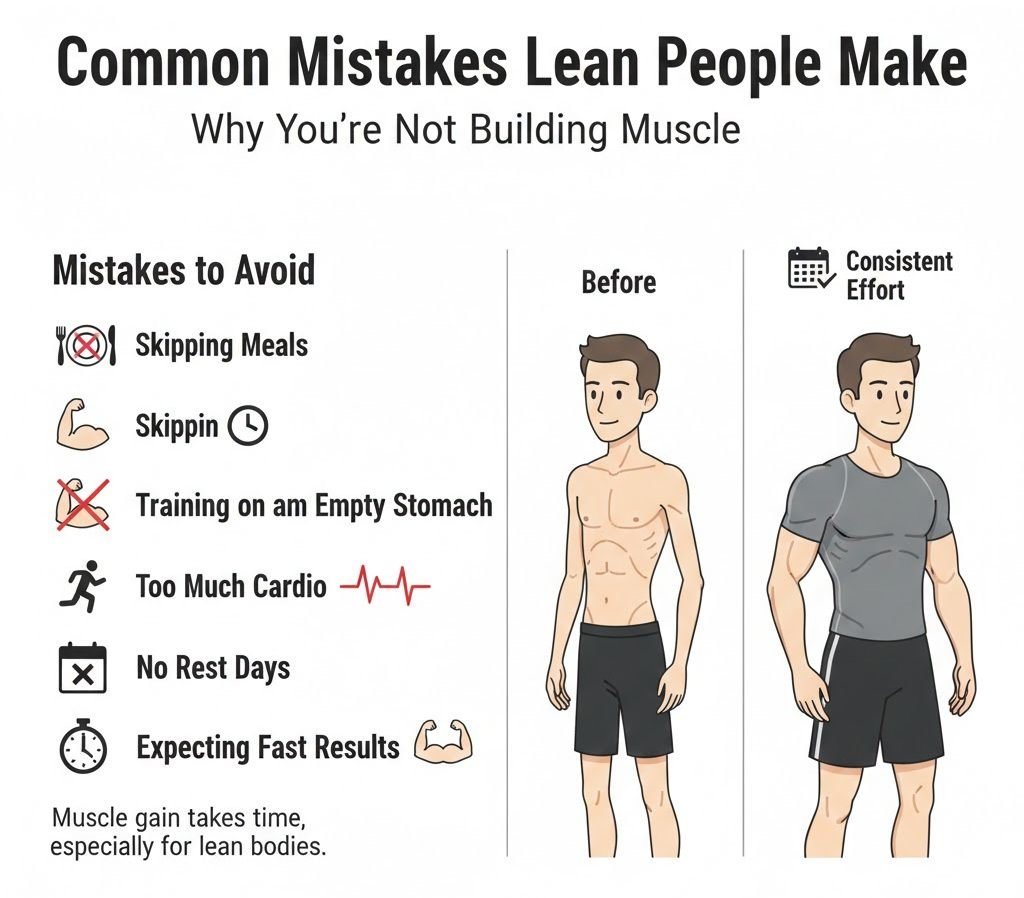
If lean people can’t build muscle, these habits are often the reason:
- Skipping meals
- Training on an empty stomach
- Too much cardio
- No rest days
- Expecting fast results
Muscle gain takes time, especially for lean bodies.
Final Thoughts
Lean people can’t build muscle easily, but they absolutely can build muscle with the right strategy.
Focus on:
- Progressive strength training
- Consistent calorie surplus
- Quality sleep and recovery
- Clever use of supplements when needed
Stay patient and consistent. Once lean bodies start gaining muscle, the results tend to last and look athletic rather than bulky.
Disclaimer
This article is for educational and informational purposes only. It is not a substitute for medical advice, diagnosis, or treatment. Always consult a qualified doctor, registered dietitian, or certified fitness professional before starting any new exercise program, supplement, or significant dietary change, especially if you have existing health conditions or injuries. Individual results may vary based on genetics, lifestyle, training history, and consistency.
References
Phillips, S. M., & Van Loon, L. J. C. (2011)
- Dietary protein for athletes: From requirements to metabolic advantage.
- Applied Physiology, Nutrition, and Metabolism, 36(5), 647–654.
- This research explains how protein intake supports muscle repair and growth, especially in resistance training populations.
Morton, R. W., et al. (2018)
- A systematic review, meta-analysis, and meta-regression of the effect of protein supplementation on resistance training induced gains in muscle mass and strength.
- British Journal of Sports Medicine, 52(6), 376–384.
- Provides evidence that muscle gain depends on sufficient calorie and protein intake, not supplements alone.
Schoenfeld, B. J. (2010)
- The mechanisms of muscle hypertrophy and their application to resistance training.
- Journal of Strength and Conditioning Research, 24(10), 2857–2872.
- Explains progressive overload, training volume, and why lifting heavier over time is essential for muscle growth.
Dattilo, M., et al. (2011)
- Sleep and muscle recovery: Endocrinological and molecular basis for a new and promising hypothesis.
- Medical Hypotheses, 77(2), 220–222.
- Supports the role of sleep quality and recovery in muscle repair and hormonal balance, relevant to discussions on recovery and ZMA supplements.
Slater, G., & Phillips, S. M. (2011)
- Nutrition guidelines for strength sports: Sprinting, weightlifting, throwing events, and bodybuilding.
- Journal of Sports Sciences, 29(S1), S67–S77.
- Covers calorie surplus, nutrient timing, and practical strategies for lean individuals trying to gain muscle mass.