


AI agents are moving healthcare past scripted chatbots: they finish tasks instead of just answering questions. Below are seven places where hospitals and clinics already use them, and what each one changes for patients and staff.
The difference is easy to see. A chatbot tells a patient the clinic’s hours; an agent books the appointment, checks coverage and updates the chart.
1. Patient intake and triage

Static intake forms ask every patient the same questions, then leave staff to sort the answers. An intake agent runs the process as a conversation instead.
It asks about symptoms, history, medications and allergies, and changes its follow-up questions based on each answer. When it finishes, it routes the patient to the right provider, visit type and care pathway, then writes a summary into the EHR before the visit.
Concurrence builds agents for this step that connect to Epic, Oracle Cerner and athenahealth over HL7v2 and FHIR. The company reports cutting staff time on manual intake by more than 80%, with anything sensitive or complex passed to a staff member along with the full conversation.
2. Scheduling and front-desk calls
Phone lines are where patient access breaks first: long holds, missed calls after hours and callers who give up and book elsewhere. Scheduling agents answer every call, check open slots and confirm the booking before the caller hangs up.
Hyro, a conversational AI company built for health systems, handles this work across voice, chat and SMS. At Intermountain Health, Hyro says its agents automated 44% of repetitive calls and cut call abandonment by 85%.
Smaller groups use the same approach. The Care Clinic, a behavioral health practice with 34 locations, runs inbound scheduling through a voice agent that checks insurance eligibility, shares copay details and writes the booking into its EHR around the clock.
3. Pre-visit preparation
Clinicians often open a visit by piecing together history from scattered notes. A pre-visit agent does that work ahead of time.
A day or two before the appointment, it confirms the visit, collects missing forms and asks what the patient wants to discuss. It then assembles a short summary from the chart, recent labs and the patient’s answers, so the clinician walks in with context instead of a blank screen.
4. Post-discharge follow-up and chronic care outreach
The days after a hospital stay are when patients most often slip through the gaps: a prescription never filled, a symptom nobody heard about, a follow-up never booked. Outreach agents call patients on a set schedule and escalate anything concerning to a nurse.
Hippocratic AI focuses on this kind of non-diagnostic, patient-facing work. Its voice agents handle discharge follow-ups, chronic care check-ins and medication education, and the company says they have been validated by more than 7,500 licensed clinicians.
5. Between-visit support and medication adherence
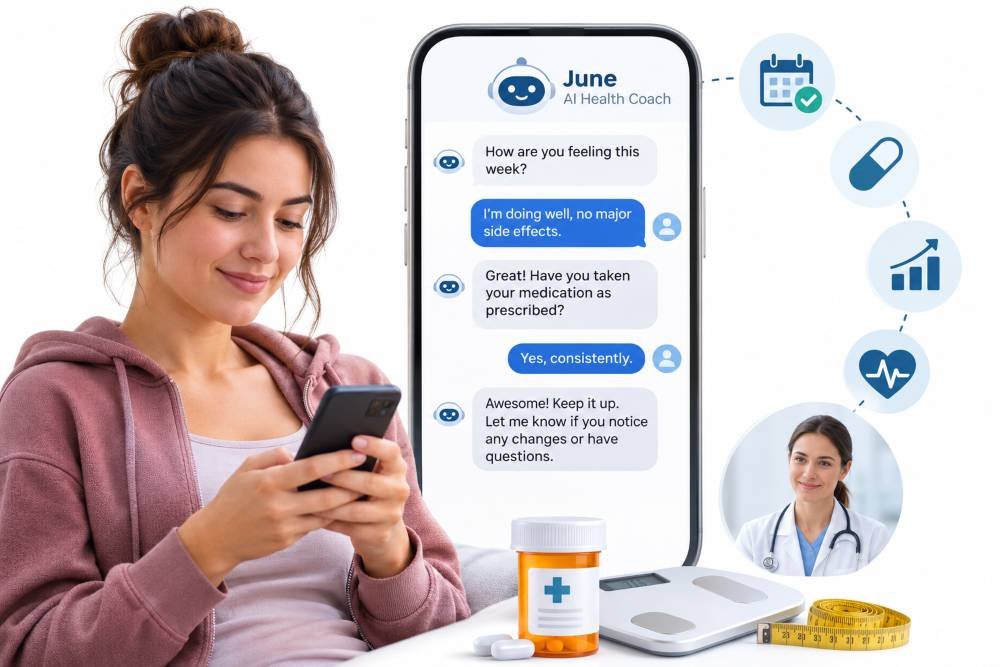
Most of a patient’s health plays out between appointments, where the care team cannot see it. Between-visit agents check in on adherence, side effects and progress, and remember what the patient said last time.
Hims & Hers built June, a health coach for patients of its Juniper weight-loss clinic, on this model. Before launch, Concurrence ran June through more than 140,000 simulated patient conversations, scoring each on clinical accuracy, empathy and correct escalation. In live use, June now handles over 98% of conversations without passing them to a human coach.
6. Referral management
Referrals still arrive by fax and PDF, and many never become a booked visit. A referral agent reads each incoming document, pulls out the patient details, diagnosis and requested service, and flags anything missing. Accuracy at this step decides everything downstream, which is why teams test to pick the most accurate API for parsing faxed and scanned referrals before they automate the rest.
It can then contact the patient to schedule, request missing records from the referring office and keep the order’s status current. The referral coordinator works the exceptions instead of every file.
7. Clinical documentation
Ambient scribes are the agents most clinicians have already met. With the patient’s consent, the agent listens to the visit and drafts the note for the clinician to review and sign.
The time saved is the obvious win, but the bigger change is attention: the clinician looks at the patient instead of the keyboard. A multi-site study in JAMA Network Open found burnout among ambient scribe users fell from 51.9% to 38.8% after 30 days, alongside lower cognitive load and less time spent documenting. Newer agents also draft referral letters, orders and after-visit instructions from the same conversation.
What to check before you deploy
The use case matters less than how the agent behaves on its worst day. Four questions separate a pilot that scales from one that stalls:
How was it tested? Ask how many simulated or supervised conversations the agent passed before it met a real patient, and how edge cases were covered.
Where does it hand off? It needs clear rules for passing clinical questions, urgent symptoms and safety disclosures to a person, with context attached.
Does it write back to the EHR? An agent that only reads creates a second inbox. Look for two-way HL7v2 or FHIR integration.
What compliance is in place? HIPAA is the baseline; SOC 2 Type II and HITRUST show the controls have been audited.
Where this goes next
Most organizations start with one high-volume workflow, usually scheduling or intake, and expand once the numbers hold. The next step is agents that share context, so the intake conversation shapes the pre-visit summary and the follow-up call. Healthcare will still need people at every step; agents give them back the hours spent on work a system can do.