

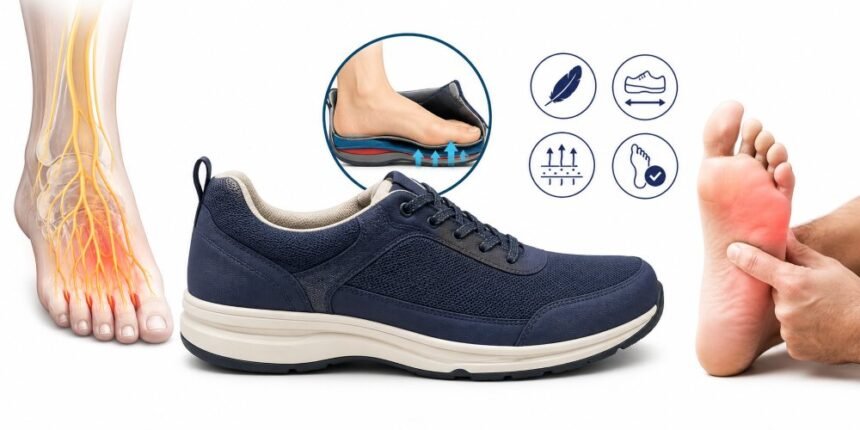
Buying shoes becomes a different task when your feet cannot reliably warn you that something is wrong.
A person with peripheral neuropathy may feel burning, tingling, or sharp sensitivity. Another person may feel very little at all. In both cases, a shoe can create pressure, rubbing or instability long before the wearer realises there is a problem.
The National Institute of Neurological Disorders and Stroke explains peripheral neuropathy as damage affecting the nerves outside the brain and spinal cord. Depending on the nerves involved, it can interfere with sensation, movement and balance.
That is why neuropathy-friendly footwear should not be judged by softness alone. A useful shoe needs enough room, but it must also hold the heel securely. It needs cushioning, but not so much that the foot feels unstable. It should accommodate swelling or an orthotic without becoming loose and sloppy.
This guide compares eight footwear brands and specialists that may suit men with sensitive, numb, swollen, or difficult-to-fit feet. No company is automatically right for every person, so individual shoe specifications and professional fitting advice still matter.
Why Neuropathy Changes the Way You Should Buy Shoes
Most people stop wearing a shoe when it hurts. That simple warning system may not work properly when sensation is reduced.
The NHS guide to peripheral neuropathy symptoms lists numbness, pins and needles, burning pain, reduced temperature awareness and balance problems among the possible symptoms. These issues can make it harder to judge whether a shoe is rubbing, pressing on a toe or allowing the foot to slide.
Someone with painful sensitivity may reject a stiff seam immediately. Someone with numbness may continue walking on the same seam for hours without noticing it. Both people need protection, but their fitting priorities may be slightly different.
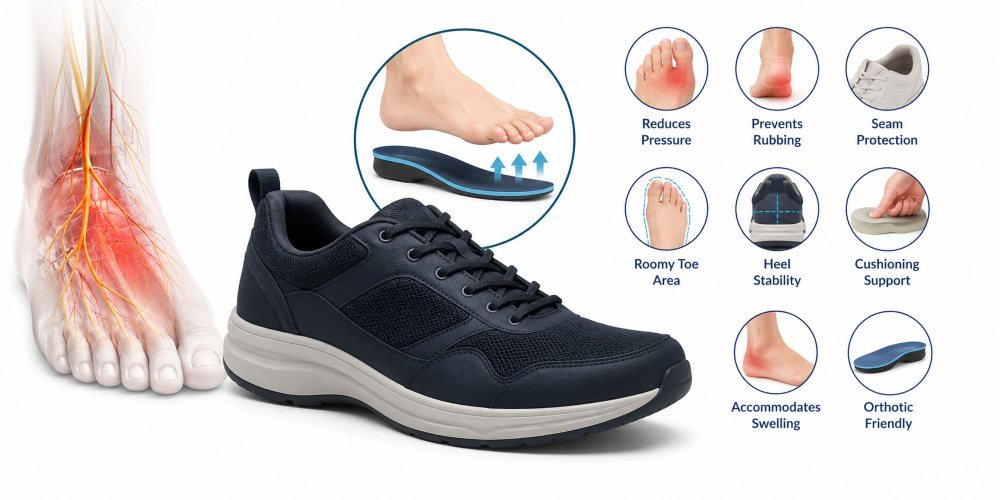
A neuropathy-friendly shoe should help reduce avoidable mechanical problems such as:
- Pressure across the toes
- Rubbing around the heel
- Contact with rough seams
- Sliding inside an oversized shoe
- Instability from an excessively soft sole
- Compression caused by daily swelling
- Crowding after an orthotic is added
- Pressure over bunions, hammertoes or prominent joints
Shoes cannot repair damaged nerves. Their purpose is to create a safer and more controlled space around the foot.
Fit Features That Matter Most
Marketing terms such as “comfort shoe” and “orthopaedic support” are not enough. Look at the construction of the individual model.
A Toe Box That Is Wide and Deep
Width and depth are not the same measurement.
A foot may be wide across the forefoot but average in height. Another foot may need more vertical space because of swelling, hammertoes, an orthotic, or a prominent joint.
Buying a longer shoe does not solve either problem. Extra length can cause the heel to lift and the foot to slide. The toes gain space, but stability becomes worse.
The goal is enough room around the toes without losing control at the back of the shoe.
A Heel That Stays in Place
A roomy front should not mean a loose heel.
Repeated heel movement can create friction, especially during longer walks. It may also make a person feel less secure when changing direction, using stairs or walking on uneven ground.
Check whether the model has:
- A shaped heel cup
- A supportive rear section
- Adjustable laces or straps
- Enough structure to resist side-to-side movement
Extra Depth With Removable Insoles
Custom orthotics and diabetic inserts take up space inside a shoe. Placing one on top of a fixed insole can push the foot upward, creating pressure over the toes or across the top of the foot.
A removable factory insole creates usable interior volume.
Some specialist shoes include more than one removable layer. This lets the wearer adjust depth without automatically moving to a longer size.
A Smooth Interior
Run your hand around the inside of the shoe before wearing it.
Check for:
- Raised stitching
- Hard joins between materials
- Rough labels
- Folded lining
- Exposed edges
- Small objects or packaging pieces
The NIDDK guidance on diabetes and foot problems recommends checking the inside of shoes and choosing properly fitting footwear with enough toe room. It also advises introducing new shoes gradually and inspecting the feet afterwards.
Stable Cushioning Rather Than Maximum Softness
A very soft shoe can feel pleasant for several minutes yet become tiring or unstable during a full day.
Men with reduced position awareness or balance difficulties may benefit from:
- A broad sole platform
- A firm heel base
- Controlled flexibility
- Reliable traction
- Cushioning that does not collapse excessively
The right balance depends on the person. Someone with significant balance problems may prefer a firmer platform than someone whose main concern is forefoot sensitivity.
Adjustable Closures
Feet may change volume between morning and evening. Fixed slip-on shoes do not always adapt well to that change.
Laces, hook-and-loop straps, and other adjustable systems can help accommodate mild swelling while keeping the heel secure. Easy-entry features can also be helpful for men with limited hand movement, but convenience should not come at the cost of fit.
Quick Comparison of the Eight Options
| Brand or Specialist Type | Best Suited To | Useful Characteristics | Main Point to Check |
|---|---|---|---|
| Specialist multi-brand retailer | Extremely wide or complex fits | Selected widths up to 14E, extra-depth options and orthotic space | Construction differs between brands |
| Orthofeet | Broad therapeutic choice | Wide toe boxes, stretch uppers and removable insoles | Shape and cushioning vary by line |
| Dr. Comfort | Traditional diabetic footwear | Extra-depth designs and smooth interior construction | Precise volume differs by model |
| Drew Shoes | Thick orthotics and high-volume feet | Multiple removable footbeds in selected styles | Some models feel firm or heavy |
| New Balance | Mainstream walking and athletic use | Familiar styling and several width choices | Not every model is neuropathy-friendly |
| Propet | Lightweight everyday wear | Adjustable closures and removable insoles | Stability differs across styles |
| Anodyne | Modern-looking diabetic footwear | Added depth, toe room and lightweight designs | Fit must take priority over appearance |
| Apis and Mt. Emey | Very wide feet, deformities or braces | Specialist widths and multi-depth construction | Careful fitting is essential |
DT Footwear — Best Specialist Selection for Extreme Widths
Standard “wide” and “extra-wide” shoes sometimes remain too narrow for severe swelling, broad forefeet, foot deformities or braces.
In these situations, a specialist retailer can offer a more useful starting point than a general shoe shop. DT Footwear carries selected men’s neuropathy footwear in widths extending to 14E, including extra-depth models designed for difficult fits, swelling and orthotic accommodation.
The main advantage is not simply the maximum width. It is the ability to compare several specialist manufacturers, closure systems and depth configurations in one place.
This may be particularly helpful for men who have been buying longer shoes because ordinary wide sizes feel tight. A true extended width can create forefoot space without adding unnecessary length.
The limitation is variation. A retailer may carry walking shoes, work footwear, boots, therapeutic shoes, and lightweight casual styles from different manufacturers. Their sole firmness, interior seams, heel structure and cushioning will not be identical.
Review each model rather than assuming every shoe in a neuropathy category provides the same level of protection.
Orthofeet for a Broad Therapeutic Collection
Orthofeet is often considered by men who want therapeutic features without moving immediately to a highly clinical-looking shoe.
Many models focus on a combination of:
- Spacious toe areas
- Stretchable upper materials
- Extra interior depth
- Removable insoles
- Cushioned walking soles
- Easy-entry or adjustable designs
Stretch uppers may be helpful when a rigid overlay presses against a bunion, hammertoe, or sensitive area. They can also accommodate small changes in foot volume more comfortably than stiff materials.
However, stretch should not be mistaken for unlimited fit. If the base of the shoe is too narrow, a flexible upper may stretch over the foot while the sole still creates pressure underneath.
Orthofeet offers many styles, which is both an advantage and a complication. One model may have a firmer walking platform, while another may feel softer or have a different heel shape. Check the exact width, depth, and insole arrangement of the shoe being considered.
Dr. Comfort for Traditional Diabetic Footwear
Dr. Comfort has a strong association with diabetic and therapeutic footwear.
Its range includes casual, walking, athletic, dress and work-oriented designs. This can be useful for men who need protective features in more than one part of daily life.
Common characteristics across selected models include:
- Added interior depth
- Removable insoles
- Softer linings
- Reduced internal friction
- Wider fitting options
- Structured support
The range may suit a person who wants footwear designed around medical fitting needs rather than a standard retail shoe that happens to come in a wide size.
The challenge is choosing the correct model. Two shoes carrying the same width label may have different toe shapes, heel volumes and upper materials.
A professional fitting is especially valuable when the wearer has previous ulceration, marked swelling, deformity, or a prescribed insert.
Drew Shoes for Extra Depth and Removable Footbeds
Drew Shoes is a practical option when the problem is not only width but interior volume.
Selected Drew models use multiple removable footbeds. Removing one or more layers can create space for a thick orthotic without forcing the foot against the top of the shoe.
This is useful because an insert changes more than arch support. It can raise the entire foot, alter heel position, and reduce toe-box height.
Drew footwear may be worth considering for men with:
- High-volume feet
- Thick prescribed orthotics
- Hammertoes
- Swelling
- A need for structured walking support
Some models have a more substantial build than ordinary casual shoes. That firmness can improve support, but men who prefer very light footwear may find certain styles heavier than expected.
Weight should be judged alongside stability. A lighter shoe is not automatically safer if it twists easily or fails to control the heel.
New Balance for a Mainstream Athletic Look
New Balance can be a useful option for men who want a familiar walking or athletic shoe rather than clearly therapeutic footwear.
The company offers several width choices in selected models, with some men’s footwear reaching 6E. Its broad availability also makes it easier to try different sizes in person.
Potential benefits include:
- Athletic styling
- Supportive heel construction in selected models
- Walking and running sole options
- Removable insoles in some shoes
- Multiple width choices
- Compatibility with certain orthotics
The important word is “selected.”
New Balance is a mainstream athletic brand, not a single therapeutic footwear line. Some models may have a narrow toe shape, stiff interior overlays, fixed insoles, or highly soft cushioning.
Do not buy by brand reputation alone. Check whether the individual shoe has the correct shape and construction for your foot.
A shoe can be available in 4E or 6E while still feeling wrong if its toe box tapers too early or its heel is too loose.
Propet for Lightweight Everyday Styles
Propet offers casual, walking, and everyday footwear that often looks less medical than traditional therapeutic shoes.
Many models include practical features such as:
- Removable insoles
- Wide and extra-wide sizing
- Adjustable straps
- Lightweight construction
- Flexible upper materials
- Easy-entry designs
This can make Propet attractive for routine errands, indoor use, or light daily walking.
The wide variety of styles means performance is not consistent across the whole range. A soft slip-on may behave very differently from a structured walking shoe.
Men with balance difficulties should pay close attention to outsole width, heel control and lateral stability. A shoe may feel light and comfortable while sitting but offer inadequate control during turns or longer walks.
Anodyne for Modern Diabetic Footwear
Anodyne aims to combine diabetic-footwear features with a more current appearance.
Selected models commonly focus on:
- Extra depth
- Removable insoles
- Protective toe space
- Adjustable closures
- Lightweight soles
- Softer interior materials
This balance may appeal to men who want footwear that does not immediately look clinical.
Appearance, however, should remain secondary to fit. A good-looking shoe is not useful if the heel moves, the toe box presses on a prominent joint, or the orthotic raises the foot too high.
When comparing Anodyne models, check both the listed width and the shape of the forefoot. A rounded toe area may suit one foot, while another person may need more vertical depth or a straighter inside edge.
Apis and Mt. Emey for Complex Fits
Apis and Mt. Emey are specialist options for men whose feet cannot be accommodated by ordinary retail footwear.
Selected styles are available in very wide fittings, including widths reaching 9E, 10E or 14E. Some designs also use multi-depth systems that create room for orthotics, swelling, braces or unusual foot shapes.
These shoes may be relevant for:
- Severe width requirements
- Significant foot-volume differences
- Ankle-foot orthoses
- Foot deformities
- Large or unusually shaped feet
- Thick custom inserts
Walking shoes, boots and other specialist styles may include more substantial fastening systems and reinforced construction.
The trade-off is appearance and weight. Some models look bulkier because they are built to create space and control a complex fit.
Careful measurement is essential. A very wide shoe can still be unsafe when it is too long or loose around the heel.
How to Match a Brand to Your Actual Problem
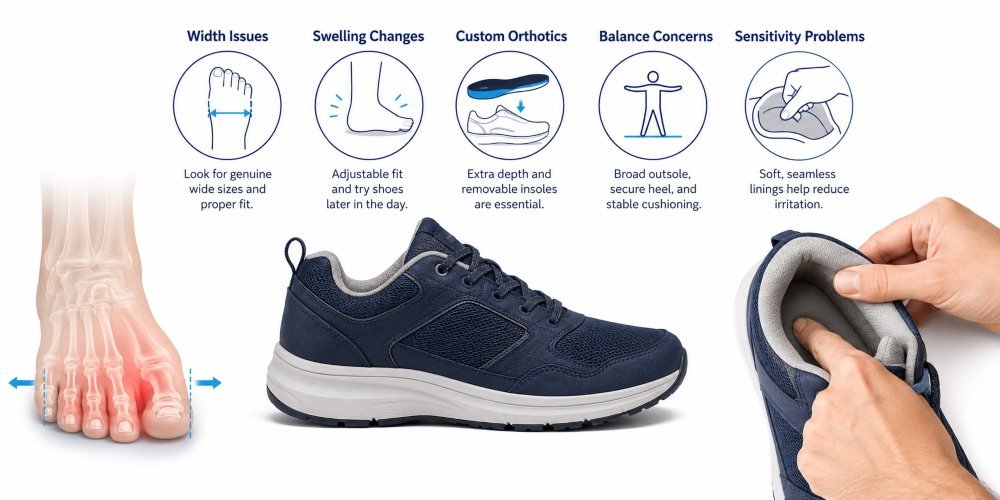
The most useful question is not, “Which brand is best?”
Ask, “What is making ordinary shoes fail?”
When Width Is the Main Problem
Look for genuine extended-width sizing rather than ordering a longer standard shoe.
Check where the foot is widest. Some men need space through the entire shoe, while others mainly need a broad forefoot with a comparatively narrow heel.
When Swelling Changes During the Day
Choose a closure system that can be adjusted without allowing the heel to move.
Try shoes later in the day, when swelling may be more noticeable. Wear the socks and inserts that will be used in daily life.
When You Use Custom Orthotics
Look for true extra depth and removable factory insoles.
Place the orthotic inside the shoe during fitting. Do not assume that a shoe described as “orthotic-friendly” will work with every insert thickness or shape.
When Balance Is a Concern
Prioritise a broad outsole, secure heel and controlled cushioning.
The American Podiatric Medical Association’s peripheral neuropathy advice recommends properly fitted shoes and avoiding barefoot walking to reduce the risk of injury.
Test shoes on a safe indoor surface. Pay attention to turning, stopping, standing from a chair, and walking at different speeds.
When Sensitivity Is the Main Concern
Inspect the lining closely.
A soft upper may help, but the whole interior matters. Feel around the tongue, toe box, heel and side panels for stitching or hard edges.
A Better Way to Test New Shoes
A quick walk around a shop is not enough when sensation is unreliable.
The MedlinePlus guidance on proper-fitting shoes notes that nerve damage can prevent a person from feeling a shoe rubbing against the skin.
Use a more deliberate fitting routine.
| Step | What to Check |
|---|---|
| Measure Both Feet | One foot may be longer, wider, or more swollen than the other. Fit the larger foot first, then adjust the smaller side if needed with professional advice. |
| Use Your Real Socks and Inserts | Test shoes with the socks and inserts you normally use, such as padded socks or custom orthotics, rather than thin shop socks. |
| Check the Interior by Hand | Feel inside the shoe for rough seams, labels, folds, or foreign objects before wearing it. |
| Check the Toes and Heel Separately | Toes: Need enough space to move without touching the front or sides. Heel: Should stay secure; extra toe space does not make up for heel slipping. |
| Introduce the Shoes Gradually | Wear new shoes indoors for a short period before using them for a full day. |
| Inspect Feet After Removal | Check for: • Redness • Blisters • Swelling • Scraped skin • Pressure marks • Changes in temperature or colour |
The CDC’s foot care guidance for people with diabetes recommends daily checks for cuts, redness, swelling, sores, blisters and other changes because nerve damage may reduce the ability to notice an injury.
Persistent redness, rubbing, or pressure marks are reasons to stop wearing the shoes and seek fitting advice.
Do Not Assume Diabetes causes all Neuropathy.
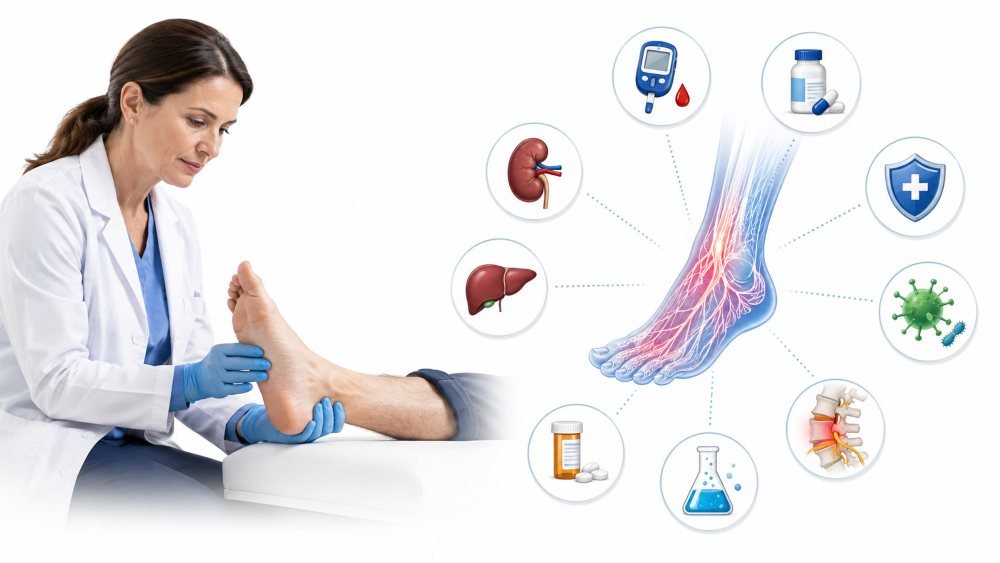
Diabetes is a common cause of peripheral neuropathy, but it is not the only one.
The Mayo Clinic overview of peripheral neuropathy causes also identifies autoimmune conditions, infections, inherited disorders, vitamin deficiencies, kidney or liver disease, certain medicines, toxins, and physical pressure on nerves as possible causes.
New or worsening numbness should therefore be medically assessed rather than managed only by changing shoes.
Footwear can reduce some external pressure and friction. It cannot identify or treat the cause of nerve damage.
When Therapeutic Footwear May Be Covered
Some people with diabetes may qualify for prescribed therapeutic shoes or inserts.
The Centers for Medicare and Medicaid Services therapeutic footwear guidance explains that coverage depends on medical criteria, documentation, and proper ordering. Qualifying conditions may include previous ulceration, foot deformity, poor circulation or peripheral neuropathy with callus formation.
Coverage rules can change and differ between health plans. Speak with the treating clinician, podiatrist, insurer and approved footwear supplier before purchasing on the assumption that a shoe will be reimbursed.
When to Speak With a Podiatrist or Doctor
Do not rely on online shoe shopping when there is an active foot problem.
Seek medical care for:
- An open wound or ulcer
- A blister that is not healing
- New redness, warmth or swelling
- Drainage or signs of infection
- Sudden changes in foot shape
- Increasing numbness
- New weakness or foot drop
- Skin colour changes
- Persistent pressure marks
- A shoe that suddenly stops fitting
- A history of ulceration or amputation
Shoes should support a medical foot-care plan, not replace one.
Final Buying Checklist
Before keeping a new pair, confirm that:
- The shoe matches the width of the foot rather than simply adding length.
- The toe box provides both horizontal and vertical room.
- The heel does not lift during normal walking.
- The outsole feels stable during turns and stops.
- The interior is free from rough seams and hard edges.
- The insole can be removed when an orthotic requires more depth.
- The closure can adapt to daily swelling.
- The shoe is tested with normal socks and inserts.
- Both feet are checked after each early wear.
- The individual model is suitable, not merely the brand name.
There is no single best neuropathy shoe for every man. The safest choice depends on width, depth, swelling, sensitivity, orthotics, balance, activity, and medical history.
The right shoe should not merely feel comfortable when first put on. It should continue protecting the foot after an hour of walking, during changes in swelling and at the end of an ordinary day.
Medical disclaimer: This article provides general footwear information and is not a diagnosis or treatment plan. Anyone with neuropathy, diabetes, circulation problems, foot deformity, previous ulceration, or an active wound should seek advice from a qualified healthcare professional.