

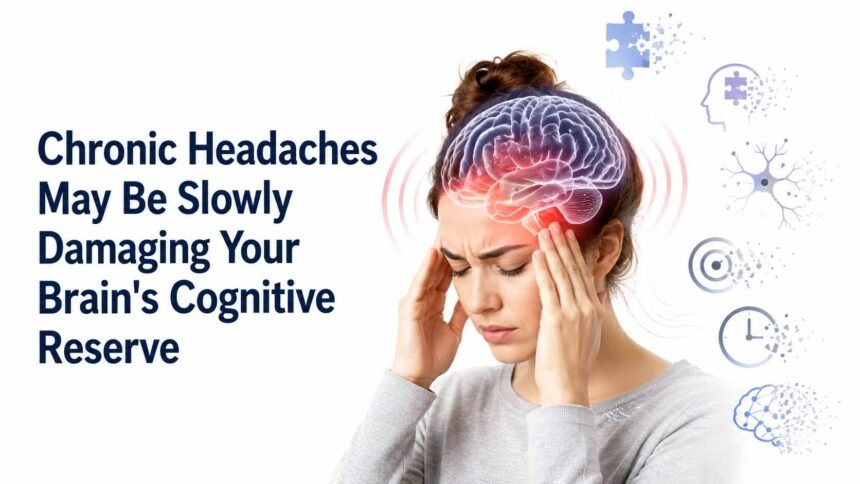
Chronic headaches were always thought of as something that comes and goes without leaving anything behind. But some recent studies are starting to suggest otherwise, and it seems like the damage might build up in the brain over the years.
A billion people deal with migraines, so if this is true, then it could play a bigger role in how thinking skills decline later in life than anyone expected. Treating them harder early on might matter, but that part still needs more looking into.
Emerging Evidence

White matter lesions turn up more often in scans from people who have headaches all the time. The spots get worse the longer it goes on, and they seem to slow things down even if nobody notices right away. Gray matter volume also looks a little lower in certain spots for those with long histories of it.
That part gets a bit messy because the changes are small and not everyone shows the same pattern. The pain processing networks, predictably, show changes. But so do areas governing executive function, memory, and attention, regions with no obvious connection to headache itself.
“We’re moving away from viewing migraine as purely episodic toward understanding it as a chronic brain condition with cumulative effects,” explains Rab Nawaz, M.D., a board-certified neurologist in the United Kingdom and expert contributor to MyMigraineTeam. “The structural changes we see on imaging correlate with headache burden over time. Patients with more frequent attacks, longer disease duration, and inadequate treatment show more pronounced changes. This suggests that reducing headache frequency isn’t just about quality of life; it may be neuroprotective.”
The mechanism remains debated. Repeated cortical spreading depression, the wave of neuronal activity underlying migraine aura, may directly damage tissue with each occurrence. Chronic inflammation associated with frequent attacks could contribute to vascular changes. Repeated exposure to pain itself may remodel neural circuits in ways that persist beyond individual episodes.
Cognitive Complaints
Patients have mentioned these thinking issues after migraines for quite a while. The part after the pain ends leaves them feeling slow and wiped out for hours or even days sometimes. Doctors used to blame it on the medicine, or lack of sleep, or just how exhausting the whole thing is.
Newer checks, though, point to something different. Testing shows small problems with focus and memory in people who get chronic migraines, even on days with no headache. It seems tied to how long someone has dealt with them and how often the attacks hit. Maybe the effects build up instead of going away right after.
That part about the speed of thinking stands out, but it is hard to say exactly why it happens. Some people see it one way, and others do not.
“Patients often describe feeling like they’ve lost a step cognitively, and for years we didn’t have good explanations for why,” explains Dr. Dani Cabral, Alzheimer’s Specialist, Neurologist and Psychiatrist at BrainLove. “Now we’re seeing objective evidence that chronic headache disorders may affect cognitive trajectories over time. The deficits are subtle; we’re not talking about dementia, but they’re measurable and meaningful to the people experiencing them. This reframes aggressive headache prevention as cognitive preservation, not just pain management.”
The question of whether these changes are reversible remains open. Some research suggests that effective treatment reducing headache frequency may halt or slow the progression of structural changes. Whether existing damage can be repaired is less clear.
Treatment Imperative

If chronic headache genuinely threatens long-term cognitive health, the calculus around treatment changes considerably. Tolerating frequent headaches because they’re “manageable” or avoiding preventive medication because of side effect concerns may carry hidden costs that only become apparent decades later.
Current treatment paradigms already emphasize prevention for anyone experiencing more than four headache days monthly. The cognitive implications strengthen this recommendation. Each prevented attack may represent not just a day without pain, but the protection of cognitive reserve.
The newer CGRP-targeting medications, which reduce headache frequency with relatively favorable side effect profiles, become particularly relevant in this context. If the goal is sustained reduction in headache burden over years or decades, tolerability matters as much as efficacy. Patients won’t stay on medications they hate, regardless of how well those medications work.
Lifestyle factors that influence both headache frequency and cognitive health, sleep quality, exercise, stress management, and cardiovascular risk factor control take on dual importance. Interventions that reduce headache burden while independently supporting brain health may offer compounded benefit.
Research Gaps
Research so far mostly takes a quick look rather than watching what happens to people over many years. Following patients with headaches for decades to check on their thinking skills would help a lot, but not many studies do that.
The link between headaches and brain changes is not straightforward. Maybe headaches harm the brain, or perhaps brains with certain features lead to more headaches happening. Figuring out which comes first needs research that has not been done much. I am not totally sure how big the difference really is.
Frequency might have a point where effects build up, or maybe it does not. Severity and the kind of headache could play roles as well. It seems like knowing this would matter for what treatments to use, but answers are missing. That part feels important, but it stays unclear.
What Patients Should Know
For people dealing with headaches that keep coming back, it might not make sense to accept them if there are real options out there. Seeing specialists and trying different medicines, along with changing daily habits, could help more than ease the pain right away, though it is hard to say how much difference it makes in the long run.
Cognitive concerns such as brain fog or difficulty concentrating likely warrant attention rather than being dismissed. Such complaints may indicate that the headaches are not being managed effectively and require a different strategy.
It seems like heart-related risks, such as blood pressure or smoking, also tie into both the headaches and thinking problems, so handling those carefully could protect against several things at once. The research on all of this is still evolving, and more details will likely turn up later.
Headlines declaring that migraines cause dementia overstate current evidence. But the emerging picture suggests that chronic headache disorders deserve respect as potentially consequential brain conditions, not nuisances to be endured, but diseases to be treated with the seriousness they may warrant.
Disclaimer
This article is for general informational and educational purposes only. It is not medical advice and should not be used to diagnose, treat, or manage headaches, migraines, cognitive symptoms, brain changes, or any neurological condition. Anyone with frequent headaches, worsening headaches, migraine with new symptoms, memory problems, brain fog, or difficulty concentrating should speak with a qualified healthcare professional or neurologist.
Current research suggests possible links between migraine, white matter changes, brain structure differences, and cognitive symptoms, but the evidence is still developing. These findings do not mean that every person with migraine has brain damage, will lose cognitive ability, or will develop dementia. Many studies are observational, and they cannot always prove cause and effect.
Seek urgent medical care if a headache is sudden and severe, follows a head injury, comes with weakness, confusion, vision loss, fever, stiff neck, seizure, fainting, trouble speaking, or is very different from a person’s usual headache pattern. Treatment decisions, including preventive medicine, CGRP-targeting therapy, lifestyle changes, or imaging tests, should always be made with a licensed clinician.
References
- Lu, Ying; Li, Quan-yao; Gan, Lu; You, Yi; Wang, Chang-de; Guo, Zhao-wei; Shi, Jun; and Liu, Xiao-ying. “The Global and Regional Burden and Trends of Migraine from 1990 to 2021: Global Burden of Disease Study 2021.” Frontiers in Neurology, vol. 16, 2025, article 1686288. Published November 3, 2025. doi: 10.3389/fneur. 2025.1686288.
- Zhang, Wenyuan; Cheng, Zicheng; Fu, Fangwang; and Zhan, Zhenxiang. “Prevalence and Clinical Characteristics of White Matter Hyperintensities in Migraine: A Meta-Analysis.” NeuroImage: Clinical, vol. 37, 2023, article 103312. Published January 3, 2023. doi: 10.1016/j.nicl.2023.103312. PMID: 36610309.
- Bashir, Asma; Lipton, Richard B.; Ashina, Sait; and Ashina, Messoud. “Migraine and Structural Changes in the Brain: A Systematic Review and Meta-Analysis.” Neurology, vol. 81, no. 14, 2013, pp. 1260–1268. Published October 1, 2013. doi: 10.1212/WNL.0b013e3182a6cb32. PMID: 23986301.
- Jia, Zhihua, and Yu, Shengyuan. “Grey Matter Alterations in Migraine: A Systematic Review and Meta-Analysis.” NeuroImage: Clinical, vol. 14, 2017, pp. 130–140. Published January 19, 2017. doi: 10.1016/j.nicl.2017.01.019. PMID: 28180071.
- Gil-Gouveia, Raquel, and Martins, Isabel Pavão. “Clinical Description of Attack-Related Cognitive Symptoms in Migraine: A Systematic Review.” Cephalalgia, vol. 38, no. 7, 2018, pp. 1335–1350. First published online August 28, 2017. doi: 10.1177/0333102417728250. PMID: 28847155.
- Fernandes, Catarina; Dapkute, Austeja; Watson, Ellie; Kazaishvili, Irakli; Chądzyński, Piotr; Varanda, Sara; Di Antonio, Stefano; Munday, Veronica; MaassenVanDenBrink, Antoinette; and Lampl, Christian. “Migraine and Cognitive Dysfunction: A Narrative Review.” The Journal of Headache and Pain, vol. 25, no. 1, 2024, article 221. Published December 19, 2024. doi: 10.1186/s10194-024-01923-y. PMID: 39701926.
- Charles, Andrew C.; Digre, Kathleen B.; Goadsby, Peter J.; Robbins, Matthew S.; Hershey, Andrew; and the American Headache Society. “Calcitonin Gene-Related Peptide-Targeting Therapies Are a First-Line Option for the Prevention of Migraine: An American Headache Society Position Statement Update.” Headache: The Journal of Head and Face Pain, vol. 64, no. 4, 2024, pp. 333–341. doi: 10.1111/head. 14692. PMID: 38466028.