

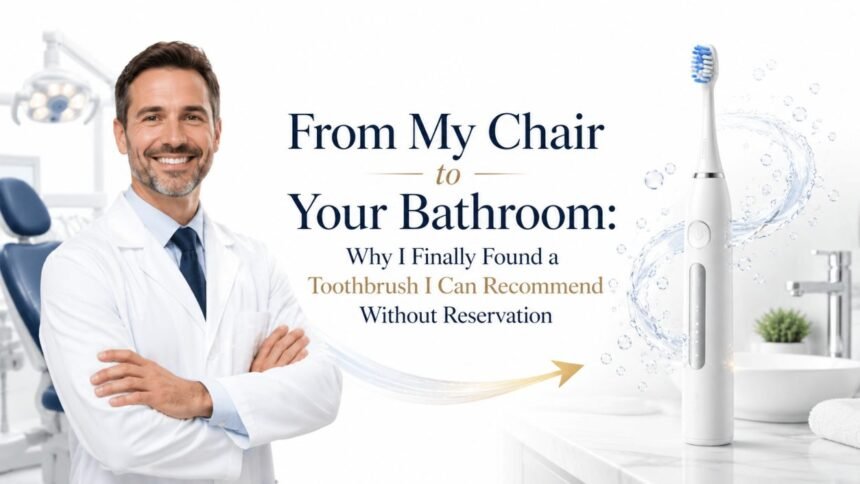
Reviewed By Dr. Michael Chen, DDS — Practicing Dentistry for 18 Years
I’ll be honest with you: I’ve spent nearly two decades telling my patients what not to use. Hard-bristle brushes. Aggressive scrubbing motions. Cheap electric toothbrushes that rattle your skull but barely clean between teeth. My exam room has seen it all: receding gum lines, worn enamel, sensitive teeth that wince at cold water.
So when a patient asks me, “Doc, what should I actually buy?” I’ve learned to be very, very careful with my answer.
That changed about four months ago, when a long-time patient walked in for her routine cleaning, and her gums looked… different. Better. This was a woman I’d been gently nagging about gum recession for three years. Her improvement was noticeable enough that I stopped mid-exam and asked what she’d changed.
“I switched brushes,” she said. “My husband bought us those RANVOO things.”
I’d never heard of the AirJet X5. I went home that night and ordered one.
What Caught My Professional Attention
Let me skip the marketing fluff and tell you what actually matters from a clinical standpoint.
The AirJet X5 uses something RANVOO calls Super Bubble 2.0 Technology. Behind that name is a real mechanism: a boosted bubble chamber paired with a specially designed Coanda-effect brush head that generates a liquid flow rate of up to 1,000 ml/min in Bubble Mode. In plain English? It pushes a stream of water-and-toothpaste mixture deep between teeth, reaching places bristles alone simply cannot. The plaque removal rate clocks in at 97% ,, and from what I’ve observed in my own patients, that number holds up in practice.
This matters because the #1 problem I treat isn’t cavities. It’s interdental decay the kind that forms between teeth, where your brush never quite reaches. If you can clean those spaces effectively without needing to master flossing technique, you’re already ahead of 80% of the population.
Part That Sold Me: It Won’t Wreck Your Gums
Here’s the uncomfortable truth about most electric toothbrushes: they’re too aggressive. High-frequency oscillation sounds impressive in a commercial, but in a mouth, excess force and amplitude translate directly to gum recession. Once gums recede, they don’t grow back.
The AirJet X5 takes a fundamentally different approach. Its Clean Mode operates at 21,600 strokes per minute with an oscillation angle of just 2.9°–12.4°; compare that to many competitors pushing 40,000+ strokes with wider sweep angles. The brush maintains a tight 12° micro-oscillating sweep that cleans effectively without traumatizing soft tissue.
Even smarter: the brush head features a rubber-coated backing that absorbs vibration impact. If you’ve ever accidentally knocked your teeth with a hard plastic brush head, you know exactly why this matters. The silicone shock absorption eliminates that jarring “chattering” sensation.
The bristles themselves deserve mention. 0.01mm ultra-fine tips with a 99.9% end-rounding rate this is the difference between bristles that clean and bristles that micro-scratch. Under a microscope, poorly rounded bristles look like tiny needles. RANVOO’s bristles, honestly, look closer to what I’d expect from surgical-grade nylon. They’re soft enough that I’ve recommended the AirJet X5 to patients with active gum bleeding, and every single one has reported improvement within two weeks.
Four Modes That Actually Make Sense
Most toothbrushes overload you with modes you’ll never use. The X5 gives you four, and each one has a distinct clinical purpose:
| Mode | Best For | Key Spec |
|---|---|---|
| Bubble | Deep interdental cleaning | 1,000 ml/min flow, 1.2–2.5 mm amplitude |
| Sensitive | Bleeding gums, post-surgery | 500 ml/min flow, 3–4.5 mm amplitude |
| Clean | Daily all-around use | 800 ml/min flow, tight 2.9°–12.4° oscillation |
| Whitening | Stain removal | 1,000 ml/min flow, alternating 130 Hz/180 Hz |
The TFT display on the handle is small, 0.79 inches, 128×128 pixels, but it’s genuinely useful. You’d be surprised how many patients lose track of which mode they’re in. A clear visual indicator solves that.
Hygiene: The Thing Nobody Talks About
I’m going to say something that might gross you out: most toothbrush handles are mold farms. They sit in damp bathrooms, accumulate residue, and within months develop that black speckling at the base. It’s not just unsightly; it’s a bacterial reservoir you’re putting in your mouth twice a day.
RANVOO addressed this with a SiC anti-mold coating on the ABS handle, backed by Grade 0 anti-mold certification. After four months in my own bathroom, and I shower with it, because it’s rated IPX7 waterproof , mine still looks new. No speckles. No residue. No mold smell.
The magnetic wall mount deserves a standing ovation from anyone who’s ever knocked their toothbrush off a crowded counter. It’s also a wireless charger. Snap the brush on, it charges. Grab it, it’s ready. The 1,600mAh battery delivers roughly 30 days of use on a single 6-hour charge, assuming twice-daily two-minute sessions. I’ve traveled with it twice and didn’t bother packing the cable either time.
Who I Recommend This For
If you have healthy gums, strong enamel, and no sensitivity, honestly, most quality brushes will serve you fine.
But if you’re among the patients I see every day, mid-30s to 50s, noticing your gums bleed when you floss, worried about recession, dealing with sensitivity to cold, then the AirJet X5 was essentially designed for you. The 22,000 vibrations-per-minute cap, the soft-bristle design, the controlled oscillation angle, and the shock-absorbing brush head all point toward one goal: clean teeth without collateral damage.
I’ve now recommended it to over 30 patients. The feedback has been consistent: less bleeding, visibly cleaner interdental spaces, and a brush handle that doesn’t grow mold. In my profession, that’s about as close to a trifecta as you get.
Disclaimer: This article is for general dental information and product review purposes only. It should not be taken as personal dental advice, diagnosis, or treatment. Results may vary from person to person based on oral health, brushing habits, gum condition, diet, and dental history. Always speak with a qualified dentist before changing your oral care routine, especially if you have gum disease, tooth sensitivity, bleeding gums, dental implants, braces, crowns, or recent oral surgery. Product claims, features, and performance details should be checked with the manufacturer before purchase.