

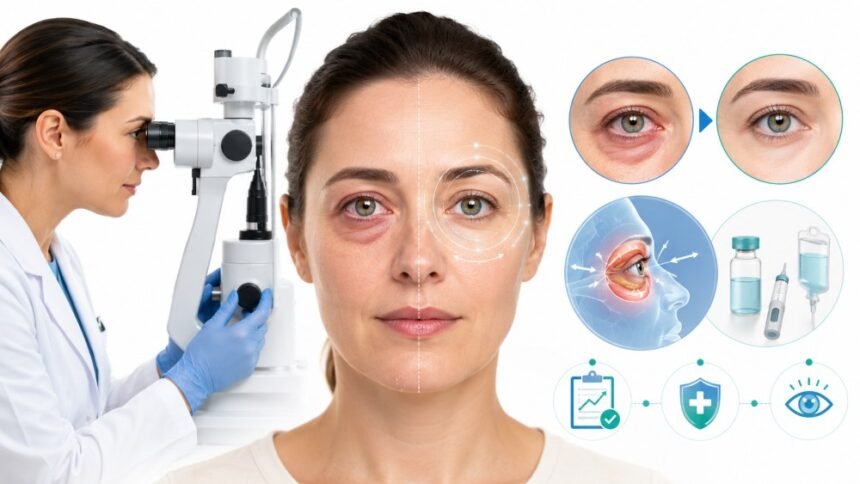
Most people spot it in the mirror before a doctor ever says the words. A stare that looks a little too wide. Eyes that feel gritty by lunchtime and stream by evening. A holiday photo where one eye sits slightly forward of the other, and you cannot unsee it. Thyroid eye disease affects the soft tissues, fat, and muscle packed into the orbit, and it rarely announces itself politely. Some people notice bulging, swelling of the lids, pressure, redness, tearing, or dryness. Others get double vision that makes the motorway genuinely frightening. A few changes arrive over a weekend. Others creep in across months.
Good care starts with slowing down long enough to measure properly. That means a careful look at the eyes, a review of thyroid status, and an honest conversation about which symptoms are actually wrecking your day. Treatment lands best when timing, disease activity, vision risk, and your own goals are weighed together rather than rushed. As the Cleveland Clinic notes, most cases remain mild, but severe cases require a proper plan, not guesswork.
Getting the Right Evaluation
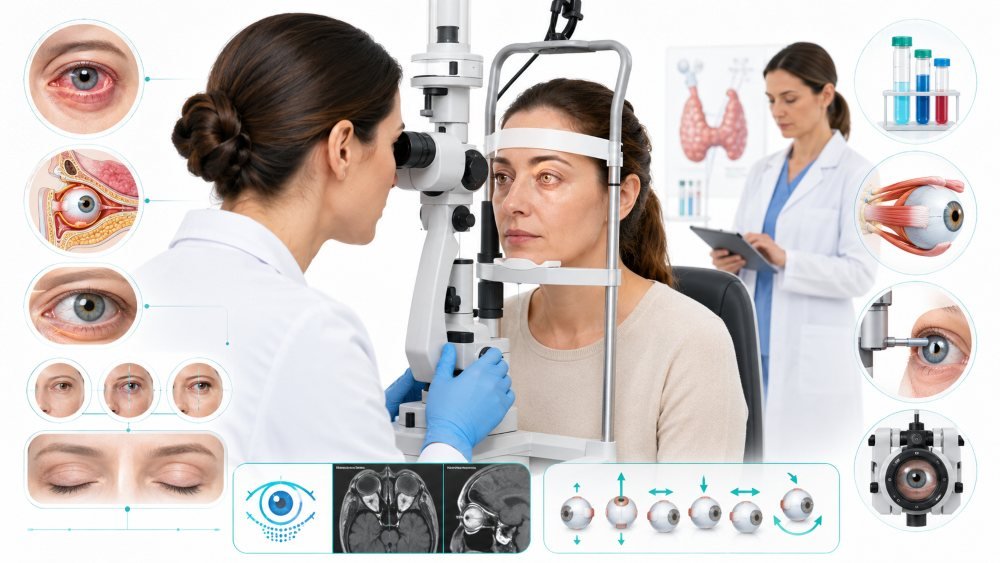
A focused evaluation has one job: separating active inflammation from stable structural change. Those two things look similar in the mirror and call for completely different treatment. Your clinician will check eye position, lid closure, intraocular pressure, corneal exposure, and whether the muscles are restricting movement. Anyone booking in with a Tepezza provider in Los Angeles can usually expect imaging, a review of thyroid bloodwork, and baseline vision testing before any therapy gets chosen. Those results guide the decision among medical management, watchful monitoring, and surgical planning.
If you take nothing else from this section, take this: the American Thyroid Association is blunt about the importance of early referral. Anyone with eye symptoms should be seen by an ophthalmologist alongside their endocrinologist, and the sooner the better, because early treatment can keep problems from becoming permanent.
What Is Actually Happening Behind the Eye
Symptoms begin when immune signals start targeting the tissue behind and around the eye. Fat expands, the muscles that move the eye thicken, and fluid collects in a space that has no room to spare. That pressure has to go somewhere, so it pushes the eye forward or limits its movement. The lids can retract, leaving the surface exposed, which is why dryness worsens. Double vision usually turns up when swollen muscles stop tracking together, and the two eyes quietly disagree about where to point. Mayo Clinic describes the same picture: bulging eyes, redness, and lids that no longer cover the eyeball the way they should.
First Things First: Protecting the Surface
Early management is not glamorous, and that is fine because the first goal is to protect the cornea and take the edge off the discomfort. Preservative-free drops ease the burning through the day. A thicker ointment at night helps if the lids stay open while you sleep. Thyroid levels, smoking, and blood sugar all deserve real attention here, because each one can push severity in the wrong direction. Small measures matter more than people expect, especially when glare and pressure are quietly ruining reading, driving, and sleep.
How Tepezza Works
Tepezza is an infusion medicine that targets the IGF-1 receptor, a signaling pathway involved in orbital tissue growth and inflammation. Blocking that pathway in orbital fibroblasts reduces the swelling that has been pushing the eye forward. Reviews of its mechanism and clinical role report meaningful reductions in bulging, pressure, redness, pain, and double vision among many treated patients. Whether it is the right fit depends on your activity level, symptom burden, medical history, hearing status, glucose control, and your specialist’s judgment, rather than on a single number on a chart.
Infusion Schedule
Treatment goes in through a vein, once every three weeks. A full course consists of eight doses spread over roughly five months. The first appointment tends to run longer, because staff is watching closely for reactions, and later visits often shorten once your tolerance is clear. Some people feel wiped out afterward. Others report cramps, nausea, or a strange metallic shift in how food tastes. None of that is unusual, and it is worth flagging early rather than white-knuckling through it.
What the Results Actually Show
Here is the honest version. The pivotal trials were genuinely impressive, and also small, so read them with both eyes open. In the phase 3 study, reported by the American Academy of Ophthalmology, most patients with active disease saw a real reduction in bulging while placebo trailed well behind. The original OPTIC trial in the New England Journal of Medicine reported a proptosis response rate above 80 percent and showed that nearly 7 in 10 improved in double vision. Response patterns still vary. Some people feel relief after a few infusions. Others need most of the course before the measurements shift, and a minority do not respond the way they hoped. That range is normal, and knowing it in advance saves a lot of mid-treatment panic.
The Side Effects Worth Watching
Potential side effects include muscle cramps, nausea, fatigue, dry skin, hair thinning, taste changes, hearing symptoms, and raised blood sugar. If you have diabetes, glucose needs closer tracking during therapy, full stop. Any change in hearing should be reported quickly rather than waited out. And one that gets missed in patient conversations: teprotumumab is contraindicated in pregnancy, so contraception and timing genuinely matter. The real decision is always a trade, weighing these risks against pressure, exposure, double vision, appearance, and any threat to your actual sight.
When Surgery Earns Its Place
Surgery becomes useful once the inflammation has quietened and the measurements have gone stable. Orbital decompression makes room for crowded tissue. Eyelid surgery improves closure, comfort, and symmetry. Eye muscle surgery can settle stubborn double vision. Timing is everything, because inflammation that is still moving will keep changing alignment and lid height, and operating on a moving target rarely ends well. The European treatment guidelines summarised by the AAO are firm on sequencing surgery only when disease is inactive.
Non-Surgical Options That Still Matter
Not everyone needs an infusion or an operation. Depending on the case, steroids, prisms, selenium, moisture chambers, or nighttime taping all have a role. Steroids can calm active inflammation but do not suit everyone, and the full EUGOGO clinical practice guidelines walk through where each option fits and where it does not. Prisms help with certain alignment patterns. Dry eye care never really stops. None of it is a cure on its own, but together these supports make screen work, reading, driving, and rest a lot more bearable while the bigger plan plays out.
Building a Care Plan You Can Live With
The plans that work tend to be team efforts: an eye specialist, a thyroid clinician, and an infusion team, all reading from the same page. Visits should track eye position, vision, color perception, corneal health, side effects, and symptom trends. Photos are underrated here, because they document progress your memory will happily distort. And know your red flags. Sudden vision loss, colors that go dull or washed out, severe pain, or new hearing changes are all reasons to call straight away, not to book something for next week.
The Short Version
Treatment for thyroid eye disease moves in stages, and that structure is a feature, not a delay. Protect sight and the ocular surface first. Bring down inflammation and improve comfort next. Fix the lasting mechanical problems last, once things have settled enough to make surgery worthwhile. Infusion therapy has genuinely widened the options for active disease, while surgery and supportive care still hold their ground. Careful diagnosis, patient follow-up, and a plan tailored to your particular eyes give you the strongest shot at lasting improvement.
Medical Disclaimer
This article is for general information only and is not a substitute for professional medical advice, diagnosis, or treatment. Thyroid eye disease varies enormously from person to person, and treatment decisions, including any use of teprotumumab (Tepezza), should be made with a qualified ophthalmologist and endocrinologist who know your full history. Teprotumumab is contraindicated in pregnancy. Never delay seeking care, or ignore new symptoms such as sudden vision loss or hearing changes, because of something you have read here. Always follow the guidance of your own treating clinicians.
References
- Douglas RS, Kahaly GJ, Patel A, et al. Teprotumumab for the treatment of active thyroid eye disease. N Engl J Med. 2020;382(4):341–352. doi:10.1056/NEJMoa1910434
- Smith TJ, Kahaly GJ, Ezra DG, et al. Teprotumumab for thyroid-associated ophthalmopathy. N Engl J Med. 2017;376(18):1748–1761. doi:10.1056/NEJMoa1614949
- Kahaly GJ, Douglas RS, Holt RJ, Sile S, Smith TJ. Teprotumumab for patients with active thyroid eye disease: a pooled data analysis, subgroup analyses, and off-treatment follow-up results from two randomized, double-masked, placebo-controlled, multicentre trials. Lancet Diabetes Endocrinol. 2021;9(6):360–372. doi:10.1016/S2213-8587(21)00056-5
- Douglas RS, Kahaly GJ, Ugradar S, et al. Teprotumumab efficacy, safety, and durability in longer-duration thyroid eye disease and re-treatment: OPTIC-X study. Ophthalmology. 2022;129(4):438–449. doi:10.1016/j.ophtha.2021.10.017
- Bartalena L, Kahaly GJ, Baldeschi L, et al. The 2021 European Group on Graves’ orbitopathy (EUGOGO) clinical practice guidelines for the medical management of Graves’ orbitopathy. Eur J Endocrinol. 2021;185(4):G43–G67. doi:10.1530/EJE-21-0479
- Douglas RS, Parunakian E, Tolentino J, et al. A prospective study examining audiometry outcomes following teprotumumab treatment for thyroid eye disease. Thyroid. 2024. doi:10.1089/thy.2023.0466
- Bahn RS. Graves’ ophthalmopathy. N Engl J Med. 2010;362(8):726–738. doi:10.1056/NEJMra0905750