

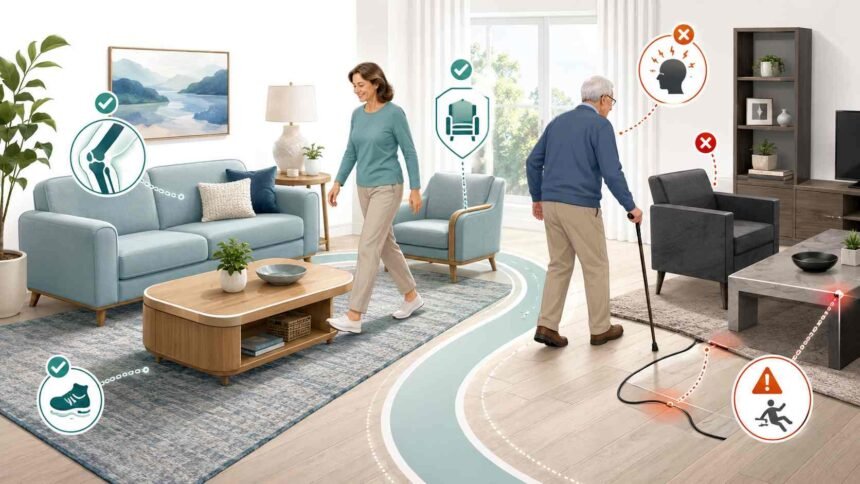
We file furniture under decorating, a question of taste with no real stakes. The body disagrees. The shapes you place in a room change how relaxed you feel sitting in it, how often someone collides with a corner, how far you twist to reach a glass, and, as you age, how safely you cross the floor at night. None of that is cosmetic. This is the living room read as a health environment, with the evidence and the limits of that evidence laid out honestly, because the popular advice gets both the science and the safety part wrong.
Link Between Room Shape and Stress Is Real, but Thinner Than Wellness Blogs Claim
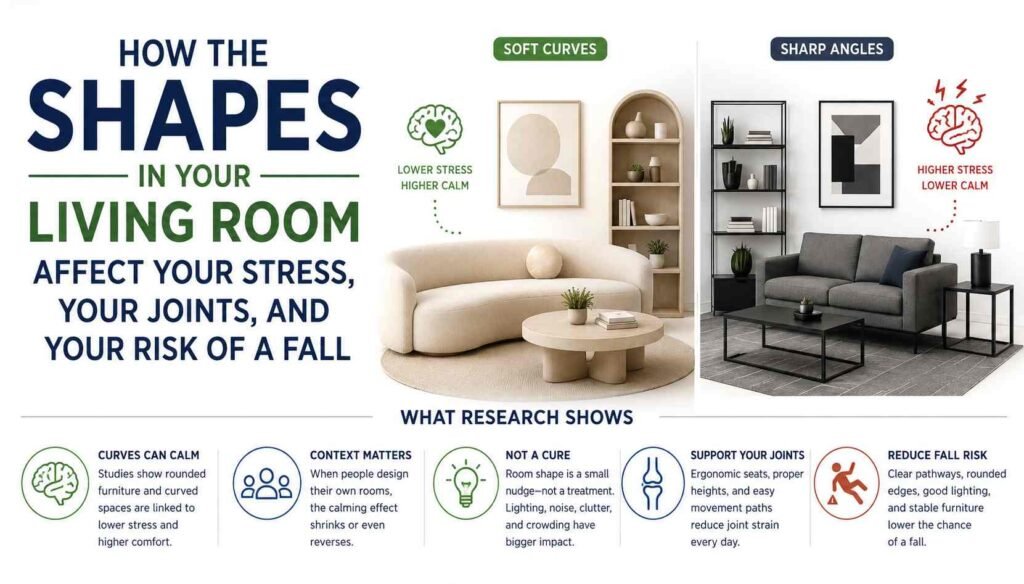
Wellness writing loves the clean version of this story: curves calm you, sharp angles stress you, so round everything for a serene home. The underlying research exists, but it has been stretched well past what it can carry, and that overreach leads people to chase the wrong fix.
What the Curvature-and-Stress Studies Actually Measured
In a controlled experiment, people rated rooms furnished with rounded pieces as calmer and more approachable than identical rooms with rectangular furniture, per the Oregon State research summary. Brain-imaging and contour work, including the research published in PMC on aesthetic and stress responses to indoor environments, points the same direction: curved interiors tend to draw slightly lower stress and higher liking scores. The effect is real and measurable, which is why it gets repeated so often.
Where the Calming Effect Quietly Disappears
It is also small and conditional. When researchers let nearly two hundred people furnish a virtual room themselves instead of rating fixed images, the calming-curve preference did not just shrink, it tilted toward angular pieces, as reported in Nature Scientific Reports. The benefit also fades when a space already carries negative associations. The honest health framing is this: softening a room’s lines is a mild, low-cost nudge toward calm, not a treatment. If a room reliably winds you up, lighting, noise, clutter, and crowding move your stress far more than whether the side table is round.
Sharp Corners Are a Household Injury You Can Design Out
Stress is the subtle effect. Injury is the obvious one, and low living-room tables are a specific, avoidable cause that most decorating advice never mentions.
Who Gets Hurt, and How the Corner Does It
Low tables injure people through corner strikes, not collapse. The recurring cases are a toddler losing balance on carpet and meeting a sharp edge at head height, and an older adult catching a hip or temple against a hard corner during a stumble. The U.S. Consumer Product Safety Commission tracks thousands of furniture-related injuries a year. While its tip-over work targets tall pieces, the side table’s danger is the edge itself, sitting at exactly the height a falling body passes through.
Edge-and-Material Fix That Beats “Just Buy Round”
A rounded or oval top removes the worst geometry, and a bullnose or eased edge does the same for a rectangular table when you want the surface area. Material matters as much as shape here. A round table made of thin tempered glass becomes a laceration hazard if it shatters, while solid wood and powder-coated metal absorb years of impact without failing. Even safety hardware that looks identical performs very differently under load, as the independent testing Consumer Reports ran on furniture anchors demonstrated. Pick the edge and the material before you pick the silhouette.
After 65, the Same Room Becomes a Fall-Risk Question
The furniture that is merely inconvenient at 35 becomes a genuine health hazard later. Roughly one in four adults aged 65 and older falls each year, and home hazards are among the modifiable risk factors, according to CDC fall-prevention data. A fall at that age is not a bruise. It often starts a decline in independence.
Why Clear Reach Paths Matter for Balance
Aging shifts the value of a table from “looks nice” to “does not interrupt a path I navigate with less balance than I used to.” A corner protruding into a walking line, or a low table positioned where someone reaches and pivots in the dark, is the kind of fixed obstacle that turns a small misstep into a fall. Keeping main paths at 30 to 36 inches of clearance and choosing footprints that sit out of the walking line, rounds and C-shapes among them, removes the obstacle without stripping the room bare.
Advice That Backfires
Here is the nuance generic safety lists miss. Blanket “remove every hazard” guidance can be counterproductive, because older adults build balance strategies around familiar layouts and sometimes steady themselves on stable furniture; clearing a room indiscriminately can disrupt those routines and raise risk, a point made in the environmental fall-prevention literature. The better approach is targeted: fix the specific corner, table, or path that intercepts movement, and keep the steadying anchors a person already relies on.
Reach and Posture: The Small Daily Strain You Stop Noticing
Beyond stress and falls sits the quiet, cumulative cost of reaching badly several times an hour, every day.
Armrest-Height Rule as an Ergonomic Rule
Keeping the tabletop level with the armrest or up to two inches below, which lands most tables in the 24-to-28-inch range, is usually presented as a styling tip. It is really an ergonomic one. A table that sits well below the armrest forces a repeated downward and forward reach that loads the shoulder and lower back, the same micro-strain that makes a poorly set desk uncomfortable over time. Match the height to the seat, and the reach stays neutral.
Recliners, Reach, and Why a C-Shape Protects Your Back
A recliner moves the body forward when the footrest extends, pushing a conventional side table out of easy range exactly when you want it. Reaching back and twisting for a drink in that position is a common way to tweak a back. A C-shaped table slides its base under the chair so the surface floats over your lap, keeping the reach in front of you and the spine neutral. The shape solves a posture problem, not a décor one.
Building a Calm, Low-Risk Room Without Turning It Into a Clinic
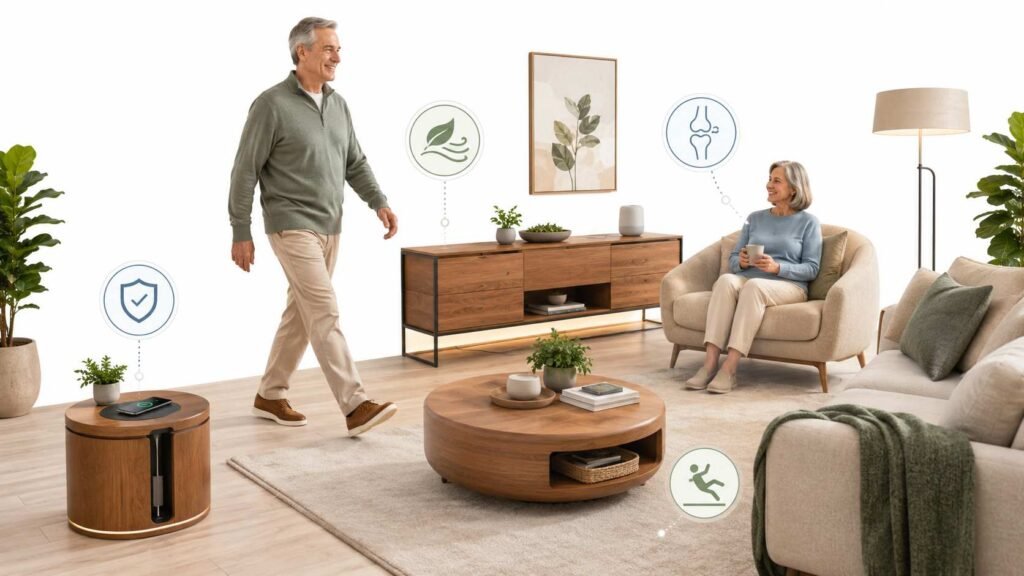
A healthy room is not a padded one. The goal is to reduce the real risks while keeping the space somewhere you actually want to sit.
Materials That Last and Keep the Air Cleaner
Solid wood and metal outlast particleboard held together with adhesives, and lower-emission finishes spare you some of the off-gassing that cheaper construction can add to indoor air. Durable materials also mean fewer wobbling, failing, or splintering pieces over time, which is its own safety dividend. This is part of why broad catalogs of round end tables for living room settings read as the safe default: a solid, soft-edged piece quietly covers stress, injury, and longevity at once.
Smart and Sustainable Features That Support Wellbeing
Function is reshaping these objects in ways that help. Built-in charging surfaces cut the cord clutter that becomes a trip hazard, and reclaimed or recycled-material tables reduce the indoor pollutants tied to some manufacturing, part of the wider move toward sustainability and smart functionality at home. Choose the feature that removes a daily friction or hazard rather than the one that looks current.
A Health-First Walkthrough Before You Buy
Run a short floor test in the store rather than trusting a checklist. Stand the table where it will live and walk past it twice at normal pace, watching for the corner that wants your hip. Sit in the matching seat and reach for an imaginary glass without leaning; if your hand passes over the top with a neutral arm, the height and reach protect your back. Press a thumb to the corner and decide whether you would trust it at a child’s head height or beside an unsteady relative. Then name the one job this table must do every day and reject any shape that fails it. A piece that survives those checks protects the people who use the room. One that only photographs well does nothing for them.
Disclaimer
This article is for general information and home safety awareness only. It is not medical advice, physiotherapy advice, occupational therapy advice, child-safety certification, product-safety certification, or a personalised fall-risk assessment. Furniture shape, height, material, and placement may reduce some risks, but no furniture choice can remove all risks.
If someone in the home has balance problems, dizziness, joint pain, mobility changes, a recent fall, vision problems, or a condition that affects walking, speak with a qualified healthcare professional, physiotherapist, occupational therapist, or home-safety specialist. Families with babies, toddlers, older adults, or people who need mobility support should also follow product instructions, local safety standards, and professional guidance when choosing, placing, or anchoring furniture.
After a fall, head impact, loss of balance, severe pain, swelling, confusion, fainting, vomiting, or any worrying symptom, seek medical help promptly.
References
- Dazkir, S. S., and Read, M. A. (2012). Furniture Forms and Their Influence on Our Emotional Responses Toward Interior Environments. Environment and Behavior, 44(5), 722 to 732. doi: 10.1177/0013916511402063.
- Oregon State University Newsroom. (2011, April 25). Rounded, Curvy Furniture Puts People at Ease. Oregon State University, Corvallis, Oregon.
- Tawil, N., Ascone, L., and Kühn, S. (2022). The Contour Effect: Differences in the Aesthetic Preference and Stress Response to Photo-Realistic Living Environments. Frontiers in Psychology, 13, Article 933344. doi: 10.3389/fpsyg. 2022.933344.
- Pohlmann, K., Lichtlein, N., Mostajeran, F., Tawil, N., and Kühn, S. (2025). Interactive Room Design as a Tool for Understanding Form and Style Preferences. Scientific Reports, 15, Article 35578. doi: 10.1038/s41598-025-23543-5.
- Vartanian, O., Navarrete, G., Chatterjee, A., Fich, L. B., Leder, H., Modroño, C., Nadal, M., Rostrup, N., and Skov, M. (2013). Impact of Contour on Aesthetic Judgments and Approach-Avoidance Decisions in Architecture. Proceedings of the National Academy of Sciences of the United States of America, 110(Suppl. 2), 10446 to 10453. doi: 10.1073/pnas. 1301227110.
- Bar, M., and Neta, M. (2006). Humans Prefer Curved Visual Objects. Psychological Science, 17(8), 645 to 648. doi: 10.1111/j.1467-9280.2006.01759.x.
- Bar, M., and Neta, M. (2007). Visual Elements of Subjective Preference Modulate Amygdala Activation. Neuropsychologia, 45(10), 2191 to 2200. doi: 10.1016/j.neuropsychologia.2007.03.008.
- Ruddy, R., Bacchi, D., and Fleisher, G. (1985). Injuries Involving Household Furniture: Spectrum and Strategies for Prevention. Pediatric Emergency Care, 1(4), 184 to 186. doi: 10.1097/00006565-198512000-00003.
- Suchy, A. (2022, February). Product Instability or Tip-Over Injuries and Fatalities Associated with Televisions, Furniture, and Appliances: 2021 Report. Directorate for Epidemiology, Division of Hazard Analysis, U.S. Consumer Product Safety Commission, Bethesda, Maryland.
- U.S. Consumer Product Safety Commission. National Electronic Injury Surveillance System. U.S. Consumer Product Safety Commission. Accessed 19 June 2026.
- Kirchner, L. Best and Worst Furniture Anchor Kits, According to CR’s Tests.