


Most hospital administrators can name the bottlenecks on demand. Registration runs slow. Prior authorization stalls. Discharge happens late. Claims get denied. These are known problems. What is less clearly understood is that these failures do not occur in sequence; they overlap, and each one tightens the margin for every step that follows. A hospital that addresses bottlenecks individually, without accounting for how they feed each other, will always be managing symptoms rather than the underlying condition.
The hospitals that achieve lasting operational improvement are those that identify where friction originates, not just where it becomes visible. That distinction drives the difference between a sustainable fix and a temporary patch.
Intake Window Sets the Conditions for Every Step That Follows
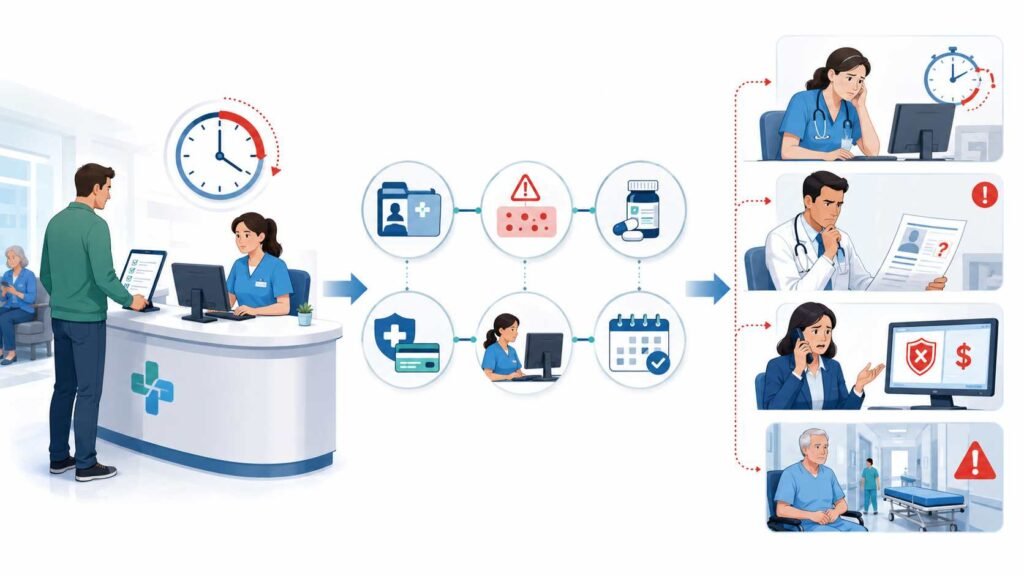
Why a Slow Registration Creates a Fast Downstream Problem
When a patient arrives, and the registration process takes 25 minutes instead of eight, the clinical team receives delayed access to allergy history, current medications, and confirmed insurance status. Each of those gaps requires someone downstream to chase information that should have arrived at the start. A nurse who pauses to verify a medication allergy before administering treatment is not experiencing a clinical problem. They are absorbing an administrative failure that originated at the front desk.
The Agency for Healthcare Research and Quality has identified incomplete patient intake data as a contributing factor in a meaningful share of preventable adverse events. That finding shifts the conversation from operational inconvenience to patient safety risk, and it argues for pre-registration systems as a clinical priority, not just an administrative one. Hospitals that give patients a secure digital portal to complete intake forms 24 to 48 hours before their appointment consistently report shorter front-desk processing times and fewer downstream reconciliation issues.
Prior Authorization Creates a Calendar Problem in a Clinical Setting
What Happens When Payer Timelines Do Not Match Clinical Timelines
Prior authorization is the single administrative process most likely to delay treatment that is already clinically justified. CMS data indicates that a significant share of denied prior authorization requests are eventually approved on appeal, which means the denial added time to a care timeline without altering the clinical decision. The care was appropriate. The paperwork was not ready.
The American Health Information Management Association has outlined how standardized authorization workflows, where required documentation is identified and assembled as part of the scheduling process rather than afterward, reduce last-minute denials and eliminate rework cycles. Hospitals that treat authorization as a scheduling step rather than a post-scheduling checkpoint consistently see fewer delays at the clinical handoff point. The reframing is small. The operational effect is not.
Transportation Coordination Is a Scheduling Variable, Not a Logistics Add-On
Why NEMT Gaps Convert Confirmed Appointments Into No-Shows
Non-emergency medical transportation is treated as a separate system from hospital scheduling in most facilities. That separation creates a predictable failure: a patient confirms an appointment and then cannot get there. No-show rates in Medicaid-dependent populations frequently exceed 20 percent, and transportation barriers are among the most commonly cited causes in patient surveys.
Each missed appointment does not simply lose its slot. It disrupts the appointments on either side, delays care for the patient who needed the visit, and forfeits reimbursement that was already entered into the revenue forecast. Hospitals and community health centers that have integrated NEMT vehicle scheduling software into their booking workflows have broken this pattern by confirming transportation at the time the appointment is made. When the ride and the appointment share a single confirmation, the no-show risk drops significantly. The patient receives one communication. The facility receives one less variable to manage.
Medical Records Fragmentation Is a Revenue Cycle Problem Before It Reaches Billing
Where Documentation Gaps Turn Into Denial Patterns
Clinical documentation is rarely thought of as a billing input. In practice, it is one of the most consequential ones. A clinical note that does not clearly support the procedure code on the submitted claim becomes a denial at a later stage, and the wait for that denial is often 30 to 60 days. According to the Healthcare Financial Management Association, documentation-related denials represent one of the largest and most preventable sources of revenue leakage in hospital systems.
The Office of the National Coordinator for Health Information Technology has advocated for interoperability standards that allow records to move cleanly between systems. Where full interoperability is not yet achievable, standardized documentation templates that map clinical findings to billing codes are a practical intermediate step. A regional hospital that implemented structured note templates tied to billing codes reported an 11-point increase in first-pass claim acceptance within six months. The improvement required no new technology. It required a consistent process applied to an existing system.
Discharge Planning That Starts at Discharge Has Already Started Too Late
How Early Planning Clears Beds and Reduces Length of Stay
The Joint Commission has identified delayed discharge as a major contributor to hospital-wide flow problems. What is less often discussed is that most delayed discharges are planning failures, not execution failures. When the first conversation about post-acute needs, home health requirements, and follow-up scheduling happens the day before discharge, the administrative tasks cannot be completed in time. The bed stays occupied. The next patient waits.
Hospitals that begin discharge planning near the time of admission, flag likely post-acute requirements early, and assign explicit ownership of each discharge task to a named team member consistently achieve shorter lengths of stay without compromising continuity of care. The American Hospital Association has identified this practice as a defining characteristic of high-performing hospital operations. Early planning does not require additional resources. It requires that existing resources be oriented toward a different point in the timeline.
Revenue Cycle Inefficiency Has an Address, and It Is Rarely in the Billing Department
Tracing Denials Back to Their Origin Point
Billing denials are almost always treated as a billing department problem. In most cases, their origin is elsewhere. A denial that stems from an unsupported clinical note traces back to documentation. A denial related to a non-covered service traces back to authorization. A denial tied to incorrect patient information traces back to registration. The Medical Group Management Association has noted that a significant portion of denied claims are never resubmitted, representing a direct financial write-off rather than a recoverable loss.
Hospitals that have made durable improvements to revenue cycle performance have done so by tracing each denial category back to its origin and addressing the upstream process failure there. Hiring additional billing staff to handle denials that originate in documentation is not a solution. It is an escalating cost applied to a solvable problem.
Interdepartmental Communication Breaks the Chain Between Good Intentions and Good Outcomes
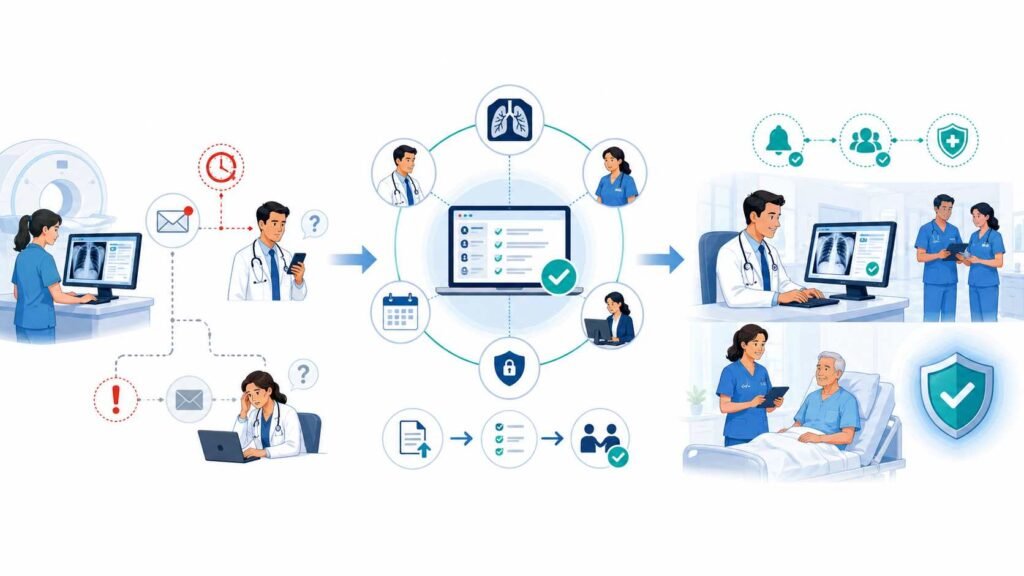
Why Structured Handoffs Outperform Informal Follow-Ups
Communication failures between departments are among the most common contributors to administrative bottlenecks, and among the least systematically addressed. When a handoff from radiology to a referring physician depends on an email that may or may not be read before the end of the day, the delay that follows is predictable. Centralized communication platforms that require structured handoffs, where the receiving party must acknowledge transfer of responsibility, eliminate the ambiguity that informal communication creates.
The Joint Commission’s National Patient Safety Goals specifically address communication failures as a patient safety issue. That framing matters for hospital administration because it elevates communication standardization from an operational preference to a regulatory expectation. A hospital that treats handoff documentation as optional is not just creating workflow friction. It is accumulating safety and compliance exposure simultaneously.
Conclusion
Hospital administrative bottlenecks are not independent failures that happen to coexist in the same facility. They are linked points in a system where delays accumulate and compound. Fixing intake without addressing authorization or improving documentation without aligning it to billing produces partial results that erode over time. The hospitals that sustain operational improvement are those that treat the administrative pathway as a single system, identify where each breakdown originates, and build accountability into the fix at that origin point. The work is specific. The outcomes are measurable. The starting point is deciding to trace problems to where they actually begin.