

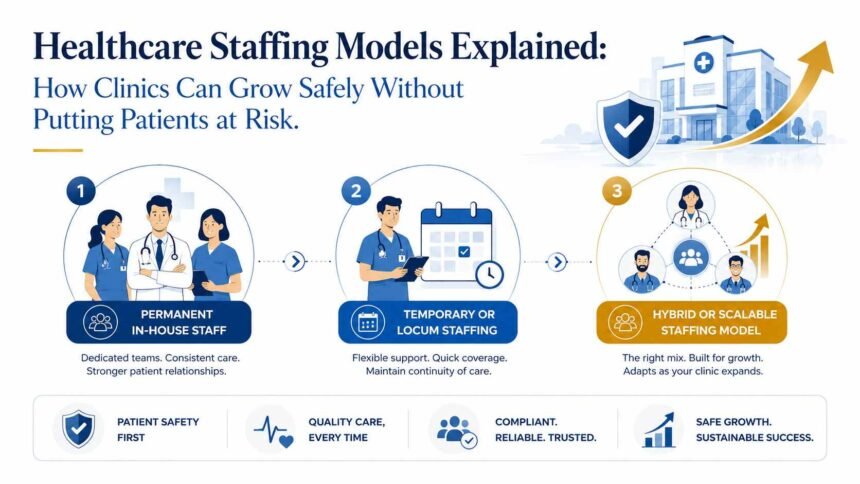
Healthcare teams are under pressure from many directions. Patients expect faster appointments, clearer communication, secure digital records, and reliable follow-up. At the same time, many clinics, telehealth providers, and healthcare organizations struggle to find enough trained staff for clinical support, administration, technology, billing, and patient communication.
This is why some healthcare organizations are reviewing new staffing models instead of relying only on traditional hiring pipelines. The goal is not just to reduce cost. In healthcare, the bigger goal is to protect patient safety, keep records secure, support staff wellbeing, and make sure patients do not feel lost in the system.
Nearshore hiring, staff augmentation, dedicated support teams, and outsourced healthcare operations can all help when used carefully. But healthcare is different from ordinary business. A poor staffing decision can affect patient privacy, appointment access, medication safety, billing accuracy, and trust.
Why Healthcare Organizations Are Rethinking Staffing
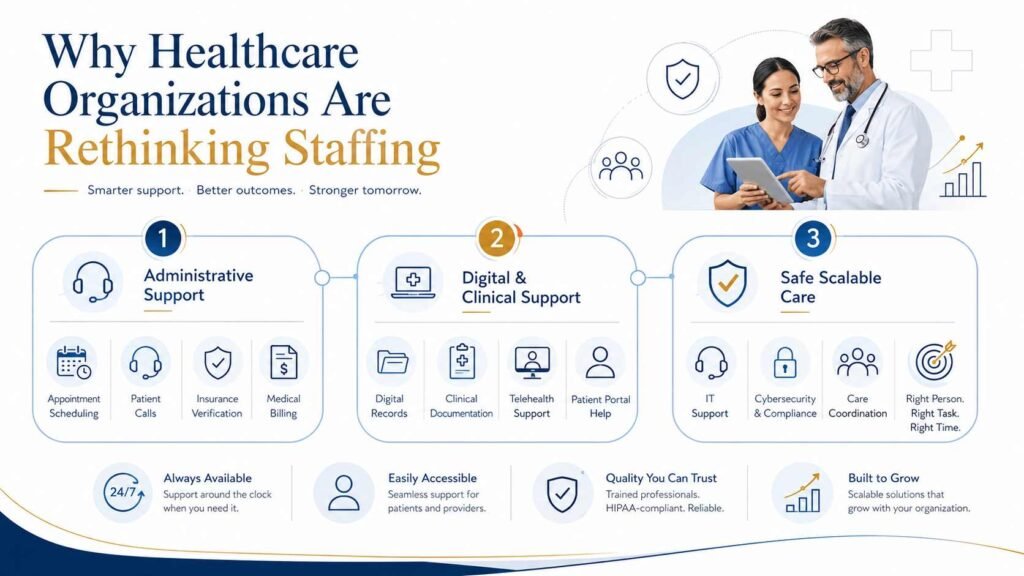
Healthcare staffing is not only about filling empty roles. It is about making sure the right person handles the right task at the right time.
A small clinic may need help with appointment scheduling, patient calls, insurance checks, medical billing, digital records, or telehealth support. A larger provider may need clinical documentation support, IT staff, cybersecurity support, patient portal assistance, or care coordination teams.
The World Health Organization explains that health systems depend on the availability, accessibility, acceptability, and quality of health workers. This is important because staffing gaps can affect access to care, service quality, and the patient experience.
What Nearshore Staffing Means in Healthcare
Nearshore staffing means working with professionals or support teams based in nearby countries or similar time zones. For healthcare organizations, this may include administrative, technical, customer support, billing, or digital health roles.
It is different from simply outsourcing work to the cheapest available provider. In healthcare, safe nearshore staffing should focus on:
- Patient privacy
- Time-zone overlap
- Clear communication
- Health data protection
- Training and supervision
- Compliance with local laws
- Strong quality checks
- Reliable escalation to licensed clinicians
Some healthcare organizations work with nearshore recruitment services when they need help finding trained support staff for healthcare operations. This can be useful, but the organization must still check qualifications, contracts, privacy rules, supervision, and security standards before giving anyone access to patient systems.
Healthcare Roles That May Fit Flexible Staffing Models
Not every healthcare task should be outsourced. Some roles require local licensing, direct clinical judgment, or in-person patient care. Others may be suitable for remote or nearshore support if properly supervised.
| Healthcare Function | May Be Suitable for Nearshore or Remote Support? | Safety Notes |
|---|---|---|
| Appointment scheduling | Yes | Staff must understand urgency levels and escalation rules. |
| Patient portal support | Yes | Access must be limited, role-based, and monitored. |
| Medical billing | Yes | Requires training on coding, payer rules, and privacy requirements. |
| Insurance verification | Yes | Staff must avoid providing medical advice. |
| Digital health IT support | Yes | Requires strong cybersecurity controls and data protection practices. |
| Clinical documentation support | Sometimes | Documentation should be reviewed by qualified clinicians. |
| Medication advice | No, unless licensed and authorized | Should remain with qualified clinical professionals. |
| Diagnosis or treatment decisions | No | Must be handled by licensed clinicians. |
| Emergency triage |
Main Staffing Models for Healthcare Providers
Staff Augmentation
Staff augmentation means adding skilled people to support your existing team for a specific need. In healthcare, this could include billing specialists, patient service representatives, IT support staff, or documentation assistants.
This model can help when a clinic has a sudden increase in patient volume or needs temporary help during staff leave.
Best for:
- Short-term staffing gaps
- Backlog reduction
- Billing or admin support
- Temporary digital health projects
- Patient communication support
Safety point: Temporary staff should not receive broad access to patient records unless it is necessary for their role.
Dedicated Healthcare Support Teams
A dedicated team works more like an extension of the healthcare organization. These teams may support patient calls, appointment follow-up, insurance checks, billing workflows, or digital system support.
This model works better when the work is ongoing and needs consistent training.
Best for:
- Telehealth platforms
- Multi-location clinics
- Long-term patient support
- Chronic care coordination support
- Patient portal and scheduling support
Safety point: Dedicated teams should follow the same privacy, communication, and escalation standards as internal staff.
Project-Based Outsourcing
Project-based outsourcing is useful for clearly defined work. For example, a clinic may need help migrating records, updating patient databases, improving appointment workflows, or setting up a patient portal.
Best for:
- Short-term technology upgrades
- Medical record cleanup
- Billing system changes
- Patient communication projects
- Website or patient education support
Safety point: Project teams should have clear limits. They should not make clinical decisions or interpret symptoms for patients.
Build-Operate-Transfer Model
In this model, a partner helps build and manage a team for a period of time, then the healthcare organization takes over the team or process later.
This may suit larger healthcare companies that want more control over operations in the future.
Best for:
- Large telehealth providers
- Multi-state or multi-region healthcare groups
- Long-term administrative teams
- Healthcare technology support centers
Safety point: The transition plan must include training, compliance checks, cybersecurity review, and patient communication standards.
Hybrid Staffing Model
A hybrid model combines internal staff, local healthcare professionals, remote support, and nearshore teams. This is often the most realistic approach for healthcare organizations.
For example, doctors and nurses may remain local and licensed, while remote teams support scheduling, billing, portal messages, or data entry.
Best for:
- Growing clinics
- Telehealth services
- Healthcare startups
- Multidisciplinary care teams
- Organizations balancing cost and patient access
Safety point: Everyone must know where their responsibility starts and stops.
How Staffing Decisions Affect Patient Safety
Healthcare staffing is directly linked to patient safety. A poorly trained support worker may schedule the wrong appointment type, delay an urgent message, enter information into the wrong chart, or expose private information.
AHRQ explains that patient safety culture includes the values, behaviors, and systems that support safe care across an organization.
Real-Life Example: Appointment Triage
A patient calls a clinic and says they have chest discomfort. A general support worker should not diagnose the problem. But they must know this may be urgent and follow a clear escalation process.
A safe workflow would include:
- Confirming basic details
- Avoiding medical advice beyond approved scripts
- Escalating to a nurse or clinician
- Advising urgent care or emergency services when required by protocol
- Documenting the call properly
This is why training matters. The issue is not whether the worker is local or remote. The issue is whether they are trained, supervised, and working inside a safe system.
Privacy and Data Security Must Come First
Healthcare organizations handle sensitive personal information. This may include diagnoses, medications, mental health notes, lab results, insurance information, addresses, and payment details.
The HHS HIPAA Security Rule requires appropriate administrative, physical, and technical safeguards to protect electronic protected health information.
Before using any external staffing partner, healthcare organizations should check:
- Who can access patient records
- Whether access is role-based
- Whether login activity is monitored
- Whether data is encrypted
- Whether staff receive privacy training
- Whether there is a breach response plan
- Whether contracts clearly cover patient data protection
- Whether access is removed when staff leave
What Healthcare Providers Should Check Before Hiring Remote or Nearshore Teams
1. Role Clarity
Every role should have a written job description. Staff should know exactly what they can and cannot do.
For example, a patient support worker may book appointments, explain office hours, and help reset portal passwords. They should not interpret lab results or advise a patient to stop medication.
2. Training Standards
Training should cover privacy, patient communication, urgent escalation, documentation rules, and software use.
Good training includes:
- Sample patient calls
- Privacy scenarios
- Emergency escalation examples
- Documentation practice
- Patient portal workflows
- Medication safety boundaries
3. Clinical Oversight
Any task connected to symptoms, diagnosis, treatment, medication, or clinical advice should be supervised by licensed healthcare professionals.
4. Data Access Limits
External staff should only access the information they need for their job. A billing worker does not need the same access as a doctor.
5. Communication Quality
Healthcare communication must be calm, clear, respectful, and accurate. Patients should never feel rushed, dismissed, or confused.
6. Audit and Review
Healthcare organizations should review performance regularly. This includes call quality, documentation accuracy, privacy compliance, patient complaints, missed messages, and escalation timing.
Technology Safety: Do Not Let Software Create New Risks
Digital systems can improve healthcare operations, but they can also introduce safety risks if they are poorly managed.
HealthIT.gov’s SAFER Guides help healthcare organizations improve the safe use of electronic health records and related systems.
Healthcare providers should ask:
- Can staff easily find the right patient record?
- Are duplicate records being created?
- Are urgent messages clearly flagged?
- Is there a downtime plan if the system fails?
- Are medication lists updated correctly?
- Are patient portal messages checked on time?
- Are staff trained before using the system?
Ethical Hiring in Healthcare
Healthcare staffing should not weaken health systems in other countries. When international recruitment involves healthcare workers, ethical hiring matters.
The World Health Organization’s Global Code of Practice on the International Recruitment of Health Personnel provides guidance on ethical recruitment and health workforce protection.
This is especially important when hiring licensed nurses, doctors, or other health professionals from countries already facing workforce shortages. Organizations should avoid recruitment practices that harm access to care elsewhere.
Cost Savings Should Not Be the Only Reason
Many business articles focus heavily on cost reduction. Cost matters, especially for small clinics. But in healthcare, the cheapest option may become expensive if it causes privacy breaches, poor patient communication, billing errors, staff burnout, or unsafe delays.
If a vendor presentation mentions an Everest Group survey, treat it as business context, not as proof that a staffing model is safe for your clinic. Healthcare leaders should still review patient safety, privacy, clinical oversight, and compliance before making a decision.
A better question is not only “How much can we save?” It is “Can this model help us deliver safer, more reliable care?”
Common Mistakes to Avoid
| Common Mistake | Why It Is a Problem | Safety / Best Practice |
|---|---|---|
| Choosing a partner only because it is cheap | Low cost does not always mean good value. A poor staffing partner can create more work for doctors, nurses, and managers. | Evaluate quality, healthcare experience, reliability, and compliance—not just price. |
| Giving too much system access | Excessive access can increase privacy and security risks. | Provide only the minimum required access based on role and need. |
| Skipping healthcare-specific training | General customer service training is not enough for healthcare environments. | Staff need training in privacy, empathy, escalation procedures, and accurate documentation. |
| Mixing clinical and non-clinical tasks | Support staff may unintentionally provide clinical advice, creating safety and liability risks. | Clearly define responsibilities and keep clinical decisions with qualified professionals. |
| Ignoring patient experience | Patients focus on the quality of support, not where the worker is located. | Ensure support staff are helpful, re |
When a Healthcare Organization May Need Extra Support
A clinic or health service may need staffing support if:
- Patients wait too long for appointments
- Phone calls are often missed
- Billing errors are increasing
- Staff are overwhelmed by admin work
- Portal messages are delayed
- Doctors spend too much time on non-clinical tasks
- Patients complain about poor follow-up
- Records are incomplete or disorganized
- New digital tools are not being used properly
These signs do not always mean the clinic needs more doctors. Sometimes the problem is workflow, training, technology, or administrative support.
Practical Checklist for Safe Healthcare Staffing
Before using a remote, outsourced, or nearshore model, healthcare leaders should ask:
| Question | Why It Matters |
|---|---|
| What tasks will this team handle? | Prevents role confusion and ensures responsibilities are clearly defined. |
| Will they access patient data? | Determines privacy, security, and compliance requirements. |
| Who supervises their work? | Protects quality, accountability, and patient safety. |
| What training will they receive? | Reduces errors and improves service quality. |
| What happens during urgent patient messages? | Supports timely escalation and appropriate response. |
| How is access controlled? | Protects patient records and sensitive information. |
| How are errors reported? | Supports learning, correction, and continuous improvement. |
| How often is performance reviewed? | Keeps standards consistent and identifies improvement areas. |
| What happens if the system goes down? | Protects continuity of care and operational reliability. |
| Are patients told clearly how support |
Final Thoughts
Nearshore and flexible staffing models can help healthcare organizations improve access, reduce admin pressure, support digital care, and give clinical teams more time for patients. But healthcare is not a normal business setting. Patient safety, privacy, supervision, and trust must come before speed or cost.
The best staffing model is the one that supports safe care, protects patient information, and helps the healthcare team work better together. Clinics and digital health providers should choose partners carefully, train staff properly, limit system access, and keep clinicians responsible for clinical decisions.
Used well, flexible staffing can strengthen a healthcare service. Used poorly, it can create risk. The difference comes down to planning, oversight, ethics, and a clear commitment to patient-centered care.
Medical and Professional Disclaimer
This article is for general educational information only. It does not replace medical, legal, compliance, or human resources advice. Healthcare organizations should consult qualified legal, compliance, clinical, and data security professionals before changing staffing models or giving external teams access to patient information.