


“Prescription drugs rehab” can land like a heavy phrase, especially when the one thing you know for certain is that ordinary life has become hard to hold together. For a lot of people, none of it began with a decision to misuse anything. It began with a surgery, a bad back, a stretch of insomnia, or an anxiety that would not settle. A doctor wrote a prescription. The medication helped. And somewhere along the way, quietly, the bottle started to matter more than work, meals, sleep, or peace of mind.
That drift is the part people rarely say out loud. Addiction to prescription medication does not usually arrive with sirens. Sometimes it looks like counting tablets in the bathroom before dinner. Sometimes it sounds like a small private promise, just one more to get through today. Often it looks like sitting in the same room as the people you love while your attention is somewhere else entirely. Rehab, stripped down to its purpose, is a structured way back from that. It is a place built to help you return to your own daily life.
When Medication Stops Feeling Like Medicine

Prescription drug addiction is confusing precisely because the substance often started as treatment. That is what makes denial so easy to reach for. A person can tell themselves, and everyone around them, that they are not using street drugs, that these were prescribed, that they will stop once things calm down. The trouble is that dependence does not care where the pills came from. What matters to the body and brain is that they have started to rely on the drug to feel normal. The National Institute on Drug Abuse defines the problem as taking a medication in a way other than prescribed, whether that means a larger dose, someone else’s bottle, or using it to change how you feel. That quiet shift is where a great deal of trouble begins.
Many people describe this stage as living with two versions of themselves. One version genuinely wants to get better. The other is frightened of withdrawal, of cravings, of pain coming back, of another night without sleep. That internal argument is exhausting, and it can leave someone feeling weak at the exact moment they are actually fighting harder than anyone around them can see. It helps to understand that this is a medical condition rather than a failure of willpower, because repeated use changes the brain’s reward circuitry in ways that make stopping far harder than choosing to skip dessert.
Rehab Gives Structure When Life Feels Scattered
Recovery tends to begin with something unglamorous: structure. When someone is misusing prescription medication, the ordinary shape of a day falls apart. Mornings feel heavy. Appointments slip. Meals happen at random. Sleep arrives at strange hours, if it arrives at all. Relationships grow tense because trust has taken a beating.

A treatment program rebuilds that shape one piece at a time. Wake at a set hour. Eat. Sit in therapy. Check in with medical staff. Say true things. Rest. Do it again tomorrow. It sounds almost too simple to matter, but during active addiction these basic rhythms can feel impossible to hold. A good program gives the day a reliable pulse again, and that matters because recovery is never built on a single dramatic choice. It is built out of small, repeated ones. This is where a structured prescription drugs rehab program earns its place, since the routine and the support around it are the scaffolding the rest of the work stands on.
First Few Days Are Often The Hardest
For many people, detox is the part they dread most, and that fear is reasonable. Stopping certain prescription medications abruptly can be genuinely uncomfortable, and in some cases it can be dangerous. This is one of the clearest reasons to lean on medical support instead of trying to white-knuckle it alone. Nobody should have to guess their way through shaking, nausea, mood swings, and insomnia with no one watching over them. With opioids in particular, Mayo Clinic is blunt that you should not stop the medication suddenly without medical help, because a supervised, gradual reduction is far safer than quitting cold.
In a supervised setting, the point is not shame. The point is stability. The first goal is modest and human: help the body get through the early stretch without the person feeling abandoned. Once the body settles a little, the deeper work can begin.
Therapy Helps You Understand The Why
Addiction is never only about pills. It is also about pain, and that pain can be physical, emotional, or both. It might be grief, old trauma, loneliness, relentless pressure, or plain fear. Therapy is where a person starts to look honestly at what the medication was actually doing for them. Was it a way to escape a memory? Was it the only thing that reliably brought sleep? Did it make them feel capable, or blunt a sadness they could not name, or take the sharp edge off an ordinary stressful day?

These questions matter because getting better is not just about stopping a substance. It is about learning to stay present in your own life without needing to disappear from it. Decades of research show that talking therapies work, often as well as medication and sometimes better, particularly for the anxiety and low mood that sit underneath so much misuse. A skilled counselor rarely stops at “why did you take it?” The more useful question is closer to this: what were you trying to survive?
Real Life Has To Be Rebuilt Slowly
Someone once described early recovery as walking back into a house after a storm. The roof held. The walls are standing. But everything inside needs attention. That is a fair picture of life after prescription drug misuse. Bills may need sorting. Trust may need mending. Work habits may need repair. Health needs looking after. Family conversations may feel awkward for a while.
Rehab helps a person face those areas without trying to fix all of them in a single week. That patience is not a minor detail. Attempting to repair an entire life at once is exactly how people become overwhelmed and give up. Recovery holds together better when the next step is clear and small. Not the next ten years. Just the next honest thing.
Learning New Coping Skills Changes Everything
A lot of relapse happens for a plain reason: a person returns to the same stress carrying no new tools. That is why coping skills sit at the center of good treatment. Someone who used pills to quiet anxiety may need breathing techniques, grounding exercises, and steadier routines in their place. Someone who leaned on medication for sleep may need to rebuild a nighttime wind-down. Someone whose use started with pain after an injury may need safer ways to manage that pain. Someone who reached for stimulants to keep pace may need boundaries and, honestly, rest.
None of these are magic, and they only work with practice. Simple, evidence-based relaxation techniques such as slow breathing and progressive muscle relaxation give the nervous system another way to settle, one that does not come from a bottle. What these skills really offer is options, and options are the thing addiction quietly takes away. Recovery hands a person back the sense that they can choose again.
Family Support Can Help Rebuild Trust
Prescription medication addiction rarely stays contained to one person. It moves through a household. Family members can feel hurt, confused, angry, and scared all at once. They may not understand why their loved one kept using, and they may quietly wonder whether promises still mean anything.
Rehab can help a family learn to talk to each other more healthily. That does not mean everything is repaired overnight, because trust rebuilds slowly by nature. But honest conversations can start. A person in recovery can practice taking responsibility without drowning in guilt. Family members can learn to support without trying to control, and everyone can begin to understand what healthy boundaries actually look like. That shared learning is a genuine part of rebuilding an ordinary daily life.
A Relapse Prevention Plan Keeps Recovery Practical
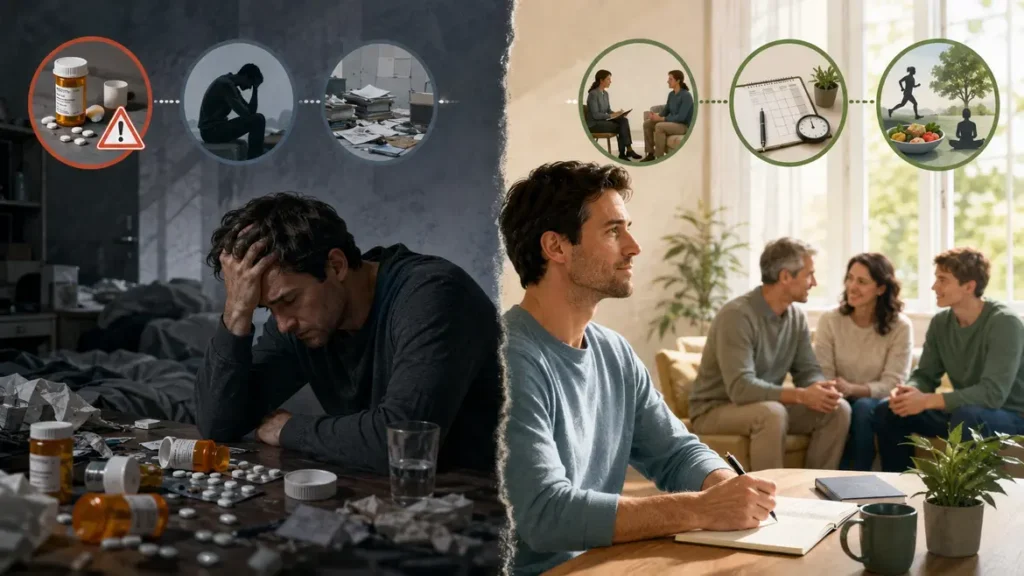
Leaving treatment with no plan is a real risk, because everyday life returns quickly. Stress comes back. Old contacts resurface. Pain can flare. Anxiety hits on a Tuesday for no clear reason. A relapse prevention plan is simply a way of getting ready for those moments before they arrive, rather than being caught flat-footed by them. A plan might include ongoing therapy, support groups, sober people to call, medication management, exercise, and a sleep routine, along with clear steps to take the moment a craving spikes. It usually also means steering clear of particular people, places, or habits for a while.
This is not about living in fear. It is about being prepared. It also helps to know that relapse does not mean treatment has failed. Recovery from a substance use disorder looks a lot like managing any other chronic condition, where a setback is a signal to adjust the plan, not proof that a person is hopeless. A solid plan turns a frightening moment into one a person can actually handle.
Daily Life Starts To Feel Possible Again
One of the most powerful parts of recovery is also the least dramatic. It is ordinary. Waking with a clear head. Remembering a conversation you had yesterday. Showing up on time and eating breakfast and laughing without having to force it and answering the phone without a jolt of panic and going to bed without counting anything.
To someone who has never struggled with addiction, these can look like nothing at all. To a person rebuilding a life, they are enormous. They are evidence that the brain and body can heal, which is exactly what the science of recovery describes: a real process of change through which people regain their health and start living self-directed lives again. They are proof that steadiness can return, and that addiction does not get the last word.
Recovery Is Not About Becoming Perfect
People often imagine that rehab is supposed to turn them into a completely different person, which is an intimidating thing to attempt. The truth is gentler. Recovery is mostly about becoming honest. Honest about what happened. Honest about what still hurts. Honest about what needs to change, and about what kind of support is needed to change it.
Nobody walks into treatment with everything figured out. People walk in because something has stopped working, and that is reason enough. A person does not have to feel brave in every single moment. They only have to be willing to take the next step.
Why Getting Help Matters
Prescription drug addiction has a way of making a life smaller and smaller, until it fits inside a daily routine of managing the next dose. Treatment works in the opposite direction. It opens life back up, offering medical care, emotional support, structure, therapy, and a practical plan for what comes after. More than any single piece of that, it offers a person the chance to stop merely surviving and start rebuilding.
That rebuilding often begins quietly. A phone call. One honest conversation. A bag packed on a hard night. A first appointment made after lying awake for hours. If reaching out feels like too much to face alone, a free and confidential line like SAMHSA’s National Helpline at 1-800-662-HELP exists for exactly that first, uncertain step. Small beginnings still lead somewhere. For a lot of people, that first step turns out to be the moment life finally starts moving in the right direction again.
Medical Disclaimer
This article is for general informational and educational purposes only and is not a substitute for professional medical advice, diagnosis, or treatment. Prescription medications should never be started, stopped, or changed without guidance from a qualified healthcare provider, as withdrawal from some drugs can be dangerous. If you or someone you know is struggling with prescription drug misuse, please speak with a licensed medical professional. In a life-threatening emergency, contact your local emergency services right away.
References
- National Institute on Drug Abuse. (2011, October). Summary of Misuse of Prescription Drugs. National Institute on Drug Abuse, National Institutes of Health, U.S. Department of Health and Human Services. https://nida.nih.gov/publications/research-reports/misuse-prescription-drugs/overview
- National Institute on Drug Abuse. (2018, June). Understanding Drug Use and Addiction DrugFacts. National Institute on Drug Abuse, National Institutes of Health, U.S. Department of Health and Human Services. https://nida.nih.gov/publications/drugfacts/understanding-drug-use-addiction
- Mayo Clinic Staff. (2024, July 20). How Opioid Use Disorder Occurs. Mayo Clinic. Mayo Foundation for Medical Education and Research. https://www.mayoclinic.org/diseases-conditions/prescription-drug-abuse/in-depth/how-opioid-addiction-occurs/art-20360372
- American Psychological Association. (2012, November 1). Understanding Psychotherapy and How It Works. American Psychological Association. https://www.apa.org/topics/psychotherapy/understanding
- Mayo Clinic Staff. (2024, January 24). Relaxation Techniques: Try These Steps to Lower Stress. Mayo Clinic. Mayo Foundation for Medical Education and Research. https://www.mayoclinic.org/healthy-lifestyle/stress-management/in-depth/relaxation-technique/art-20045368
- National Institute on Drug Abuse. (2025, June 9). Treatment. National Institute on Drug Abuse, National Institutes of Health, U.S. Department of Health and Human Services. https://nida.nih.gov/research-topics/treatment
- National Institute on Drug Abuse. (n.d.). Recovery. National Institute on Drug Abuse, National Institutes of Health, U.S. Department of Health and Human Services. https://nida.nih.gov/research-topics/recovery
- Substance Abuse and Mental Health Services Administration. (2023, June 9). National Helpline for Mental Health, Drug, Alcohol Issues. Substance Abuse and Mental Health Services Administration, U.S. Department of Health and Human Services. https://www.samhsa.gov/find-help/helplines/national-helpline