


She screamed at her husband over a misplaced phone charger. Screamed. Not irritated, not annoyed, full volcanic rage over something that wouldn’t have registered two years ago. The look on his face brought her back to herself, and she burst into tears. What was happening to her? She’d always been even-tempered, patient, the calm one in every room. Now she felt like a stranger in her own mind, hijacked by emotions that made no sense and scared everyone around her, including herself.
Mood Symptom Nobody Prepares You For
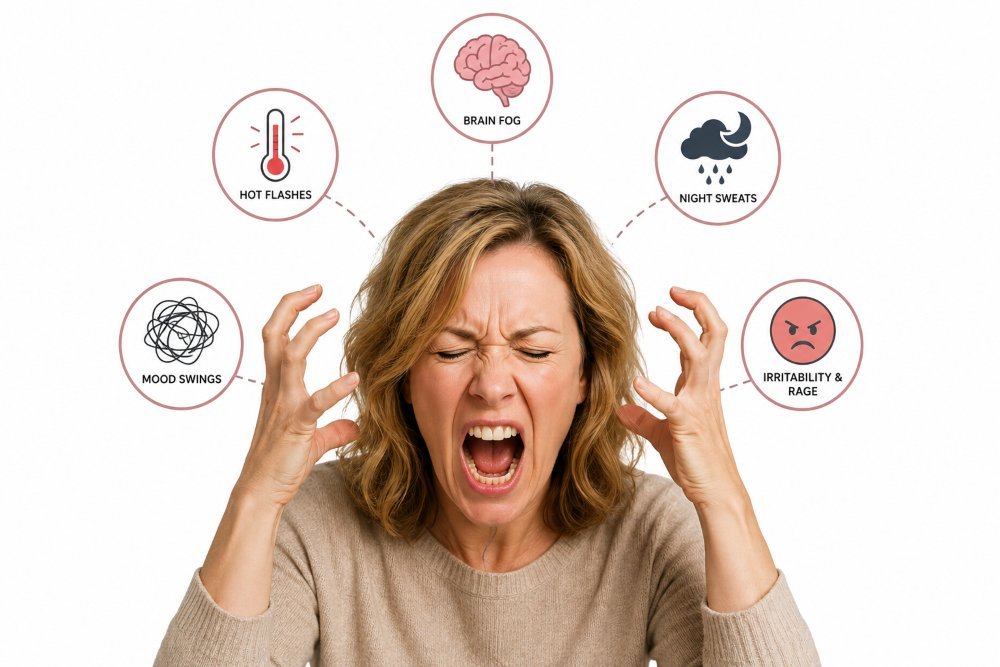
Hot flashes get all the attention. Night sweats, sure. Maybe some brain fog if you’re lucky enough to have a doctor who acknowledges it. But the rage? The irritability so intense it feels like a personality transplant? That barely gets mentioned, leaving women blindsided by emotions they can’t explain or control.
Here’s what’s actually happening: estrogen doesn’t just regulate your reproductive system. It modulates neurotransmitters that control mood: serotonin, dopamine, norepinephrine. When estrogen levels swing wildly during perimenopause, your brain’s emotional regulation system swings with it. The result isn’t weakness or character failure. It’s neurochemistry in chaos.
The rage often surprises women more than any other symptom because it feels so fundamentally unlike themselves. Hot flashes are uncomfortable but impersonal, your body doing something weird. Rage feels like you, like a character flaw, like something you should be able to control but can’t. That disconnect between who you’ve always been and how you’re suddenly behaving creates its own layer of distress.
“Menopause rage is one of the most distressing symptoms women describe to me, partly because it affects their relationships and self-image so profoundly,” explains Dr. Sundus Amena, expert contributor to ThisIsMenopause. “Women tell me they don’t recognize themselves. They’re frightened by their own reactions. What helps is understanding that this is hormonal, not personal. Your brain is experiencing significant neurochemical fluctuations, and irritability and rage are predictable responses to those fluctuations. It doesn’t excuse harmful behavior, but it explains it, and explanation is the first step toward management.”
Triggers That Didn’t Used to Be Triggers
What’s maddening about menopause rage is how disproportionate it feels. Things that would have mildly annoyed you before now send you into orbit. The barking dog. The slow driver. The family member who chews too loudly. Your tolerance has collapsed, and you don’t know why.
Part of this is the cumulative burden of menopause symptoms. You’re exhausted from disrupted sleep. You’re uncomfortable from hot flashes. You’re cognitively stretched from brain fog. By the time some minor irritation hits, you have no reserves left to absorb it. The reaction isn’t really about the phone charger or the chewing; it’s about everything piling up with nowhere to go.
The other part is neurological. Estrogen helps buffer stress responses. When it’s fluctuating or declining, your nervous system becomes more reactive. The gap between stimulus and response shrinks. You feel things faster, bigger, with less ability to moderate before reacting.
“Women often describe feeling like they’ve lost their filter,” explains Eileen Wang, Physician at Modern Menopause. “Things they would have let slide before now demand immediate response. It’s not that they’ve become less patient people; their neurological buffering capacity has genuinely decreased. Recognizing this helps women develop workarounds, like building in pauses before responding or removing themselves from situations when they feel dysregulation building.”
Relationship Toll
Nobody suffers menopause rage alone. Partners bear the brunt of outbursts they don’t understand. Children feel the shift in household atmosphere. Friendships strain under reactions that seem out of proportion. Work relationships suffer when irritability leaks into professional interactions.
The guilt afterward often exceeds the original rage. You know you overreacted. You see the hurt or confusion in the other person’s face. You apologize, but the apologies start sounding hollow when the pattern keeps repeating. Some women start isolating to protect others from themselves, which creates its own problems.
Partners who don’t understand what’s happening may take the rage personally. They may pull away, become defensive, or match escalation with escalation. Relationships that were stable for decades can suddenly feel fragile. Some couples genuinely struggle through this transition if they don’t recognize it as temporary and hormonal.
What Actually Helps

Managing menopause rage requires both immediate strategies for acute moments and longer-term approaches to reduce baseline reactivity.
In the moment, removing yourself works better than trying to suppress the feeling. Walking away, going outside, finding a few minutes alone- these create space between trigger and response. It’s not running away; it’s harm reduction.
Physical movement helps discharge the energy rage generates. A brisk walk, some aggressive cleaning, even just shaking out your hands and arms- anything that moves the activation through your body rather than letting it explode verbally.
Naming what’s happening can defuse it slightly. Telling your partner “I’m having a hormonal rage moment and I need ten minutes” is infinitely better than pretending nothing is wrong or trying to power through. It warns them, holds you accountable, and acknowledges the reality without letting it control the interaction.
Longer-term, hormone therapy helps many women significantly. Stabilizing estrogen levels stabilizes the neurotransmitter fluctuations driving the mood symptoms. It’s not appropriate for everyone, but for many women, it’s the intervention that actually addresses the root cause rather than just managing symptoms.
Sleep protection matters enormously. Poor sleep and irritability feed each other viciously. Prioritizing sleep, even when it means saying no to other things, can reduce baseline reactivity substantially.
Talking About It
Breaking the silence around menopause rage helps everyone. Telling your family what’s happening, explaining that it’s hormonal and temporary, and asking for patience while you work on management- this context changes how people interpret your behavior.
Some women find that their partners become more supportive once they understand. Others find that naming it helps them catch it earlier, intervening before full escalation. The shame around admitting you’re struggling often makes things worse, not better.
She finally told her husband what was happening. Showed him articles about perimenopause and mood. Explained that she was as confused and frightened as he was. He didn’t fully understand- how could he?- but he stopped taking the outbursts personally. He learned to recognize the signs and give her space. She started therapy to build better coping strategies. She talked to her doctor about hormone options. Slowly, the rage became less frequent, less intense, more manageable. She was still there. She just needed help finding her way back.
Medical Disclaimer
This article is for general educational purposes only and is not a substitute for professional medical advice, diagnosis, or treatment. Irritability, anger, anxiety, sleep problems, and mood changes can occur during perimenopause and menopause. Still, similar symptoms may also be linked to thyroid disorders, medication effects, depression, anxiety, or other health conditions.
Speak with a qualified healthcare professional if mood changes are severe, persistent, affecting your relationships or daily life, or feel difficult to control. Menopausal hormone therapy is not suitable for everyone and should only be considered after an individual assessment of symptoms, medical history, potential benefits, and possible risks. Do not start, stop, or change hormone therapy, antidepressants, or other medication without medical guidance.
References
- Maki PM, Kornstein SG, Joffe H, et al. Guidelines for the evaluation and treatment of perimenopausal depression: Summary and recommendations. Menopause. 2018;25(10):1069–1085.
- Maki PM, Kornstein SG, Joffe H, et al. Guidelines for the evaluation and treatment of perimenopausal depression: Summary and recommendations. Journal of Women’s Health. 2019;28(2):117–134.
- Gordon JL, Rubinow DR, Eisenlohr-Moul TA, Xia K, Schmidt PJ, Girdler SS. Efficacy of transdermal estradiol and micronized progesterone in the prevention of depressive symptoms in the menopause transition: A randomized clinical trial. JAMA Psychiatry. 2018;75(2):149–157.
- Gordon JL, Peltier A, Grummisch JA, Sykes Tottenham L. Estradiol fluctuation, sensitivity to stress, and depressive symptoms in the menopause transition: A pilot study. Frontiers in Psychology. 2019;10:1319.
- Turek J, Gąsior Ł. Estrogen fluctuations during the menopausal transition are a risk factor for depressive disorders. Pharmacological Reports. 2023;75:32–43.
- Borozan S, Kamrul-Hasan ABM, Pappachan JM. Hormone replacement therapy for menopausal mood swings and sleep quality: The current evidence. World Journal of Psychiatry. 2024;14(10):1605–1610.