

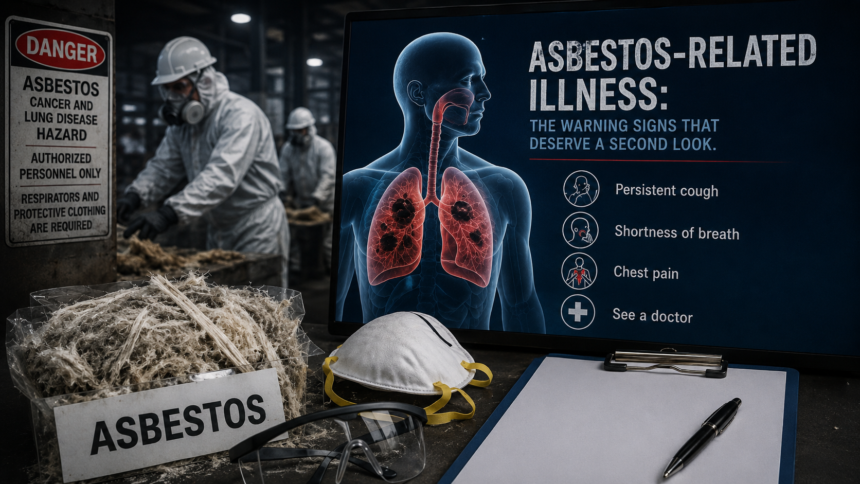
Most diseases announce themselves reasonably close to their cause. You catch something, and within days you feel it. Asbestos-related illness does not work that way. The exposure that matters may have happened during a summer job in 1974, in a boiler room nobody thought twice about, and the first symptom may not arrive until a person is well into retirement.
That delay is the central problem. By the time breathlessness or a nagging cough shows up, the job that caused it has been out of mind for decades. The symptom gets filed under getting older. Nobody mentions the shipyard, because nobody connects the shipyard to a chest that feels tight on the stairs.
This article is about closing that gap. It is not a diagnostic tool, and no list of symptoms can tell you what you have. What it can do is help you recognize when a set of ordinary complaints deserves a real conversation with a physician, and when your work history belongs in that conversation.
Why This Disease Hides in Plain Sight
Mesothelioma is a cancer of the mesothelium, the thin tissue lining the chest, abdomen and the space around the heart. Most cases are caused by asbestos.
Its early symptoms are almost aggressively unremarkable. Shortness of breath. A cough that will not quit. Some weight coming off without effort. Tiredness that sleep does not fix. The American Cancer Society notes plainly that these early symptoms are more often caused by other things, which is exactly why people set them aside.
That is not a failure of attention. It is a reasonable response to symptoms that usually mean something benign. The signal is not any single complaint. The signal is a complaint that persists, worsens, or has no obvious explanation, occurring in someone whose history includes asbestos.
Symptoms Split by Where the Disease Starts
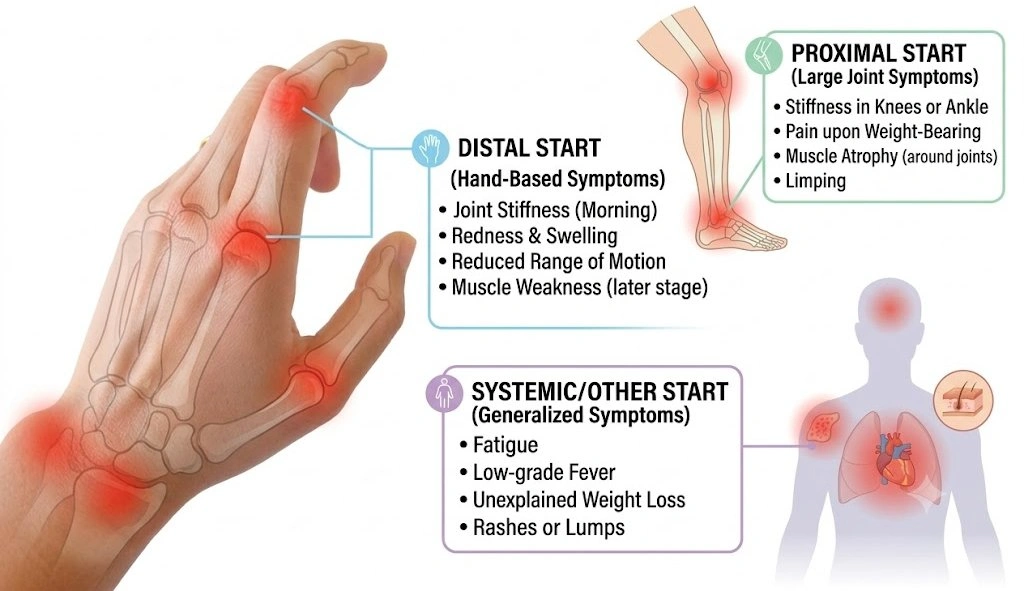
Mesothelioma presents very differently depending on which lining is involved, and this is the part most symptom lists flatten out.
Pleural mesothelioma develops around the lungs. It tends to produce chest complaints: breathlessness, pain around or beneath the ribs, a persistent cough. Fluid often collects between the lung and the chest wall, which compresses the lung and makes the breathlessness worse. That fluid buildup is frequently what sends someone to a doctor in the first place.
Peritoneal mesothelioma develops in the abdominal lining, and it looks like a digestive problem. Swelling. Abdominal pain. Constipation. Loss of appetite. Weight loss. Sometimes a palpable lump. A person with these symptoms is unlikely to think about their lungs at all, and neither, initially, is anyone else.
| Where it starts | What people commonly notice |
|---|---|
| Pleura (around the lungs) | Getting winded on stairs or walks that used to be easy; ongoing chest or rib pain; a cough with no clear cause; a sense of pressure when breathing deeply |
| Peritoneum (abdominal lining) | Swelling or fullness in the belly; abdominal pain; constipation; loss of appetite; a lump that can be felt |
| Either | Weight loss without trying; fatigue that does not resolve with rest; night sweats or low-grade fever |
None of this is diagnostic. Every entry in that table has a long list of more likely explanations. Its usefulness is as a prompt, particularly when several appear together and stay.
What the National Numbers Actually Show
Mesothelioma is genuinely rare. Compared with lung, breast or prostate cancer, the case counts are small, and they are falling as historical exposure recedes.
According to the CDC’s 2025 malignant mesothelioma data, 2,669 cases were reported in the United States in 2022. Across the twenty years from 2003 to 2022, federal registries recorded 63,620 cases in total, and the distribution across body sites is where the data becomes clinically interesting.
| Site | All cases, 2003 to 2022 | Share of male cases | Share of female cases |
|---|---|---|---|
| Pleura | 81.0% | 84.2% | 71.1% |
| Peritoneum | 11.1% | 8.1% | 20.5% |
| Other sites | 7.5% | 7.3% | 8.0% |
| Pericardium | 0.2% | 0.1% | 0.3% |
| Tunica vaginalis | 0.2% | 0.3% | 0.0% |
The headline figure, 81 percent pleural, explains why almost all public messaging about mesothelioma is about breathing. But look at the split. Among women, peritoneal disease accounts for roughly one in five cases, more than twice the proportion seen in men.
That single comparison carries a practical warning. Women with an asbestos history are considerably more likely than men to present with abdominal symptoms rather than chest symptoms, and abdominal symptoms are the ones least likely to trigger anyone’s asbestos alarm. Persistent bloating in a woman whose father or husband came home from a plant in dusty coveralls is not an obvious mesothelioma story to most people. Statistically, it is more of one than the public conversation suggests.
There Is No Screening Test, Which Is Precisely Why This Matters
It is reasonable to assume that people with known asbestos exposure are routinely screened. They do not.
The American Cancer Society is direct about this: no major medical organization currently recommends mesothelioma screening, even for people known to have been exposed. Some physicians order periodic chest imaging for high-risk patients, but the evidence that it catches disease early enough to change outcomes is not established. Most mesotheliomas are found because someone went to a doctor about symptoms.
That is an uncomfortable fact, and it is the reason a piece like this exists. In the absence of a screening program, symptom awareness plus a disclosed exposure history is the system. There is no safety net underneath it.
Mesothelioma Is Not the Only Asbestos Disease

Asbestos causes a range of illnesses, and their symptoms overlap enough that a list cannot separate them.
Asbestosis is scarring of lung tissue from inhaled fibers. ATSDR describes how the scarring impedes gas exchange, which is why the dominant symptom is breathlessness that worsens over time, often alongside a dry cough, chest tightness and reduced exercise capacity. Physicians may hear crackles at the lung bases. In advanced disease, the fingertips can widen and round in a change called clubbing. Mayo Clinic’s overview of asbestosis also notes that having asbestosis raises the risk of lung cancer, particularly for people who smoke or once did.
Asbestos-related lung cancer can cause a worsening cough, chest pain, breathlessness, weight loss or coughing up blood. That last symptom warrants prompt medical attention regardless of anyone’s exposure history.
Pleural plaques and pleural thickening are non-cancerous changes to the membrane around the lung. They often cause no symptoms at all and are found incidentally on imaging. They are not precursors to cancer, though the National Cancer Institute notes that people with asbestos-related pleural disease may carry elevated lung cancer risk. Asbestos exposure has also been linked to cancers of the larynx and ovary.
The point of listing these together is not to expand the worry. It is that they cannot be told apart from a symptom description, which is another way of saying that this is a question for imaging and a physician rather than for a search engine.
Exposure Was Probably a Long Time Ago
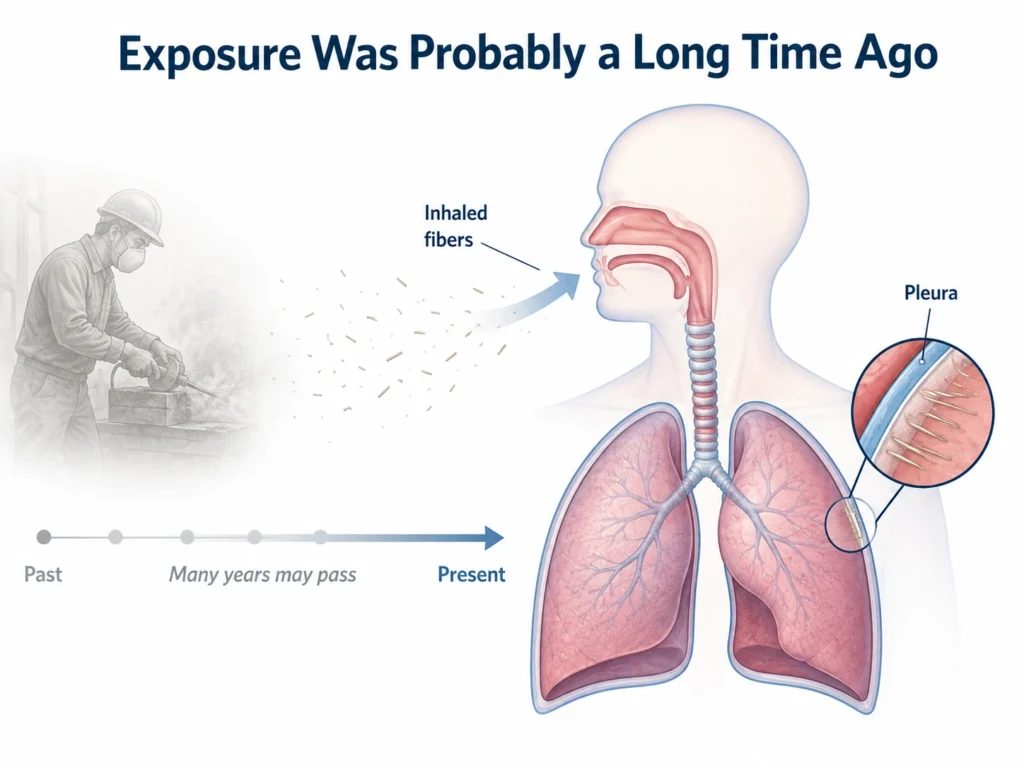
Asbestos use in the United States peaked in the 1970s and declined sharply afterward as mines closed and products came off the market. The illnesses being diagnosed now largely trace back to that earlier era.
Asbestosis symptoms are commonly described as emerging 10 to 40 years after exposure begins. Mesothelioma latency is typically longer still, often two decades or more and sometimes far beyond that. A person diagnosed today may be dealing with fibers inhaled before their children were born.
The trades where exposure was routine are well documented. OSHA maintains standards specific to general industry, construction and shipyards, which is itself a map of who was most at risk: insulation installers, shipyard workers, boilermakers, pipefitters, electricians, mechanics working on brakes and clutches, refinery and power plant workers, demolition crews and construction laborers.
Military service belongs on that list too. Asbestos was widespread in Navy vessels, base housing and infrastructure, and the VA’s public health guidance on asbestos exposure covers both the health effects and the disability compensation process for service-connected illness.
Older buildings remain a live consideration rather than a purely historical one. The EPA’s guidance on asbestos in the home explains that intact, undisturbed material is generally not a hazard, but that cutting, sanding, drilling or improperly removing it can release fibers. Renovation is when risk appears.
Exposure Did Not Stop at the Factory Gate
One of the most consequential and least discussed exposure routes involves people who never worked around asbestos at all.
Fibers travel home on clothing, shoes, skin and hair. A spouse shaking out coveralls before putting them in the wash was, in effect, handling the material. The National Cancer Institute’s fact sheet notes evidence that family members of heavily exposed workers face increased mesothelioma risk for exactly this reason, which is why federal rules now require some employers to provide showers, separate storage for street clothes and controls on laundering work garments.
If you are trying to build an exposure history, the question is not only “where did you work.” It is also “what did the people in your household do, and did their work clothes come home dirty?”
What to Tell a Doctor, and Why the Details Matter
Physicians cannot factor in an exposure they do not know about, and patients routinely fail to mention jobs they consider ancient history.
Bring specifics. The employer’s name. The years. What the job actually involved, in physical terms, rather than the job title. Whether the work meant cutting insulation, sweeping dust, working overhead in old buildings, or handling brake components. Military assignments, including ship names and hull numbers if you have them. Renovation projects on older homes—household members’ occupations.
Evaluation depends on what the symptoms suggest, and may involve chest imaging, CT scanning, pulmonary function testing or blood work. If an abnormality appears and mesothelioma is suspected, further testing is generally needed before the diagnosis can be confirmed. Federal registry data indicate that 93 percent of recorded mesothelioma cases were confirmed microscopically, which reflects how much this diagnosis depends on tissue rather than imaging alone.
After a Diagnosis, Two Separate Clocks Start Running
For anyone newly diagnosed, medical care is the priority and should stay the priority. Treatment planning may involve oncologists, thoracic or abdominal surgeons and palliative care specialists, and it moves quickly.
Running alongside it is a second, quieter process that families are often unprepared for. Establishing where the exposure occurred can require decades-old employment records, union documentation, plant and jobsite information, and identification of specific products used at a particular site in a particular year. Companies merge, dissolve or reorganize. Coworkers who could corroborate an account get harder to find every year. Statutes of limitation vary by state and are generally measured from diagnosis rather than from exposure, so the calendar is not indefinite.
None of that reconstruction should land on a patient in the middle of treatment. Firms that handle these cases regularly maintain their own records of historical worksites and products, and a diagnosed person can have that investigation run in parallel rather than doing it themselves. Nemeroff Law Firm works with patients and families on exactly this kind of history, and its experienced mesothelioma attorneys can walk through what options exist after a diagnosis without pulling attention away from the medical side of it.
When to Make the Appointment
An occasional cough or a tired week means very little on its own. The threshold is persistence, progression, or the absence of any sensible explanation.
Book the appointment for shortness of breath that is not improving, ongoing chest or rib pain, unexplained weight loss, abdominal swelling or pain that keeps up, a cough that has outlasted any plausible cause, or fatigue that rest does not touch. Then say the thing people leave out: mention the exposure history, even if it is 40 years old, even if you are not certain, even if it was somebody else’s job and not yours.
Symptoms cannot tell you whether you have mesothelioma, asbestosis, lung cancer or something with nothing to do with asbestos at all. What they can do is start a conversation that includes the right history. For a disease this slow and this quiet, that conversation is most of the battle.
This article is general information and is not medical or legal advice. Anyone experiencing the symptoms described should consult a physician.