


A tight chest feeling is not always a heart attack. It is a symptom with over a dozen possible causes, ranging from acid reflux to anxiety to genuine cardiac problems. The cause determines whether you need rest, antacids, or an ambulance.
Chest tightness is one of the top reasons people visit emergency rooms in the US, with over 8 million ER visits annually for chest-related complaints. Most of those visits are not cardiac. But some are. Knowing the difference before you get there changes the outcome.
This guide is designed to help readers understand the possible causes of a tight chest feeling, recognise key warning signs, and make informed decisions about when to seek medical care. It aims to simplify complex medical information into clear, practical guidance so you can respond appropriately rather than react out of panic or delay necessary help.
Common Causes of a Tight Chest Feeling
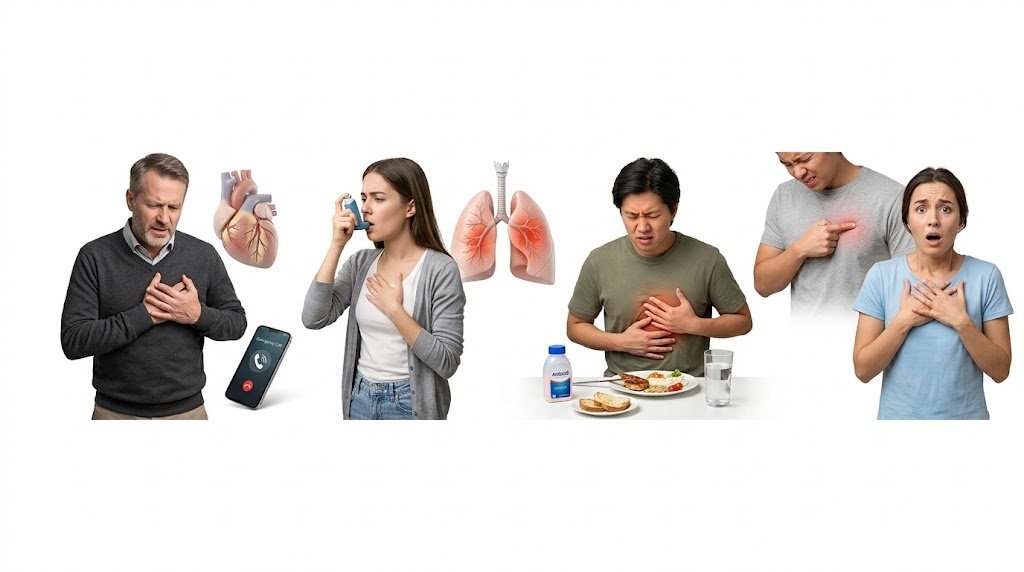
A tight chest feeling has different characteristics depending on its source. Location, timing, and what makes it better or worse are the clues.
Heart-Related Causes of Chest Tightness
The heart-related causes of chest tightness are the ones that cannot wait. These three are the main ones doctors rule out first.
- Angina is chest tightness caused by reduced blood flow to the heart muscle. It feels like pressure or squeezing behind the breastbone. It typically lasts 2 to 10 minutes and fades with rest. Stable angina follows a pattern, triggered by exertion or stress, and relieved with rest. Unstable angina happens without warning and does not improve with rest. Unstable angina is a medical emergency.
- A heart attack causes a tight chest feeling that does not go away. It lasts more than 15 to 20 minutes. The pain spreads to the left arm, jaw, neck, or back. Cold sweats, nausea, and shortness of breath come with it. Women sometimes skip the chest pain entirely and feel only jaw pain, nausea, or extreme fatigue. If these signs appear, call emergency services immediately. Do not drive yourself.
Pericarditis is inflammation of the sac around the heart. The tightness is sharp, worsens when lying flat, and improves when leaning forward. It often follows a viral illness. Most cases resolve in weeks with anti-inflammatory medication like ibuprofen.
Lung and Respiratory Causes
- Asthma: Tightness with wheezing and shortness of breath. Worsens at night or after exercise. A bronchodilator inhaler relieves it within minutes.
- Pneumonia: Tightness with fever, productive cough, and fatigue. Breathing deeply worsens the pain. Needs medical assessment and often antibiotics.
- Pulmonary embolism: A blood clot in the lungs. Causes sudden, sharp chest tightness with rapid breathing and low oxygen. This is a life-threatening emergency. People with recent surgery, long flights, or a history of blood clots are at higher risk.
Digestive Causes
- Acid reflux (GERD) causes a burning, tight chest feeling that rises from the stomach toward the throat. It worsens after eating, lying down, or bending forward. It improves with antacids. Roughly 42% of Americans report GERD symptoms at least once a month, making this one of the most common non-cardiac causes of chest tightness and GERD back pain.
- Esophageal spasm causes sudden, intense chest tightness that mimics a heart attack. It happens when the esophagus (the tube from mouth to stomach) contracts abnormally. Cold liquids sometimes trigger it. It resolves in minutes to hours.
Musculoskeletal Causes
- Muscle strain from lifting, coughing, or poor posture causes chest tightness that worsens with movement or when you press on the chest wall. This is different from cardiac pain, which does not change with touch.
- Costochondritis is inflammation where the ribs connect to the breastbone. Pressing on the area reproduces the pain. It heals on its own in days to weeks with rest and anti-inflammatory medication.
Anxiety and Panic Attacks
Anxiety triggers a real physical tight chest feeling. The brain activates the stress response, flooding the body with adrenaline. This tightens the chest muscles and speeds up breathing. Hyperventilation (breathing too fast) drops carbon dioxide levels, which causes additional chest tightness, dizziness, and tingling in the fingers.
Panic attacks peak within 10 minutes. The chest tightness during a panic attack is intense but not dangerous. Slowing the breathing cycle breaks the attack. This distinguishes it from cardiac tightness, which does not respond to breathing changes.
Symptoms Associated with Chest Tightness
Chest tightness does not come alone. These are the symptoms that accompany it and what each one points toward:
| Symptom | Possible Cause |
| Pressure or squeezing | Angina or heart attack |
| Shortness of breath | Asthma, pulmonary embolism, heart failure |
| Rapid heartbeat | Anxiety, panic attack, arrhythmia |
| Dizziness | Low blood pressure, pulmonary embolism, panic attack |
| Pain spreading to jaw or arm | Heart attack |
| Burning that rises to throat | Acid reflux (GERD) |
| Worsens when pressing chest | Costochondritis or muscle strain |
| Worsens lying flat, improves leaning forward | Pericarditis |
Chest Tightness During Exercise
Chest tightness during exercise is not always abnormal. Mild breathlessness during intense cardio is a normal response. The heart and lungs work harder. Some pressure is expected.
Abnormal signs during exercise:
- Tightness that starts during moderate activity and gets worse with continued effort
- Pain spreading to the arm or jaw
- Sudden dizziness or near-fainting
- Tightness that continues after you stop exercising
Chest tightness during exercise that appears specifically during exertion and fades within 10 minutes of rest is a textbook sign of stable angina. This needs a cardiology evaluation, not just rest.
Stop exercising immediately if tightness is accompanied by jaw pain, arm pain, nausea, or shortness of breath that does not resolve within 5 minutes of stopping. Call emergency services.
Exercise-induced asthma also causes chest tightness during exercise, usually starting 5 to 10 minutes into physical activity. An inhaler before exercise prevents this.
How to Relieve Chest Tightness

How to Relieve Chest Tightness at Home
Relieve chest tightness at home using these approaches, matched to the likely cause:
- Deep breathing: Breathe in for 4 seconds, hold for 2, exhale for 6. This resets carbon dioxide levels and relaxes chest muscles within 2 to 3 minutes.
- Posture correction: Slumping compresses the chest cavity. Sitting upright or standing opens the ribcage and reduces pressure immediately.
- Warm compress: For musculoskeletal tightness, a warm cloth on the chest wall for 15 minutes reduces muscle tension.
- Antacids: For reflux-related tightness, calcium carbonate antacids (Tums, Gaviscon) work within 5 to 10 minutes.
These methods relieve chest tightness at home only when the cause is non-cardiac. Do not use home remedies if cardiac symptoms are present.
Anxiety-Related Chest Tightness Relief
How to relieve chest tightness from anxiety focuses on breaking the stress cycle:
- Box breathing: Inhale for 4 counts, hold for 4, exhale for 4, hold for 4. Repeat 4 times. This is the same technique used by US Navy SEALs to manage physical stress responses.
- Grounding technique: Name 5 things you can see, 4 you can touch, 3 you can hear. This pulls the brain out of the panic loop and reduces adrenaline release.
- Progressive muscle relaxation: Tense and release each muscle group from the feet upward. Reduces physical chest tension within 10 minutes.
How to relieve chest tightness from anxiety long-term requires treating the anxiety itself through therapy (specifically CBT), not just managing each episode.
Medical Treatment Options
Medications for chest tightness cause vary by diagnosis:
- Antacids or proton pump inhibitors (omeprazole): For GERD-related tightness
- Bronchodilator inhalers (salbutamol/albuterol): For asthma-related tightness
- Nitrates (glyceryl trinitrate/GTN spray): For angina; works within 1 to 3 minutes under the tongue
- NSAIDs (ibuprofen): For costochondritis and pericarditis
- SSRIs or benzodiazepines: For anxiety-driven tightness, prescribed by a doctor
- Beta-blockers or calcium channel blockers: Medication for chest tightness causes linked to angina or heart disease
Medication for chest tightness that are linked to the heart requires a formal diagnosis first. Never self-prescribe cardiac medication.
Diagnosis of Chest Tightness
Doctors use a layered approach to identify the cause:
- Physical exam: Listening to heart and lungs, pressing on the chest wall to check for costochondritis
- ECG (electrocardiogram): Records the heart’s electrical activity. Shows signs of a heart attack, angina, or arrhythmia within minutes
- Blood tests: Troponin levels rise within 3 to 6 hours of a heart attack. Normal troponin with normal ECG rules out most cardiac causes.
- Chest X-ray: Shows pneumonia, enlarged heart, or fluid in the lungs
- CT pulmonary angiography: The gold standard test for pulmonary embolism
An ECG and troponin blood test together rule out a heart attack with over 99% accuracy within 3 hours of symptom onset.
Can Chest Tightness Be Prevented?
- For cardiac causes: yes, with consistent lifestyle management. High blood pressure, smoking, high cholesterol, and diabetes are the four biggest risk factors for angina and heart attacks. Controlling all four significantly reduces cardiac chest tightness.
- For reflux: avoid large meals, alcohol, caffeine, and lying down within 2 hours of eating.
- For anxiety, regular aerobic exercise reduces baseline cortisol and anxiety levels. A 2018 study in JAMA Psychiatry found that 30 minutes of moderate cardio 5 days a week reduced anxiety symptoms by up to 48%.
- For asthma: identify and avoid triggers (dust, cold air, pollen). Pre-treat with an inhaler before exercise if exercise-induced asthma is the pattern.
Frequently Asked Questions
What causes a tight chest feeling?
- A tight chest feeling has over 10 documented causes. The most common are acid reflux (GERD), anxiety, asthma, and musculoskeletal strain. The most serious are angina, heart attack, and pulmonary embolism. Cause identification depends on the location, timing, and what makes it better or worse.
How do I know if chest tightness is heart-related?
- Heart-related causes of chest tightness follow a specific pattern: pressure or squeezing behind the breastbone, pain spreading to the left arm or jaw, tightness lasting more than 15 minutes, and no relief from position changes or antacids. Sweating and nausea alongside chest tightness are strong cardiac indicators.
Can anxiety cause chest tightness?
- Yes. Anxiety triggers adrenaline, which tightens chest muscles and speeds up breathing. Hyperventilation drops carbon dioxide, adding more tightness and dizziness. To relieve chest tightness from anxiety quickly, slow your exhale to 6 seconds. This reverses the carbon dioxide drop within 2 to 3 minutes.
How to relieve chest tightness at home quickly?
- To relieve chest tightness at home, use 4-6 breaths (inhale 4 seconds, exhale 6 seconds) for anxiety causes, calcium carbonate antacids for reflux causes, and an upright posture with a warm compress for muscle strain. These work within 5 to 15 minutes for non-cardiac tightness.
Is chest tightness during exercise dangerous?
- Chest tightness during exercise is dangerous when it starts during moderate activity, spreads to the arm or jaw, and continues after you stop. That pattern signals angina or early heart disease. Tightness that appears only during intense sprinting and fades within 2 minutes of rest is typically benign.
What medications help with chest tightness?
- Medication for chest tightness depends on the diagnosis. GTN spray works in 1 to 3 minutes for angina. A salbutamol inhaler works in 5 minutes for asthma. Omeprazole reduces reflux tightness over days. Ibuprofen treats costochondritis and pericarditis within hours.
When should I go to the ER for chest tightness?
- Go to the ER immediately if the tight chest feeling lasts more than 15 minutes, spreads to the jaw, arm, or back, comes with sweating, vomiting, or fainting, or appears suddenly at rest with no clear trigger. Do not drive yourself. Call emergency services.
Can acid reflux cause chest tightness?
- Yes. Acid reflux causes a burning, tight chest feeling that rises from the stomach toward the throat, worsens after eating or lying down, and improves within 10 minutes of taking antacids. This is distinct from cardiac tightness, which does not respond to antacids.
How long does anxiety-related chest tightness last?
- Anxiety-related tight chest feeling during a panic attack peaks at 10 minutes and fully resolves within 20 to 30 minutes. Chronic anxiety causes low-grade tightness that persists for hours. Box breathing reduces an active anxiety episode to under 5 minutes in most cases.
Is chest tightness always serious?
- No. Most cases of a tight chest feeling are benign. Acid reflux, muscle strain, anxiety, and costochondritis account for the majority of cases seen in general practice. The serious causes, specifically cardiac and pulmonary, are identified by specific accompanying symptoms, not by chest tightness alone.
Closing Thoughts
A tight chest feeling can be unsettling, but it is not automatically a sign of something life-threatening. In many cases, it is linked to manageable conditions such as acid reflux, anxiety, or muscle strain. The key difference lies in recognising patterns.
Short-lived discomfort that improves with rest, posture changes, or simple remedies is often less serious. However, persistent pressure, spreading pain, or symptoms like breathlessness, sweating, or dizziness should never be ignored.
The most important takeaway is this: when in doubt, treat chest symptoms with caution. It is always better to seek medical evaluation and be reassured than to overlook a serious condition. Understanding your body, knowing your risk factors, and acting early can make a significant difference in outcomes.
References
- Amsterdam, E.A. et al. (2014). Testing of low-risk patients presenting to the emergency department with chest pain. Journal of the American College of Cardiology, 63(12), pp. 1147–1157. DOI: 10.1016/j.jacc.2013.11.061
- Benjamin, E.J. et al. (2019). Heart disease and stroke statistics update. Circulation, 139(10), pp. e56–e528. DOI: 10.1161/CIR.0000000000000659
- Cannon, C.P. and Braunwald, E. (2018). Unstable angina and non-ST elevation myocardial infarction. Harrison’s Principles of Internal Medicine. DOI: 10.1036/0071802152
- Eslick, G.D. and Talley, N.J. (2008). Non-cardiac chest pain: Squeezing the life out of the Australian healthcare system. Medical Journal of Australia, 189(11–12), pp. 607–608. DOI: 10.5694/j.1326-5377.2008.tb02257.x
- Fass, R. and Achem, S.R. (2011). Noncardiac chest pain: Epidemiology, natural course and pathogenesis. Journal of Neurogastroenterology and Motility, 17(2), pp. 110–123. DOI: 10.5056/jnm. 2011.17.2.110
- Kline, J.A. et al. (2004). Clinical criteria to prevent unnecessary diagnostic testing in emergency department patients with suspected pulmonary embolism. Journal of Thrombosis and Haemostasis, 2(8), pp. 1247–1255. DOI: 10.1111/j.1538-7836.2004.00790.x
- Nabel, E.G. and Braunwald, E. (2012). A tale of coronary artery disease and myocardial infarction. New England Journal of Medicine, 366(1), pp. 54–63. DOI: 10.1056/NEJMra1112570
- Ong, T.H. and Keng, F.Y.J. (2008). Chest pain evaluation in the emergency department. Singapore Medical Journal, 49(5), pp. 357–362. DOI: 10.11622/smedj.2008.49.5.357
- Piepoli, M.F. et al. (2016). European guidelines on cardiovascular disease prevention in clinical practice. European Heart Journal, 37(29), pp. 2315–2381. DOI: 10.1093/eurheartj/ehw106
- Smoller, J.W. et al. (2016). Panic anxiety, dyspnea, and respiratory disease. American Journal of Respiratory and Critical Care Medicine, 194(6), pp. 659–667. DOI: 10.1164/rccm.201604-0736PP
Disclaimer
This article is for informational and educational purposes only and does not constitute medical advice, diagnosis, or treatment. Chest tightness can be a symptom of serious medical conditions, including a heart attack or a pulmonary embolism. Always seek immediate medical attention if you experience persistent chest pain, pressure, or associated symptoms such as shortness of breath, dizziness, sweating, or pain spreading to the arm or jaw. Consult a qualified healthcare professional for personalised medical guidance.