By using this site, you agree to the Privacy Policy and Terms.
Accept
DoctiPlus Logo DoctiPlus Logo
  • Find
  • Patient
  • Doctors
  • Health Conditions
  • Write For Us
  • Complaints & Feedback
  • Login
DoctiplusDoctiplus
Aa
  • Doctiplus | Doctors Online 24/7 Without Registration
  • Find
  • Our Services
  • Sign Up
Search
  • Find
  • Our Services
  • Sign Up
Follow US
Addiction RecoveryHealthcare News and Updates

The Connection Between Dementia Behaviors and Hallucinations

Natalia Dankwa Psychotherapist
Last updated: 2026/08/14 at 4:21 PM
By Natalia Dankwa Psychotherapist
Share
17 Min Read
The Connection Between Dementia Behaviors and Hallucinations
SHARE

A daughter walks into her mother’s kitchen and gets shoved toward the door. A husband of forty years is accused, with total conviction, of being a stranger who has broken in. A calm afternoon curdles into panic over insects that no one else can see. To the people living it, these look like behavior problems, sudden cruelty, or a personality unraveling. Much of the time they are something else entirely. They are the visible end of a thread whose other end is a hallucination.

Contents
Two Symptoms, or One Chain of Cause and EffectWhy the Brain Conjures What Isn’t ThereHow a Hallucination Becomes a BehaviorWhen the Change Is Sudden, Suspect Something ReversibleThe Medication TrapWhat Actually HelpsDisclaimerReferences

That thread is the real subject here. The usual way these symptoms get discussed treats hallucinations and difficult behaviors as two separate entries on a checklist, one perceptual and one behavioral, each managed on its own terms. In practice they are frequently a single chain of cause and effect. The behavior is what everyone in the room can see. The hallucination is what only one person can see, and it is often the reason the behavior exists at all.

Two Symptoms, or One Chain of Cause and Effect

Two Symptoms, or One Chain of Cause and Effect

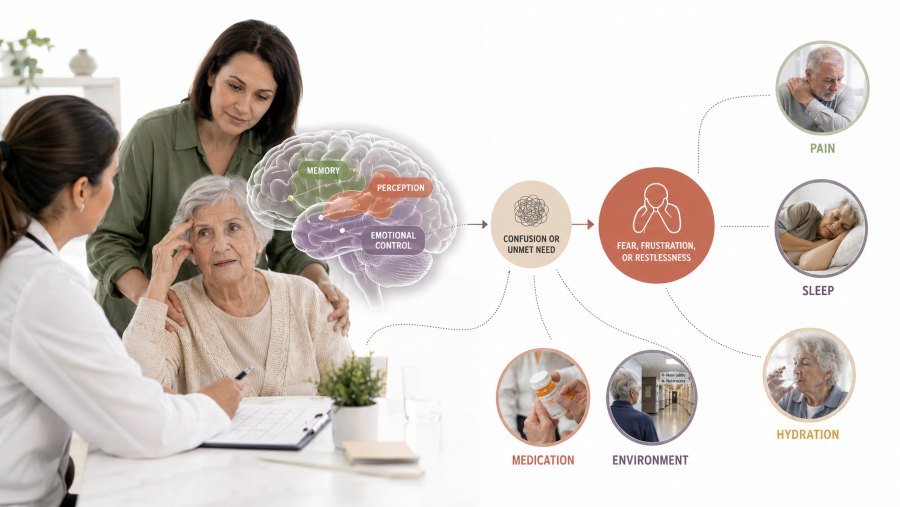
Clinicians describe the noncognitive side of dementia using an umbrella term, and it helps to know it, because it is what a doctor will reach for. The agitation, the aggression, the wandering, the suspicion, the hallucinations, and the delusions are grouped together as the noncognitive changes known as behavioral and psychological symptoms of dementia. Grouping them is useful for a chart. It is misleading for a family, because it flattens a relationship that matters. Within that cluster, psychosis, meaning hallucinations and delusions, sits upstream of a great deal of the behavior. Someone who genuinely sees a menacing figure by the bed does not become agitated for no reason. They become agitated for an excellent reason that happens not to be real.

Hold that distinction and a lot of what looks irrational starts to make a grim kind of sense. The person is not misbehaving. They are behaving exactly as any of us would if the room contained what they perceive it to contain. The problem is not their logic. The problem is their input.

Why the Brain Conjures What Isn’t There

Hallucinations are not distributed evenly across dementia. They cluster, and the clustering is one of the more useful diagnostic clues in the whole field.

They are most characteristic of the Lewy body dementias, which include dementia with Lewy bodies and Parkinson’s disease dementia. Recurrent, well formed visual hallucinations are so central to this group that they appear in the international consensus criteria used to diagnose dementia with Lewy bodies as one of its core clinical features, not a late complication but often an early calling card. The numbers bear this out. A meta-analysis of hallucination prevalence across Parkinson’s disease and Lewy body dementia put the pooled rate of visual hallucinations at roughly 28 percent in Parkinson’s disease and about 62 percent in dementia with Lewy bodies, with auditory hallucinations less common in both. Consumer health guidance from the National Institute on Aging goes further, noting that visual hallucinations occur in a large majority of people with Lewy body dementia and frequently appear early in the disease. In Alzheimer’s disease, by contrast, hallucinations are less frequent and tend to arrive later, and many of what look like hallucinations there are actually misperceptions, a coat on a door read as a person, a shadow read as an animal.

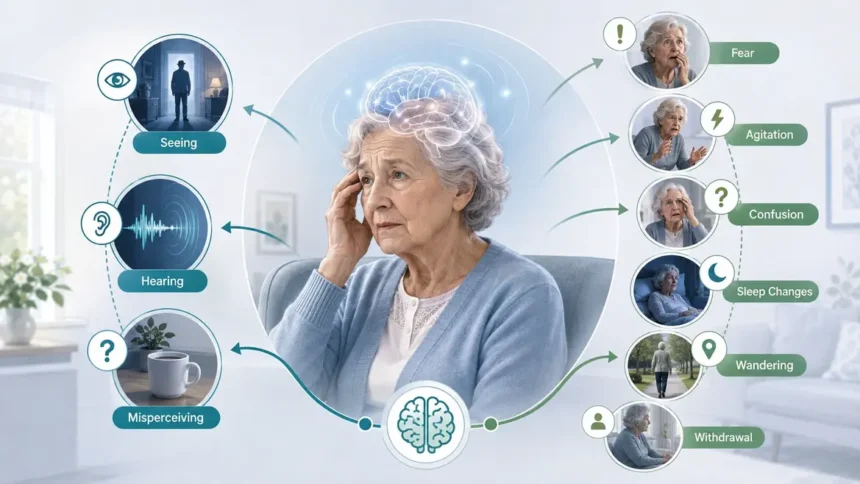
The mechanism is not mystical. Visual hallucinations in Lewy body disease track with damage and dysfunction in the brain’s visual and attention systems, the networks that are supposed to sort incoming signals into a stable picture of the world. When the higher visual areas and the attentional machinery that checks them fall out of step, the brain does what brains do with ambiguous or degraded input. It fills the gap with a guess, and it presents the guess as fact. A person prone to this is far more likely to conjure a figure out of a bunched curtain or a face out of a patterned rug, because the raw material is already there and the editor that would normally overrule it has gone quiet.

How a Hallucination Becomes a Behavior

This is where perception turns into action, and where families get hurt.

Follow the logic from the inside. If you sincerely believe there is a stranger in your home, you might raise your voice, refuse to let them near you, or try to make them leave. If you feel insects on your skin, you scratch, you pick, you demand help, you refuse to sit still. If the familiar face in front of you has been replaced, in your perception, by an impostor wearing your husband’s clothes, you pull away from the impostor. None of these responses is a character flaw. Each is a reasonable answer to a false premise.

How a Hallucination Becomes a Behavior

The cruel arithmetic is that the people most often on the receiving end are the ones who are present, which means the family and the primary caregiver. They are close enough to be woven into the delusion, and they are there at the moment the fear peaks. Caregivers describe the particular grief of being treated as an intruder by a parent, or as a threat by a spouse. The pattern of dementia and being mean to family is among the most painful and most misread parts of the illness, precisely because the hostility is not really aimed at the family at all. It is aimed at a frightening world that only the patient can see, and the family simply happens to be standing inside it. Research on caregiving reinforces how heavy this load is. Studies of family caregiver burden have found that the psychosis symptoms, hallucinations and delusions among them, act as a pathway through which declining function translates into caregiver distress, rather than being a side issue.

Reframing the behavior as a downstream effect is not a soft or sentimental move. It is the step that points toward everything that actually works, and away from the responses that make things worse.

When the Change Is Sudden, Suspect Something Reversible

Before anyone concludes that new hallucinations are simply the disease advancing, there is an urgent question to ask. Did this come on quickly.

A gradual increase in hallucinations over months can fit the trajectory of a Lewy body dementia. A sharp change over hours or days is a different animal, and it is often a treatable one. Sudden confusion and hallucination in an older adult is the signature of delirium, an acute and usually reversible disturbance that rides on top of the dementia rather than being part of it. The Alzheimer’s Society is blunt that hallucinations arriving with a physical illness such as infection can signal delirium, which it treats as a medical emergency. The most notorious trigger in this age group is a urinary tract infection, which in older adults frequently announces itself not with fever or pain but with confusion, agitation, or hallucinations that appear from nowhere. Medications, dehydration, constipation, poor sleep, and pain can all do the same. People with Lewy body dementia are especially prone to tipping into delirium when infection strikes, which makes prompt assessment all the more important.

The practical rule is simple and worth holding onto. A slow drift is likely the illness. A sudden storm deserves a same day medical look before it is chalked up to progression, because the cause may be something a course of antibiotics or a medication change can undo.

The Medication Trap

When hallucinations and the behaviors they drive become frightening, the instinct, sometimes the family’s and sometimes the clinician’s, is to reach for an antipsychotic to switch the perceptions off. This instinct deserves real caution, and in one situation it can be dangerous.

Antipsychotic drugs carry a boxed warning from regulators because, across pooled trials in older adults with dementia, they raise the risk of death compared with placebo, on the order of one and a half to nearly two times. That warning applies broadly. In the Lewy body dementias it becomes sharper still, because these patients can have a severe and occasionally fatal sensitivity to antipsychotics. The Alzheimer’s Association warns that antipsychotic drugs can cause serious reactions in as many as half of people with Lewy body dementia, including sudden worsening of consciousness, severe rigidity, and a dangerous decline. The drugs most likely to cause this are the older agents and the ones that strongly block dopamine, so a reflexive dose of something like haloperidol in an emergency room can turn a bad night into a catastrophe. Safer options exist and are used cautiously, and any use follows a low and slow principle, but the headline for families is this. The medication that seems like the obvious fix is, in this particular disease, one of the things most capable of causing harm, which is exactly why the perceptual symptom should never be treated in isolation from its cause.

What Actually Helps

If the behavior grows out of the perception, then the most effective responses treat the perception’s emotional charge rather than arguing with its content, and they start with no medication at all.

Arguing loses, every time. Telling someone that the intruder is not real, that the bugs do not exist, that the impostor is really their spouse, pits your reality against a sensory experience their brain is presenting as fact, and it tends to escalate fear rather than dissolve it. Meeting the emotion works far better than debating the content. Acknowledging that they seem frightened, offering calm reassurance of safety, and gently shifting attention to something concrete will often bring the temperature down when a factual correction only raises it. Not every hallucination even needs intervention. Some people, particularly in Lewy body dementia and in the vision related condition called Charles Bonnet syndrome, experience hallucinations that are neutral or even pleasant and that they recognize as unreal, and those can simply be left alone. The trigger for action is distress or danger, not the mere presence of a hallucination.

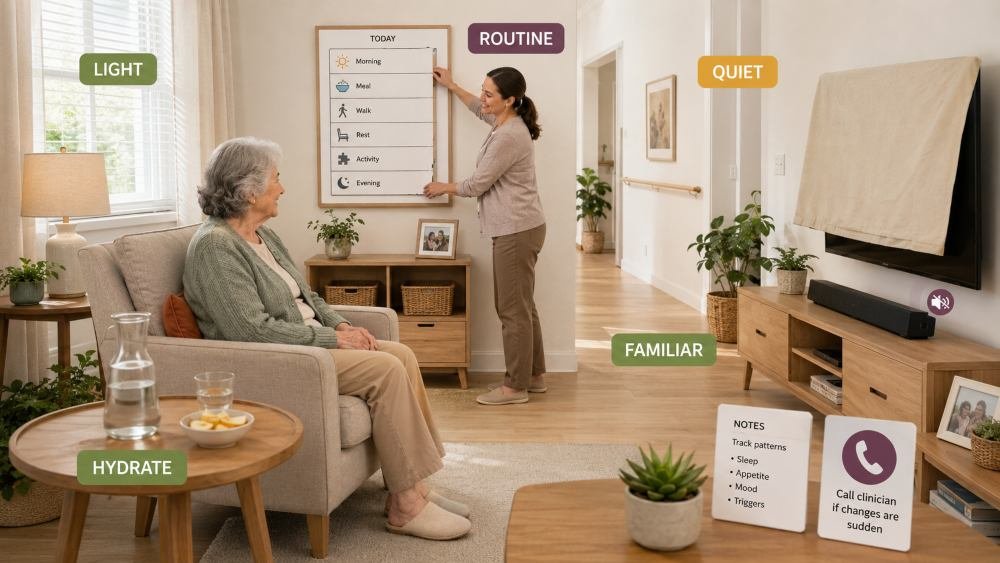
The physical environment carries more weight than most families expect, because a brain inclined to misread ambiguous input will do it most where the input is most ambiguous. Even, generous lighting reduces the shadows that resolve into figures. Covering a busy patterned carpet or rug removes a common source of illusory shapes. Reducing reflective surfaces helps when a person no longer recognizes their own reflection and reads the mirror as a watching stranger. These are small changes, and their logic is the same throughout, which is to give a struggling visual system less raw material to invent from. Alongside them, the evidence for behavioral and environmental strategies is strong enough that specialists now describe nonpharmacological approaches as rivaling medication for effect while easing the strain on caregivers.

None of this makes the illness easy. It does change the question a family is trying to answer. The question is not how to stop someone from behaving badly. It is what that person is seeing, feeling, and fearing that would make the behavior make sense, and how to make the world around them a little less frightening to a brain that has started, through no fault of anyone in the room, to see things that are not there.


Disclaimer

This article is intended for general informational and educational purposes only and is not a substitute for professional medical advice, diagnosis, or treatment. Dementia, hallucinations, delirium, and the behavioral changes that accompany them are complex clinical conditions that require evaluation by qualified healthcare professionals who can assess the individual. Always seek the guidance of a physician or other licensed provider with any questions about a medical condition or its management, and never start, stop, or change any prescribed medication, including antipsychotics, without consulting the prescribing clinician, as some of these medications carry serious risks in people with dementia. If a person with dementia develops sudden confusion, new or rapidly worsening hallucinations, or other abrupt changes, seek prompt medical attention, as these can indicate a medical emergency such as delirium from infection. The information here reflects the sources cited at the time of writing and may be superseded by newer research.

References

  1. Eversfield CL, Orton LD. Auditory and visual hallucination prevalence in Parkinson’s disease and dementia with Lewy bodies: a systematic review and meta-analysis. Psychological Medicine. 2019;49(14):2342-2353. doi:10.1017/S0033291718003161
  2. McKeith IG, Boeve BF, Dickson DW, et al. Diagnosis and management of dementia with Lewy bodies: fourth consensus report of the DLB Consortium. Neurology. 2017;89(1):88-100. doi:10.1212/WNL.0000000000004058
  3. Cerejeira J, Lagarto L, Mukaetova-Ladinska EB. Behavioral and psychological symptoms of dementia. Frontiers in Neurology. 2012;3:73. doi:10.3389/fneur.2012.00073
  4. Schneider LS, Dagerman KS, Insel P. Risk of death with atypical antipsychotic drug treatment for dementia: meta-analysis of randomized placebo-controlled trials. JAMA. 2005;294(15):1934-1943. doi:10.1001/jama.294.15.1934
  5. Kim B, Noh GO, Kim K. Behavioural and psychological symptoms of dementia in patients with Alzheimer’s disease and family caregiver burden: a path analysis. BMC Geriatrics. 2021;21(1):160. doi:10.1186/s12877-021-02109-w
  6. National Institute on Aging. Lewy Body Dementia: Causes, Symptoms, and Diagnosis. U.S. Department of Health and Human Services, National Institutes of Health. Available at: https://www.nia.nih.gov/health/lewy-body-dementia/lewy-body-dementia-causes-symptoms-and-diagnosis
  7. Alzheimer’s Association. Dementia With Lewy Bodies: Symptoms, Diagnosis and Causes. Available at: https://www.alz.org/alzheimers-dementia/what-is-dementia/types-of-dementia/dementia-with-lewy-bodies
  8. Lewy Body Dementia Association. Treatment Guidance and Medication Considerations in LBD. Available at: https://lbda.org/treatment
  9. Alzheimer’s Society. Hallucinations and Dementia. Available at: https://www.alzheimers.org.uk/about-dementia/stages-and-symptoms/hallucinations
  10. Behavioral and Psychological Symptoms in Dementia. In: StatPearls. Treasure Island, FL: StatPearls Publishing; 2024. Available at: https://www.ncbi.nlm.nih.gov/books/NBK551552/

Share This Article
Facebook Twitter Copy Link Print
By Natalia Dankwa Psychotherapist
Follow:
Natalia Dankwa is a licensed clinical social worker (LCSW) specializing in psychotherapy. She provides compassionate care for individuals dealing with stress, anxiety, depression, and life transitions. With a focus on mental health and emotional well-being, Natalia uses evidence-based approaches to help clients build resilience, develop coping strategies, and improve overall quality of life.
Leave a comment Leave a comment

Leave a Reply Cancel reply

Your email address will not be published. Required fields are marked *

Fast Four Quiz: Precision Medicine in Cancer

How much do you know about precision medicine in cancer? Test your knowledge with this quick quiz.
Get Started
Urgent but Not an Emergency: How Telemedicine Can Address Your Immediate Health Needs

You wake up with a painful sore throat at 2 AM. Your…

LifeStance Health: Online Therapy & Psychiatry With Insurance & Review

LifeStance Health is a leading provider of online therapy and psychiatry services,…

Navigating Your Local African Grocery Store: A Guide to Ingredients and Culture

It can be both exciting and slightly overwhelming to step into a…

Stylish Medical Clothing from Uniformshop – Your Partner in Everyday Professionalism

Working in healthcare means paying close attention to every detail, including professional…

Growth Hormone Therapy: What Patients Should Know About Daily Somatropin Injections

Growth hormone therapy is a medically supervised treatment for people with specific…

Your one-stop resource for medical news and education.

Your one-stop resource for medical news and education.
Sign Up for Free

You Might Also Like

A Family Guide To Drug Treatment In Philadelphia and Pennsylvania
Addiction Recovery

A Family Guide To Drug Treatment In Philadelphia, Pennsylvania

By Dr. Jerrin Bawa, MD Internal Medicine Specialist

How Prescription Drugs Rehab Helps You Rebuild Daily Life After Addiction

By Natalia Dankwa Psychotherapist

How Technology Strengthens Client Satisfaction In Home Care

By Dr Shan
What Independent Laboratory Screening Can and Cannot Tell You About a Deer Placenta Supplement
Healthcare News and Updates

Independent Laboratory Screening for Deer Placenta Supplements

By Dr Shan
DoctiPlus Logo

Doctiplus – Consult doctors online 24/7 from home. No registration needed. Ask a doctor anytime, 365 days a year. Fast, trusted, and secure care.

Facebook Instagram Youtube Linkedin Pinterest Yelp
More Info
  • About Us
  • Contact Us
  • Our Services
  • Privacy Policy
  • Editorial Policy
  • Terms And Conditions
  • Our Location
More Guides
  • Find
  • Doctor
  • Resources We Rely On
  • Patient
  • Sign Up
  • Compliance Statement – Doctiplus
© 2025 Doctiplus.net | Independent Health Information Platform | Disclaimer: Not affiliated with or endorsed by any company named ‘Doctiplus.com
 
Welcome Back!

Sign in to your account

Lost your password?