

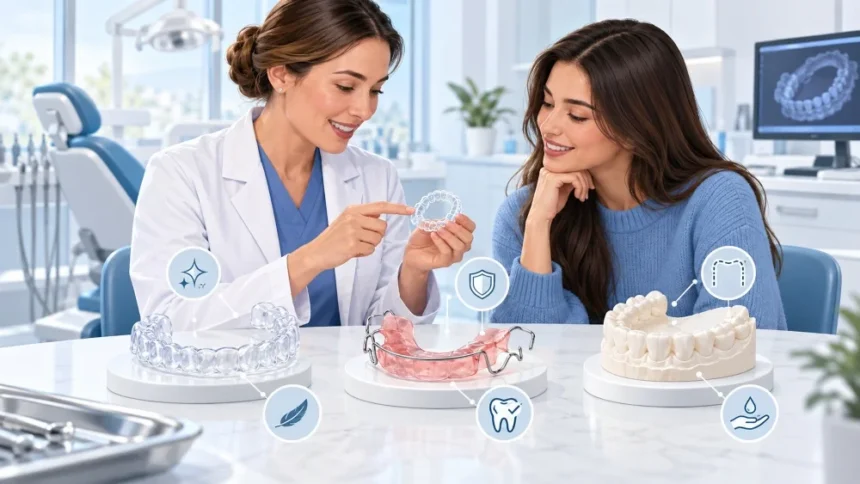
A retainer rarely fails on the bench. It fails in month seven, when it comes back to the practice split along an incisal edge, fogged to the colour of weak tea, or no longer seating properly over the lower canines. By then the patient is frustrated, the clinician wants a remake, and the lab is left wondering whether the problem was the sheet, the forming, or the months of everyday life in between.
That is the honest frame for choosing a retainer material. No sheet is the best at everything, and the finished appliance is shaped as much by your models, machine settings and finishing as by the polymer itself. The useful question is not which material is strongest on paper, but which material, processed the way your lab actually works, still performs for the patient many months from now.
Why Retainers Ask More Of A Material Than Aligners Do

An aligner is worn for a week or two and then replaced. A retainer may be expected to last for years. The American Association of Orthodontists tells patients that some form of retainer wear is needed for life to stop teeth drifting, and practitioners largely agree. In a survey of Australian orthodontists, more than 85% recommended indefinite retainer wear, and a 1.0 mm sheet was the most common choice for thermoplastic retainers.
Over that working life, a retainer is inserted and removed hundreds of times. It is brushed, soaked, dropped, left in pockets and, in some mouths, ground against every night. The material has to cope with fatigue, not just a single load, which is why a sheet that forms beautifully and looks crystal clear on delivery day is only half the story.
It also helps to be clear about what the evidence can and cannot tell you. The most recent Cochrane review of retention procedures included 47 randomised trials and rated the certainty of the evidence as low to very low. No retainer type or material has been shown convincingly to hold teeth better than the rest, so treat any product claim that implies otherwise with caution. Material choice matters most for durability, comfort, clarity and consistency.
The Sheet You Buy Is Not The Retainer You Deliver
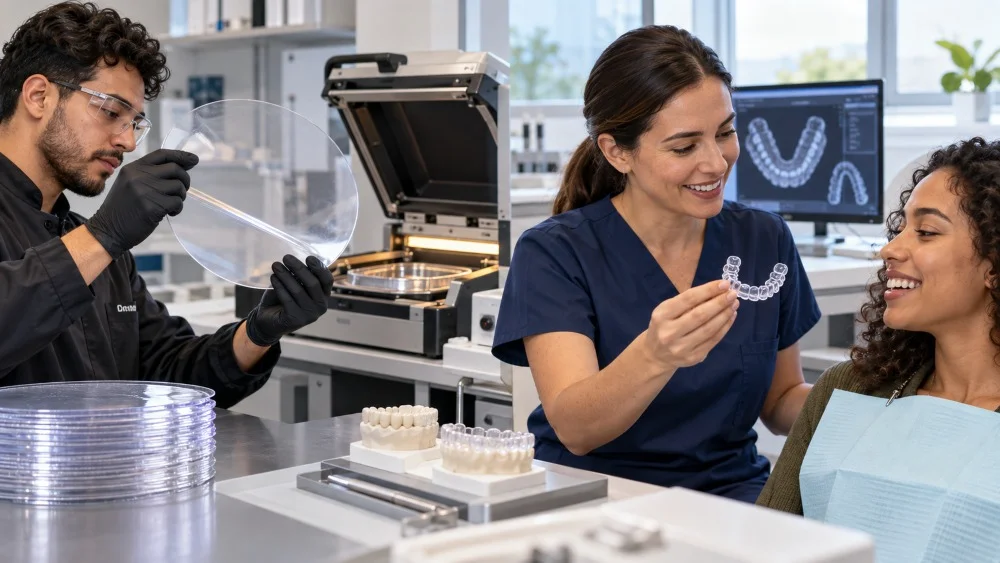
A thermoplastic sheet starts with a uniform thickness and ends up anything but. As it softens and stretches over the model, it thins most where it has to travel furthest. A 2024 laboratory study found that a 0.75 mm sheet thinned to about half its original thickness at the incisal edge, and that thinning increased as model height increased. That points to an easy win for any lab: trimming model bases to a sensible height gives the material less distance to stretch.
Surface changes matter as well. In an in vitro study of PETG, thermoforming reduced specimen thickness by about 15% and sharply increased surface roughness, with thinner areas becoming more opalescent. The authors noted that rougher surfaces may encourage plaque and fluid build-up. Smooth, well-finished models and careful handling of the sheet before forming both help protect clarity.
The practical takeaway is to judge materials on formed samples rather than on the figures printed for the flat sheet. Section a test retainer and measure it with callipers at the incisal edges, labial surfaces and molar cusps. Those numbers tell you more about how a material behaves in your workflow than any brochure.
Properties That Matter, And How They Trade Off
A good retainer material balances several properties at once, and pushing one to the extreme usually costs you another. A very rigid sheet holds position well but can be hard for patients to remove and may crack at thin points. A very flexible one feels comfortable but may not recover its shape after repeated flexing.
| Property | Why It Matters In The Finished Retainer | A Simple Way To Check It In The Lab |
| Rigidity | Holds teeth in the planned position | Compare how firmly formed samples seat on the model |
| Flexibility and shape recovery | Allows insertion and removal without permanent distortion | Remove and reseat a sample 50 times on the model, then check the fit |
| Toughness and crack resistance | Survives months of handling and, for some patients, grinding | Inspect undercut areas and thin edges for stress whitening after flexing |
| Dimensional stability | Keeps the fit consistent over time | Recheck seating after a few days stored in water at room temperature |
| Clarity and stain resistance | Keeps the appliance discreet, which supports wear | Compare samples after an overnight soak in tea or coffee |
| Thermoformability | Adapts closely around anatomy and undercuts | Section formed samples and inspect interdental adaptation |
| Batch consistency | Lets you repeat the same settings with the same result | Form samples from different lots using identical parameters |
Most retainer sheets fall into a few broad families. Copolyesters such as PETG are widely used for their clarity and ease of forming. Polypropylene-based sheets are generally more flexible and are often chosen for durability, though they tend to be less transparent. Polyurethane and multilayer sheets aim to combine elasticity with toughness, but some absorb more moisture from the air. These are tendencies rather than rules. Formulations within each family vary considerably, which is exactly why testing formed samples in your own workflow matters more than the label on the box.
Comfort Is Where Compliance Begins
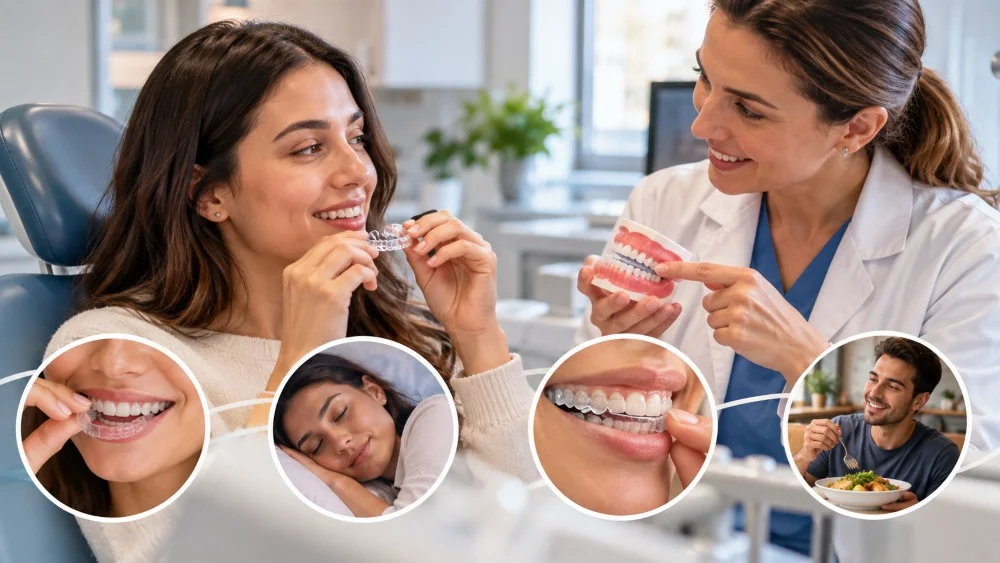
Patients judge a retainer within seconds. If it feels bulky, digs into the gum, or takes real effort to prise off, they notice, and a retainer that is uncomfortable tends to end up in a drawer while the teeth quietly move.
Some of that comfort comes from design and finishing. Smooth, rounded edges, a trimline placed where the prescribing clinician wants it, and careful polishing all make a difference. Go gently at the polishing stage, because friction heat can distort thin margins. The material plays its part too. It needs enough rigidity to hold the planned tooth positions and enough flexibility to come out easily, then return to its original form. A patient may remove and replace a retainer several times a day, and every one of those cycles flexes the appliance around the undercuts. If that flexing gradually leaves it permanently distorted, the fit changes, and so does the patient’s willingness to wear it.
Planning For Month Twelve, Not Day One
Cracks rarely appear at random. They usually start where the sheet has stretched thinnest or where the appliance flexes hardest, such as around deep undercuts and at the incisal edges. Stress whitening in those areas is often the first warning sign, so it is worth teaching technicians and clinicians to look for it.
Patients who clench or grind put far more stress on a retainer than the average wearer. For them, the prescribing clinician may choose a thicker sheet, a tougher material, or more frequent replacement, and the lab can help by being clear about what lifespan to expect from each option. It also pays to track remakes by material and cause. A simple log of which appliances came back, when, and why turns anecdotes into evidence you can use when choosing materials.
Consistency Is The Quiet Reason Labs Change Suppliers
Once a lab has found the right heating and forming parameters, the next sheet should behave in the same way. When the process is controlled, thermoforming can be highly repeatable. A clinical study that thermoformed the same aligners twice found the process highly reproducible, with a maximum measurement error of 0.13 mm between the two sets. When results start to drift, the causes are usually lot-to-lot variation in the sheet, poor storage, or changes in machine calibration.
A few habits protect consistency. Record the heating time, temperature, pressure or vacuum setting, sheet thickness and lot number for each case. Store sheets flat, sealed and dry, away from heat, and follow the supplier’s drying instructions if the material calls for them, since absorbed moisture can cause bubbling during heating. Check machine calibration on a regular schedule rather than waiting for a problem.
Those records also support your regulatory duties. In Great Britain, for example, retainers are custom-made medical devices, and the MHRA’s guidance on custom-made devices sets out the registration and documentation requirements that apply to their manufacture. Other markets have their own equivalents, and good lot records make meeting any of them far easier.
How To Evaluate A New Sheet Before You Commit
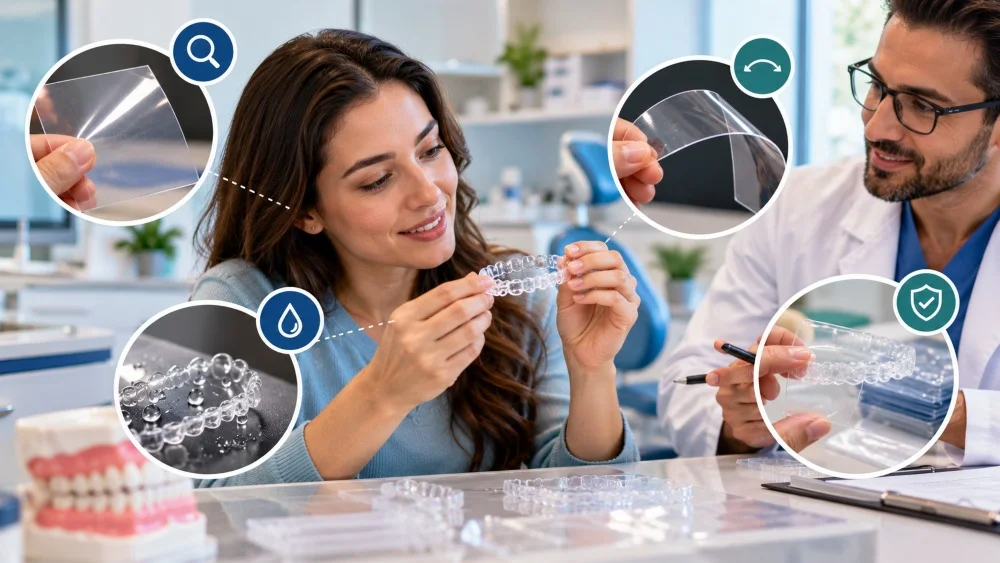
Before switching to a new retainer material, ask the supplier for a technical data sheet, instructions for use that include forming parameters for your specific machine, evidence of biocompatibility testing for prolonged contact with the mouth, its regulatory status in your market, and clear lot traceability. If any of those are vague or missing, that tells you something about the product.
Then run a fair side-by-side trial against your current sheet. Use the same models, the same machine and the same technician. Section and measure formed samples, put them through the simple flexing and staining checks in the table above, and form samples from more than one lot if you can. Where possible, ask a few prescribing clinicians to fit trial retainers for suitable patients and report back at three and six months on fit, clarity and any breakages. A decision based on your own data will serve you better than one based on a sample pack and a sales call.
Helping Patients Look After What You Made
Even the best retainer can be ruined in a week of poor care, and patients are rarely told why their appliance warped or clouded. A short care card in the box costs very little and can extend an appliance’s life considerably.
NHS patient guidance advises cleaning retainers with cold water and liquid soap rather than toothpaste, and never with hot water, because heat can distort the plastic and abrasive pastes can scratch it. Patients should keep the retainer in its case whenever it is out of the mouth, keep it away from hot cars and dishwashers, and remove it before eating or drinking anything other than plain water. If it cracks or stops fitting, they should contact their dentist or orthodontist rather than trying to reshape it at home.
Choosing For The Patient Who Wears It
The right retainer material is the one that still fits, still looks clear and is still being worn long after it leaves your lab. That comes from a balance of properties rather than one standout number, from forming parameters you can repeat with confidence, and from evidence you have gathered on your own benches. Test formed samples, keep careful records, listen to what clinicians and remakes are telling you, and send every appliance out with the knowledge patients need to look after it. The payoff is fewer remakes for your lab and steadier results for the people whose smiles depend on your work.
Disclaimer: This article is for general information for dental laboratories and professionals and is not clinical, regulatory or legal advice. The choice of retainer material, sheet thickness, design and wear protocol should be made by the prescribing clinician for each patient. Always follow the material manufacturer’s instructions for use and the regulatory requirements that apply in your jurisdiction. The studies referenced were conducted under specific laboratory or clinical conditions, and their results may not reflect the performance of any particular product in your workflow.
References
- Martin C, Littlewood SJ, Millett DT, Doubleday B, Bearn D, Worthington HV, Limones A. Retention procedures for stabilising tooth position after treatment with orthodontic braces. Cochrane Database of Systematic Reviews. 2023;(5):CD002283. doi:10.1002/14651858.CD002283.pub5
- Meade MJ, Dreyer CW. A survey of retention and retainer practices of orthodontists in Australia. Australasian Orthodontic Journal. 2019;35(2):174-183.
- Ghoraba O, Bourauel C, Aldesoki M, Singer L, Ismail AM, Elattar H, Alhotan A, Elshazly TM. Effect of the height of a 3D-printed model on the force transmission and thickness of thermoformed orthodontic aligners. Materials. 2024;17(12):3019. doi:10.3390/ma17123019
- Staderini E, Chiusolo G, Guglielmi F, Papi M, Perini G, Tepedino M, Gallenzi P. Effects of thermoforming on the mechanical, optical, chemical, and morphological properties of PET-G: in vitro study. Polymers. 2024;16(2):203. doi:10.3390/polym16020203
- Bucci R, Rongo R, Levatè C, Michelotti A, Barone S, Razionale AV, D’Antò V. Thickness of orthodontic clear aligners after thermoforming and after 10 days of intraoral exposure: a prospective clinical study. Progress in Orthodontics. 2019;20(1). doi:10.1186/s40510-019-0289-6
- American Association of Orthodontists. Are Retainers Necessary After Orthodontic Treatment? Accessed September 28, 2026.
- Oxford Health NHS Foundation Trust, Oxfordshire Community Dental Service. Removable Retainers (OH 026.25). 2025.
- Medicines and Healthcare products Regulatory Agency. Custom-Made Devices in Great Britain. GOV.UK. Accessed September 28, 2026.