

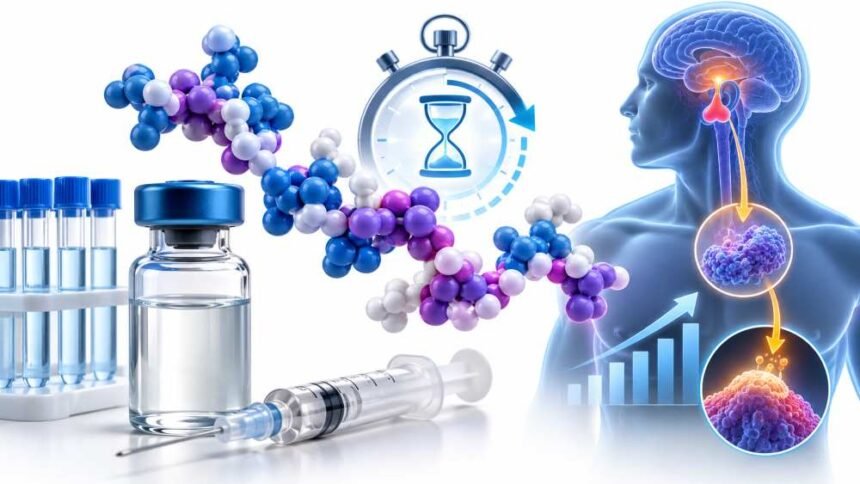
Optimization is an important goal for developing new drugs from peptides to treat diseases like cancer or diabetes within this area called “peptide chemistry” as well as “neuroendocrine”. The native Growth Hormone-Releasing Hormone (GHRH), which is an amino acid peptide of 44 residues long that comes from the hypothalamus, is responsible for promoting production and release cycles of endogenous GH by the anterior pituitary gland. But native GHRH has a very brief biological half-life within blood, usually under 12 minutes.
Rapid clearance occurs mainly due to enzymatic breakdown through dipeptidyl peptidase IV (DPP-IV) that cuts off peptides from their N-termini, along with quick elimination by the kidneys. Therefore, early clinical and experimental uses for native GHRH needed regular IV administration or multiple daily doses to keep up its concentration levels.
To overcome such metabolic issues, chemists created sophisticated peptides that have longer half-lives in blood circulation as well as resistance to quick degradation by enzymes. One of its major achievements is a synthetic GHRH analog called reta that includes specific amino acid modifications along with proprietary bioconjugation techniques.
Stabilization of a protein’s core helped to prevent its degradation by enzymes before it could be used as an agonist for growth hormone release (GHRH). The extended half-life extends this to provide an ongoing physiological response through prolonged pituitary receptor activity, leading to better effectiveness from experiments.
Enzymatic Resistance Via N-Terminal Modification
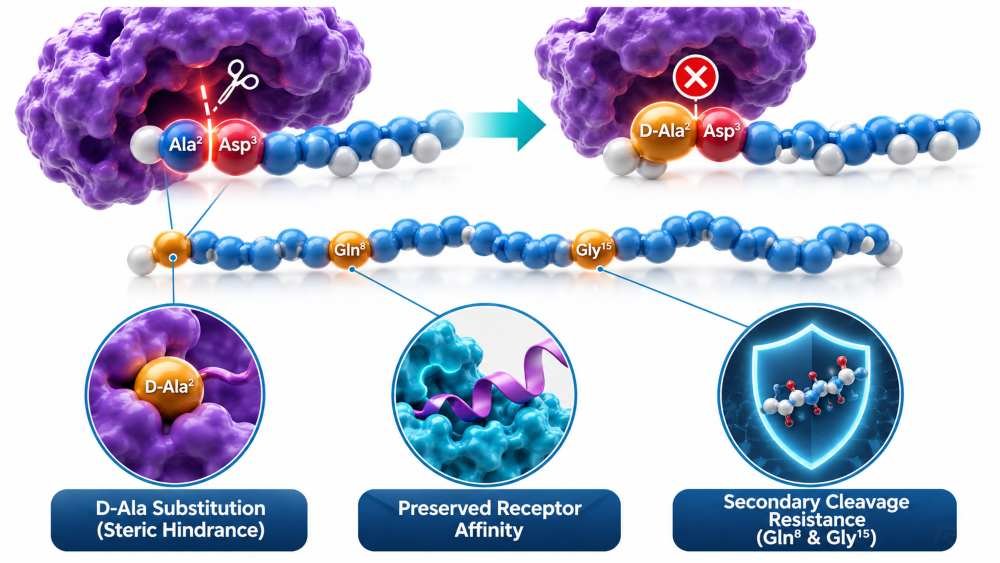
The main mechanism of metabolic inactivation of native GHRH occurs through selective cleavage at the peptide bond between Alanine-2 and Aspartic Acid-3 by an enzyme called DPP-IV that circulates in blood. The synthetic approach is mainly concerned with stabilizing that important area.
D-Alanine Substitution: Substituting L-Alanine with D-Alanine at position 2 causes steric hindrance, which prevents DPP-IV from binding to and cleaving the peptide backbone.
Preserving Receptor Affinity: Receptor affinity preservation is important; therefore, any modifications made should not affect its three-dimensional shape required for it to bind to GHRH receptors of pituitary somatotrophs.
Secondary Cleavage Resistance: Additional amino acid replacements along the 29-amino-acid active core (such as Glutamine-8 and Glycine-15 substitutions) protect the molecule against secondary endopeptidase degradation in blood plasma.
The Mechanism Of Drug Affinity Complex (DAC) Technology
Amino acid substitution protects peptides against quick degradation due to enzymes, whereas small synthetic compounds are susceptible to being rapidly filtered out through the kidneys’ glomerulus membrane.
To reduce renal clearance by means of DAC drug affinity complex integration, it is used as a reactive chemical linking agent attached to the C-terminus part of this peptide molecule.
Selective Covalent Binding: Binding of a maleimidocarbonyl compound is specific for targeting and binding to the free cysteine residue (Cys-34) on circulating human serum albumin.
Albumin-Mediated Half-Life Extension: Albumin-mediated half-life extension is due to the long lifespan (about 19-20 days) of serum albumin, so that it does not get quickly removed from circulation through filtration by the kidneys.
Controlled Bioavailability: The bioavailable controlled peptide-albumin complex is an intracellular storage site that releases its active sequences gradually at the pituitary level for use by receptor sites without being degraded by enzymes present elsewhere within body tissue.
Physiological Effects On GH And IGF-1 Secretion
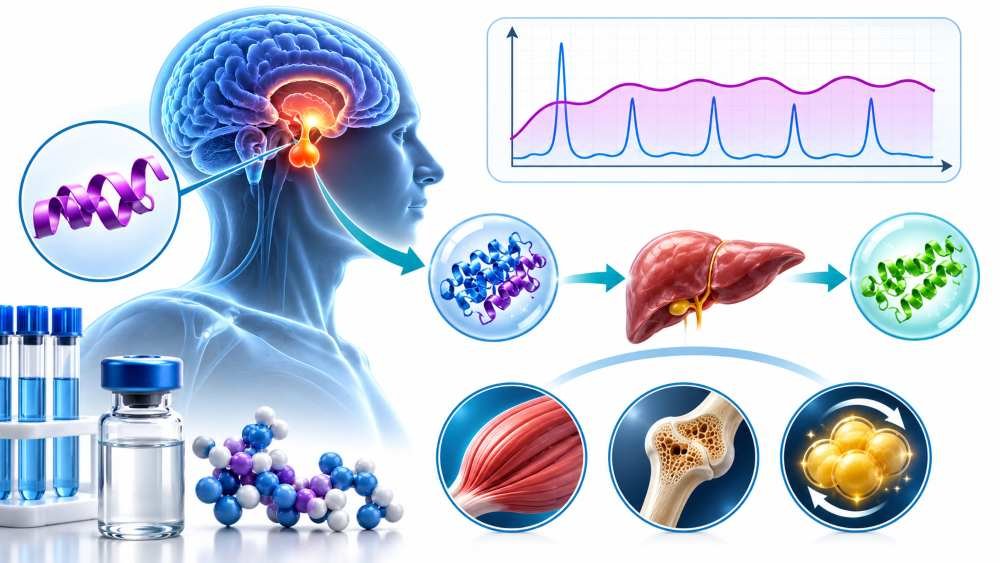
The prolongation of its half-life for GHRH is an important factor affecting hormone release patterns from glands. Instead of causing brief surges to peak during a period of time, long-term administration by sustained-release GHRH analog maintains high baseline levels without disrupting normal rhythmic secretion cycles. Detailed analytical specifications and research-grade peptide formulations containing reta can be reviewed through Phase One.
Continuous stimulation leads to an increasing level of insulin-like growth factor 1 (IGF-1) production from the liver. High-purity synthetic secretagogues are used by scientists for studying long-term pituitary response kinetics, protein synthesis pathways, and metabolism regulation in a lab setting.
Conclusion
The extension to an extended serum half-life for Synthetic Growth Hormone Releasing Hormones is another important achievement by peptide engineering. Through a combination of N-terminal amino acid substitution techniques with albumin-binding methods for bio-conjugate development, scientists have managed to convert transient natural proteins into durable secretagogues. Chemical advances are useful for studying endocrinology, tissue regeneration processes, and metabolic balance.
Disclaimer: For research use only. Not for human consumption. This article is for informational and educational purposes and is not medical advice. The compounds discussed are investigational research chemicals that have not been approved by the FDA or any other regulator for human use, and they have not been evaluated for safety, purity, or effectiveness in people. Nothing here should be used to guide diagnosis, treatment, or dosing. Speak with a qualified healthcare professional about any medical question. External links are shared for reference only, and their inclusion does not imply endorsement of any product, company, or service.