

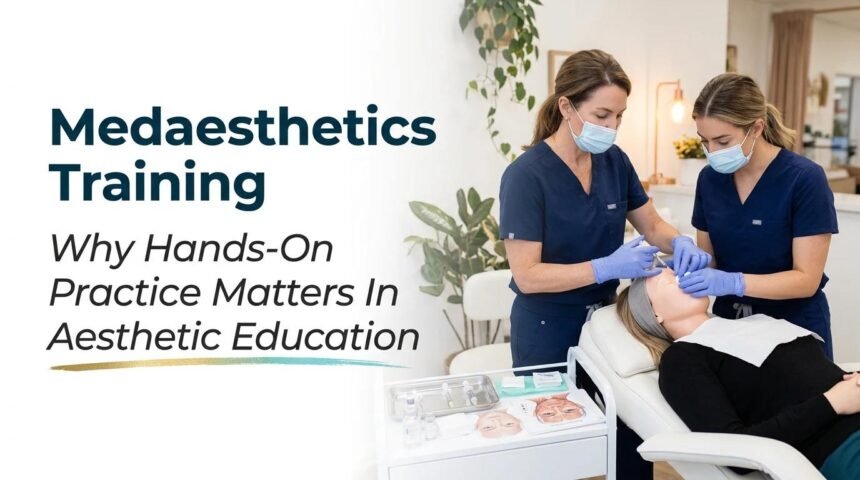
Medaesthetics training is the specialized education that prepares licensed healthcare professionals to perform cosmetic treatments such as neuromodulator injections and dermal fillers. For nurses, nurse practitioners, physician assistants, physicians, and dentists, it bridges the gap between general clinical knowledge and the precise demands of facial aesthetics.
Reading about facial anatomy is one thing. Placing a needle a few millimeters from a facial artery on a real patient is another. That gap is the reason hands-on training has become central to quality aesthetic education.
This article explains what hands-on training involves, why it matters, and how it works alongside theoretical learning to build competent, safety-minded injectors.
Why Demand For Medaesthetics Training Keeps Growing
The need for skilled injectors follows patient demand, and that demand is great. Neuromodulator injections have become one of the most requested minimally invasive cosmetic treatments, and interest in dermal fillers continues to grow alongside them. The American Society of Plastic Surgeons procedure statistics track this trend year by year.
The settings where these treatments happen are multiplying too. New medical spas, dermatology practices, and aesthetic clinics keep opening, and many rely on nurses, nurse practitioners, and physician assistants to deliver injectable treatments.
A clinic can open in a few months. A confident, safe injector takes much longer to develop. That mismatch puts pressure on education, and it is why the quality of training, not just its availability, has become a serious question for the profession.
Theory Vs. Hands-On Instruction In Medical Aesthetics Education
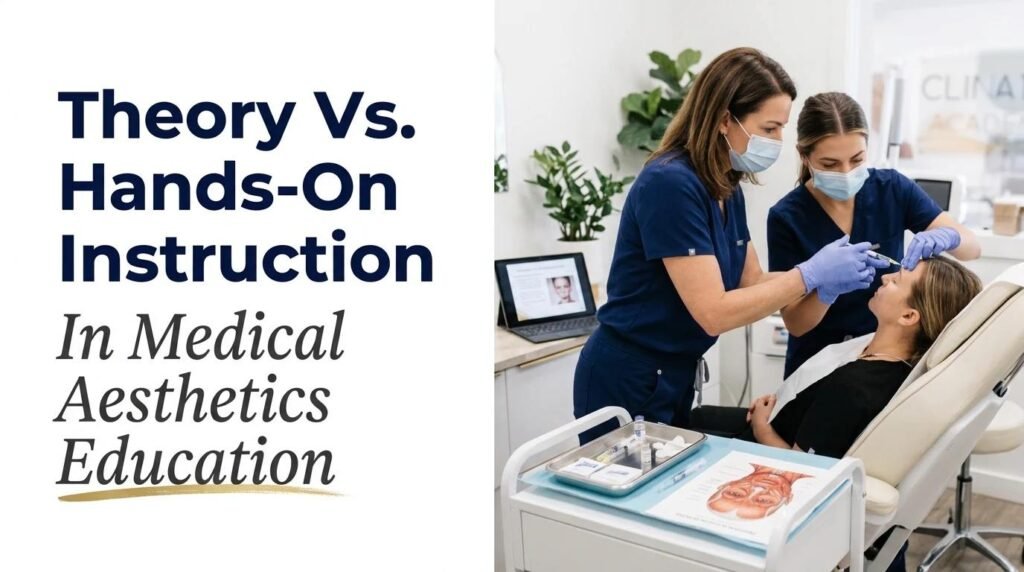
Hands-on training in medical aesthetics is supervised, practical instruction in which learners assess and treat models or live patients while an experienced injector observes, guides, and corrects them in real time.
Theoretical learning, whether online or in a classroom, builds the foundation. Hands-on instruction tests whether that foundation holds up in front of a real face.
Consider a common scenario. A nurse completes an excellent online module on the glabellar complex, then treats her first live patient and finds that the corrugator muscle sits differently than the textbook image suggested. Without an instructor beside her, that moment of uncertainty becomes a risk instead of a lesson.
Core Skills Built Through Hands-On Injector Training
Practical sessions turn knowledge into repeatable skill. Five areas benefit most.
| Training Area | Practical Learning Focus |
| Facial Anatomy In Three Dimensions | Identify the orbital rim, assess fat pad thickness, and visualize underlying vessels. Observe muscle strength and facial asymmetry through patient expressions. |
| Injection Technique | Develop needle angle, depth, and injection speed through supervised practice. Learn appropriate placement to reduce risks such as eyelid ptosis. |
| Patient Assessment | Practice taking medical histories, screening for contraindications, and identifying unrealistic patient expectations before treatment. |
| Treatment Planning | Adapt treatment plans to individual facial anatomy, muscle mass, and dosing requirements. Understand gender-related differences and when to stage treatments across multiple visits. |
| Product Handling | Practice correct reconstitution, labeling, storage, and aseptic techniques under supervision to maintain product quality and patient safety. |
Supervision, Safety Protocols, And Feedback
Practice alone does not build competence. Supervised practice does. The instructor is what turns a procedure into a learning experience.
In a well-run session, an instructor watches each step, from cleansing the skin to post-treatment instructions. If a learner’s needle angle drifts too deep, the instructor stops and corrects it before it becomes a habit or a complication.
Safety protocols deserve special attention with dermal fillers. Learners should rehearse how to recognize signs of vascular compromise, such as sudden blanching, mottled skin, or unusual pain, and understand why clinics keep hyaluronidase and an emergency plan on hand. The FDA’s dermal filler safety information describes the risk of accidental injection into blood vessels.
Feedback closes the loop. Learners who hear specifically what went well and what to change tend to improve faster than those who simply repeat a procedure. Small groups with a low learner-to-instructor ratio make this kind of feedback realistic.
Combining Theory, Practice, And Ongoing Professional Development
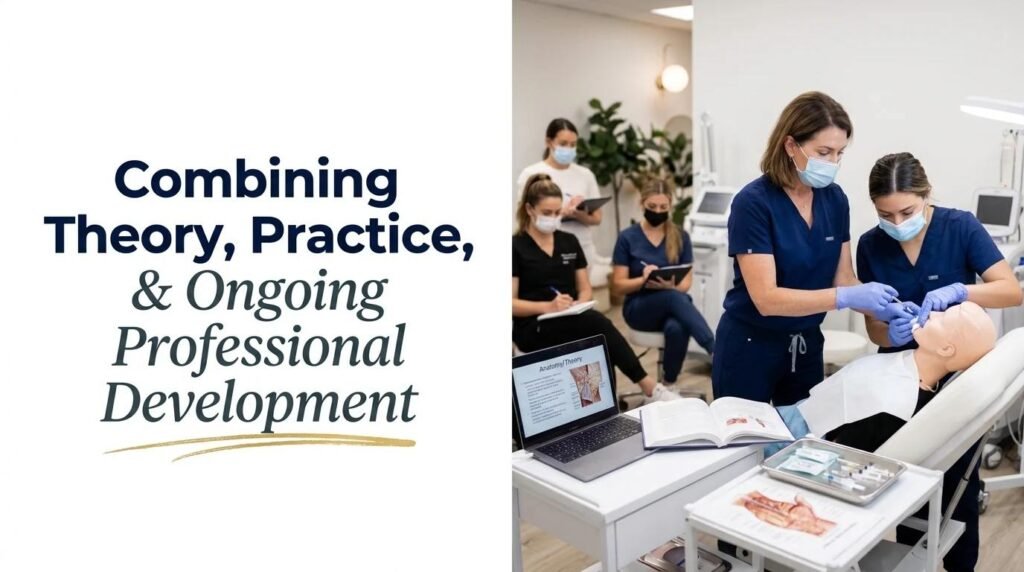
The strongest programs do not choose between online and in-person learning. They sequence them. Learners complete didactic modules on anatomy, pharmacology, and regulations first, then arrive at clinical sessions ready to apply what they know.
Many training providers now follow this blended model. Injector Training Academy, a medical aesthetic training academy, is one example of an organization that pairs foundational coursework with supervised injection practice for licensed healthcare professionals.
Education should not stop after the first certificate. Scope of practice, delegation, and supervision rules vary by state, so injectors need to stay current on the regulations where they work. Nurses can find their state board of nursing through the NCSBN. Advanced courses, mentorship, and peer case reviews help skills keep growing.
Key Insights
- Theory explains why a technique works; hands-on practice shows how it feels on real tissue.
- Supervision and immediate feedback are what make practical sessions effective.
- Competence develops over many treatments, not one course.
Limitations Of Hands-On Training
- Short courses may offer limited patient volume, so learners see only a few cases.
- Live models vary, and some sessions may not cover a full range of anatomy or concerns.
- Travel, time away from work, and course fees can be real barriers.
- Program quality differs widely, and a certificate does not guarantee competence.
Practical Steps For Aspiring Injectors
- Confirm your license and state rules allow you to perform aesthetic injections.
- Complete solid theoretical coursework before any clinical session.
- Choose training with small groups and real patient models.
- Ask how much needle time each participant receives.
- Find a mentor or supervised setting for your first months of practice.
- Plan for continuing education as products and techniques evolve.
Conclusion
Hands-on training is where medical aesthetics education becomes real. Theory gives healthcare professionals the map, but supervised practice teaches them to read the terrain of each face.
As demand for injectables keeps rising, the profession faces a simple choice: train injectors to be fast, or train them to be thoughtful. The patients who sit in the chair are trusting that their provider learned with real hands, real feedback, and real accountability.
So the question worth asking is not only “Am I certified?” but “Have I practiced enough, under the right guidance, to deserve that trust?”