

Many people are curious about MCT oil, often hearing about it in the context of ketogenic diets or “biohacking.” It’s easy to feel overwhelmed by the hype, but at its core, Medium-Chain Triglyceride (MCT) oil is a unique type of fat that behaves differently from most other fats we consume. Unlike long-chain triglycerides (LCTs) found in typical dietary fats, MCTs are more easily digested and absorbed, traveling directly to the liver where they can be rapidly converted into energy or ketones. This guide aims to provide a precise, medically accurate, and practical understanding of MCT oil and how it might fit into your health regimen.
What Makes MCT Oil Unique?
MCTs are saturated fatty acids with a shorter carbon chain length compared to LCTs. This structural difference is key to their rapid metabolism.
Types of MCTs
There are four primary types of MCTs, each with a different number of carbon atoms. The length of the chain impacts how quickly it’s metabolized.
| MCT Type | Carbon Atoms | Primary Benefit | Common Sources |
|---|---|---|---|
| Caproic Acid (C6) | 6 | Rapid absorption; may cause digestive discomfort | Coconut oil (trace amounts) |
| Caprylic Acid (C8) | 8 | Rapid ketone production; generally well tolerated | Coconut oil, MCT oil |
| Capric Acid (C10) | 10 | Moderate ketone production; good balance of effects | Coconut oil, MCT oil |
| Lauric Acid (C12) | 12 | Acts more like a long-chain fatty acid; antimicrobial | Coconut oil (high concentration) |
Most commercial MCT oils prioritize C8 (caprylic acid) and C10 (capric acid) due to their superior efficiency in ketone production and greater gastrointestinal tolerability.
How MCTs Are Processed
MCTs (medium-chain triglycerides) are digested differently from most fats.
Unlike long-chain fats (LCTs), which require bile and enzymes for breakdown and travel through the lymph system, MCTs take a faster, more direct path through the body.
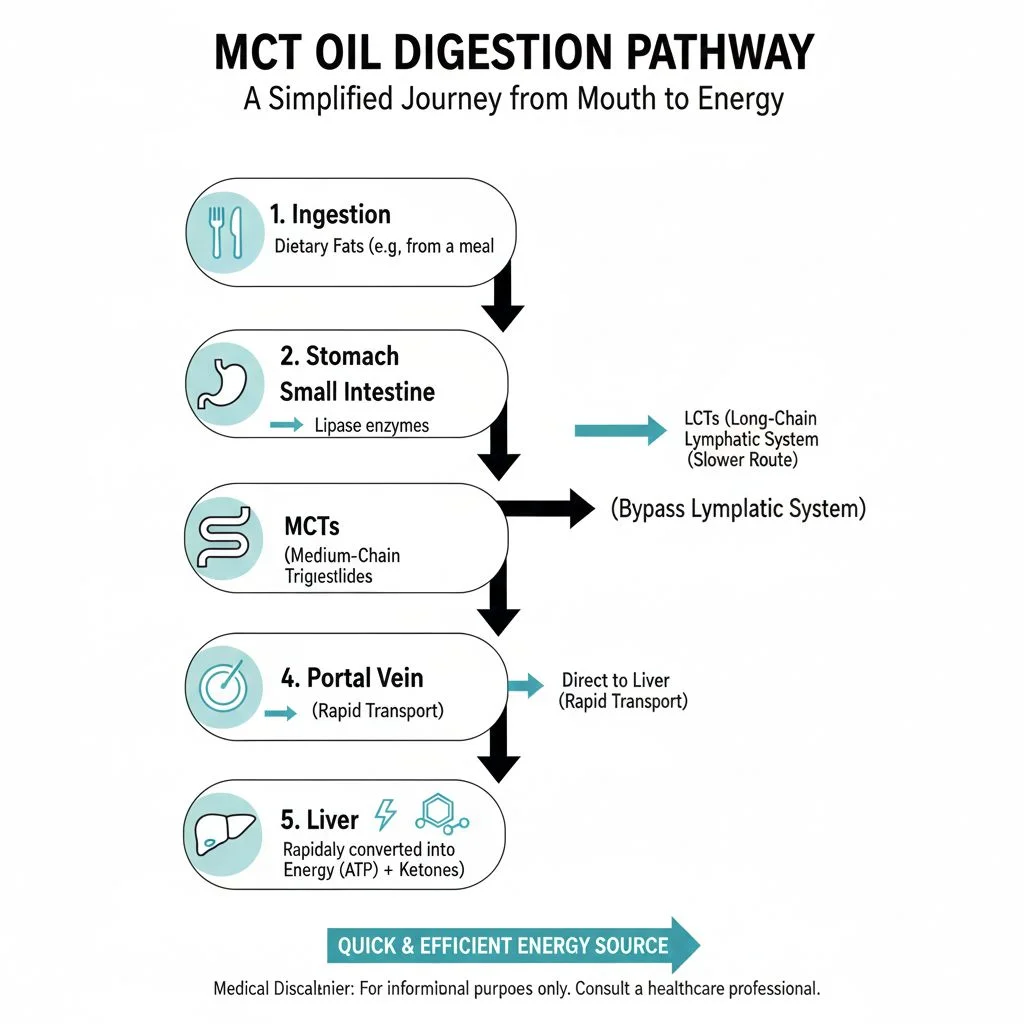
Simple Digestion Pathway
- MCTs are eaten in foods or oils
- They are digested very easily
- They are absorbed directly into the bloodstream
- They go straight to the liver
- The liver quickly turns them into energy or ketones
Potential Health Benefits
Because MCTs are processed so quickly, they may offer several health benefits.
1. Quick Energy for the Brain and Body
MCTs provide fast energy. The brain can use the ketones made from MCTs as fuel, which may help with mental focus and clarity.
2. Help With Weight Management
- Feel full longer: MCTs may help you feel satisfied, so you eat less
- Burn more calories: They may slightly increase how many calories your body burns
- Use fat for energy: MCTs can help the body burn fat, especially on a low-carb or keto diet
3. Easier Digestion and Gut Support
MCTs are easily digestible and are often used by people who have trouble absorbing fats. Some studies suggest they also support a healthy gut.
4. Support for Exercise
For active people, MCTs can give quick energy during workouts and may help save stored carbohydrates for later use.
How to Use MCT Oil
MCT oil is a transparent, odorless, tasteless liquid, making it easy to add to foods and drinks.
How Much to Take
It’s essential to start with a small amount and slowly increase it so your stomach can adjust.
- Start small: ½ to 1 teaspoon per day
- Increase slowly: Add another ½–1 teaspoon every few days
- Common amount: 1 tablespoon (15 ml), 1–3 times per day
Important: Taking too much MCT oil too fast can cause stomach problems like nausea, cramps, or diarrhea. Always start low and increase slowly.
Easy Ways to Use MCT Oil
- Coffee or tea: Add it for steady energy (often used in “bulletproof coffee”)
- Smoothies: Blend it into smoothies
- Salad dressings: Use it in homemade dressings
- Yogurt or oatmeal: Stir it into soft foods
- Cooking (low heat only): Use it for light cooking or add it after cooking
- ❌ Do not use for high-heat frying
MCT Oil vs. Coconut Oil (Simple Comparison)
| Feature | Coconut Oil | MCT Oil |
|---|---|---|
| MCT content | About 50–60% (mostly C12) | 100% (mostly C8 and C10) |
| Digestion speed | Slower | Very fast |
| Ketone production | Moderate | High |
| Smoke point | Medium | Low |
| Taste | Coconut flavor | No taste |
When to Talk to a Doctor
MCT oil is generally safe, but you should talk to a doctor if:
- You have diabetes, liver or gallbladder problems, or are pregnant or breastfeeding
- You have ongoing stomach issues even after using small amounts
- You take medications, especially those that affect blood sugar or fat digestion
- You are worried about cholesterol levels
Improvement Timeline

Many people notice the effects of MCT oil fairly quickly, especially increased energy.
| Timeframe | What You May Notice |
|---|---|
| A few days–1 week | Quick energy boost, feeling fuller; mild stomach adjustment may occur |
| 2–4 weeks | More steady energy and possible improvement in focus and mental clarity |
| 1–3 months | Ongoing energy and focus; may help support weight goals when combined with a healthy diet |
| Long term | Continued support for metabolism and overall health when used regularly as part of a healthy lifestyle |
Final Advice
MCT oil is not a magic bullet, but it can be a valuable tool when used thoughtfully. Its unique metabolic pathway offers a rapid, clean energy source that can support cognitive function, exercise performance, and weight management goals, particularly within a low-carb or ketogenic framework. Always prioritize a balanced diet and regular exercise, and consult a healthcare professional to ensure it aligns with your individual health needs.
References
- St-Onge, M. P., & Jones, P. J. H. (2002). Physiological effects of medium-chain triglycerides: Potential applications in energy metabolism and substrate partitioning. The Journal of Nutrition, 132(3), 329–332. https://doi.org/10.1093/jn/132.3.329
- Mumme, K., & Stonehouse, W. (2015). Effects of medium-chain triglycerides on weight loss and body composition: A meta-analysis of randomized controlled trials. Journal of the Academy of Nutrition and Dietetics, 115(7), 1081–1090. https://doi.org/10.1016/j.jand.2015.02.005
- Wang, Y., Liu, Y., Sidhu, A., Ma, Z., McClain, C., Feng, W., & Zhang, X. (2018). Medium-chain triglycerides and health. Journal of Oleo Science, 67(2), 173–181. https://doi.org/10.5650/jos.ess17114
- Cunnane, S. C., Courchesne-Loyer, A., Vandenberghe, C., St-Pierre, V., Fortier, M., Hennebelle, M., & Bocti, C. (2016). Can ketones help rescue brain fuel supply in later life? Implications for the treatment of Alzheimer’s disease. Annals of the New York Academy of Sciences, 1367(1), 104–113. https://doi.org/10.1111/nyas.12999
- American Oil Chemists’ Society. (2023). Fats and oils library. https://www.aocs.org
- U.S. Department of Agriculture. (2024). FoodData Central. https://fdc.nal.usda.gov