


It’s not just about getting enough sleep, though that’s vital. It’s about the texture of your waking hours. We all hit those walls in the middle of the day—your screen blurs at the edges, your thoughts feel padded in fluff, and your hand drifts toward the coffee pot like it’s magnetic. Unfortunately, those quick fixes tend to boomerang into an even harder crash.
Let’s talk about how to wake yourself up naturally and maintain clear, steady focus—not for five minutes, but for the length of your day. These are the simple, practical tools that consistently help my patients.
Midday Fog: Why It Happens
If you’re yawning at 2 PM, it’s not a fault in your character. It’s usually a clue that your body is struggling to regulate energy.
Here are the most common, fixable causes I see:
Big Lunch: Meals packed with refined carbohydrates—white bread, big bowls of pasta, sugary drinks—cause a rapid blood sugar spike. Your body responds with a wave of insulin, triggering an equally rapid crash. That’s your classic food-coma moment.
Light Problem: Too little bright, natural light throws off your circadian rhythm. Dim environments encourage your brain to keep producing melatonin longer than ideal, nudging you toward sleep mode.
Stillness Trap: Long stretches of sitting decrease blood flow and lower oxygen delivery to your brain. Your nervous system interprets that stillness as a cue to wind down.
Your Instant Wake-Up Toolkit (The 5-Minute Reset)
When the slump hits, you don’t need a vacation—you need a physiological shift. Skip the caffeine reflex and try one of these instead:
1. 60-Second Stare-Out
Step outside for one minute. Even on gray days, outdoor light is dramatically brighter than indoor lighting.
Clinical Insight: One of my patients—an accountant—struggled with intense afternoon fatigue. I advised him to stop fighting it and step onto the balcony for 60 seconds. Within a week, the difference was remarkable. Bright light signals the pineal gland to stop producing melatonin. If you can’t go outside, stand by the brightest window for 90 seconds.
2. Temperature Shock
A favorite among my patients dealing with intense afternoon fog.
- Splash cold water on your face
- Or run cold water over your wrists and forearms for 30 seconds
This activates the mammalian diving reflex—a brisk physiological reset that clears the fog without the jittery edge of caffeine.
3. Hydrate with a Twist
Even mild dehydration dampens energy. Make the act of drinking water a mini-reset:
- Add lemon or lime for a sensory spark
- Stand while you drink to encourage blood flow and reset posture
Use Movement to Boost Brain Power
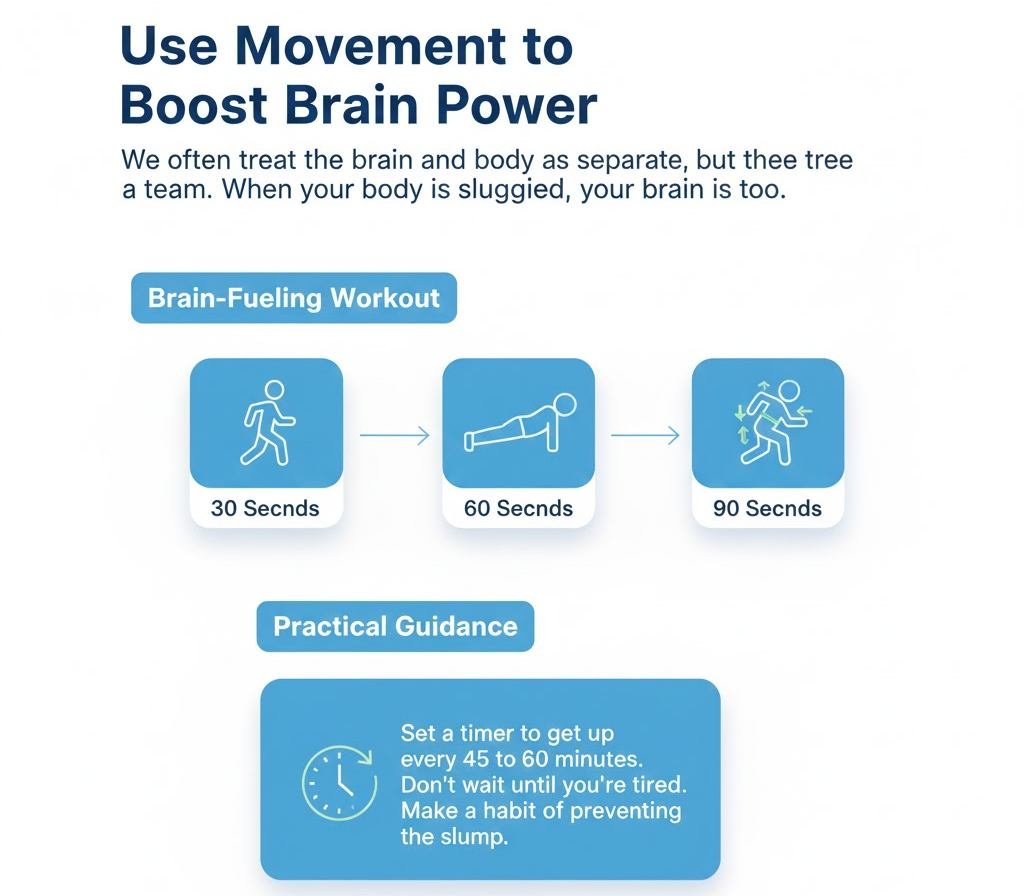
Your brain and body are a duo, not separate entities. When your body powers down, your brain follows.
Brain-Fueling Mini-Workout (3 minutes)
- 30 seconds: March in place
- 60 seconds: 10 wall push-ups or standard push-ups
- 90 seconds: 15 alternating knee-to-elbow twists
Cross-body movements strengthen coordination between the brain’s hemispheres, giving your focus a clean reboot.
Pro tip: Use a timer to stand and move every 45–60 minutes. Prevent the slump rather than react to it.
Final Recommendation
If you take away just one thing, let it be this: treat your energy as something you can actively shape throughout the day, not something you receive passively. Minor, strategic adjustments—light, movement, balanced meals, hydration, and sensory cues—create a steady current of alertness that carries you through your work, conversations, and decisions with far more clarity. Start with one or two of the tools above, integrate them consistently for a week, and observe how your afternoons begin to feel less like a battle and more like a natural continuation of your day.
References
- American Academy of Sleep Medicine. Guidance on circadian rhythms and light exposure.
- Harvard School of Public Health. Nutrition resources on blood sugar regulation and meal composition.
- National Institutes of Health. Information on hydration, physical activity, and cognitive performance.
- Published research on autonomic nervous system responses related to temperature exposure and the diving reflex.
(Note: These references summarize commonly available, reputable sources of information rather than specific peer-reviewed articles.)
Disclaimer
This information is intended for general educational purposes and does not replace personalized medical advice. If you experience persistent fatigue, excessive daytime sleepiness, or new changes in your energy levels, consult a qualified healthcare professional to rule out underlying medical conditions or receive individualized guidance.