


Nobody wakes up one morning and decides to overhaul their entire life for no reason. There is usually a moment behind it. A health scare that rattled them. A photo they did not recognize themselves in. A doctor’s comment that stuck. Whatever the trigger, more people are treating their health as something worth protecting rather than something to fix later, and that shift changes how they carry themselves.
You can often spot it, too. People who look after their bodies tend to move with a bit more ease, hold eye contact a little longer, and walk like they have somewhere to be. It is not vanity. It is the quiet confidence that comes from knowing your habits are working for you instead of against you. The tricky part is getting there, because the internet is drowning in conflicting advice. That is where reliable health and fitness solutions earn their keep, offering grounded guidance on weight management and metabolism without the gimmicks, so progress actually lasts.
What Is the Foundation of Good Health?
Strip away the trends, and it comes back to movement. Regular physical activity strengthens the heart, lungs, muscles, and even the brain, and the research behind that claim is about as settled as science gets. It also cuts the risk of chronic conditions like type 2 diabetes, which is why exercise sits at the center of nearly every prevention guideline. The CDC recommends at least 150 minutes of moderate aerobic activity each week for adults, which sounds like a lot until you realize it is thirty minutes of brisk walking, five days out of seven.
Food is the other half of the equation. Build your plate around leafy greens, colorful vegetables, and lean proteins like fish, and treat sugary snacks as occasional guests rather than permanent residents. You do not need a culinary degree either. A quick search turns up thousands of recipes that cover multiple food groups without demanding an hour at the stove.
Then there is the part most people shortchange: rest. If constant fatigue has become your baseline, stress may be the culprit, and practices like yoga or mindfulness can genuinely help you manage it. So can simply getting outside, since time in nature has a way of resetting both focus and mood. And do not gamble with sleep. While you are out cold, your body repairs tissue, consolidates memory, and restores the cognitive sharpness you will need tomorrow. The National Heart, Lung, and Blood Institute has an excellent breakdown of why those hours matter so much.
How to Create a Balanced Fitness Routine?
A good routine is less about punishing yourself and more about covering your bases. Cardiovascular work like jogging trains the heart. Swimming builds endurance and doubles as relief on a scorching afternoon. The American Heart Association suggests spreading that aerobic work across the week rather than cramming it into one heroic weekend session.
Resistance training deserves equal billing. Working your muscles against weight, bands, or your own bodyweight preserves muscle mass and builds strength that pays off in everyday life, from carrying groceries to climbing stairs without a second thought. The World Health Organization recommends muscle-strengthening work at least twice a week for exactly this reason. Mix the two styles, keep your body guessing, and stiffness tends to fade while the workouts stay interesting enough that you actually show up.
How to Have a Nutritious Diet?
Start with the boring but powerful stuff: higher-fiber carbohydrates. Brown rice, wholegrain pasta, and similar staples keep you full longer and do real work for your long-term health, with higher fiber intake consistently linked to lower rates of heart disease and type 2 diabetes. The NHS Eatwell Guide suggests including a starchy food with each meal while keeping an eye on the fats you add during cooking. Load up on vegetables, and when the sugar craving hits, reach for fresh fruit first.
Oily fish like salmon earns its reputation, too. It is rich in omega-3 fats that support heart health, and canned works just as well as fresh if the budget is tight [5]. The National Institutes of Health covers what these fats do and how much you actually need. And do not overlook hydration, like drinking a lot of water throughout the day, because even mild dehydration can drag down concentration, mood, and physical performance before you ever feel thirsty.
How to Support a Healthier State of Mind?
Mind and body are not separate projects. A steadier emotional state helps the body recover, while emotional exhaustion can drain the motivation to do even basic daily tasks. Exercise is one of the few tools that works both sides of that equation at once. The Mayo Clinic describes movement as meditation in motion, a chance to disconnect from the day’s pressures while your body gets stronger anyway.
Meditation itself holds up under scrutiny as well. A large review in JAMA Internal Medicine found mindfulness programs produced measurable improvements in anxiety, depression, and stress. Over time, the practice sharpens emotional regulation, deepens self-understanding, and builds a baseline of calm you can draw on when life gets loud. If low mood lingers, though, do not white-knuckle it alone. The National Institute of Mental Health offers practical guidance on caring for your mental health and knowing when to reach out for support.
How to Set Realistic Health Goals?
Goals give a wellness journey direction and a way to measure whether anything is actually changing. The SMART framework helps here, turning vague intentions into trackable metrics so you can start with small, concrete actions instead of staring down an overwhelming to-do list. Massive overnight changes are a recipe for burnout. Baby steps with gradual increases are a recipe for progress.
Break big goals into smaller milestones, and each one becomes proof that things are moving, even when the results feel slow. That evidence matters, because lasting change takes time, and there will be weeks when the strategy needs adjusting. Patience and flexibility are not signs of weakness in this process. They are the process.
Why Is Being Consistent Essential?
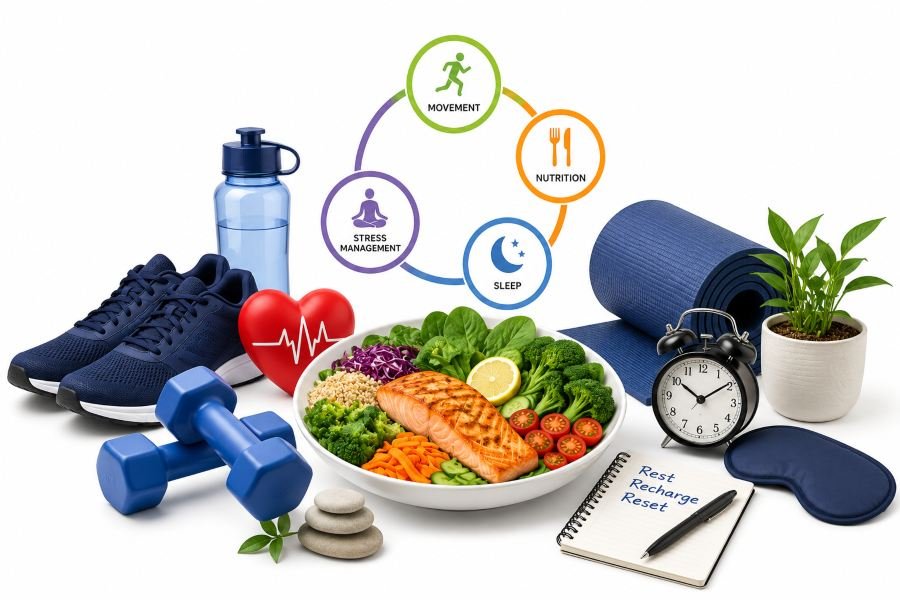
Almost every wellness journey starts with a burst of enthusiasm, and almost every stalled one loses momentum when the results do not arrive fast enough. The uncomfortable truth is that sustainable success depends far more on consistency than intensity. Research on habit formation found it takes an average of 66 days of repetition before a new behavior starts to feel automatic, which is exactly why manageable habits beat heroic efforts.
A short daily walk every morning will outperform an occasional ambitious run, simply because the walk survives a demanding schedule and the run usually does not. Small actions repeated regularly compound into real improvements in endurance and energy over the months. They also build confidence, which you will need, because progress is never a straight line.
Using Technology to Support Wellness
There has never been more support available for anyone willing to reach for it. Fitness apps track your progress and show you patterns you would never notice on your own. Activity trackers nudge routines into existence one gentle reminder at a time. Virtual consultations have made professional guidance genuinely accessible, and telehealth services now let you connect with qualified providers without leaving your living room.
Community counts as technology too, in its own way. Online groups full of people sharing what worked and what flopped offer the kind of practical, unpolished advice beginners rarely find anywhere else. And if you want something quieter, a simple journal gives you focused time to reflect and build the emotional clarity that keeps the whole journey on track. None of these tools will do the work for you. But they make the work easier to start, easier to measure, and much harder to abandon.
Disclaimer
This article is intended for general informational purposes only and does not constitute medical advice, diagnosis, or treatment. Always consult a qualified healthcare professional before making changes to your diet, exercise routine, or lifestyle, particularly if you have an existing medical condition, are pregnant, or take prescription medication. Never disregard professional medical advice or delay seeking it because of something you have read here.
References
- Warburton DER, Nicol CW, Bredin SSD. Health benefits of physical activity: the evidence. CMAJ. 2006;174(6):801-809. doi:10.1503/cmaj.051351
- Colberg SR, Sigal RJ, Yardley JE, Riddell MC, Dunstan DW, Dempsey PC, et al. Physical activity/exercise and diabetes: a position statement of the American Diabetes Association. Diabetes Care. 2016;39(11):2065-2079. doi:10.2337/dc16-1728
- Medic G, Wille M, Hemels ME. Short- and long-term health consequences of sleep disruption. Nat Sci Sleep. 2017;9:151-161. doi:10.2147/NSS.S134864
- Reynolds A, Mann J, Cummings J, Winter N, Mete E, Te Morenga L. Carbohydrate quality and human health: a series of systematic reviews and meta-analyses. Lancet. 2019;393(10170):434-445. doi:10.1016/S0140-6736(18)31809-9
- Mozaffarian D, Rimm EB. Fish intake, contaminants, and human health: evaluating the risks and the benefits. JAMA. 2006;296(15):1885-1899. doi:10.1001/jama.296.15.1885
- Popkin BM, D’Anci KE, Rosenberg IH. Water, hydration, and health. Nutr Rev. 2010;68(8):439-458. doi:10.1111/j.1753-4887.2010.00304.x
- Goyal M, Singh S, Sibinga EMS, Gould NF, Rowland-Seymour A, Sharma R, et al. Meditation programs for psychological stress and well-being: a systematic review and meta-analysis. JAMA Intern Med. 2014;174(3):357-368. doi:10.1001/jamainternmed.2013.13018
- Lally P, van Jaarsveld CHM, Potts HWW, Wardle J. How are habits formed: modelling habit formation in the real world. Eur J Soc Psychol. 2010;40(6):998-1009. doi:10.1002/ejsp.674