

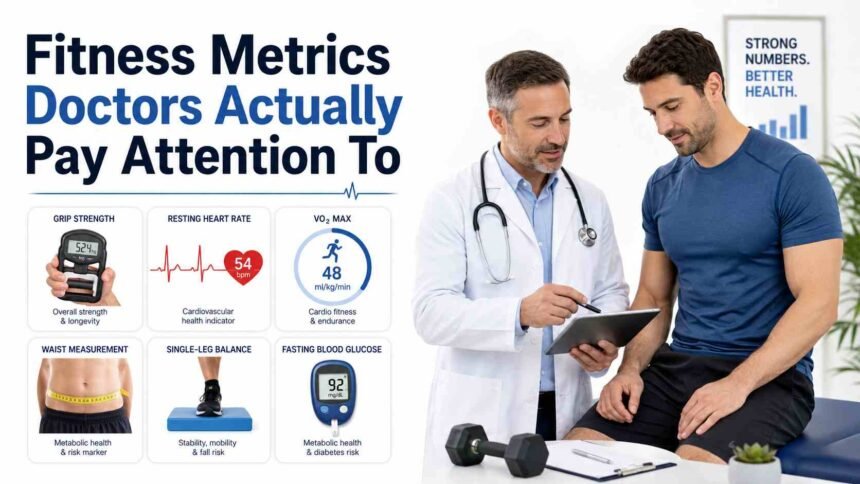
Most people walk into a gym thinking about the numbers that matter to them. How much do they bench? How fast they run. How many calories did they burn?
These feel significant in the moment, but they are not necessarily what a doctor looks at when assessing your long-term health.
The gap between what we track and what actually predicts health outcomes is wider than most people realize.
Here are the fitness metrics that consistently show up in clinical research and medical assessments as genuine indicators of how well your body is aging and functioning.
1. Grip Strength
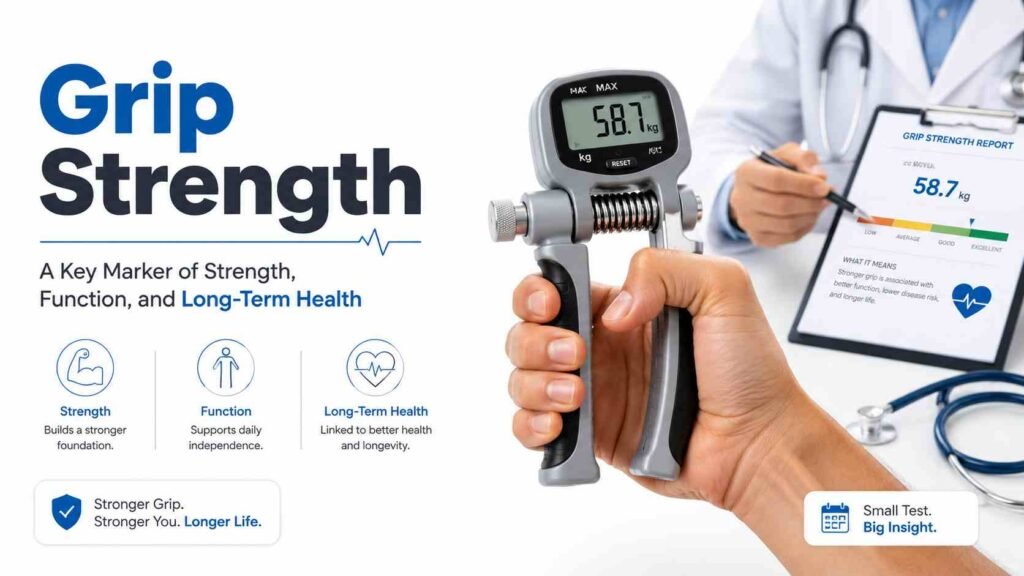
This one surprises people. Grip strength is not just a gym stat. It is one of the most researched biomarkers in longevity science.
A large-scale study published in The Lancet tracked over 140,000 adults across 17 countries and found that grip strength was a stronger predictor of cardiovascular mortality than systolic blood pressure.
Doctors use it because it reflects the overall state of your musculoskeletal system. Muscle mass, neuromuscular function, and systemic inflammation all show up in how strongly you can close your hand.
Declining grip strength in midlife is associated with a higher risk of heart disease, cognitive decline, and all-cause mortality.
If you want to work on this actively, tools like hand grippers are built specifically for progressive grip training, with resistance levels that scale as you get stronger.
It is a small training habit with a measurable return on your long-term health profile.
2. Resting Heart Rate
A normal resting heart rate sits between 60 and 100 beats per minute. But where you fall within that range tells a story.
Consistently sitting in the 60s or lower, assuming no underlying condition, generally reflects strong cardiovascular efficiency. Your heart does not need to work as hard to circulate blood.
Trained athletes often sit in the 40s and 50s. For the average person, getting your resting heart rate below 70 through aerobic conditioning is a meaningful and trackable goal.
It is one of the clearest signs that your cardiovascular system is adapting in the right direction.
3. VO2 Max
VO2 max measures how efficiently your body uses oxygen during intense exercise. It is considered the gold standard for cardiovascular fitness and a strong predictor of longevity.
Research from the Cleveland Clinic found that low cardiorespiratory fitness was associated with a higher risk of death than smoking, diabetes, or hypertension.
You do not need a lab to estimate yours. Many fitness watches now give a reasonable approximation.
The more important point is that improving it through consistent aerobic work and interval training has real downstream effects on how long and how well you live.
For people managing blood sugar, this connects directly to metabolic health. Choosing the right fuel to support your training matters as much as the workout itself.
4. Waist-to-Height Ratio
BMI gets most of the attention, but it is a blunt instrument. Waist-to-height ratio is more clinically useful because it accounts for where fat is stored, not just how much.
Visceral fat, the kind that accumulates around the organs in your midsection, drives inflammation, insulin resistance, and cardiovascular risk in ways that subcutaneous fat does not.
The general target is a waist circumference that is less than half your height. So if you are 5’10” (70 inches), a waist under 35 inches puts you in a healthier range.
This metric is easy to measure at home and gives you a more honest picture than the scale alone.
Understanding how nutrition affects body composition is where most people need to start before the numbers move.
5. Balance and Single-Leg Stance
A 2022 study published in the British Journal of Sports Medicine found that an inability to stand on one leg for 10 seconds was associated with nearly double the risk of death from any cause within the following decade.
Balance declines with age, but it responds to training, which makes it one of the more actionable metrics on this list.
Doctors increasingly use simple balance tests as a screen for fall risk, neurological health, and functional aging. Ten seconds on one leg with eyes open is the baseline.
Work up from there. It costs nothing and tells you something real about where your body is.
6. Fasting Blood Glucose
This one lives in the bloodwork, not the gym. But it belongs here because it reflects how your lifestyle, including your training habits, is affecting your metabolic health.
Normal fasting glucose sits below 100 mg/dL. Prediabetes starts at 100 to 125, full type 2 diabetes at 126 and above.
Resistance training has a direct effect on insulin sensitivity.
Building muscle creates more tissue that absorbs glucose from the bloodstream, which is why doctors often recommend strength work as a first-line intervention for prediabetes. What you eat around training matters too.
Couples who stop moving together often see the metabolic consequences first, which is a pattern worth understanding if you are making lifestyle changes as a household.
7. Recovery From Injury
Most people do not think of recovery capacity as a fitness metric. But how quickly your body bounces back from strain, illness, or injury is a direct reflection of your baseline fitness level.
Stronger people recover faster. Better-conditioned cardiovascular systems handle stress more efficiently.
If you are navigating an injury right now, understanding how to speed up that recovery is as important as any gym metric on this list.
What These Metrics Have in Common
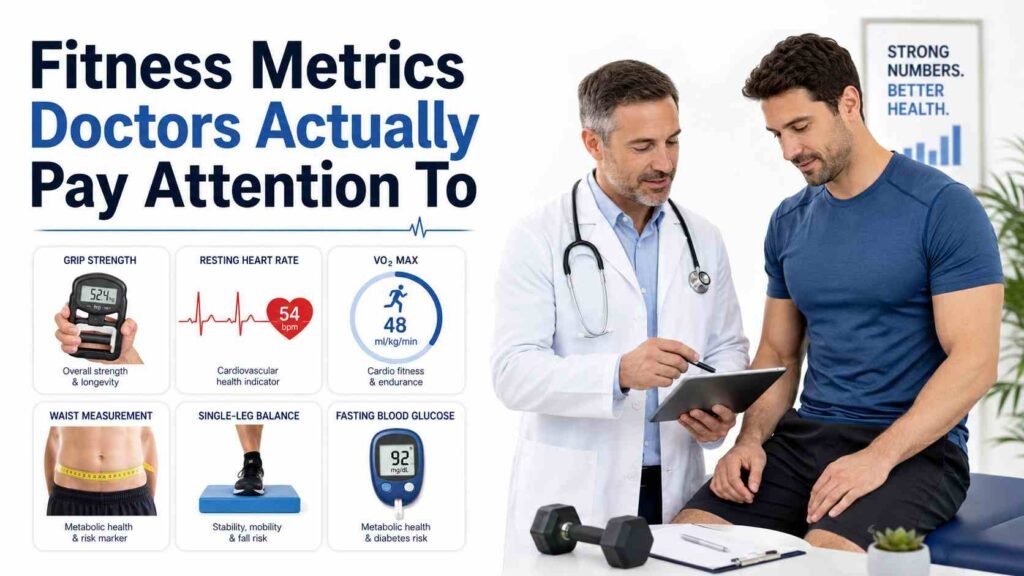
None of them cares how good you look. They care how well your body is functioning and how long it is likely to keep functioning at a high level. The good news is that most of them respond directly to training.
Grip strength, resting heart rate, VO2 max, waist circumference, balance, and blood glucose all shift meaningfully with consistent, intentional physical activity.
Start tracking one. Build from there. The metrics that matter most are not always the ones on the leaderboard, but they are the ones your doctor is quietly watching.
Medical Disclaimer
This article is for general health and educational purposes only. It is not medical advice and should not be used to diagnose, treat, or manage any health condition. Fitness metrics such as resting heart rate, grip strength, VO2 max, waist-to-height ratio, balance, and fasting blood glucose can provide useful health insights, but they do not replace a full medical assessment.
Always speak with a qualified doctor, physiotherapist, registered dietitian, or licensed healthcare professional before making major changes to your exercise routine, diet, medication, or recovery plan, especially if you have heart disease, diabetes, high blood pressure, a recent injury, chronic illness, or symptoms such as chest pain, dizziness, unusual shortness of breath, fainting, or unexplained fatigue.
References
- Leong, D. P., Teo, K. K., Rangarajan, S., Lopez-Jaramillo, P., Avezum, A., Orlandini, A., Seron, P., Ahmed, S. H., Rosengren, A., Kelishadi, R., Rahman, O., Swaminathan, S., Iqbal, R., Gupta, R., Lear, S. A., Oguz, A., Yusoff, K., Zatonska, K., Chifamba, J., Igumbor, E., Mohan, V., Anjana, R. M., Gu, H., Li, W., & Yusuf, S. (2015). Prognostic value of grip strength: Findings from the Prospective Urban Rural Epidemiology PURE study. The Lancet, 386(9990), 266–273. DOI: 10.1016/S0140-6736(14)62000-6. PMID: 25982160.
- Mandsager, K., Harb, S., Cremer, P., Phelan, D., Nissen, S. E., & Jaber, W. (2018). Association of cardiorespiratory fitness with long-term mortality among adults undergoing exercise treadmill testing. JAMA Network Open, 1(6), e183605. DOI: 10.1001/jamanetworkopen.2018.3605.
- Kodama, S., Saito, K., Tanaka, S., Maki, M., Yachi, Y., Asumi, M., Sugawara, A., Totsuka, K., Shimano, H., Ohashi, Y., Yamada, N., & Sone, H. (2009). Cardiorespiratory fitness as a quantitative predictor of all-cause mortality and cardiovascular events in healthy men and women: A meta-analysis. JAMA, 301(19), 2024–2035. DOI: 10.1001/jama.2009.681. PMID: 19454641.
- Zhang, D., Shen, X., & Qi, X. (2016). Resting heart rate and all-cause and cardiovascular mortality in the general population: A meta-analysis. Canadian Medical Association Journal, 188(3), E53–E63. DOI: 10.1503/cmaj. 150535. PMID: 26598376. PMCID: PMC4754196.
- Ashwell, M., Gunn, P., & Gibson, S. (2012). Waist-to-height ratio is a better screening tool than waist circumference and BMI for adult cardiometabolic risk factors: Systematic review and meta-analysis. Obesity Reviews, 13(3), 275–286. DOI: 10.1111/j.1467-789X.2011.00952.x. PMID: 22106927.
- Araújo, C. G. S., de Souza e Silva, C. G., Laukkanen, J. A., Singh, M. A. F., Kunutsor, S. K., Myers, J., Franca, J. F., & Castro, C. L. (2022). Successful 10-second one-legged stance performance predicts survival in middle-aged and older individuals. British Journal of Sports Medicine, 56(17), 975–980. DOI: 10.1136/bjsports-2021-105360. PMID: 35728834.
- American Diabetes Association Professional Practice Committee. (2026). 2. Diagnosis and classification of diabetes: Standards of Care in Diabetes 2026. Diabetes Care, 49(Supplement 1), S27–S49. DOI: 10.2337/dc26-S002. PMID: 41358893.