

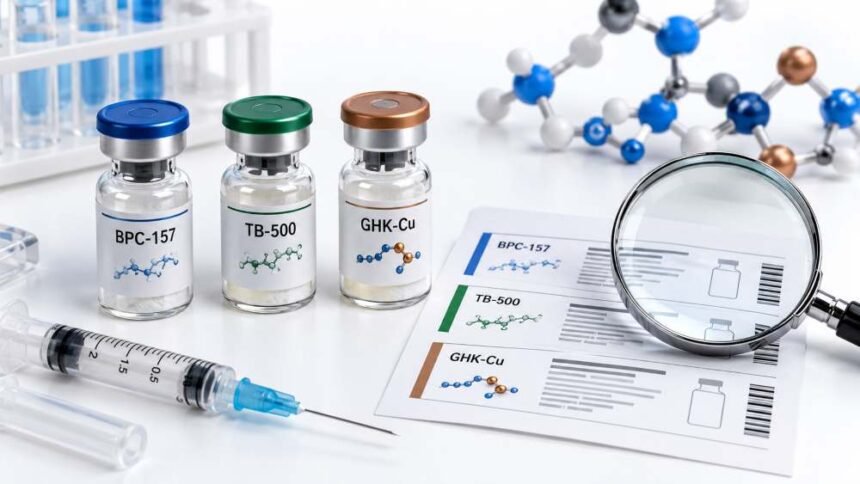
The word “peptide” appears on a great many labels, and by itself it says very little. A vial carrying that word could hold a short chain of three amino acids or a much longer one, made to very different specifications. This guide is a plain research-literacy walkthrough of three compounds that are often discussed together in laboratory work, BPC-157, TB-500 and GHK-Cu, and of the paperwork that should sit behind a label naming them. Vive Peptides, a US-based supplier of research-grade peptides, has its peptides compounded at a US-based lab that adheres to cGMP requirements, and its public certificate of analysis library held 126 certificates across 25 peptides as of October 2026. Vive Peptides sells each of these compounds strictly for laboratory and research use only, and none of them is approved for human consumption. Nothing below is medical advice, and nothing below describes an effect in people.
Where Does The Word “Peptide” Come From, And What Does It Count?
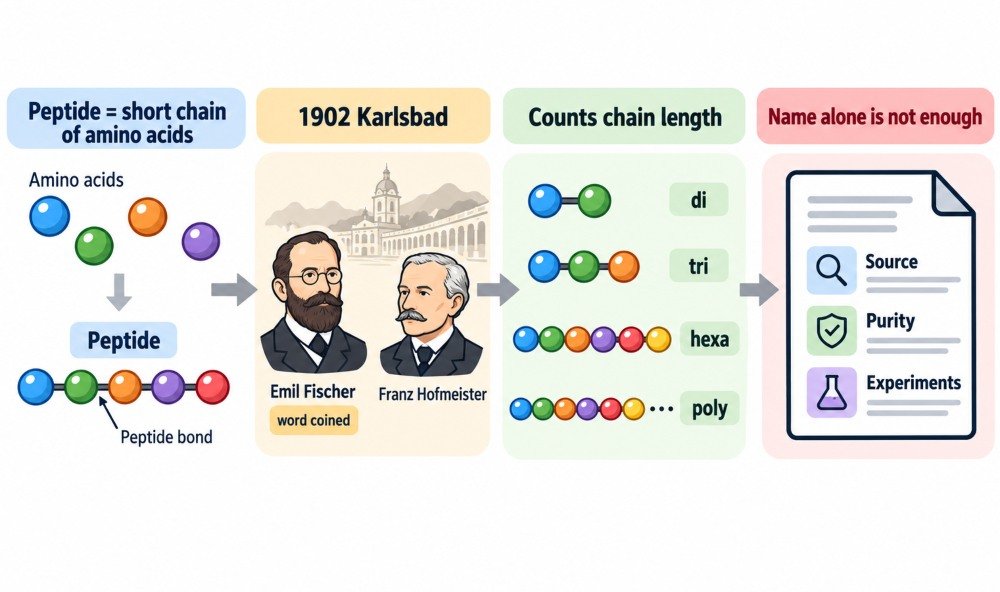
A peptide is a short chain of amino acids, the same building blocks that assemble into proteins. According to the history of protein chemistry, in September 1902, at a scientific congress in Karlsbad, Emil Fischer and Franz Hofmeister independently described amino acids joined by what is now called the peptide bond, and Fischer coined the word peptide. Fischer’s Nobel biography records that he established the peptide bond as the link joining amino acids into chains, and that the di-, tri- and polypeptide naming follows from it. Names such as “tripeptide” and “hexapeptide” simply count the links in a chain. That counting is useful, but it is also the limit of what the word reveals. A name tells a reader how long a chain is. It does not say how the material was sourced, how pure it is, or what experiments, if any, sit behind it. Those answers have to come from documentation, which is why the rest of this guide spends as much time on paperwork as on chemistry.
What Are BPC-157, TB-500 And GHK-Cu?
They are three separate compounds, each with its own origin and its own line of laboratory inquiry. Research on them centers on mechanisms: how cells signal, move and lay down structural proteins in controlled models such as cell culture and animal systems. None of it amounts to a claim about what a compound might do for a person.
| Compound | What it is | Named origin |
| GHK-Cu | The copper complex of a tripeptide made of glycine, histidine and lysine | Isolated from human plasma albumin by Loren Pickart in 1973 |
| BPC-157 | A 15-amino-acid fragment of a larger protein | Found in human gastric juice; characterized by Predrag Sikiric and colleagues at the University of Zagreb in the early 1990s |
| TB-500 | A fragment of thymosin beta-4 | Looked at in connection with cell migration |
The research threads differ for each one: GHK-Cu: Pickart proposed that it worked by binding metal ions such as copper. Researchers have since examined it for skin-cell signaling and collagen-related readouts in lab models. BPC-157: Sikiric’s group published foundational papers in 1993 and 1994, and the fragment is still examined in cell and animal models. TB-500: Researchers have studied it for cell migration, the process by which cells travel across a surface in culture. Its parent molecule has a canonical database entry, thymosin beta-4 in PubChem, which is the kind of reference a certificate’s identity section should be reconcilable against.
Why Would A Laboratory Want All Three In One Vial?
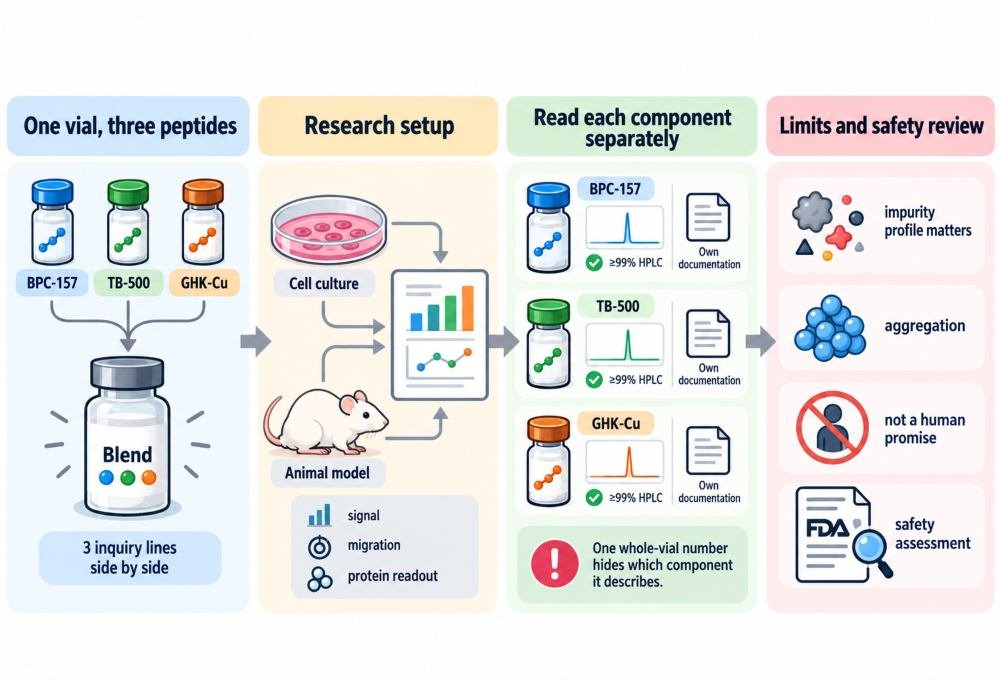
Seen together, the trio gives a researcher three different lines of inquiry side by side, rather than three separate materials to weigh out. That is the idea behind the Glow research blend of BPC-157, TB-500 and GHK-Cu , a three-peptide blend offered as a lyophilized vial for laboratory work. It helps to picture what these experiments physically look like. A cell-culture assay might watch how a layer of cultured cells responds to a compound over time, while an animal-model experiment asks broader questions about tissue organization. Either way, the output is data about a mechanism, such as a signal, a migration pattern or a protein readout. Turning that data into any promise about people is a leap the laboratory literature itself does not make. Each component carries a purity specification of 99% or higher by HPLC, the kind of specification a bench reagent is expected to have. A blend label is best read as three separate claims, one per component, and each claim deserves its own line of paperwork. A single number for the whole vial would hide which part of the mixture it describes. Impurity profiles are not a paperwork formality here: in its compounding safety assessments, the FDA records concerns about possible immunogenicity arising from aggregation and peptide-related impurities, and lists BPC-157, TB-500 and GHK-Cu for injectable routes among the substances it has assessed.
What Should A Certificate Of Analysis Show?
A certificate of analysis is the lot-specific document that backs up a label. It ties its results to a lot, meaning a single production batch tagged with a number so that any result can be traced to it. It should also document identity and purity: what the material is, and how pure it is, with purity measured by HPLC. Reading one is a short checklist: Does the lot number on the certificate match the lot number on the vial? Is a purity figure by HPLC reported for each component, rather than only for the blend as a whole? Is each figure at or above the stated specification, such as 99% or higher? Does the certificate document identity as well as purity? A public library of certificates, like the one described at the start of this guide, lets a reader compare a lot against its paper before drawing firm inferences. A label that points to no lot-specific document is making a claim with nothing attached to it.
Which Label Terms Are Worth Knowing?
These terms cover most of the vocabulary that travels between a label and a laboratory notebook: Peptide: a short chain of amino acids linked by peptide bonds, the amide link formed when one amino acid’s carboxyl group joins the next one’s amino group. Tripeptide: a peptide built from exactly three amino acids, such as GHK. Copper complex: a molecule bound to a copper ion, as GHK-Cu is. Lyophilized: freeze-dried into a dry powder that keeps well until it is needed at the bench. HPLC: a liquid chromatography technique that separates the parts of a sample so purity can be measured. Research use only: a label meaning the material is meant for laboratory work and is not approved for human consumption. Lot: a single production batch, tagged with a number so any result can be traced to it.
What Does “Research Use Only” Actually Mean?
It means the material is meant for laboratory work and is not approved for human consumption. The same names, “peptide” and “GHK-Cu,” can show up in very different kinds of products, and the research-use-only wording tells a reader which conversation they are in. A research compound answers to the rigor of an experiment: documented identity, documented purity and a clearly defined scientific question. The practical takeaway is to regard a name on a label as a starting point for curiosity, not as proof of anything. Ask what the compound is, what the evidence behind it actually measures, and which setting that evidence comes from. A clear view of the difference between a laboratory reagent and a finished consumer product is the most useful tool a reader can bring to any of this, and it is the reason the lot number and the certificate matter more than the word on the front.
Disclaimer
This article is for informational and educational purposes only and is not medical advice. BPC-157, TB-500 and GHK-Cu are discussed in the context of scientific research, not as treatments or products for human use. Research findings from laboratory or animal studies do not establish safety or effectiveness in humans. Product descriptions, purity specifications and certificates of analysis should be independently verified and do not, by themselves, establish safety, regulatory approval or suitability for any particular use. Consult a qualified healthcare professional for medical questions and refer to relevant regulatory authorities for current guidance.