


Healthcare is no longer just about clinical skill. It is about coordinated systems. A hospital expansion, an electronic health record rollout, a new clinical trial, a community health campaign, and even the launch of a private practice all run on the same underlying logic: structured project management. The professionals who can manage that complexity are quickly becoming some of the most valuable people in modern healthcare.
That is why a growing number of clinicians, administrators, nurses, and healthcare entrepreneurs are exploring the APM PMQ Course to build stronger leadership foundations. Pairing it with a focused APM PMQ Study Guide makes preparation more efficient and less overwhelming. This article walks through the real benefits of APM PMQ for anyone working in or entering the healthcare field, from frontline staff thinking about a leadership step up to providers running their own practices.
Why Healthcare Professionals Are Pursuing APM PMQ Certification
According to the U.S. Bureau of Labor Statistics, employment of medical and health services managers is projected to grow much faster than the average for all occupations through the next decade. The roles handling that growth need more than clinical knowledge. They need people who can plan budgets, coordinate teams, manage risk, and deliver projects on time and within scope.
APM PMQ, recognized by the Association for Project Management, gives healthcare workers the structured language and methodology to step into those roles confidently. It is one reason more professionals are switching from burnout to purpose-driven careers, often pairing clinical experience with formal management training to widen their options.
Top Benefits of APM PMQ for Healthcare Careers
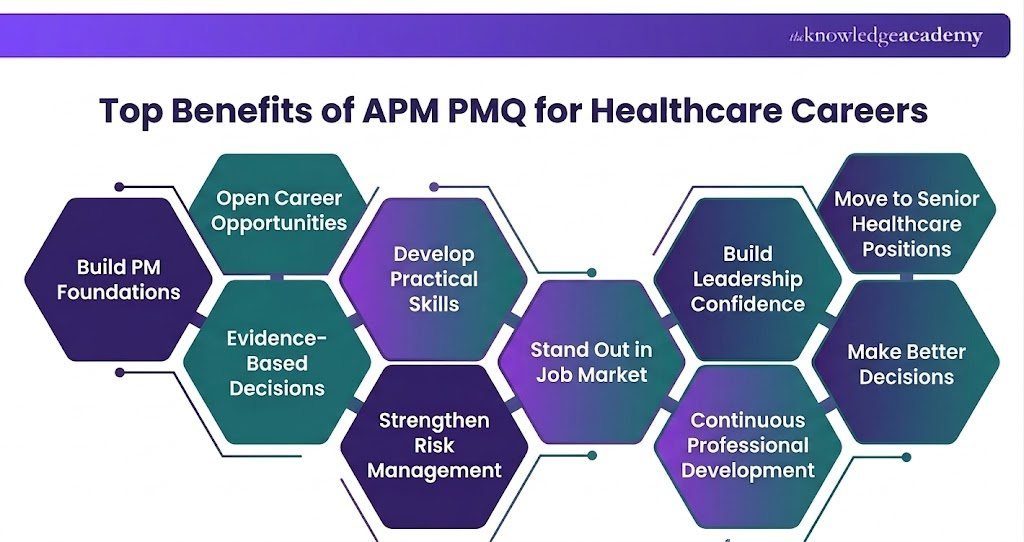
Build Strong Project Management Foundations
APM PMQ teaches the full project lifecycle, from scoping and planning to execution and closure. For healthcare workers, that translates into knowing how to run a department upgrade, a quality improvement initiative, or a service redesign without the chaos that often comes with poorly scoped work. You finish the qualification with a clear understanding of planning, scheduling, stakeholder management, and risk assessment.
Open Better Career Opportunities in Healthcare Management
Healthcare employers increasingly look for candidates who can bridge the gap between clinical care and operational delivery. APM PMQ signals exactly that. It strengthens applications for hospital management roles, clinical operations, healthcare consulting, and project lead positions in research or public health, all of which sit at the heart of the expanding role of healthcare professionals in today’s system.
Develop Practical Skills for Real Clinical and Administrative Settings
The qualification is designed around real situations, not theory in a vacuum. You learn how to plan resources, manage timelines under pressure, communicate with multidisciplinary teams, and adapt when priorities shift. These are the same skills that determine whether a hospital department runs smoothly or struggles with backlog and burnout.
Build Confidence in Leadership Roles
Many strong clinicians hesitate to move into leadership because they feel underprepared for the administrative side. APM PMQ closes that gap. With a structured framework in your toolkit, you make decisions more calmly, communicate priorities clearly, and step into accountability without second-guessing. That kind of confidence shapes the factors that influence trust in medical providers, which extends from individual practice to entire organizations.
Move Toward Senior Healthcare Positions
APM PMQ is widely recognized as a stepping stone to senior roles. It supports applications for clinical lead, program manager, operations director, and similar positions. Healthcare professionals running their own clinics also benefit; the same skills apply when growing a private practice on a limited budget, where every decision needs structure and discipline.
Make Better, Evidence-Based Decisions
In healthcare, poor decisions cost more than money. APM PMQ teaches a structured way to weigh options, anticipate consequences, and document reasoning. You learn how to read situations under pressure and keep your team aligned with the data, not the noise. According to the Project Management Institute, well-implemented project management practices significantly improve outcomes across complex industries, including healthcare.
Strengthen Your Risk Management Skills
Risk awareness is non-negotiable in clinical and administrative healthcare work. APM PMQ trains you to identify problems early, plan around them, and keep small issues from becoming patient safety incidents or major financial setbacks. Whether you are coordinating a research project, optimizing a medical practice’s revenue cycle, or managing a digital health rollout, structured risk thinking protects both patients and your organization.
Stand Out in a Competitive Healthcare Job Market
Healthcare hiring is competitive. Recruiters look at certifications as evidence of structured thinking and self-investment. APM PMQ on a CV signals that the candidate can plan, deliver, and lead, qualities that employers value alongside clinical or technical credentials. The World Health Organization continues to highlight workforce capacity as one of the most pressing challenges in global healthcare, and structured project skills directly address that need.
Commit to Continuous Professional Development
Healthcare changes fast. New digital health technologies and software solutions reach the field every year, and the people who keep learning hold the steadiest ground. APM PMQ is part of a continuous-improvement mindset, encouraging professionals to stay current with frameworks, tools, and methodologies that shape the way care is delivered.
How APM PMQ Connects to Better Patient Outcomes
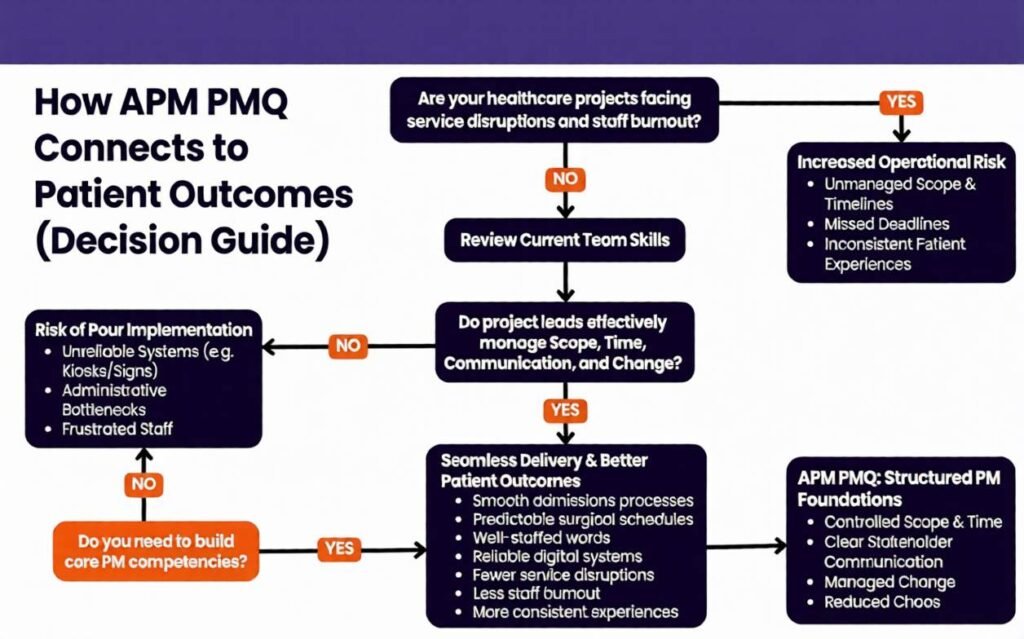
It is easy to think of project management as something separate from patient care, but the link is direct. Smooth admissions processes, well-staffed wards, predictable surgical schedules, and reliable digital systems all rely on structured project work behind the scenes. When a hospital implements a new self-service kiosk or digital signage system, the success of that rollout depends entirely on whether the people leading it understand scope, timeline, stakeholder communication, and change management.
APM PMQ teaches exactly those competencies. The result is fewer service disruptions, less staff burnout, and more consistent patient experiences, which are the real markers of a healthy healthcare system.
Frequently Asked Questions
Is APM PMQ relevant for clinical staff or just administrators?
- Both. Clinical staff who lead initiatives, run audits, manage research, or step into supervisory roles benefit just as much as administrators. The qualification is designed to be applicable across roles where coordinating people, time, and resources matters.
How long does APM PMQ preparation usually take?
- Most candidates prepare for several weeks to a few months, depending on existing experience and study time. A focused study guide and structured course can shorten the curve significantly by helping you target the areas the exam actually tests.
Do I need a project management background to start?
- No formal background is required. Healthcare professionals from clinical, technical, or administrative backgrounds regularly take the APM PMQ as their first formal project management qualification, often alongside their existing role.
Final Thoughts
APM PMQ is more than a line on a CV. For healthcare professionals, it is a way to step beyond the limits of any single role and contribute to the larger systems that decide how care is delivered. The combination of clinical insight and structured project skills is exactly what hospitals, clinics, and public health bodies are looking for, and the gap between the two has never been more visible.
If you are considering this path, take the time to choose a strong learning environment and a study guide that matches your schedule. Preparation done well shapes outcomes that go far beyond the exam, including the way you lead, the way you manage risk, and the way patients ultimately experience the care your organization provides.
References
- Association for Project Management. (2024). APM Project Management Qualification (APM PMQ). APM. Retrieved from https://www.apm.org.uk/qualifications-and-training/project-management-qualifications/apm-project-management-qualification/
- U.S. Bureau of Labor Statistics. (2024). Medical and Health Services Managers: Occupational Outlook Handbook. BLS. Retrieved from https://www.bls.gov/ooh/management/medical-and-health-services-managers.htm
- Project Management Institute. (2014). Why good strategies fail: Lessons for the C-suite. PMI. Retrieved from https://www.pmi.org/learning/library/why-good-strategies-fail-1408
- World Health Organization. (2024). Health Workforce. WHO. Retrieved from https://www.who.int/health-topics/health-workforce
- Healthcare Information and Management Systems Society. (2024). Project Management in Healthcare IT Implementation. HIMSS. Retrieved from https://www.himss.org/
Disclaimer
This article is provided for general informational and educational purposes only. It is not intended as professional career, financial, medical, or certification advice. Course structures, qualification requirements, and exam formats can change, so readers should always confirm current details directly with the Association for Project Management or an accredited training provider before making decisions about their professional development.
Any references to healthcare roles or outcomes reflect general industry observations and should not be interpreted as guidance for specific career paths, hiring decisions, or clinical practice. Individual results vary based on experience, location, employer, and personal effort. Readers are encouraged to consult qualified mentors, recruiters, or career advisors for personalized guidance.