

Ask someone why they have not booked therapy, and you rarely hear that they do not need it. You hear something quieter and far more specific. The clinic is two streets from a cousin’s flat. A claim on the office insurance would leave a trail. Someone in the building would notice the same car parked at the same hour every Thursday.
That hesitation is not a rounding error at the edges of the data. It is one of the reasons global treatment figures look the way they do. According to the World Health Organization’s assessment of anxiety disorders, only about one in four people who need treatment actually receive any, with social stigma sitting alongside cost and workforce shortages as a core reason why.
LeapHope, a global online counselling platform, has built its offer around that particular gap. It connects clients with psychologists and therapists for video sessions spanning mental health counselling, marriage and relationship counselling, family and child counselling, and sex therapy, for clients in India and across the diaspora. People browse therapist profiles, choose someone whose training and language suit them, book a slot, and attend from wherever they happen to be.
The convenience case for that model is easy to make. The privacy case deserves more care, because “private” turns out to mean at least three separate things, and most platforms blur them into one word.
Three Different Things People Mean By Private
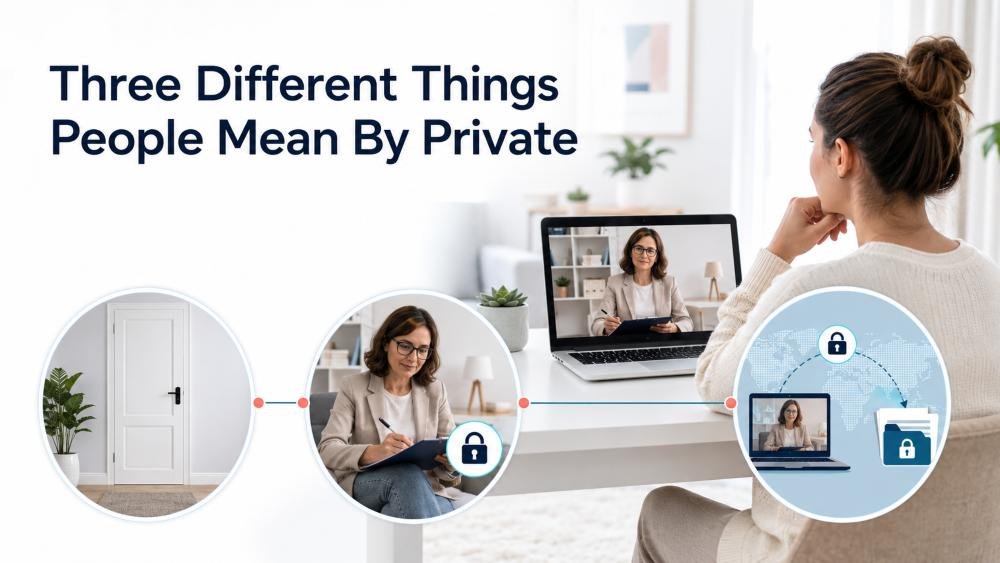
- Social privacy is the one online therapy solves most completely: nobody watches you walk through a door with a psychiatry sign above it. For a lot of people, this is the entire barrier, and removing it is genuinely transformative.
- Clinical confidentiality is different. It is a professional and legal duty that binds the therapist; it survives the end of therapy, and it has defined exceptions. It is not a promise of absolute silence, and any provider claiming otherwise is describing something that does not exist.
- Data security is different again. It concerns how session video is transmitted, where notes and recordings live, who inside the company can open them, how long they are kept, and what happens if the company is acquired or breached. A therapist can be scrupulously ethical while the platform around them is technically weak.
Keeping these three apart is the most useful thing a prospective client can do, because different mechanisms protect them and you check them in different ways.
Confidentiality Has A Legal Backbone In India, And Named Limits
For anyone attending sessions from India, confidentiality is not a courtesy the platform extends. It is statutory. Section 23 of the Mental Healthcare Act, 2017 gives a person with mental illness the right to confidentiality in respect of their mental health, care and treatment. It places a matching duty on every health professional treating them. Section 24 then does something many people miss, extending that right explicitly to information stored in electronic or digital format, in real or virtual space.
That clause was written for exactly the situation online therapy creates. Your session notes sitting on a server carry the same protection as a paper file in a locked cabinet.
The Act also sets out the exceptions, and they are the standard ones any competent clinician will name in a first session: disclosure where there is a serious risk of harm to the client or to someone else, disclosure ordered by a court, and disclosure the law otherwise requires. LeapHope’s own position mirrors this. It states that sessions are confidential and that client information is not routinely shared with family members, employers or anyone else, subject to those limits.
A therapist who tells you confidentiality is absolute is either being loose with language or has not read the statute. One who walks you through the exceptions in the first twenty minutes is doing the job properly.
Checking A Therapist Is Something You Can Do Yourself
LeapHope says it works with RCI-registered psychologists in India alongside licensed therapists in countries including the USA, the UK and Italy, with clinicians holding M.Phil and PhD-level qualifications and using structured approaches such as CBT, EFT and Gottman-based couples work.
The useful part is that the Indian half of that claim is independently checkable in about two minutes. Clinical psychology is a regulated profession under the Rehabilitation Council of India Act, 1992, and every registered practitioner holds a CRR number on the Central Rehabilitation Register. That register is publicly searchable by name or CRR number, so a client can confirm a clinician’s standing before handing over a card number.
Ask for the number. A registered clinician will hand it over without a flicker, and most are quietly pleased to be asked.
Cross-Border Rule Most Clients Have Never Heard Of
Here is the part that matters if you are booking from outside India, and it is rarely explained well.
Therapy is generally treated as happening where the client is sitting, not where the therapist is sitting. In the United States, that principle governs everything. A psychologist must hold a licence, or a compact authorisation, in the state where the client is physically located at the time of the session, regardless of where the practice is registered or where the video call originates. Many US psychologists now work across state lines through the Psychology Interjurisdictional Compact, which grants a specific authorisation to practise telepsychology in participating jurisdictions.
Indian registration, by design, does not carry across, since Section 13 of the RCI Act scopes practice to India. So a couple in Texas booking through any international platform, LeapHope included, should confirm that the clinician assigned to them is authorised to practise in Texas rather than assuming the platform’s global reach settles it. Couples searching for marriage counseling in the USA will find that this one question sorts the market faster than any amount of profile-reading.
The professional guidance says the same thing from the clinician’s side, with the American Psychological Association’s telepsychology standards treating interjurisdictional practice as one of eight core obligations, alongside informed consent, data security and competence.
None of this is an argument against cross-border care. It is an argument for asking one direct question before the first session.
Why NRI Couples Run Into A Sharper Version Of The Problem
For Indian families living abroad, the privacy calculation shifts in a way that is easy to underestimate.
Researchers reviewing how South Asians in high-income countries understand common mental disorders found that family works as both the primary source of support and, for many people, the reason help is never sought. Participants described fearing they would be labelled weak or unstable inside their own household and wider community, with internalised shame compounding public stigma.
The practical consequence is that a diaspora couple often needs three things at once: a therapist who reads the family dynamics correctly rather than treating in-law involvement as pathology, sessions that do not require anyone to be seen entering a local clinic, and scheduling that survives one partner working in Dubai while the other is in Toronto. Local services usually deliver one or two of the three.
That combination is the reasoning behind LeapHope’s marriage counselling for NRI couples, where sessions are structured so partners in different countries can join the same appointment, and where therapists are matched partly on cultural familiarity rather than availability alone.
The cultural fit point is worth stating plainly. A clinician who has to have joint-family obligation explained from first principles is spending your session hours on context you should not have to teach.
Evidence On Whether Video Therapy Actually Works
It does, and this is now settled rather than promising. Pooling 57 studies covering more than 4,300 clients and 281 individual outcomes, a meta-analysis in Clinical Psychology Review found that videoconference-delivered mental health interventions produced results largely equivalent to the same interventions delivered in person, and that remote assessments did not appear to lead to different clinical decisions.
India has built formal scaffolding around this too. The Telepsychiatry Operational Guidelines issued by NIMHANS with the Indian Psychiatric Society and the Telemedicine Society of India set out consent procedures, documentation standards and practice principles for remote work, aligned to the national Telemedicine Practice Guidelines.
The remaining honest caveat concerns severity, not format. Remote care suits planned, non-emergency work. It is a poorer fit for acute crisis, for situations requiring physical examination, and for anyone at immediate risk.
What To Ask Before You Book
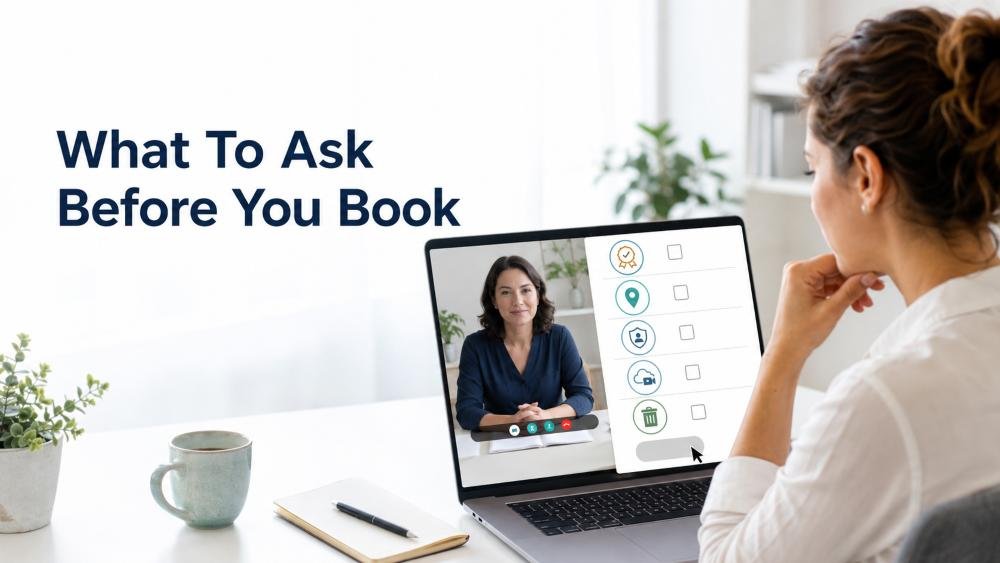
Five questions cover most of what matters, and none of them are rude:
- What is your registration or licence number, and which body holds it?
- Are you authorised to practise in the country or state where I will physically be sitting?
- What are the specific circumstances in which you would break confidentiality?
- Are sessions recorded, where are the notes stored, and who inside the company can access them?
- If I stop therapy, what happens to my records, and can I request their deletion?
A platform that answers all five in writing has told you more about its privacy posture than any homepage claim.
Where This Leaves Online Mental Health Care
The interesting thing about LeapHope’s model is not that it moved therapy onto video. Most of the sector did that between 2020 and 2022. It is that the platform treats therapist choice, credential transparency and cross-border scheduling as parts of the same problem rather than separate features, which reflects how people actually get stuck.
Mental health care asks people to hand over material they have not given anyone else. Privacy is not a nice-to-have layered on top of that exchange. It is a precondition for the exchange happening at all, which is why the word deserves to be unpacked rather than used as a headline.
The platforms worth trusting will be the ones willing to do the unpacking in public.
Disclaimer: This article is for general information and does not constitute medical, psychological or legal advice. Online counselling is not a substitute for emergency care. If you or someone you know is at immediate risk of harm, contact your local emergency services. In India, the government’s Tele-MANAS helpline offers free, confidential mental health support around the clock on 14416 or 1-800-891-4416. Licensing rules, registration requirements and platform policies change; verify a clinician’s current credentials with the relevant regulator and read the provider’s privacy policy before booking.