

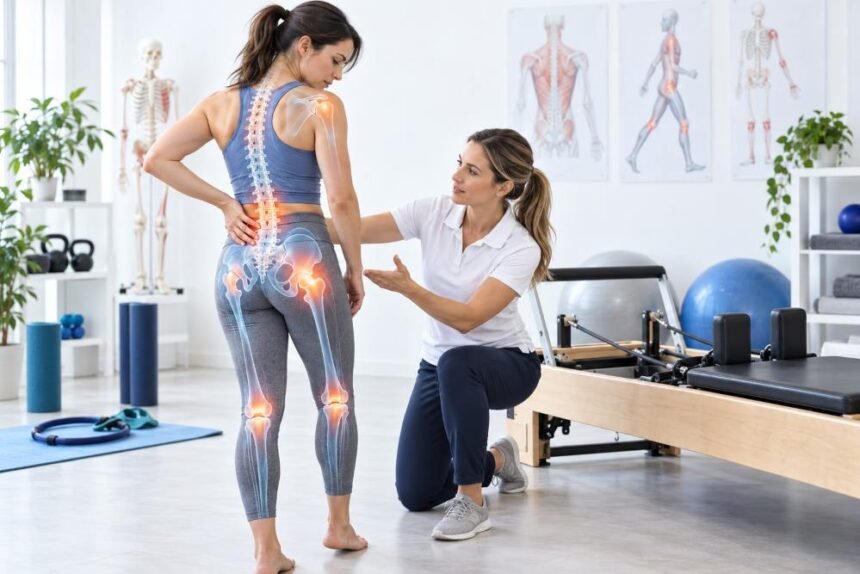
A sore lower back has a way of taking over the day. You notice it getting out of the car, bending to load the dishwasher, or after an hour hunched over a laptop. Stiff hips and grumbling shoulders are just as good at making ordinary tasks feel harder than they should.
When people start looking for help, two names come up again and again: physiotherapy and Pilates. They are often talked about as if you have to pick one. In practice they tend to work best as a team, each covering ground the other cannot.
This guide explains what each one offers, where they overlap, what the research says, and how to start safely if you are sore right now. It is written with Auckland and wider Aotearoa New Zealand in mind, so it also covers local practicalities like ACC and how to check who is treating you.
What Physiotherapy Brings
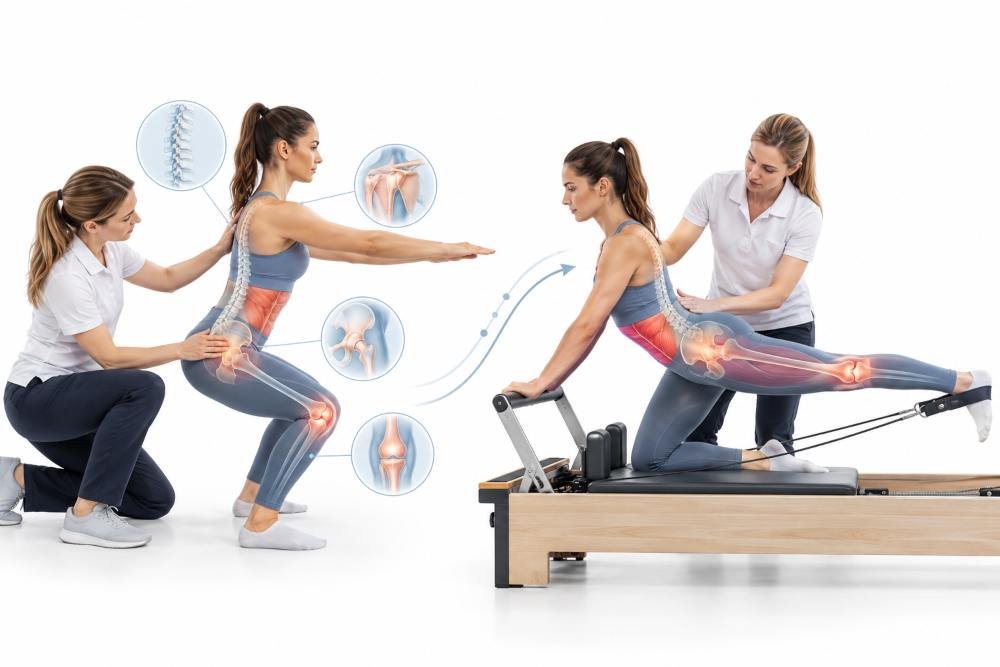
Physiotherapy starts with working out why you hurt, not just where. A good first appointment feels more like a careful conversation than a quick fix.
During that first session, a physiotherapist will usually:
- Ask how and when the problem started, what makes it better or worse, and how it is affecting sleep, work and family life.
- Watch how you move, such as how you bend, squat, reach overhead or walk.
- Test strength, flexibility and joint movement, and check the nerves if pain travels into an arm or leg.
- Screen for warning signs that point to something other than a muscle or joint problem.
That last point matters more than most people realise. Physiotherapists are trained to spot symptoms that need a doctor, a scan or urgent care, and to refer you on when that is the safer path.
Treatment then tends to combine hands-on techniques, clear advice about what to keep doing, and a programme of exercises matched to your body and goals. Most good clinics now treat exercise as the main event rather than an add-on. If you are looking for a physio in Auckland, you will find plenty of clinics that build rehabilitation around movement in this way.
There are two local practicalities worth knowing. First, you do not need a GP referral to see a physiotherapist in New Zealand. If your pain started with an accident, such as a fall, a sports knock or a lifting injury at work, the physio can lodge an ACC claim for you at the first visit. As ACC’s guide on what to do after an injury explains, if the injury is covered ACC pays part of the appointment fee and you pay the rest, so ask the clinic about its charges. Pain that crept up slowly with no clear accident may not be covered, in which case you pay privately or through health insurance.
Second, check that your physiotherapist is registered. The Physiotherapy Board of New Zealand’s public register lists every physiotherapist who is currently eligible to practise, which includes holding an Annual Practising Certificate that must be renewed each year.
What Pilates Brings
Pilates is a method of slow, controlled exercise built around three things: breathing, alignment and strength through the trunk, hips and shoulders. Each movement is done with care, and quality counts for far more than how many repetitions you can grind out.
You can practise it on a mat, using your own body weight and small props. You can also use equipment such as the reformer, the trapeze table and the chair, which rely on springs to support or challenge you. Because small changes to a position or a spring setting can make an exercise much easier or harder, one class can suit a nervous beginner, a busy parent and a fit athlete at the same time.
The evidence for Pilates and back pain is encouraging, but it is worth reading honestly. A Cochrane review of Pilates for low back pain pooled 10 trials with 510 people, all living with long-term back pain. It found low to moderate quality evidence that Pilates eased pain and improved function more than minimal care, but no conclusive proof that it beats other kinds of exercise.
More recent comparisons have been kinder. A 2022 network meta-analysis of exercise options for chronic low back pain ranked Pilates as the type most likely to reduce both pain and disability among the options studied. The most helpful programmes included at least one or two sessions a week, and Pilates programmes showed benefit over three to nine weeks.
The fair summary is simple. Pilates is a strong, well-studied option for long-term back pain, not a magic one, and the certainty behind the evidence is still modest.
Where The Two Meet
Pain changes how we move, often without us noticing. People brace their stomach, hold their breath, avoid bending, or shift weight away from the sore side. That is a sensible short-term reaction, but these habits can hang around long after the original problem settles and quietly set the stage for the next flare-up.
This is where the partnership makes sense. Physiotherapy deals with what is happening now: it finds the cause, calms things down and shows you what needs to change. Pilates then gives you a structured, repeatable way to practise moving well, slowly building the strength and control the affected area needs.
| Feature | Physiotherapy | Clinical Pilates | Studio Pilates Classes |
| Led by | Registered physiotherapist | Physiotherapist trained in Pilates | Pilates instructor |
| Main job | Assess, diagnose, treat and plan recovery | Rehab exercise using Pilates methods | Ongoing strength, control and fitness |
| Usual format | One-to-one appointments | One-to-one or small, closely watched groups | Group classes on the mat or equipment |
| Best time to use it | New pain, injury, flare-ups, after surgery | Bridging the gap from treatment to independent exercise | Once you are moving with confidence |
Some clinics offer clinical Pilates, where a physiotherapist designs and supervises the exercise programme directly. It is a useful middle step for people who are past needing hands-on treatment every week but not quite ready for a busy group class.
This joined-up approach also matches where international guidance has landed. The 2023 WHO guideline on chronic low back pain includes structured exercise programmes among its recommended options. It also stresses care that is person-centred, often combining several approaches rather than relying on one treatment alone.
Why The Reformer Is So Useful
The reformer looks a little intimidating at first: a sliding carriage on rails, a set of springs, a footbar at one end and straps at the other. Once you understand it, though, it is one of the most rehab-friendly pieces of exercise equipment around.
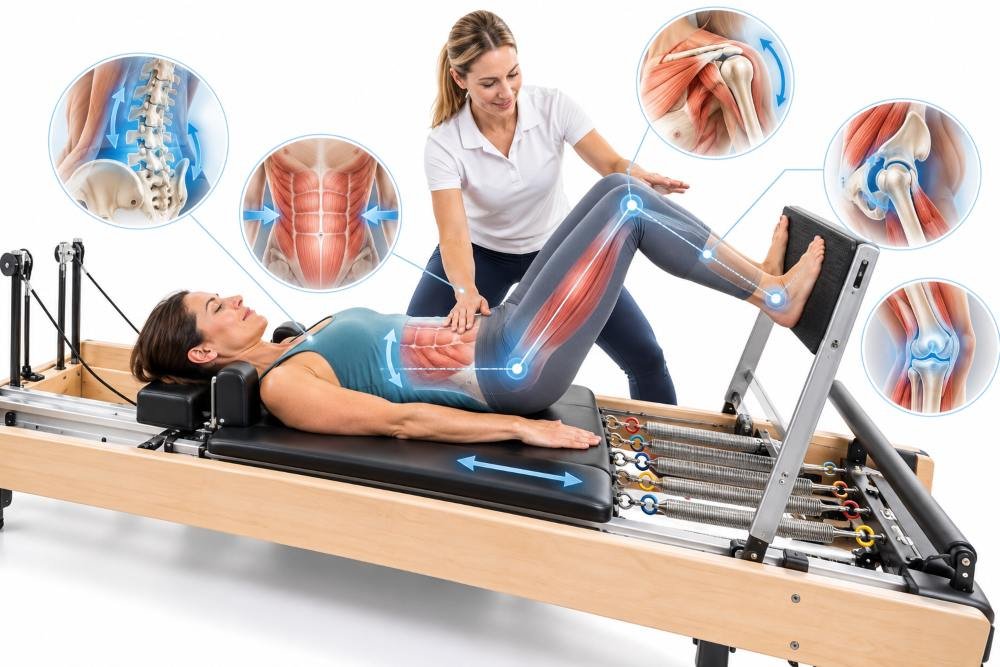
The key is the springs. Depending on the exercise, they can make a movement harder by adding resistance, or easier by taking some of your body weight. That gives a physiotherapist or instructor very fine control over how much load a joint takes.
Picture someone a few weeks into recovery from a knee or hip problem. On the reformer they can do a leg press lying on their back, with the joint moving through a comfortable range while the springs share the work. As strength returns, the spring settings change bit by bit, so the challenge rises in small, measurable steps rather than big jumps.
A few other features make the reformer well suited to recovery:
- Lying and seated positions take pressure off sore backs, hips and knees.
- The moving carriage gives instant feedback, because wobbles and shortcuts show up straight away.
- Springs resist you on the way back as well as on the way out, which trains control as muscles lengthen, the same control you need to lower yourself into a chair.
- It is low impact, yet a full session can still leave you pleasantly worked.
That mix of gentleness and genuine effort is a big part of why interest in Reformer Pilates in Auckland has grown among people who want low impact exercise that still feels like a proper workout.
Common Reasons People Combine Them
Persistent lower back pain is the most common reason by a long way. Current guidance favours staying active and gradually building strength over long periods of rest, and Pilates offers a gentle, structured way to do that. A 2021 review in the Journal of Physiotherapy ranked Pilates among the most effective exercise types for chronic back pain, while adding that people should be encouraged to perform the exercise that they enjoy.
Beyond back pain, these are the situations where the two approaches are most often paired:
- Neck and shoulder tension from desk work. Long hours at a screen can leave the upper back stiff and the shoulders tight. Work on breathing, shoulder blade control and upper back mobility helps many people feel looser through the day.
- Recovery after surgery or injury. After a knee reconstruction, hip replacement or shoulder repair, the physio sets the rules on what is safe and when. Pilates can add controlled strength once the surgeon and physio give the green light.
- Living with joint conditions. People with osteoarthritis often find that spring-assisted, low impact work lets them strengthen around a joint without stirring it up.
- Rebuilding after pregnancy. Many people want to reconnect with their deep tummy and pelvic floor muscles after birth. A check with a women’s health physio first is wise, especially if there is leaking, a feeling of heaviness, or a gap down the middle of the tummy.
- Sport. Runners, cyclists, netballers and golfers use Pilates to balance out the one-sided or repetitive demands their sport places on the body.
Whatever the reason, the pattern is much the same. The physio makes sense of the problem, and Pilates helps turn short-term relief into longer-term resilience.
What To Expect When Starting Out
If you have pain right now or a recent injury, start with an assessment rather than a class. A physiotherapist can tell you which movements to focus on, which to modify for now and which to leave alone for a while. That one appointment can save weeks of guesswork.
Most studios then offer an introductory session or a short beginner course. This is where you learn the equipment, the basic positions and the breathing pattern before joining a group. It is worth doing even if you are already fit, because Pilates asks for a different kind of attention than a gym session.
The first few weeks can feel surprisingly subtle. You may spend a lot of time on breathing, on finding a neutral spine and on switching on muscles you have rarely thought about. That is normal, and it is the groundwork that makes harder exercises safe later on.
| Stage | What it usually involves | What you might notice |
| Weeks 1 to 2 | Learning positions, breathing and basic control | More concentration than sweat, mild muscle tiredness |
| Weeks 3 to 6 | Longer sequences, gradual spring or position changes | More confidence moving, everyday tasks feel easier |
| Weeks 6 to 12 | More load, balance and whole-body work | Better posture and stamina, fewer or milder flare-ups |
Treat this as a rough guide, not a promise. Progress depends on your starting point, the problem you are managing and how regularly you turn up. Two sessions a week is a common and sensible place to begin, and consistency matters far more than intensity.
Before you book, a few questions are worth asking:
- Who will be teaching, and what training do they have?
- Can the instructor talk with my physio about my programme?
- How big are the classes, and is there a beginner option?
- What should I do if a movement hurts during class?
A Few Sensible Cautions
Pilates is generally safe, but it is not a cure-all, and some situations call for extra care. The most useful skill is telling the difference between ordinary effort and a genuine warning sign.
| Usually fine | Stop and get advice |
| Mild muscle soreness for a day or two after a session | Sharp, stabbing or rapidly worsening pain |
| A sense of working muscles you rarely use | Pain, pins and needles or numbness spreading down an arm or leg |
| Slight stiffness that eases as you warm up | Pain that keeps getting worse from week to week |
| Feeling tired but steady after class | Dizziness, chest pain or feeling faint |
Some symptoms need urgent medical attention rather than a wait-and-see approach. Get help the same day if back pain comes with loss of bladder or bowel control, numbness around the groin or buttocks, new weakness in the legs, fever or unexplained weight loss, or if it follows a significant fall or accident. In New Zealand you can call Healthline free on 0800 611 116 at any hour, or 111 in an emergency.
Certain situations mean your instructor needs to know before you start, so exercises can be adapted:
- Osteoporosis. Exercise is generally encouraged. The UK consensus statement on exercise for osteoporosis found little evidence that physical activity causes significant harm and judged that the benefits generally outweigh the risks. It also noted that people with osteoporosis may benefit from guidance on adapting postures and movements, which is why deep, loaded forward bends are commonly modified or swapped.
- Recent surgery. Follow your surgeon’s and physio’s timeline. Healing tissue has limits that no amount of good technique can override.
- Pregnancy. Guidance from the American College of Obstetricians and Gynecologists says that, without medical or obstetric complications, staying active through pregnancy is safe and worthwhile, though routines often need adjusting. Later in pregnancy, long spells lying flat on your back can leave some people feeling unwell, so good instructors switch to side-lying, seated or propped-up positions.
It is also worth checking who is teaching. Unlike physiotherapy, Pilates instruction is not a regulated health profession in New Zealand, and training ranges from short courses to comprehensive programmes that take many months. Where there is an existing injury, regular contact between your physiotherapist and your instructor keeps the programme appropriate.
Carrying The Benefits Into Daily Life
The real test of any programme is not how you feel on the reformer. It is whether you can sit through a working day, lift a toddler, weed the garden, or get back on the court or the golf course with less worry.
The hours between sessions matter as much as the sessions themselves. Small, repeatable habits help the work stick:
- Change position every half hour or so when you sit for long stretches.
- Take short walks through the day, even five minutes around the block.
- Do a few minutes of the home exercises your physio or instructor gives you on most days.
- Use the breathing you learn in class when you lift, carry or notice yourself tensing.
- Keep a quick note of what eases your pain and what stirs it up, and share it with your physio.
Over a few months, many people find the gains go well beyond less pain. Posture, balance and confidence in movement often improve too, and that confidence is easy to underrate. Being able to bend, twist and carry without bracing for pain changes how freely people live.
Finding What Suits You
There is no single right way to combine these approaches. Some people see a physiotherapist for a handful of sessions, move into classes, and check back in only if something flares. Others keep both going for months, especially while managing a long-term condition or working back towards sport.
What the research and clinical experience agree on is that the best programme is the one you keep doing. That means it has to fit your body, your budget and your week, and ideally it should be something you look forward to.
Having physiotherapy and Pilates available through connected providers can make the move from treatment to exercise much smoother, because your physio and instructor can share notes and adjust the plan together. That is the approach taken by Peak Pilates and its associated physiotherapy clinic. Wherever you go, look for care that is tailored to you and progressed at a pace that feels manageable, because that is the kind people stick with.
Disclaimer
This article is for general information only and is not medical or health advice. Everyone’s situation is different, and what is described here may not apply to you. Please talk with a registered physiotherapist, your GP or another qualified health professional before starting a new exercise programme or making decisions about your treatment, especially if you have pain, a recent injury or surgery, osteoporosis, or are pregnant. If you have urgent symptoms, call 111 or Healthline on 0800 611 116.
References
Accident Compensation Corporation. What to do if you’re injured. Wellington: ACC. Available from: https://www.acc.co.nz/im-injured/what-to-do
American College of Obstetricians and Gynecologists. Physical activity and exercise during pregnancy and the postpartum period: ACOG Committee Opinion, Number 804. Obstetrics & Gynecology. 2020;135(4):e178-e188. doi:10.1097/AOG.0000000000003772
Brooke-Wavell K, Skelton DA, Barker KL, Clark EM, De Biase S, Arnold S, Paskins Z, Robinson KR, Lewis RM, Tobias JH, Ward KA, Whitney J, Leyland S. Strong, steady and straight: UK consensus statement on physical activity and exercise for osteoporosis. British Journal of Sports Medicine. 2022;56(15):837-846. doi:10.1136/bjsports-2021-104634
Fernández-Rodríguez R, Álvarez-Bueno C, Cavero-Redondo I, Torres-Costoso A, Pozuelo-Carrascosa DP, Reina-Gutiérrez S, Pascual-Morena C, Martínez-Vizcaíno V. Best exercise options for reducing pain and disability in adults with chronic low back pain: Pilates, strength, core-based, and mind-body. A network meta-analysis. Journal of Orthopaedic & Sports Physical Therapy. 2022;52(8):505-521. doi:10.2519/jospt.2022.10671
Hayden JA, Ellis J, Ogilvie R, Stewart SA, Bagg MK, Stanojevic S, Yamato TP, Saragiotto BT. Some types of exercise are more effective than others in people with chronic low back pain: a network meta-analysis. Journal of Physiotherapy. 2021;67(4):252-262. doi:10.1016/j.jphys.2021.09.004
Physiotherapy Board of New Zealand. Search register. Wellington: Physiotherapy Board of New Zealand. Available from: https://www.physioboard.org.nz/
World Health Organization. WHO guideline for non-surgical management of chronic primary low back pain in adults in primary and community care settings. Geneva: World Health Organization; 2023. ISBN 978-92-4-008178-9. Available from: https://www.who.int/publications/i/item/9789240081789
Yamato TP, Maher CG, Saragiotto BT, Hancock MJ, Ostelo RWJG, Cabral CMN, Menezes Costa LC, Costa LOP. Pilates for low back pain. Cochrane Database of Systematic Reviews. 2015;(7):CD010265. doi:10.1002/14651858.CD010265.pub2