


The thought usually arrives at a low point. You’re tired of the same street, the same phone contacts, the same excuses, and some part of you says: if I could just get out of here, I could finally stop.
Sometimes that instinct is right. Leaving home for treatment can put real distance between you and the people, places, and routines that keep pulling you back. It can also open the door to a program that simply doesn’t exist where you live. But a plane ticket is not a treatment plan. Relocating works best when you know exactly what the move is buying you, and when you’ve thought about the day you come home before you ever leave.
Here’s how to tell whether traveling for rehab makes sense for you, what it costs, and which housing, insurance, and safety decisions are far easier to make now than from a bed in another state.
What Distance Can Actually Do For You

Cravings aren’t random. They’re tied to cues: the gas station where you used to buy, the coworker who always had something, the drive home at six o’clock. Early recovery is when those cues hit hardest, and being a thousand miles away from them gives your brain a quieter place to start rebuilding.
Distance also changes the social math. It’s much harder for an old friend to “just stop by” when you’re in another state. For some people, the relief is about privacy too. A nurse, teacher, or small-business owner from a small town may find it easier to be honest in group therapy where nobody knows their family.
Then there’s the care itself. Someone with a co-occurring condition like PTSD or bipolar disorder, someone who needs medication for opioid use disorder alongside therapy, or someone looking for a program built for veterans, young adults, or LGBTQ+ clients may not find that combination nearby. That gap is a big part of why Florida draws so many patients from other states.
What Moving Can’t Do
People in recovery have a name for trying to outrun addiction by changing zip codes: pulling a geographic. The phrase exists because it so rarely works on its own. Your habits, your stress, and the reasons you started using all come along for the ride. A new setting buys you breathing room. The work you do inside the program is what turns that room into change.
It also helps to be realistic about time. In its principles of effective addiction treatment, the National Institute on Drug Abuse notes that most people need at least three months in treatment to significantly reduce or stop their drug use, and many need more than one episode of care. A 30-day residential stay is often the first stage, not the whole thing. If you’re relocating, plan your money, your job, and your housing around several months away, not several weeks.
Trade-Offs Worth Weighing Honestly
Family Gets Harder To Include
Addiction rarely affects just one person, and recovery tends to hold up better when the people closest to you are part of it. Many programs now run family sessions by video, which helps. Still, a parent or partner who can’t afford to fly in for a family weekend misses something, and the people back home have their own repair work to do. Ask every program how it includes families who live far away, and how often those sessions actually happen.
Insurance Rules Don’t Always Cross State Lines
This is where good intentions run into paperwork. Plans differ a lot:
- HMO and EPO plans usually pay only for in-network care outside of emergencies, and many networks are regional.
- PPO plans often include out-of-network benefits, but with higher deductibles and coinsurance, and you may be billed for whatever the insurer doesn’t cover.
- Medicaid is run by each state, and coverage for non-emergency care outside your home state is usually limited. Don’t assume it follows you.
If your plan comes through the Health Insurance Marketplace, substance use disorder treatment is an essential health benefit, and federal parity protections for mental health and substance use coverage mean your plan’s limits on addiction care generally can’t be stricter than its limits on medical and surgical care. Many employer plans carry similar protections. None of that erases network rules, though. Before you book anything, get the program’s verification of benefits in writing, call your insurer yourself to confirm it, and ask whether a single case agreement is possible if no in-network provider offers the care you need.
Your Job And Your Legal Obligations
If you work for a covered employer and meet the eligibility rules, the Family and Medical Leave Act can protect your job for up to 12 workweeks in a year. The U.S. Department of Labor’s guidance on FMLA leave for mental health conditions specifically lists an overnight stay at an addiction treatment center as inpatient care. FMLA leave can be unpaid, and you generally need to have worked for your employer for at least 12 months and 1,250 hours, at a location with 50 or more employees within 75 miles. Talk to HR before you go, not after you’ve already missed a week.
If you’re on probation or parole, or you have an open court case, you’ll usually need permission before leaving the state. Call your attorney or probation officer first. A treatment stay should never turn into a warrant.
Sorting Out Housing Before You Leave
The housing decisions people make in a panic the week before admission are the ones they regret most. A few calm hours now can save you months of mess later.
If you rent, read your lease for early termination or subletting terms, then talk to your landlord directly. Don’t count on a medical exception to break a lease, because most leases and most state laws don’t offer a general one for treatment. If there’s a decent chance you’ll come back, keeping the apartment for a few months may cost less than breaking the lease and hunting for a new place afterward.
If you own your home, set up autopay where you can, give a trusted person a key and a short list (mail, plants, the car, anything that could leak or freeze), and consider forwarding your mail through the Postal Service.
Either way, ask someone you trust to clear out alcohol, leftover prescriptions, and paraphernalia while you’re gone. Walking back into a stocked cabinet on your first night home is a test nobody needs.
If you have kids or pets, put the care arrangements in writing, with phone numbers, so the people helping you aren’t left guessing.
Sober Living: The Step Most People Underestimate
After residential care, many people move into a sober living home, also called a recovery residence, for a few months. These are drug- and alcohol-free houses with house rules and peer accountability. Residents pay rent and usually work, look for work, or attend outpatient treatment during the day. For someone who relocated, a good one can be the bridge between a structured program and a life that holds up on its own.
Quality varies widely, so give this choice the same scrutiny you gave the rehab itself:
- Look for certification. The National Alliance for Recovery Residences and its state affiliates set the standards most certification programs use. In Florida, certification is voluntary, but state-licensed treatment providers are generally allowed to refer patients only to certified recovery residences. If a program recommends a house, ask whether it’s certified and by whom.
- Ask about medication. If you take buprenorphine, methadone, or naltrexone, ask directly whether the house accepts residents on those medications. Some still don’t, and you shouldn’t have to choose between your treatment and a roof over your head.
- Be suspicious of deals that seem too good. Free rent in exchange for attending a particular outpatient program, or a house that insists on frequent drug tests through one specific lab billed to your insurance, are classic warning signs of patient brokering.
Riskiest Day Is Often The Day You Leave
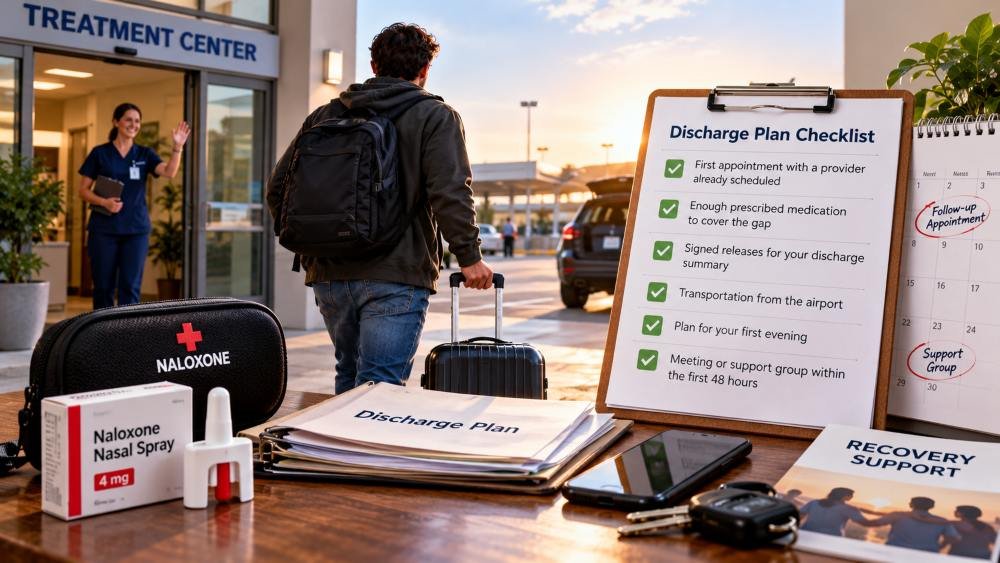
Discharge feels like a finish line. Clinically, it’s one of the most dangerous points in the whole process.
While you’re in treatment, your tolerance drops. If a return to use happens, especially with opioids, an amount your body once handled can now stop your breathing. That’s a major reason overdose risk climbs after detox, residential treatment, or time in jail. Keep naloxone with you and at home. As the CDC explains in its guide to carrying and using naloxone, it’s now available over the counter in all 50 states, and because you can’t give it to yourself, the people around you need to know where it is.
A strong program starts planning your discharge in the first week, not the last afternoon. Before you leave, you should have:
- A first appointment with a provider back home, or in your new city, already on the calendar and ideally within a few days of discharge
- Enough of any prescribed medication to cover the gap until that appointment, plus a prescriber who has agreed to take over
- Signed releases so your discharge summary actually reaches your next provider
- A ride from the airport, a plan for your first evening, and a meeting or group you’ll attend in your first 48 hours
If the plan is to fly straight back into your old routine with none of that in place, that’s a reason to slow down, not speed up.
Thinking About Staying For Good?
Plenty of people decide to build a new life where they got sober, and that can be a healthy choice. It works best when it’s a real decision rather than a way to avoid the next hard conversation back home.
Give yourself a few months of stable recovery and steady income before you sign a long-term lease or buy property. Use that time to build the things that actually keep people well: a sponsor or peer group, an outpatient counselor, a primary care doctor, and a couple of people you can call at 11 at night. If you’re renting in a new city, it helps to know that the federal Fair Housing Act protects people in recovery from housing discrimination, although that protection doesn’t cover current illegal drug use.
How To Vet An Out-Of-State Program Before You Book A Flight
Out-of-state admissions are where predatory operators have done the most damage, so verify everything before you travel.
- Check the license and accreditation. The program should hold a current license from the state where it operates. Accreditation from The Joint Commission or CARF is an extra signal of quality, not a substitute for a license.
- Get costs in writing. Ask for a written estimate after the admissions team verifies your insurance, including what happens to your bill if you step down to a lower level of care or leave early.
- Ask clinical questions. Does the program offer FDA-approved medications for alcohol and opioid use disorders? How does it treat co-occurring mental health conditions? How are families involved?
- Treat freebies as red flags. Free flights, free housing, cash, gift cards, or an offer to pay your insurance premiums in exchange for enrolling can all signal patient brokering. Paying or receiving kickbacks for treatment referrals is a federal crime under the Eliminating Kickbacks in Recovery Act, and Florida has its own patient brokering law.
- Know who you’re talking to. Some hotlines and directory sites route callers to whichever facility pays them. Ask the person on the phone which facility they work for, then look that facility up on your own.
SAMHSA’s FindTreatment.gov lets you search state-licensed facilities by location, which makes it a useful place to confirm a program’s details before you commit.
If you’re comparing options for rehab in Fort Myers or anywhere else in Florida, press every program on one question in particular: how exactly will you hand me off to care back home? A good answer names who you’ll be referred to, how your records will get there, and when your first appointment will happen. A vague promise to set you up with aftercare isn’t an answer.
So, Is Relocating For Rehab A Smart Move?
It can be, when it’s done for a clear reason and planned from both ends. Moving gives you distance, and sometimes access to care you couldn’t get at home. It doesn’t do the recovery for you, and it adds real risks around insurance, family, housing, and the trip back. If you can name what the move gets you, confirm the program is legitimate, and leave with a concrete plan for life after discharge, the odds tilt in your favor.
If you’re not sure where to start, SAMHSA’s National Helpline at 1-800-662-4357 is free, confidential, and answered around the clock, every day of the year.
Disclaimer: This article is for general information only and is not medical, legal, or financial advice. Insurance coverage, employment protections, and state laws vary, so confirm the details with your insurer, employer, attorney, and treatment providers. If you or someone near you may be overdosing, call 911. If you’re in crisis or thinking about harming yourself, call or text 988 to reach the 988 Suicide & Crisis Lifeline.