

Quick Summary
- Don’t pick a supplement before you know your actual goal. Muscle gain, strength, endurance, and general wellness- these need different approaches, not the same tub of powder.
- A popular product isn’t automatically the right product for you. What works for a strength athlete might make zero sense for someone who wants to eat a bit better.
- Check the ingredient panel, the serving size, and the evidence. Not just the bold claims on the front of the box.
- Supplements are there to support your diet and training, not replace them. NIH guidance backs this up pretty clearly.
- Start with the basics. A simple, well-understood product beats a complicated stack with ten mystery ingredients almost every time.
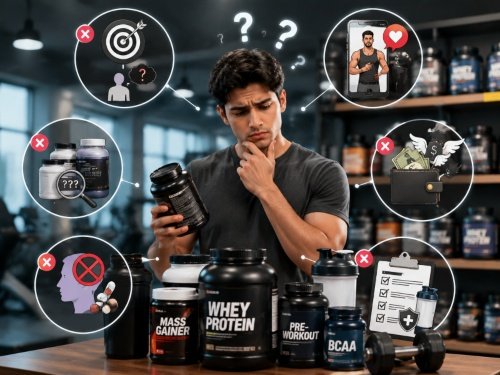
Walking into the supplement aisle for the first time can feel like a lot. Powders for strength, capsules for recovery, pre-workouts promising energy you don’t currently have, electrolyte mixes, protein blends, and shelf after shelf of colourful tubs. Honestly, picking one can feel like a workout in itself.
The problem isn’t that there are too many options. It’s that people choose based on the wrong signals.
A beginner might buy fitness supplements with the biggest claims on the label, copy their gym buddy’s stack, or assume more ingredients automatically means a better formula. That’s usually where things go wrong.
A simpler approach works better: start with your goal, look at what your diet and training already give you, then find something that fills the actual gap.
Top Reasons Beginners Buy The Wrong Fitness Supplement

1. They Buy For The Goal They Wish They Had, Not The One They Actually Have
This happens constantly.
Someone starts training three days a week and wants to get stronger, so they go straight to searching “best muscle-building stack.” But what if their real priority is just being more consistent and hitting their protein target? Or maybe they’re training for a 10K, not chasing a bigger squat number.
The right supplement changes depending on the answer.
So write down one main goal for the next 8 to 12 weeks. Something like:
- Build strength
- Support muscle gain
- Improve endurance
- Make daily nutrition easier
- Support hydration during long sessions
Then judge any supplement against that one goal, not against everything it claims to do.
2. They Copy Someone Else’s Stack
Your gym partner’s routine isn’t your routine. Simple as that.
Maybe they train six days a week, and you train three. Maybe their diet, body size, training history, or goals look nothing like yours. Even something like caffeine tolerance can be wildly different from one person to the next.
NIH points out that people respond differently to caffeine, and taking more of it doesn’t automatically mean better performance.
Treat someone else’s stack as an example you can learn from, not a set of instructions you have to follow.
3. They Mistake A Long Ingredient List For A Better Formula
More isn’t always better. Sometimes it’s just more.
A beginner sees a product with 12 ingredients and figures it has to be more advanced than something with just one. Not necessarily true.
NIH notes that a lot of performance supplements combine ingredients that haven’t actually been studied together, so a long list doesn’t tell you much on its own.
That’s why a transparent label matters so much. FDA guidance also recommends reading labels carefully and sticking to the directions on the pack.
4. They Shop The Marketing, Not The Evidence
“Explosive energy.” “Maximum gains.” “Rapid transformation.”
These lines sound great. They don’t tell you whether the product actually fits your goal.
A better question to ask is: what does the research actually say about this ingredient, and at what dose?
Take creatine, for example. It isn’t popular just because brands talk about it a lot. NIH identifies creatine monohydrate as the most studied form out there, with real benefits for certain kinds of high-intensity training.
5. They Skip The Fundamentals
This is probably the biggest mistake beginners make, and it’s an easy one to fall into.
A supplement can’t fix poor nutrition, bad recovery, or a training plan you don’t actually stick to.
So before you spend ₹3,000 on a new stack, look at the basics first.
Are you eating enough? Getting enough protein from your regular meals? Sleeping reasonably well? Training consistently? Are you drinking enough water throughout the day?
If those pieces aren’t sorted, another tub on the shelf probably won’t fix the real problem.
How To Choose The Right Fitness Supplement
Turn the purchase into a small, simple process instead of a guessing game.
Step 1: Define The Job
Don’t start with a product category. Start with a problem.
Instead of “which pre-workout should I buy?” ask, “do I actually need something for energy before I train?”
Instead of “what’s the best supplement for muscle?” ask, “is there a gap in my current diet that a supplement could realistically fill?”
That small shift in wording makes the whole decision a lot clearer.
Step 2: Check The Ingredient And Serving Size
Look at how much of the active ingredient you’re actually getting per serving, and compare that to the evidence behind it. A product with an ingredient in a tiny, token amount isn’t the same as one giving you a properly studied dose. This matters a lot when you’re comparing pre-workouts and multi-ingredient formulas side by side.
Step 3: Prefer Transparent Labels
A transparent product tells you exactly what you’re getting, no guesswork involved.
The FDA states that supplement labels must include a Supplement Facts panel, covering things like serving size, number of servings, and the dietary ingredients and amounts in each one.
That’s genuinely useful for beginners, since it lets you compare products on what’s actually inside them, not just what’s printed on the front.
Step 4: Check If It Actually Fits Your Routine
A supplement can look great on paper and still not work for your real life.
Think about how often and when you train, your diet, your budget, whether you’d rather have a powder, capsule, or ready-to-drink product, whether caffeine agrees with you, and any dietary restrictions you’re working around.
Someone training after 8 p.m., for instance, probably wants to think twice before grabbing a heavily caffeinated pre-workout.
Step 5: “Available” Doesn’t Mean “Necessary”
Just because a product exists on a shelf doesn’t mean you need it in your bag.
Wellversed, for example, offers products across categories like creatine, pre-workout, omega-3, electrolytes, and other functional nutrition items, with brands including Wellcore, YouWeFit, Dynamite, Okami, Osmo, and Zero Sugar under one roof.
If you’re browsing to buy fitness supplements online, start by comparing purpose and formulation instead of just grabbing whatever has the highest rating or the loudest marketing.
Conclusion
The best first supplement isn’t necessarily the one everyone at your gym keeps talking about. It’s the one you can actually justify buying.
Start with your training goal. Look honestly at your diet. Understand what’s in the product. Check the serving size. Then decide if you genuinely need it.
That’s a much better way to buy fitness supplements than chasing whatever’s new or copying somebody else’s cart.
Wellversed takes a science-first approach to nutrition, bringing functional foods and health and fitness supplements together across several categories. For a beginner, that range works best once you know exactly what you’re trying to achieve.
FAQs
What’s The Best Fitness Supplement For Beginners?
- There’s no single universal answer here. It depends on your goal, diet, training routine, and what you personally need.
Should Beginners Take Creatine?
- Creatine can help with repeated high-intensity activities like resistance training and sprinting. If you’re thinking about it, go with a well-understood formulation and follow the directions on the label.
Do I Need A Pre-Workout To Build Muscle?
- No, not really. Consistent resistance training, decent nutrition, and proper recovery are what actually build the foundation. Some pre-workout ingredients might help with specific parts of a session, but that doesn’t make one essential.
How Should I Compare Two Fitness Supplements?
- Look at the purpose, the ingredient list, the amount per serving, the serving size, the evidence behind those ingredients, the directions, and how well it fits your routine. Don’t judge purely on price, reviews, or ingredient count.
What Should I Check Before Buying A Supplement Online?
- Check the full ingredient panel, serving size, amount per serving, directions, warnings, manufacturer details, and whether the claims actually hold up against real evidence. Skip decisions based only on an influencer’s word or a dramatic headline.
Disclaimer
This article is general information about choosing supplements and is not medical or nutritional advice. Supplements are not a substitute for a balanced diet, adequate sleep, or consistent training, and nothing here is a recommendation for any individual. Speak to a doctor or a registered dietitian before starting anything new, particularly if you are pregnant or breastfeeding, under 18, taking medication, or managing a health condition.