


Most people start this search during a bad week. There has been an emergency room visit, or an ultimatum, or a quiet morning where someone finally admitted that the drinking is not slowing down on its own. Then they open a browser and find dozens of programs that all look the same, all promise the same thing, and all have a phone number answered by someone who sounds very glad they called.
Underneath the search is a simpler question: how much treatment does this person actually need, and how would anyone know?
That question has a real answer, and it is not “as much as possible.” Treatment placement is a clinical decision with a structure behind it, and understanding that structure is the difference between choosing a program and choosing the right one.
What “Level Of Care” Actually Means

Level of care describes how much structure, supervision, and clinical contact a treatment setting provides. It is a measure of intensity, not a measure of how serious someone’s addiction is. Two people with identical diagnoses can belong in completely different settings because one has a stable home, a supportive partner, and no withdrawal risk, and the other has none of those things.
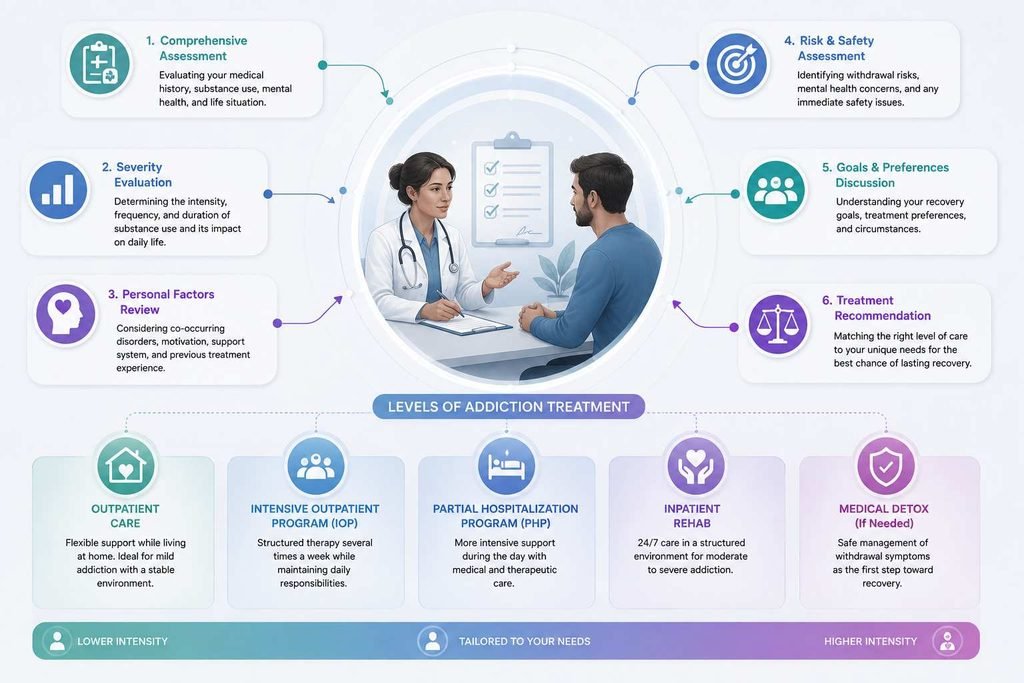
In practice, the continuum runs roughly like this, though exact definitions shift between editions of the standards and between insurers:
- Outpatient treatment. Typically fewer than nine hours a week of structured clinical service for adults. This can mean a weekly therapy session, a prescriber appointment for medication, or a group. People work, parent, and sleep at home.
- Intensive outpatient (IOP). Around nine or more hours a week, often three hours a day across three or more days. Enough contact to interrupt a pattern, structured enough to notice quickly when something is going wrong.
- Partial hospitalization (PHP). Roughly twenty or more hours a week, usually most of the day, five days a week, with the person returning home at night. It is close to the intensity of residential care without the residence.
- Residential treatment. Twenty-four-hour care in a live-in setting, with clinical intensity varying widely between programs. Some are heavily medical. Others are primarily structured living with counseling attached.
- Medically managed inpatient care. Hospital-level care with physician and nursing coverage for people whose medical or psychiatric condition needs monitoring around the clock.
The important thing to notice is that these are settings, not stages. Nobody is required to work through them in order, and starting at the top is not a head start.
What Happens In A Real Assessment
A proper placement decision comes from a structured, multidimensional interview, not from a phone screen that ends with “we have a bed available Thursday.”
Most United States providers organize this around the ASAM Criteria, the placement standards published by the American Society of Addiction Medicine alongside its clinical practice guidelines. The Fourth Edition, released in October 2023, assesses six dimensions:
- Intoxication, withdrawal, and addiction medications
- Biomedical conditions
- Psychiatric and cognitive conditions
- Substance use-related risks
- Recovery environment interactions
- Person-centered considerations
The first five drive the level of care recommendation. The sixth covers barriers, preferences, and social circumstances, and shapes what is realistically achievable rather than what is clinically ideal.
One change in the Fourth Edition matters more to patients than it might sound. Earlier editions treated “readiness to change” as its own dimension, which in practice sometimes meant ambivalent people were told to come back when they were serious. That dimension was removed as an independent factor. Motivation is now something treatment is supposed to build, not a prerequisite for receiving it. If a program tells someone they are not ready enough for treatment, that is worth questioning. ASAM’s own summary of what changed in the Fourth Edition lays this out directly.
Adoption is uneven, which is a practical detail rather than a technicality. Illinois moved its licensing to the Fourth Edition on July 1, 2025, while Virginia Medicaid’s provider manuals still reference the Third Edition from 2013. The edition your assessor uses may depend on who is paying.
Why More Intensive Is Not Automatically Better
There is a persistent assumption that residential treatment is the real thing and everything else is a compromise. It is understandable, and it is often wrong.
Higher levels of care take people out of their lives. That is precisely the point when the environment is the problem, but it carries costs: lost income, disrupted childcare, a job that may not be there afterward, and a return to an unchanged home at the end of it. Somebody who spends thirty days in a residential program and then goes back to the same apartment, the same friends, and the same routine has not necessarily gained more than someone who spent those thirty days practicing new behavior inside that exact environment with clinical support.
The opposite error is just as real. Placing someone in weekly outpatient counseling when they cannot get through a Tuesday without using is not respecting their autonomy. It is setting them up to fail and then calling the failure a lack of motivation.
The clinical question is narrower and more useful than “how bad is this”: can the necessary services be delivered safely in the least disruptive setting available? If yes, that setting is the right one.
Where Withdrawal Changes The Calculation
This is the part of the decision that is genuinely a safety issue rather than a preference, and it deserves plain language.
- Alcohol withdrawal can kill people. Not usually, but it can. Seizures typically appear six to forty-eight hours after the last drink, with risk peaking around twenty-four hours. Withdrawal delirium, historically called delirium tremens, usually begins two to three days out and is a medical emergency. MedlinePlus guidance on alcohol withdrawal notes that mild to moderate withdrawal can often be managed on an outpatient basis with someone present to monitor the person, while moderate to severe withdrawal needs a hospital or a facility equipped for it. Anyone who has been drinking heavily and daily should be assessed before stopping, not after symptoms start.
- Benzodiazepines should not be stopped abruptly. People who have taken them longer than about a month need a gradual, supervised taper rather than a sudden stop.
- Opioid withdrawal is rarely fatal, but what follows it can be. Tolerance drops fast during abstinence. Returning to a previously ordinary amount after detox can cause a fatal overdose, and this risk is not theoretical: estimates suggest only around 13 to 36 percent of patients go on to any treatment after detoxification. Detox on its own is stabilization, not treatment. Anyone leaving a detox setting without a next appointment already scheduled, and without a conversation about buprenorphine, methadone, or naltrexone, has been handed a gap at the most dangerous possible moment. Naloxone should go home with them.
If withdrawal management is part of the picture, the question is not just “inpatient or outpatient” but “what happens on day four, and who is responsible for making sure it happens.”
When Mental Health Changes The Decision
Substance use rarely arrives alone. At least a third of people in treatment for alcohol use disorder also have a co-occurring mental health condition, most often anxiety or depression, and roughly one in four people in mental health treatment have a co-occurring substance use disorder.
This changes placement in a specific way. Sequential treatment, meaning addressing the addiction first and the depression later, works less well than treating both together. A setting that cannot manage psychiatric medication, or that requires someone to stop their existing psychiatric care to enter, is not a neutral choice.
The National Institute on Drug Abuse has made the same point for decades: effective treatment addresses the whole person, not one diagnosis, and medication combined with behavioral therapy generally outperforms either alone. NIAAA’s guidance on finding providers who treat co-occurring conditions is worth reading before making calls, because integrated capability is easier to ask about than to spot from a website.
Questions Worth Asking Before Accepting A Recommendation

The single most useful thing a person can do is ask questions that a marketing team cannot answer:
- Who performs the assessment, and what are their clinical credentials? If the person recommending a level of care is in admissions rather than clinical staff, that is a signal.
- Do you offer or coordinate medications for opioid and alcohol use disorder on site? A program that treats medication as optional or as a moral failing is out of step with the evidence.
- What is the weekly schedule in actual hours?
- What happens if I use during treatment? Programs that discharge people for a return to use are treating a symptom of the illness as a rule violation. The better answer involves adjusting the treatment plan.
- What is the step-down plan, and who arranges it before discharge?
- Can my existing therapist or prescriber stay involved?
- What will this cost, and what has my insurer authorized?
Anyone comparing Virginia rehab centers or providers anywhere else can use these questions to distinguish a clinical operation from a sales funnel. NIAAA’s Alcohol Treatment Navigator offers a similar checklist of quality indicators, and SAMHSA’s treatment locator at FindTreatment.gov allows filtering by level of care and by whether a program accepts specific insurance.
What This Looks Like In Virginia
Virginia has a more complete public treatment continuum than many states, and people frequently do not know it exists.
The Addiction and Recovery Treatment Services benefit, launched by the Department of Medical Assistance Services in 2017, covers the full ASAM continuum from outpatient through medically managed inpatient care for Medicaid and FAMIS members. Placement is based on a documented multidimensional assessment, and most levels above standard outpatient require service authorization, which means an independent clinical review of the recommendation.
Two practical details that rarely appear in program brochures: Virginia Medicaid covers non-emergency transportation to covered treatment services, which removes one of the most common reasons people drop out of IOP; and the state requires naloxone co-prescribing in relevant circumstances. Every locality also has a Community Services Board that can perform an assessment regardless of ability to pay, which is a reasonable starting point for anyone uninsured or unsure where to begin.
Stepping Down Is The Part Most People Skip
Placement is a snapshot, and the snapshot expires.
The strongest predictor of how a treatment episode ends is often not which level someone started at but whether the transitions were planned. Leaving residential care without an IOP appointment on the calendar, or finishing IOP without a therapist and a prescriber lined up, creates exactly the kind of gap that people fall through. The Fourth Edition of the standards leaned into this by treating addiction as a chronic condition requiring ongoing monitoring rather than a discrete episode with a completion date, and by allowing recovery residences to be combined with outpatient levels of care.
Movement can go both ways. Stepping down reflects real progress. Stepping up is not a relapse in the moral sense and should not be experienced as starting over. It is a treatment plan responding to new information, which is what treatment plans are supposed to do.
Honest Limits
No framework resolves everything. Assessments depend on what someone discloses, and people minimize, particularly at intake and particularly when they are frightened. Insurance authorization introduces real constraints that clinical judgment does not always overcome. Bed availability shapes decisions more than anyone would like. And the same person assessed on two different days can reasonably land in two different places.
None of that makes the process arbitrary. It means the right question to bring to a provider is not “what is your best program” but “what does my situation actually require, and can you deliver it?” A provider who can answer that specifically, including by saying that a different setting would serve better, is demonstrating exactly the judgment worth trusting.
Support and crisis resources: SAMHSA’s National Helpline offers free, confidential treatment referral and information twenty-four hours a day at 1-800-662-HELP (4357), in English and Spanish. For a mental health, substance use, or suicidal crisis, the 988 Suicide and Crisis Lifeline can be reached by call or text at 988.
Medical disclaimer: This article is for general information only and does not constitute medical advice, diagnosis, or treatment. Levels of care, coverage rules, and clinical standards vary by state, insurer, and individual circumstance. Decisions about addiction treatment, withdrawal management, and medication should be made with a qualified healthcare professional who has assessed the individual directly. Never stop drinking alcohol or taking prescribed medication abruptly without medical guidance. If you are experiencing a medical emergency, call 911.
References
- American Society of Addiction Medicine. Clinical Guidelines. Rockville, MD: ASAM. Available at: https://www.asam.org/quality-care/clinical-guidelines
- American Society of Addiction Medicine. The ASAM Criteria, Fourth Edition. Rockville, MD: ASAM, published October 2023. Available at: https://www.asam.org/asam-criteria/asam-criteria-4th-edition
- Illinois Department of Human Services, Division of Substance Use Prevention and Recovery. The ASAM Criteria: Transition from 3rd Edition to 4th Edition. Effective 1 July 2025. Available at: https://www.dhs.state.il.us/page.aspx?item=170097
- U.S. National Library of Medicine. Alcohol Withdrawal. MedlinePlus Medical Encyclopedia, article 000764. Bethesda, MD: NIH. Available at: https://medlineplus.gov/ency/article/000764.htm
- National Institute on Drug Abuse. National Institute on Drug Abuse (NIDA). Bethesda, MD: NIH. Available at: https://nida.nih.gov/
- National Institute on Alcohol Abuse and Alcoholism. NIAAA Alcohol Treatment Navigator. Bethesda, MD: NIH. Available at: https://alcoholtreatment.niaaa.nih.gov/
- National Institute on Alcohol Abuse and Alcoholism. FAQs: Searching for Alcohol Treatment. NIAAA Alcohol Treatment Navigator. Available at: https://alcoholtreatment.niaaa.nih.gov/FAQs-searching-alcohol-treatment
- Substance Abuse and Mental Health Services Administration. FindTreatment.gov. Rockville, MD: SAMHSA. Available at: https://findtreatment.gov/