


Getting diagnosed with ADHD often lands as an odd mix of relief and uncertainty. There is finally a name for the years of missed deadlines, half-read books, and conversations that slipped away mid-sentence. Then comes the harder question, the one nobody seems to answer plainly: what do you actually do about it?
An ADHD treatment plan is a personalized combination of medication, therapy or coaching, skills training, and everyday adjustments, put together with a psychiatric or medical provider to ease symptoms like inattention, impulsivity, and restlessness while making daily life more workable. The word that matters most is personalized. A real plan is not a single prescription or one counseling session. It is a working document that gets reviewed every few months and shifts as your symptoms, your routines, and your life change. Most effective plans lean on at least two approaches at once, and almost none of them look the same from one person to the next.
What An ADHD Treatment Plan Actually Includes Beyond Medication
A common assumption is that treating ADHD starts and stops at a prescription. Medication matters, and for a lot of people it is the thing that finally makes everything else possible. But stimulants and non-stimulants only address the biological side of attention. They will not teach you to build a filing system, keep a calendar you trust, repair a relationship strained by forgotten promises, or sit through a ninety-minute meeting without your mind wandering off. That gap is exactly why clinicians who focus on ADHD tend to build plans with several moving parts rather than a single lever.
Medication As A Starting Point, Not The Whole Plan
For many people, medication comes first simply because it can produce noticeable change within weeks instead of months. Stimulants, which include methylphenidate and amphetamine-based options like lisdexamfetamine, remain the most studied and most widely prescribed. Non-stimulants such as atomoxetine, guanfacine, and clonidine are often reached for when someone does not tolerate stimulants well or has a co-occurring condition like anxiety.
A study led by researchers at the University of Oxford and the University of Southampton, published early in 2025, pooled data from more than a hundred trials to see how different treatments affected core ADHD symptoms in adults over twelve weeks. Of everything reviewed, stimulants and atomoxetine were the only options with solid evidence of reducing those core symptoms in that window. However, the researchers also flagged that atomoxetine came with tolerability problems for a meaningful share of patients. Dosing is rarely settled in one visit. Providers usually start low and adjust gradually, watching for side effects and tracking how symptoms respond.
Worth keeping in mind: stimulants are controlled medications for good reason. They belong under the supervision of a licensed prescriber, not a trial-and-error approach of your own, and side effects like reduced appetite, disrupted sleep, or a rise in heart rate and blood pressure are part of why follow-up appointments exist. The U.S. Centers for Disease Control and Prevention keeps a plain-language rundown of medication and behavior therapy options for ADHD that is worth reading before your first medication conversation.
Therapy, Coaching, And Skills That Make Change Stick
Cognitive behavioral therapy, ADHD coaching, and skills-based counseling are where symptom control turns into actual habits. This is the part where someone learns to break a daunting task into pieces small enough to start, to catch a procrastination spiral before it swallows an afternoon, or to ride out the emotional swings that so often travel with ADHD. For children, this frequently means working with parents directly, coaching them to set up and reinforce routines at home. A well-built plan usually pairs medical management with this kind of skills training rather than betting everything on one piece or the other.
Daily Habits That Support Everything Else
Sleep, movement, food, and structure will not replace medication or therapy, but they quietly shape how well both work. A short night of sleep can blunt the benefit of an otherwise well-chosen dose. Many providers also treat external scaffolding as part of the plan rather than a nice-to-have: an accountability partner, a planning app you will genuinely open, or formal accommodations at work or school. If a plan ignores your daily reality, it tends not to survive contact with a busy week.
Three Shapes Most ADHD Treatment Plans Take
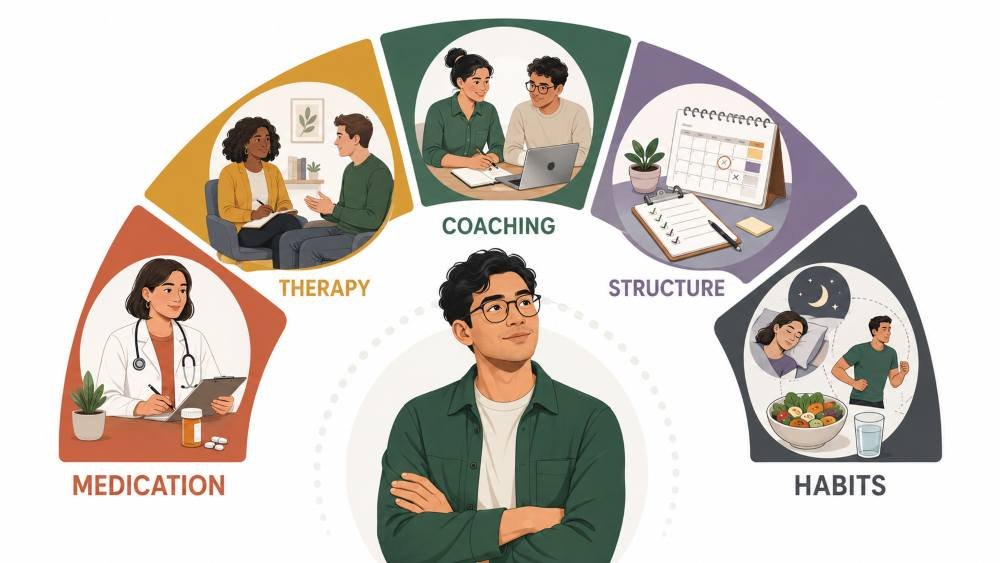
Because ADHD shows up so differently from person to person, providers usually work from a shared toolkit rather than one fixed protocol. Most plans settle into one of three broad shapes.
| Plan Type | What It Usually Involves | Often Suits |
|---|---|---|
| Medication-first | A stimulant or non-stimulant introduced early, then fine-tuned | Moderate to severe symptoms that need faster relief |
| Combined | Medication paired with CBT, coaching, or counseling | People who want symptom relief plus practical skills |
| Non-medication | Behavioral therapy, coaching, and lifestyle changes on their own | Those who prefer to avoid medication or cannot tolerate it |
Most people end up somewhere in the middle, starting with one approach and adding pieces as their provider gets a clearer read on what helps. CHADD, a long-running ADHD nonprofit, describes this layered approach as multimodal treatment, and it remains the pattern most specialists reach for.
Setting ADHD Treatment Goals That Survive A Hard Week
Vague goals like “focus better” rarely make it past the first rough patch. Clear, specific goals give both you and your provider something concrete to measure at each check-in. The strongest ones share a few traits: they are specific, tied to a real daily task, and reviewed on a set schedule instead of left floating.
- Task completion, such as finishing a work report by its deadline without three reminders, or a child completing homework without a parent parked beside them the whole time.
- Time management, like landing at appointments within a five-minute window rather than chronically running late.
- Emotional regulation, such as noticing frustration build during a task and pausing before reacting, instead of snapping and regretting it later.
- Organization, like keeping one planner updated daily rather than juggling sticky notes, memory, and missed dates.
- Relationships, such as reducing the forgotten commitments that wear on friendships, partners, and family.
None of these ask for perfection. They need to be trackable, so your provider can tell whether the current plan is working or needs a tweak.
How An Adult ADHD Treatment Plan Differs From A Child’s
Childhood plans usually lean hard on parents and schools to supply structure. An adult plan has to account for a very different landscape: a job, finances, relationships, and often years of coping habits that formed long before anyone said the word ADHD.
- Self-directed structure. No parent is managing an adult’s calendar, so the plan often leans on systems like reminders, time-blocking, and workplace accommodations.
- Co-occurring conditions. Anxiety, depression, and sleep problems show up often enough alongside adult ADHD that many plans address them in the same breath as the core symptoms.
- Real-world stakes. A missed deadline, a forgotten conversation, or an impulsive purchase can carry heavier consequences for an adult, so goals tend to zero in on those specific friction points.
- Later diagnosis, longer catch-up. People diagnosed well into adulthood sometimes need room to process years of misread struggles before skills training even begins to land.
Mayo Clinic’s overview of diagnosis and treatment for adult ADHD is a solid starting reference, and CHADD keeps a dedicated section on living and working with ADHD as an adult. None of this makes an adult plan harder to run. It just has to be built around a real adult routine instead of a classroom schedule.
What The Latest Research Says About Combining Treatments
The evidence keeps pointing in the same direction. In a major analysis published in The BMJ in late November 2025 by a team from Université Paris Nanterre, the Institut Robert-Debré du Cerveau de l’Enfant, and the University of Southampton, researchers reviewed more than two hundred existing meta-analyses spanning different treatments and age groups. Medication for both children and adults, along with cognitive behavioral therapy for adults, carried the strongest short-term evidence.
One nuance is worth stating honestly, because it often gets flattened in coverage. Mindfulness was the single intervention that showed large benefits lasting into extended follow-up, but the researchers noted that the long-term evidence behind it is limited in quality. So mindfulness reads as a promising lasting support rather than something proven on the same footing as medication or CBT. The broader takeaway is not that one approach wins outright. It is that individualized, combined plans built around evidence-backed options continue to hold up best when researchers look closely. You can explore the findings treatment by treatment through the BMJ umbrella review the team published.
How To Build Your Treatment Plan With A Provider

Building an adhd treatment plan works best as a two-way conversation, not a one-time instruction sheet handed across a desk. A thorough intake usually covers your symptom history, your daily routines, your work or school demands, your sleep, and any mental health concerns riding alongside. From there, a provider proposes a starting point, explains what to expect, and sets a timeline to check back in.
Those follow-ups carry as much weight as the first visit. Plans are rarely static. Doses get fine-tuned, new coping strategies get introduced, and goals get rewritten as circumstances shift, whether that is a new job, a school transition, or simply a clearer sense of what is actually helping. If you want to walk into that conversation better prepared, the research team behind the 2025 BMJ review built a free shared decision-making tool for ADHD treatments that lays out the evidence for each option in plain terms.
Frequently Asked Questions
| Question | Answer |
|---|---|
| What Is The Best Treatment For Adults With ADHD? | There is no single best treatment. Many adults benefit from a combination of medication and therapy or coaching, depending on symptom severity, other conditions, and personal preferences. |
| What Type Of Therapy Works Best For ADHD? | Cognitive behavioral therapy (CBT) has strong evidence for adults with ADHD. It focuses on practical skills for organization, time management, and managing daily challenges. |
| Is Medication Required For An ADHD Treatment Plan To Work? | No. Some people manage ADHD with therapy, coaching, and lifestyle changes alone, particularly when symptoms are mild or medication is not well tolerated. |
| What Should I Bring To My First ADHD Appointment? | Bring specific examples of difficulties, such as missed deadlines, sleep problems, relationship issues, or workplace challenges. Also prepare questions about treatment options, side effects, and how progress will be measured. |
| Can An ADHD Treatment Plan Change Over Time? | Yes. Providers may adjust medication, introduce new strategies, or update goals based on your response. Treatment can evolve as your needs change. |
A Note On Medical Guidance
This article is for general education and is not a substitute for personalized medical advice. ADHD medications, stimulants in particular, are prescription treatments that require evaluation and monitoring by a licensed provider. Do not start, stop, or change any medication on your own. If you think you or your child may have ADHD, or you want to adjust an existing plan, speak with a qualified psychiatric or medical professional who can account for your full history.
References
- Ostinelli EG, Schulze M, Zangani C, et al. Comparative efficacy and acceptability of pharmacological, psychological, and neurostimulatory interventions for ADHD in adults: a systematic review and component network meta-analysis. The Lancet Psychiatry, January 2025.
- Gosling CJ, Garcia-Argibay M, De Prisco M, et al. Benefits and harms of ADHD interventions: umbrella review and platform for shared decision making. The BMJ, 27 November 2025. DOI: 10.1136/bmj-2025-085875.
- Centers for Disease Control and Prevention—treatment of ADHD.
- National Institute of Mental Health. Attention-Deficit Hyperactivity Disorder: What You Need to Know.
- CHADD (Children and Adults with ADHD). Treatment of ADHD.
- Mayo Clinic. Adult ADHD: Diagnosis and Treatment.