


Deciding to get help for drinking or drug use is hard enough. Then comes a second decision that nobody warns you about: what kind of help. Outpatient treatment is often the first option people consider, and for good reason. You keep sleeping in your own bed, keep your job, keep picking up your kids from school, and fit treatment around the life you are trying to protect.
For many people, that is exactly the right fit. For others, it starts too light, and a few weeks of white-knuckling between sessions ends in a return to use and a crushing sense that “treatment doesn’t work for me.” Usually it is not that treatment failed. It is that the level of care did not match what the person needed at that moment. Knowing which group you are likely in, and what a solid outpatient program should offer, gives treatment a fair chance from the start.
Signs Outpatient Care May Be A Good Match
Outpatient programs work best when your everyday life can hold you steady between sessions. You may be a good candidate if most of these are true:
- You can stop or cut back without dangerous withdrawal symptoms, or you have already finished detox
- Your home is reasonably stable and free of people who pressure you to use
- At least one person knows what you are going through and supports your decision
- You can get to appointments reliably, several times a week if needed
- Your physical and mental health are steady enough that you do not need round-the-clock monitoring
- You have some motivation of your own, even if it comes and goes
The National Institute on Drug Abuse describes several treatment settings for substance use disorders, ranging from regular office or telehealth visits to more intensive outpatient care with many hours of services per week. That range matters more than most people realize. “Outpatient” can mean one counseling session a week, or a structured program that meets most weekdays for several hours.
Most programs and insurers use the American Society of Addiction Medicine’s framework to match people with the right intensity. The ASAM guide to levels of care in addiction treatment sets out a continuum that looks roughly like this:
| Level of care | What it looks like | Typical time commitment | Often a fit when |
| Standard outpatient | Individual or group sessions, sometimes by telehealth | Under 9 hours a week | Use is milder, or as a step-down after more intensive care |
| Intensive outpatient (IOP) | Structured groups, counseling and education several days a week | About 9 to 19 hours a week | You need more structure but can live safely at home |
| Partial hospitalization (PHP) | Day-long programming, home at night | 20 or more hours a week | You need daily monitoring but not 24-hour care |
| Residential or inpatient | Living on site with round-the-clock support | 24 hours a day | Home is unsafe, withdrawal is risky, or outpatient has not held |
The evidence for the middle of that ladder is encouraging. A review of intensive outpatient programs in Psychiatric Services concluded that, for many people, IOPs produce outcomes comparable to inpatient and residential treatment. The key phrase is “for many people.” The right intensity depends on you.
Signs You May Need More Support First
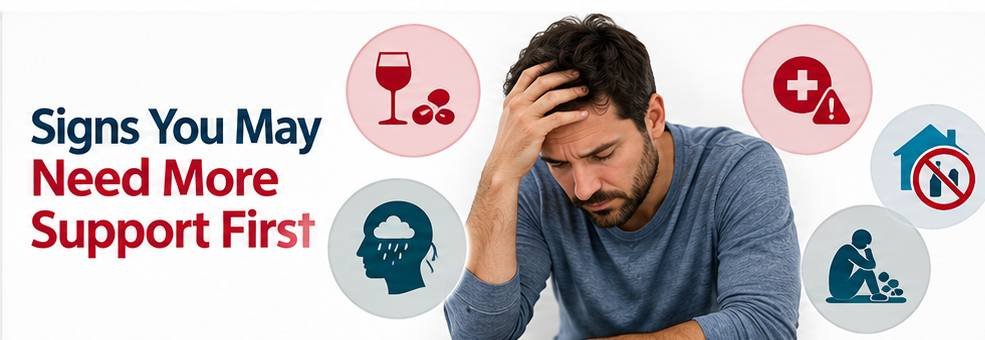
Some situations call for a higher level of care before outpatient treatment makes sense. This is not about willpower. It is about safety and giving recovery a stable place to start.
Withdrawal is the first thing to take seriously. Heavy daily drinking, or regular use of opioids, benzodiazepines or other sedatives, can bring withdrawal that needs medical supervision. Alcohol and sedative withdrawal can be dangerous: according to MedlinePlus, alcohol withdrawal seizures and delirium tremens can develop in the days after a last drink and are a medical emergency. Talk to a doctor before you try to stop on your own, and never stop a prescribed benzodiazepine suddenly.
Opioid withdrawal is rarely life-threatening in itself, but it is miserable, and the days afterward carry a hidden danger. Tolerance drops quickly, so a dose that used to feel normal can cause a fatal overdose. Anyone who uses opioids, or lives with someone who does, should keep naloxone at home.
Other signs that more support may be needed first include:
- Several outpatient attempts that ended in a return to use within days
- A home where drugs or alcohol are always around, or where someone pressures you to use
- Serious depression, anxiety or trauma symptoms that make it hard to get through the day
- Thoughts of suicide or self-harm
- Medical problems that need close monitoring, such as liver disease or pregnancy
- No safe or stable place to live
In those cases, a short stay in detox or residential care can create enough stability for outpatient treatment to hold. Many people step down to outpatient care afterward, so starting at a higher level keeps the outpatient option open for later. Think of it as a staircase you can move up and down, not a single door.
Two people with similar drinking can need very different starting points. Imagine one person who drinks most weekends heavily, has never had shakes or sweats when stopping, lives with a supportive partner and has a steady job. An intensive outpatient program may be a strong fit. Now imagine someone who drinks a bottle of wine every day, starts shaking by mid-morning, lives alone and has tried outpatient care twice. For them, a few days of medically supervised withdrawal first, then outpatient care, gives recovery a much safer foundation. Same substance, different needs.
What A Good Outpatient Program Should Include
Once you know outpatient care fits, look closely at what a program actually offers. Brochures often sound alike. The details are what separate a strong program from a weak one.
A Real Mix Of Therapy
Look for individual counseling, group therapy and education about how addiction affects the brain and behavior. Cognitive behavioral therapy helps you spot the thoughts, feelings and situations that lead to use, and practice different responses. Motivational interviewing helps when part of you wants to change, and part of you does not. For stimulant use, such as cocaine or methamphetamine, contingency management, which rewards verified drug-free periods, has some of the strongest evidence of any approach.
Family sessions can repair strain at home and teach loved ones how to help without enabling. Ask how often groups meet, how large they are, and whether you will have a consistent individual counselor.
Scheduling That Fits Your Life
Ask how many hours per week the program requires and when sessions meet. Evening and weekend options make a big difference if you work days or care for children, and some programs offer part of their schedule by telehealth.
Telehealth sessions can remove long drives and childcare problems, but they work best when you have a private, quiet space. If home is crowded or tense, in-person sessions may be the better choice for at least part of the week.
Be honest with yourself here. A program you can attend consistently will do more for you than a more intensive one you keep missing. Missed sessions are not just lost time; they are often the first sign that the plan needs adjusting.
Medication Support When It Applies
For opioid and alcohol use disorders, medications can reduce cravings and lower the risk of relapse. For opioid use disorder in particular, the evidence is striking. A large study of different treatment pathways for opioid use disorder in JAMA Network Open found that treatment with buprenorphine or methadone was linked to a 76% lower risk of overdose at three months and a 59% lower risk at twelve months.
These medicines are evidence-based treatments, not “trading one drug for another.” Since 2023, any clinician with a standard DEA registration can prescribe buprenorphine, which has made it much easier to find. For alcohol use disorder, naltrexone and acamprosate are common options.
A good program either prescribes these medications or coordinates closely with a provider who does. Ask directly whether medication is an option for you. A program that discourages or refuses medication for opioid use disorder is a warning sign.
Care For Mental Health
Depression, anxiety and trauma often travel with substance use, and each can feed the other. Programs that can assess and treat both at once avoid sending you to two separate offices that never talk to each other. Ask whether a psychiatrist or psychiatric nurse practitioner is part of the team, and how quickly you can be seen if your mental health worsens. Some symptoms that look like depression or anxiety ease after a few weeks without alcohol or drugs, while others need their own treatment. A good program reassesses over time rather than guessing on the first day.
A Plan For What Comes Next
Outpatient treatment eventually ends, and the weeks just after discharge can be a vulnerable time. Ask how the program handles aftercare, including step-down to less frequent sessions, alum groups, and connections to local mutual-support meetings such as AA, NA or SMART Recovery. A good plan also covers what happens if you slip, so a single lapse does not turn into a full relapse.
It helps to know that returning to use is common. The National Institute on Drug Abuse estimates that relapse rates for substance use disorders are around 40% to 60%, similar to rates for other chronic conditions such as high blood pressure and asthma. A relapse is a signal to adjust treatment, not proof that recovery is out of reach.
Finding Outpatient Care In Rhode Island

If you live in the Ocean State, you have options ranging from community clinics to programs connected to larger treatment systems. Start by listing what you need most: evening hours, medication support, dual diagnosis care, or a program close to work or home.
People in the Providence and South County areas who want structured outpatient care can compare local programs, including outpatient rehab in Rhode Island offered in North Kingstown. AdCare Rhode Island runs an intensive outpatient program there with an evening option of three-hour sessions three to four times a week, and it includes individual counseling and group therapy. Because detox and inpatient care are offered at the same North Kingstown location, it is also possible to step up or down within one system if your needs change.
You can also search for state-licensed programs by location, services and payment options on SAMHSA’s FindTreatment.gov. If you are in crisis, Rhode Island’s BH Link offers 24/7 behavioral health support by phone at 401-414-LINK (5465), and you can call or text 988 from anywhere in the US. Naloxone nasal spray is also sold over the counter at pharmacies, and it is worth keeping at home if opioids are part of the picture.
On cost, federal parity rules generally require health plans that cover addiction treatment to cover it on terms comparable to other medical care. Call the number on your insurance card and ask what outpatient and intensive outpatient benefits you have, and whether prior authorization is needed.
Make A Short List This Week
Write down your must-haves, then call two or three outpatient programs and ask each one the same questions:
| Question to ask | Why it matters |
| Do you do a full assessment before placing me? | Ensures the level of care matches your needs |
| How many hours a week, and when do sessions meet? | Tells you whether you can realistically attend |
| Do you offer or coordinate medication treatment? | Medication can greatly reduce relapse and overdose risk |
| Can you treat mental health conditions too? | Avoids split, disconnected care |
| What happens if I need more support? | Shows whether they can step you up quickly |
| Which insurance plans do you accept? | Prevents surprise bills |
| What does aftercare look like? | Protects the progress you make |
An assessment usually takes about an hour. A clinician will ask about what you use and how often, past attempts to cut back, withdrawal symptoms, physical and mental health, your living situation and your goals. There are no wrong answers, and the more honest you are, the better the recommendation will be. Bring a list of your medications, and consider bringing someone you trust.
Ask each program for an assessment. It will tell you whether outpatient care is the right place to start or whether a short step up would serve you better first. Either answer is a step forward. The most important thing is that you are asking, and that you do not have to figure out the rest alone.
Disclaimer
This article is for general information only and is not a substitute for professional medical advice, diagnosis or treatment. Do not stop drinking alcohol or taking benzodiazepines suddenly without speaking to a healthcare professional, as withdrawal can be dangerous. If you or someone else has overdosed, is having a seizure or is in immediate danger, call 911. For emotional crisis support, call or text 988.
References
- National Institute on Drug Abuse. Treatment. https://nida.nih.gov/research-topics/treatment
- National Institute on Drug Abuse. Drugs, brains, and behavior: the science of addiction. Treatment and recovery. https://nida.nih.gov/publications/drugs-brains-behavior-science-addiction/treatment-recovery
- American Society of Addiction Medicine. What are the ASAM levels of care? https://www.asam.org/blog-details/knowledge-base-continuum/2015/05/13/what-are-the-asam-levels-of-care
- McCarty D, Braude L, Lyman DR, et al. Substance abuse intensive outpatient programs: assessing the evidence. Psychiatric Services. 2014;65(6):718-726. DOI: 10.1176/appi.ps.201300249
- MedlinePlus, US National Library of Medicine. Delirium tremens. https://medlineplus.gov/ency/article/000766.htm
- Wakeman SE, Larochelle MR, Ameli O, et al. Comparative effectiveness of different treatment pathways for opioid use disorder. JAMA Network Open. 2020;3(2):e1920622. DOI: 10.1001/jamanetworkopen.2019.20622
- Substance Abuse and Mental Health Services Administration. FindTreatment.gov. https://findtreatment.gov/
- US Department of Labor, Wage and Hour Division. Family and Medical Leave Act. https://www.dol.gov/agencies/whd/fmla