


There’s a particular kind of panic that sets in when symptoms appear out of nowhere and you genuinely don’t know whether to call 911, drive to the ER, or just… wait it out. That uncertainty is uncomfortable, and it’s also expensive when you guess wrong. Show up at the emergency room with something minor, and you’re staring at a four-hour wait and a bill that’ll haunt you for months.
Wait too long with something serious, and the consequences can be permanent. According to the Journal of Urgent Care Medicine, the median ER visit time across U.S. hospitals sits at 163 minutes, meaning half of all emergency department visits run longer than two and a half hours. That’s a long time to sit in a waiting room when another setting might have handled your situation in thirty minutes flat.
Understanding Immediate Medical Attention vs Urgent Care
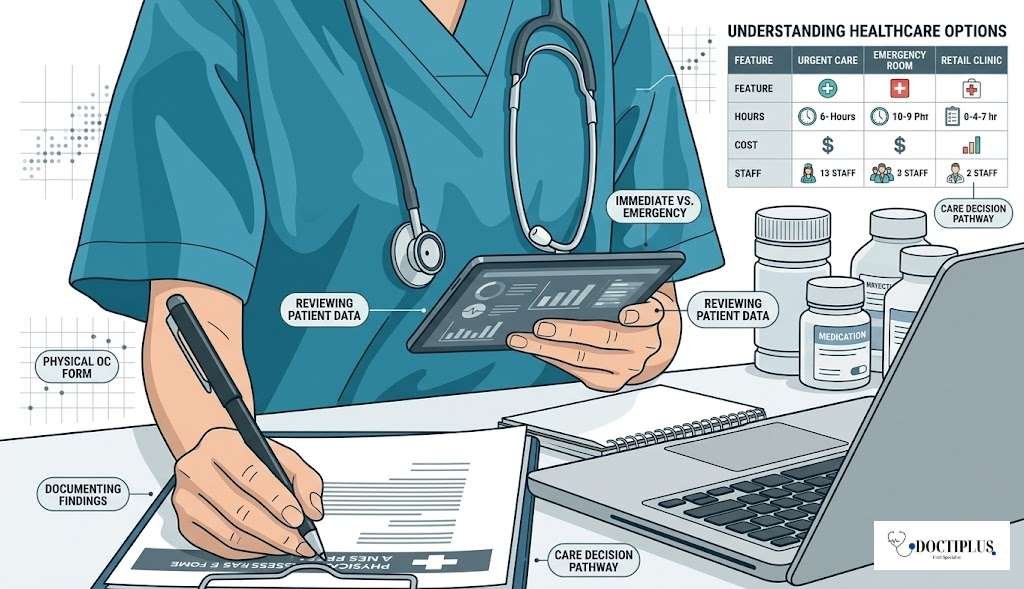
Most people only know two healthcare settings: their doctor’s office and the ER. But there’s a whole middle layer that handles the majority of sudden health concerns faster, cheaper, and without the chaos.
What “Immediate Medical Attention” Actually Means
Here’s a common misconception worth clearing up. “Immediate medical attention” doesn’t always mean lights, sirens, and an ER bed. More often, it simply means you need a clinician to assess you today, not next Thursday when your primary care doc has an opening.
The real skill, the one that saves you time, money, and potentially your health, is knowing when to go to urgent care vs ER. These two settings overlap in ways that confuse even experienced patients, and that confusion costs the healthcare system billions every year.
Your Main Options at a Glance
Utah-based Premier Family Medical operates several locations offering urgent care, primary care, physical therapy, and IV hydration, a useful example of what a full-service urgent care walk in center looks like compared to a retail clinic or telehealth-only provider.
| Feature | Urgent Care | Emergency Room | Retail Clinic |
| Hours | Extended, not 24/7 | 24/7 | Limited daytime |
| Staff | Physicians, NPs, PAs | ER physicians, specialists | NPs, PAs |
| On-site testing | X-ray, basic labs | Full imaging, labs | Minimal |
| Typical wait | 20–60 minutes | 1–4+ hours | 15–30 minutes |
| Cost | Moderate | High | Low |
Why the Distinction Genuinely Matters
Overcrowded ERs are a direct result of patients using emergency departments for issues that never needed to be there. Longer waits. Higher costs. Fewer resources for people who are actually critical. On the flip side, delaying a stroke, heart attack, or severe hemorrhage because you “didn’t want to overreact” can mean permanent disability or worse.
In the first six months of 2025 alone, at least 430 new urgent care locations opened, with 40% affiliated with major health systems. That level of infrastructure investment reflects exactly where the healthcare system thinks routine urgent needs should land.
A Fast Decision Guide You Can Run Through in Under 60 Seconds
When symptoms come on suddenly, you don’t have time for a long flowchart. Here’s a stripped-down framework that works in real time.
ER: Yes or No?
Ask yourself these four questions quickly. Is the person unconscious or barely responsive? Is there bleeding that won’t stop? Is there chest pain, facial drooping, sudden arm weakness, or slurred speech? Is breathing severely labored?
One “yes” means 911 or the ER immediately. Don’t drive yourself.
How to Think Through the Urgent Care or Emergency Room Decision
The urgent care or emergency room decision really hinges on three things: severity, how fast symptoms come on, and whether they’re affecting core functions, such as breathing, vision, consciousness, and coordination.
Gradual, mild-to-moderate symptoms with none of those red flags? Urgent care. Sudden, severe symptoms that change how you think, breathe, or move? Emergency room, no debate.
Telehealth as a First Triage Step
If you’re genuinely unsure and symptoms aren’t critical, a quick virtual visit can help you choose ER or urgent care before you walk out the door. HRSA’s FY2025 Year in Review reports 17.6 million telehealth visits, representing 13% of all patient visits and 37% of all mental health encounters.
These services are legitimately reliable as a first triage step. That said, skip it entirely if you’re dealing with chest pain, labored breathing, stroke symptoms, or major trauma.
Signs That Demand Emergency Care No Exceptions
Some symptoms simply bypass the decision framework entirely. You need to recognize them on instinct.
Emergencies That Always Require the ER
These are the signs you need emergency care, full stop: chest pain with sweating, nausea, or jaw pain; sudden slurred speech, facial drooping, or one-sided weakness; severe difficulty breathing or blue lips; uncontrolled heavy bleeding; major trauma from crashes or falls; first-time seizures, or any seizure lasting more than five minutes; and sudden, prolonged confusion or loss of consciousness. Don’t rationalize any of these away.
Serious but Less Obvious ER Situations
High fever paired with a stiff neck or spotted rash can indicate meningitis, straight to the ER. Severe abdominal pain, especially during pregnancy or with a rigid belly, belongs there too. Burns to the face, major head injuries with vomiting, sudden vision loss, and allergic reactions involving throat swelling all require emergency evaluation, not an urgent care visit.
Children Are Different, Their Timelines Are Faster
A limp or unresponsive child, noisy breathing using neck or chest muscles, bluish skin, any fever in an infant under three months, a febrile seizure, or clear signs of severe dehydration all warrant immediate ER care. Children can deteriorate far more quickly than adults, and hesitation is not worth the risk.
When Urgent Care Is Actually the Smarter Choice
Recognizing true emergencies is critical. But it’s equally important to understand that most sudden health concerns never reach that threshold, and urgent care handles them far better than the ER does.
Conditions Urgent Care Manages Well
Sprains, minor fractures, small lacerations needing stitches, ear and sinus infections, mild asthma flares, uncomplicated UTIs, minor burns, stomach bugs without red-flag symptoms, and basic rashes are all well within urgent care’s scope. You’ll be seen faster, pay significantly less, and leave without the anxiety that comes with a hospital setting.
Real Benefits of Choosing an Urgent Care Walk-In Clinic
Opting for an urgent care walk-in clinic for non-emergency concerns gives you access to shorter wait times, lower out-of-pocket costs, on-site X-rays and basic labs, and extended hours that work around your schedule. An urgent care walk-in setting means you’re not sitting behind ambulance cases, and you’re not absorbing hospital-level facility fees.
And here’s something worth knowing: if urgent care staff discover something more serious during your visit, they will escalate you to the ER. You’re not taking a safety risk by starting there.
Real Scenarios, Clear Answers
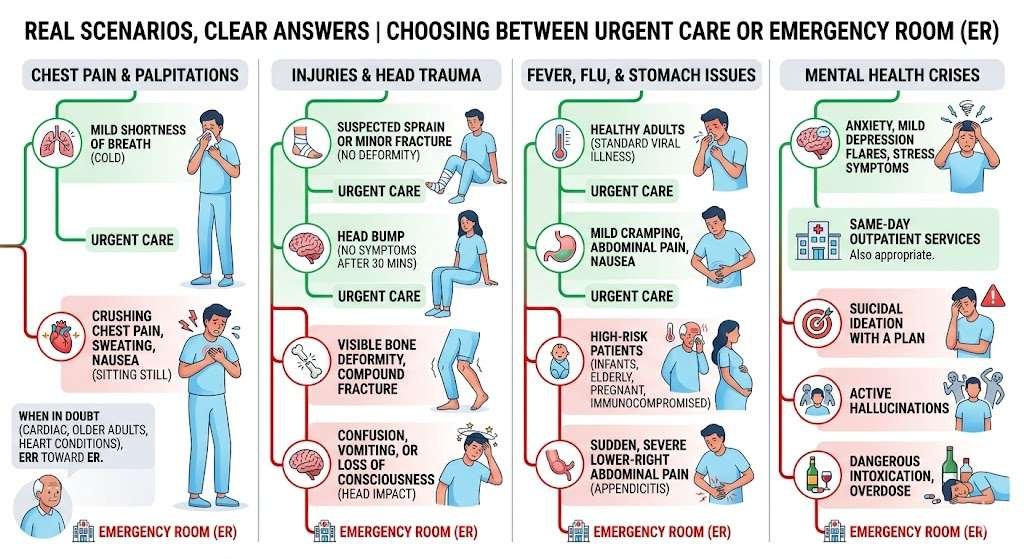
Chest Pain or Palpitations
Mild shortness of breath from a cold in urgent care. Crushing chest pain with sweating and nausea while sitting still always requires the ER. When in doubt on anything cardiac, especially in older adults or anyone with existing heart conditions, err toward emergency care every time.
Injuries and Head Trauma
A suspected sprain or minor fracture without deformity? Urgent care is appropriate. Visible bone deformity, inability to bear weight, or a compound fracture? ER. A head bump with no symptoms after 30 minutes is manageable at urgent care. Confusion, vomiting, or any loss of consciousness after a head impact means go to the ER immediately.
Fever, Flu, and Stomach Issues
Healthy adults with a standard viral illness are well-served by urgent care. Infants, elderly patients, pregnant individuals, and immunocompromised people face a higher risk and should lean toward the ER sooner rather than later.
Abdominal pain, mild cramping, and nausea are in the urgent care territory. Sudden, severe pain, especially in the lower-right abdomen, may indicate appendicitis and demands emergency evaluation.
Mental Health Crises
Urgent care and same-day outpatient services can address anxiety, mild depression flares, and stress-related symptoms. But suicidal ideation with a plan, active hallucinations, dangerous intoxication, or overdose require the ER immediately without exception.
Cost, Wait Times, and Practical Access
| Factor | Urgent Care | Emergency Room (ER) |
|---|---|---|
| Typical Cost | $20 – $100 co-pay | Hundreds to thousands of dollars |
| Billing Risk | Predictable, lower costs | High risk of surprise bills |
| Wait Time | Usually faster | Often long (hours), depending on severity |
| Triage Priority | First-come, first-served (generally) | Life-threatening cases prioritized |
| Best For | Non-life-threatening conditions | Severe, life-threatening emergencies |
| Hours | Extended (8 a.m. – 8/10 p.m.) | Open 24/7 |
| Access Features | Online check-in, real-time wait updates | Limited or no wait-time visibility |
| Patient Flow | More predictable and quicker turnaround | Delays common due to critical case priority |
Common Questions Worth Answering Directly
Is it safer to use the ER just in case, even for something minor?
For true emergencies, yes, always. For mild symptoms without red flags, urgent care is typically faster, safer for your finances, and equally effective.
Can urgent care evaluate chest pain?
Some locations can run an EKG and assess lower-risk presentations. If there’s any doubt, go to the ER. Cardiac symptoms mimic heartburn convincingly, and that’s not a gamble worth taking.
What if I go to urgent care and they redirect me to the ER?
Go immediately. Urgent care teams escalate only when genuinely warranted. Trust the assessment of someone who has already examined you in person.
Final Thoughts
Knowing when to seek immediate medical attention isn’t about memorizing a long list of symptoms; it’s about recognizing patterns. If something affects the way you breathe, think, move, or stay conscious, that’s your signal to treat it as an emergency without hesitation. The cost or inconvenience of an ER visit should never outweigh the risk of delaying care for a life-threatening condition.
At the same time, not every sudden symptom requires hospital-level intervention. Urgent care centers exist for a reason: they bridge the gap between routine care and true emergencies. Using them appropriately means faster treatment, lower costs, and less strain on overcrowded emergency departments.
A simple rule to carry with you:
- Life-threatening or rapidly worsening symptoms → ER (or call emergency services)
- Moderate, non-life-threatening issues needing same-day care → Urgent care
- Uncertain but stable → Telehealth or urgent care first
When in doubt, it’s always better to on the side of caution, but make that decision based on symptom severity, not fear alone. The more confidently you can make this call, the better outcomes you’ll have not just medically, but financially and emotionally as well.
References
- Weinick RM, Burns RM, Mehrotra A. Many emergency department visits could be managed at urgent care centers and retail clinics. Health Affairs. 2010;29(9):1630–1636. doi:10.1377/hlthaff. 2009.0748
- Uscher-Pines L, Mehrotra A. Analysis of Teladoc use indicates expanded access to care for patients without prior connection to a provider. Health Affairs. 2014;33(2):258–264. doi:10.1377/hlthaff. 2013.0989
- Rui P, Kang K. National Hospital Ambulatory Medical Care Survey: 2021 emergency department summary tables. National Center for Health Statistics. doi:10.15620/cdc:130244
- Morganti KG, Bauhoff S, Blanchard JC, et al. The evolving role of urgent care in the U.S. health care system. RAND Corporation. 2013. doi:10.7249/RR472
- American College of Emergency Physicians. Know When to Go: Emergency vs Urgent Care. doi:10.1016/j.annemergmed.2017.03.019