

Most owners do not arrive at this question through a limp. They arrive through a small absence.
The dog stops jumping onto the sofa and starts waiting to be lifted. He takes the stairs one at a time instead of two. He still goes for walks, still eats, still greets you at the door, but he lies down sooner than he used to, and he takes a moment to get organised before standing up. Nothing looks like an emergency. It looks like getting older.
That reading is the single most common reason joint disease in dogs is caught late. Dogs do not complain, and they do not rest a sore joint the way we do. They quietly stop doing the things that hurt, and because the change is gradual, it reads as age rather than pain.
If you have started searching for what is happening, you will quickly meet two words that seem to be used interchangeably. They are not the same thing, and the difference genuinely changes what your vet can offer.
Short Answer
Hip dysplasia is a problem with how the hip joint is built. Osteoarthritis is what happens to a joint over time when it is not working properly.
One is a description of structure. The other is a description of a process. A dog can have the first without the second, the second without the first, or both together, which is the most common situation in a middle-aged or older dog.
| Hip Dysplasia | Osteoarthritis | |
| What it describes | A hip joint that develops loose and unstable | Progressive degeneration of a joint |
| Where | The hip only | Any joint: hips, elbows, knees, shoulders, spine |
| When it starts | During growth, in puppyhood | Over time, usually after joint instability, injury or abnormal loading |
| Cause | Genetics, plus growth rate, nutrition and body weight | Often secondary to another joint problem |
| Relationship | Can lead to osteoarthritis | Can result from hip dysplasia or many other causes |
What Hip Dysplasia Actually Is
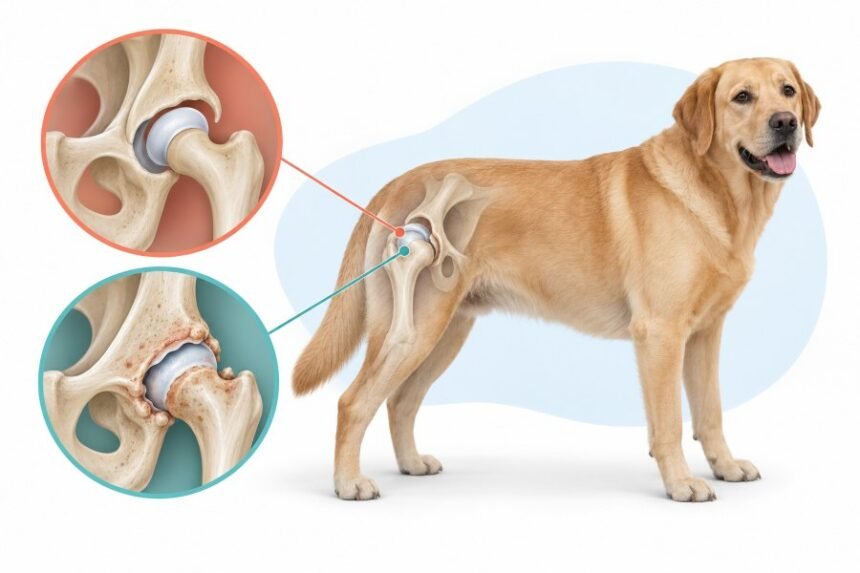
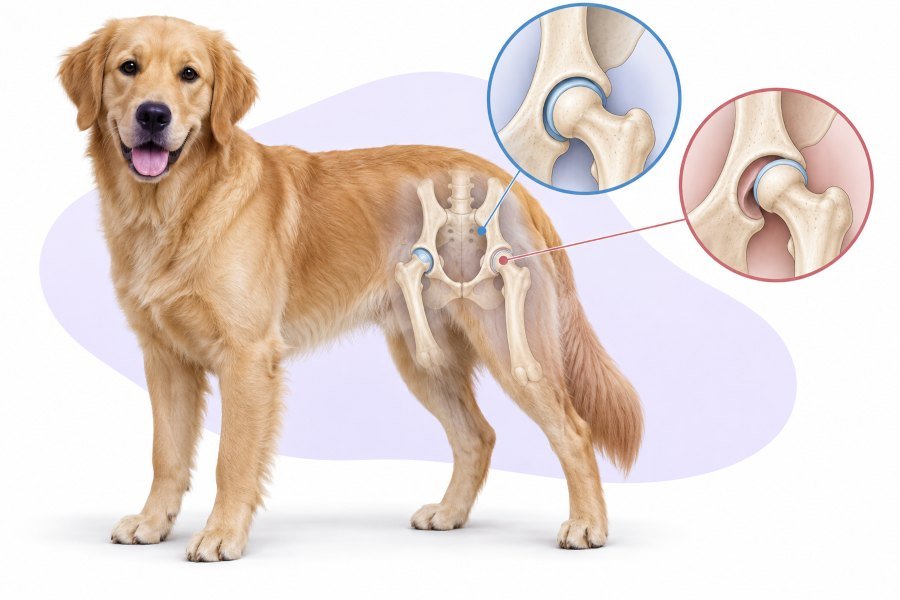
The hip is a ball and socket joint. The head of the femur is the ball, the acetabulum in the pelvis is the socket, and in a well-formed hip the two fit closely enough that the joint stays congruent through the full range of movement.
In a dysplastic hip, that fit is loose; the ball slides within the socket instead of rotating cleanly inside it. The joint is not broken, and it is not dislocated. It is simply carrying weight with more play in it than it should have.
The important part is what that laxity does over years. Each step loads cartilage that was never designed to take force at those angles. Cartilage wears, the joint capsule stretches and thickens, the socket remodels to become shallower, and bone responds by laying down new growth at the margins. That process is osteoarthritis, and in a dysplastic hip it is not bad luck. It is the predictable end of the sequence.
Hip dysplasia is inherited, but genetics set the risk rather than the outcome. Growth rate, calorie intake, calcium excess in growing large breeds and body weight all influence how severely the risk is expressed. It is most common in larger breeds, though smaller dogs are not exempt.
What Arthritis Actually Is
Arthritis means inflammation in a joint. What owners almost always mean, and what vets usually diagnose, is osteoarthritis, also called degenerative joint disease.
Osteoarthritis is a whole-joint disease. Cartilage thins and roughens, the fluid inside the joint loses its cushioning quality, the underlying bone stiffens and remodels, and the joint lining becomes chronically inflamed. Chronic inflammation is painful in its own right, which is why arthritic pain is not only mechanical.
It is also common. A large study of UK dogs in first-opinion practice put the annual prevalence of limb osteoarthritis at around one in forty dogs, with the risk rising sharply after eight years of age and with higher body weight, and the full VetCompass analysis of prevalence and risk factors also found affected dogs spent a substantial share of their lives living with it.
Osteoarthritis follows hip dysplasia, cruciate ligament disease, elbow dysplasia, old fractures involving a joint surface, patellar luxation and joint infections. Worth knowing: not every arthritis is osteoarthritis. Immune-mediated polyarthritis and septic arthritis behave differently, often with fever, a stiff, shifting lameness affecting several joints, or a dog that is unwell rather than simply stiff. Those need a different work-up and are not managed by weight control and joint supplements.
Why The Symptoms Look Identical
Because in the hip, quite often, they are.
A dog with hip dysplasia and a dog with hip osteoarthritis may both show:
- Difficulty rising, especially after sleeping or after a long rest
- Stiffness in the first few minutes of movement that eases as the dog warms up
- Reluctance to jump into the car or onto furniture
- Taking stairs slowly, or avoiding them
- A swaying or narrow hind-limb gait, sometimes with both back legs moving together in a bunny hop
- Muscle loss over the hindquarters, while the shoulders look comparatively bulky
- Shorter, slower walks by the dog’s own choice
- Irritability when touched near the hips, or a dog that moves away when handled there
Add the behavioural signs owners tend not to report because they do not seem medical: sleeping more, a dog that has stopped greeting you at the door, reluctance to be groomed at the back end, licking at a hip, house soiling in a dog that cannot posture comfortably, or new grumpiness with a younger dog in the house.
None of this tells you which condition you are dealing with. Worse, it does not even tell you the problem is in the hip. Cruciate disease, lumbosacral pain, degenerative myelopathy, tick-borne disease and, in older large-breed dogs, bone tumours can all begin as vague hind-limb difficulty. That last possibility is uncomfortable to read, and it is exactly why a persistent limp in a big dog deserves an examination rather than a wait-and-see approach.
Why The Distinction Changes What Can Be Done
This is the part most articles leave out, and it is the practical heart of the question.
The label matters because of timing. Treatment options for hip dysplasia are age-dependent in a way that arthritis treatment is not.
A young dog with significant hip laxity and little or no arthritic change still has a window. Certain procedures aim to change how the hip develops, altering the way the socket covers the ball before the joint has degenerated. They are only viable within specific and quite narrow age ranges, some of them measured in weeks rather than months. Once osteoarthritis is established, that window has closed and those procedures no longer apply.
An older dog with established degenerative change is in a different conversation. The realistic goals become comfort, muscle preservation and function, delivered through weight control, exercise modification, medication and rehabilitation, with salvage surgery considered if that combination stops being enough.
So when a vet distinguishes between laxity and degeneration on a radiograph, they are not being pedantic. They are working out which conversation you are in.
How Hip Dysplasia Is Diagnosed
Diagnosis combines history, hands-on examination and imaging, and each part contributes something the others cannot.
The examination assesses gait, muscle mass, range of hip extension and pain response, and includes specific tests for joint laxity. The American College of Veterinary Surgeons explains the palpation and radiographic methods used, including the Ortolani test, which detects the ball slipping and reducing back into the socket. Meaningful laxity testing requires sedation, because a tense, awake dog braces the muscles around the hip and can mask exactly what is being tested.
Radiographs then show conformation: how deeply the socket covers the femoral head, whether the head is subluxated, and whether osteoarthritic change is already present as new bone at the joint margins or a remodelled femoral neck.
A vet hospital will usually examine more than the hips before settling on a diagnosis, because a dog can have both a dysplastic hip and a partially torn cruciate ligament, and treating only the one you looked for is a common way to end up with a dog that does not improve.
What A Hip Dysplasia Test Involves
Standard hip radiographs answer the question “does this hip look abnormal now?” Laxity-based screening answers a different and earlier question: “how loose is this hip, and what is the risk?”
PennHIP is the best-known quantitative method. It uses a distraction view to measure how far the femoral head can be displaced from the socket, expressed as a numerical index, which allows risk to be assessed in a young dog before arthritis appears. It requires specific positioning, certified equipment and sedation or anaesthesia.
Registry-based schemes assess conformation instead. In North America, the Orthopedic Foundation for Animals maintains hip evaluation records, while in the UK, Ireland, Australia and New Zealand the BVA hip scoring scheme grades nine features of each hip to produce a total score, with breed medians published to guide breeding choices. These schemes exist mainly to reduce disease in future generations rather than to manage the dog in front of you, and there is now evidence from a large cohort of assistance dogs that dogs scoring poorly at around a year old carry a higher risk of being diagnosed with hip arthritis later in life.
If you are choosing a puppy from a breed prone to this condition, ask to see hip results for both parents. It is the single most effective thing an owner can do about hip dysplasia, and it can only be done before the puppy comes home.
Does A Bad X-Ray Mean A Painful Dog?
Not reliably, and the mismatch runs in both directions.
Some dogs have hips that look alarming on film and trot around comfortably for years. Others have modest radiographic change and are clearly struggling. Cartilage has no nerve supply, and what generates pain is inflammation, joint capsule stretch, bone remodelling and secondary muscle strain, none of which photograph in proportion to how they feel.
This is why the assessment should include how your dog actually lives. The 2022 AAHA pain management guidelines place real weight on owner-completed questionnaires for chronic pain, because you see behaviour over weeks that no consultation can capture in ten minutes.
Two things you can do that make a genuine difference to the accuracy of a diagnosis: film your dog on your phone walking away from you and towards you on a non-slippery surface, and write down specific lost behaviours with rough dates. “Stopped jumping into the boot in March” is worth more than “seems stiff sometimes.”
Managing Both Conditions
Body Weight Is Not A Footnote
It is the most powerful intervention available to an owner, and the evidence behind it is unusually strong.
In a lifetime study of Labrador littermates fed the same diet in different quantities, radiographic hip osteoarthritis at two years of age was present in about a quarter of the dogs fed freely, compared with a small fraction of their lean-fed pair-mates. The published radiographic findings from that cohort tracked the gap widening across their lives. In the same programme, lean-fed dogs did not require treatment for osteoarthritis until around three years later than their overfed siblings, and lived meaningfully longer.
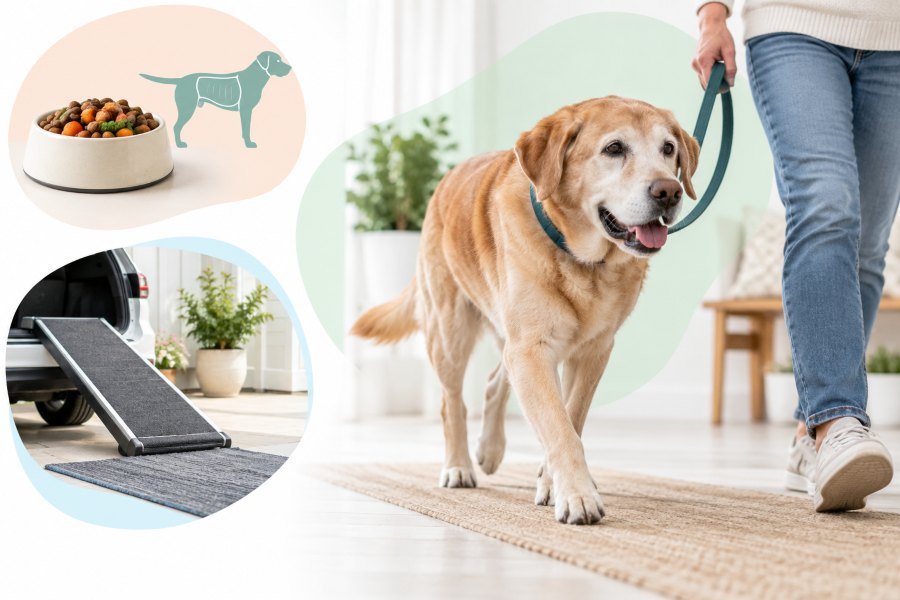
Three years of comfort, from food portions. Ask your vet to body condition score your dog and to show you how, then do it yourself monthly. You should feel ribs easily under light pressure and see a waist from above.
Exercise, Changed Rather Than Stopped
Cage rest is not the answer to chronic joint disease. Muscle around a hip acts as its stabiliser, and a dog that stops moving loses that support and gets worse.
What usually helps is trading intensity for consistency. Several shorter lead walks beat one long one. Steady walking and controlled swimming are kinder than ball chasing, sudden turns and rough play with other dogs, which load the joint unpredictably. Progression should be gradual, and after surgery it must follow the surgeon’s protocol rather than the dog’s enthusiasm.
Home Environment, Especially On Hard Floors
This matters more in Singapore than most guides acknowledge, because tiled, marble and polished concrete flooring is everywhere, and a dog with weak hindquarters spends the day with its legs sliding out from under it. Every slip triggers a muscle guard, and a dog that has fallen once becomes reluctant to move at all.
Practical fixes: runners or rugs along the routes your dog uses most, a non-slip mat at the food bowl, keeping paw pad fur trimmed, a ramp for the car instead of a jump, a supportive bed away from direct aircon draughts, and raised bowls if the dog struggles to hold a lowered head position.
Medication And Rehabilitation
Prescription anti-inflammatory medication is often the backbone of osteoarthritis management, sometimes with additional pain modifiers, and newer injectable options have changed what is possible for chronic canine joint pain. All of it needs veterinary supervision, including baseline bloodwork in older dogs.
One firm safety rule: never give your dog human painkillers. Paracetamol and ibuprofen are not simply weaker options for dogs; they are toxic, and ibuprofen in particular causes gastrointestinal ulceration and kidney injury at doses owners consider trivial. If your dog is uncomfortable tonight, restrict movement and call a vet in the morning rather than opening your own medicine cabinet.
Physiotherapy, hydrotherapy and targeted strengthening are worth asking about, particularly for rebuilding hind-limb muscle and after any orthopaedic procedure.
When Surgery Enters The Conversation
Most dogs with hip dysplasia never need an operation, and surgery is not a treatment for arthritis in general. It is a treatment for a specific joint that has stopped responding to everything else.
For young dogs with laxity and minimal degeneration, procedures that reorient the socket may be discussed within tight age limits. For dogs with a painful, degenerate hip and function that has genuinely declined despite good conservative management, total hip replacement removes the diseased joint and replaces both components with an implant. It is the only option that eliminates the arthritic surface rather than managing it, and in suitable candidates the functional results are very good. Femoral head and neck excision is an alternative in some dogs, particularly smaller ones, and works by removing the painful contact entirely rather than restoring normal mechanics.
Whether an individual dog is a candidate depends on age, weight, the state of the other hip, the condition of the knees and spine, general health and how much function has actually been lost. A surgical assessment for hip dysplasia in dogs is the point at which those variables get weighed properly, and a good consultation is as likely to end with a management plan as with a surgery date.
When To Get Your Dog Seen
Book an appointment for persistent changes: limping lasting more than a few days, stiffness after rest, difficulty rising, reluctance to jump or climb, a change in gait, loss of muscle over the hindquarters or a general decline in activity.
Seek same-day veterinary attention if your dog cannot bear weight on a limb, suddenly cannot rise or stand, is dragging or knuckling a paw, has a hot swollen joint, is panting and restless in a way that suggests severe pain, or has had significant trauma. Sudden severe signs point away from slow degenerative disease and towards time-critical problems.
Bottom Line
Hip dysplasia describes a hip that grew loose. Osteoarthritis describes a joint that is wearing out. Hip dysplasia is the most common route to hip arthritis in dogs, but it is not the only one, and arthritis can affect joints that have nothing to do with the hips.
For your dog, the useful questions are narrower than the terminology suggests. Which joint is the problem, is there an underlying structural cause, how much degeneration is already present, how much is it costing your dog day to day, and is there still a preventive window?
And if your dog has stopped doing something he used to do, that is worth mentioning to your vet. It is far more often the beginning of joint disease than the beginning of old age.
Frequently Asked Questions
| Question | Answer |
|---|---|
| Is hip dysplasia the same as arthritis in dogs? | No. Hip dysplasia is abnormal development of the hip joint that causes looseness and instability. Osteoarthritis is degeneration of a joint. Hip dysplasia commonly causes secondary osteoarthritis in the affected hip. |
| Can a dog have hip dysplasia without arthritis? | Yes. This is typical in younger dogs. The laxity is present from puppyhood, while degenerative changes often accumulate later. |
| Can a dog have arthritis without hip dysplasia? | Yes. Cruciate ligament disease, elbow dysplasia, old joint injuries, patellar luxation, and joint infection can all lead to osteoarthritis. |
| At what age does hip dysplasia show up? | Signs can appear as early as four to twelve months when laxity is severe, or not until middle age when secondary arthritis becomes symptomatic. |
| Is bunny hopping always hip dysplasia? | No. It can be suggestive, particularly in a young large-breed dog, but other hind-limb or neurological problems can produce a similar gait. A veterinary examination is needed for diagnosis. |
| Does hip dysplasia always need surgery? | No. Many dogs are managed successfully with weight control, exercise modification, medication, and rehabilitation. Surgery may be considered when comfort and function cannot be maintained otherwise. |
| Can I give my dog joint supplements instead of seeing a vet? | Supplements may be part of a treatment plan, but they cannot diagnose the problem or reliably control established pain. Getting a proper diagnosis first is important. |
Disclaimer
This article is general information for dog owners and is not veterinary advice. It cannot account for your individual dog’s age, breed, weight, medical history, medications or specific findings on examination. Do not start, stop or change any treatment on the basis of this article, and never give human medication to a dog. Always consult a licensed veterinarian about your own dog, and seek urgent veterinary attention for sudden severe lameness, inability to stand, or signs of significant pain.