

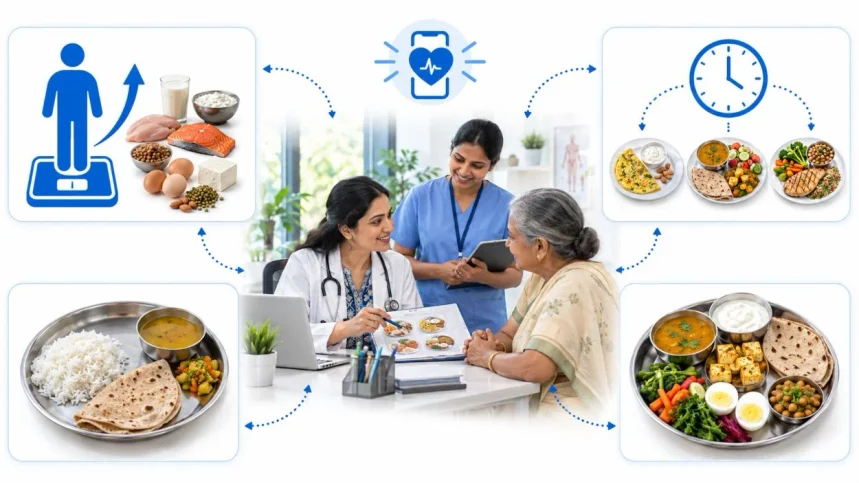
Ask about protein in an Indian household, and How Much Protein Do Indians Need Daily you will probably hear two confident answers in the same week. The trainer at the gym says two scoops a day. Someone at home says dal-chawal has always been enough. Both are partly right, which is exactly why the question feels so muddled.
Here is the part that clears most of it up. For most healthy adults, the daily target is modest and very reachable with ordinary Indian food. The problem is rarely what is in the kitchen. It is how protein is spread across the day, and one meal in particular, breakfast, which often arrives with almost none. So before any app, calculator, or tub of powder, the most useful thing you can do is take an honest look at what is on your plate from morning to night.
Short Answer Is Smaller Than You Might Think
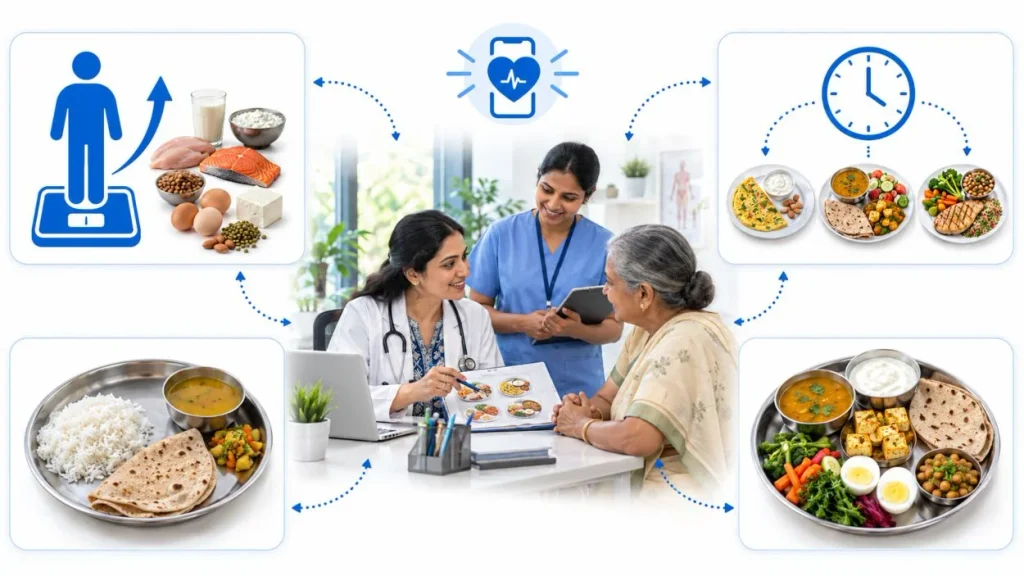
India’s own benchmark comes from ICMR-NIN. The Dietary Guidelines for Indians published by ICMR-NIN in 2024 put the protein requirement for healthy adults at 0.83 grams per kilogram of body weight per day. In real numbers, that is about 46 grams for a 55 kg woman, about 50 grams for someone weighing 60 kg, and about 54 grams for a 65 kg man.
That figure is designed to cover the needs of nearly all healthy adults with ordinary activity levels, so for a lot of readers it is a genuinely sufficient target rather than a bare minimum to beat. If you are carrying a lot of extra weight, a dietitian will often calculate from a healthier reference weight instead of your current one, because using the scale number can overshoot what your body actually needs.
Where it gets more personal is in the groups below.
Who Needs More, And Who Needs A Different Number
People who strength train regularly. Lifting weights raises protein needs. The International Society of Sports Nutrition’s position statement on protein and exercise suggests 1.4 to 2.0 grams per kilogram per day for most people who exercise, spread across the day in servings of roughly 20 to 40 grams. There is a ceiling on the benefit, though. A widely cited meta-analysis of protein and resistance training found that muscle gains largely levelled off at around 1.6 grams per kilogram. For a 70 kg person, that is about 112 grams a day, and anything well beyond it mostly adds cost rather than muscle. If building strength is your main reason for reading, this guide on Protein Powder for Muscle Growth looks at how protein, resistance work, and daily routine fit together.
Adults over 65. Muscle becomes harder to hold on to with age, and the body responds less efficiently to the protein it gets. An international expert group, PROT-AGE, recommends that older adults aim for 1.0 to 1.2 grams per kilogram a day, with more for those who are active or recovering from illness. The same group makes an important exception for people with severe kidney disease who are not on dialysis, whose intake needs medical supervision.
Pregnancy and breastfeeding. Needs rise, mostly in the later trimesters and while breastfeeding. The WHO, FAO, and UNU expert report on protein requirements recommends that this extra protein come from normal food rather than commercially prepared high-protein supplements. Your obstetrician or dietitian should set the number for you.
People with kidney disease. This is where more is not better. The National Kidney Foundation explains that the right protein intake with kidney disease depends on body size, nutritional status, and the type of kidney disease, and that eating too little can also cause malnutrition. People on dialysis often need more, not less. Because diabetes and high blood pressure are the most common routes to kidney damage in India, anyone living with either should ask for a kidney function check before pushing protein up significantly.
Why A Good Indian Plate Can Still Fall Short
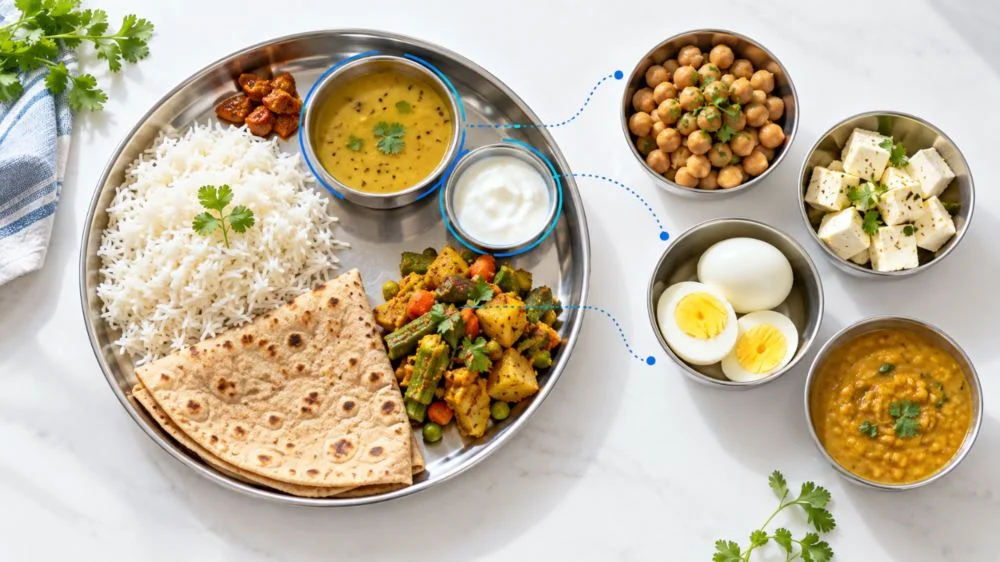
Indian food is not short of protein sources. Dal, rajma, chole, curd, paneer, milk, eggs, fish, chicken, soya, and sprouts are all familiar. The shortfall usually comes from proportion. The ICMR-NIN guidelines note that the cost and availability of pulses and meat push many families towards cereal-heavy meals, and they suggest cereals and millets should supply no more than about 45% of daily calories, with pulses, beans, and meat contributing up to 15%.
Quality matters as well as quantity. Cereals and pulses are each short on a different essential amino acid, and eating them together covers the gap. That is why dal-chawal, rajma-rice, and idli-sambar are nutritionally smarter than they look. The guidelines themselves emphasise getting good quality protein through food combinations like these.
The bigger issue is distribution. Picture a 60 kg adult with a desk job. Breakfast is poha and chai, maybe 5 grams of protein. Lunch is two rotis, sabzi, and a thin dal, roughly 12 grams. The evening brings chai and a couple of biscuits, another 2 grams. Dinner of rice, dal, and sabzi adds around 11 grams. That is about 30 grams against a need of roughly 50.
Nothing on that plate is wrong. It is just thin. And notice how the gap closes: a katori of curd and a handful of peanuts with the poha, roasted chana instead of biscuits, and some paneer, eggs, or a thicker dal at dinner. Three small changes, no powder, and the day lands on target.
How Much Protein Is In What You Already Eat
These are approximate figures for common portions. Recipes, portion sizes, and how thick the dal is will all shift them, so treat them as a guide rather than a lab result. For food-by-food detail, the National Institute of Nutrition’s Indian Food Composition Tables are the most reliable Indian reference.
| Everyday Portion | Approximate Protein |
| 1 large egg | About 6 g |
| 1 katori cooked dal, thin to medium | 6 to 7 g, more if thick |
| 100 g paneer | 18 to 20 g |
| 1 katori curd (about 100 g) | 3 to 4 g |
| 1 glass milk (200 ml) | About 6 g |
| Small handful roasted chana (30 g) | About 6 g |
| Small handful peanuts (30 g) | About 7 g |
| 30 g dry soya chunks | About 15 g |
| 2 medium rotis | About 5 to 6 g |
| 100 g cooked chicken or fish | About 20 g or more, depending on the cut |
Closing The Gap Meal By Meal
Breakfast is where most Indian days lose ground, so it gives the biggest return. If you eat poha or upma, add peanuts while cooking and a katori of curd on the side. With idli or dosa, ask for more sambar and add curd. Moong dal chilla, besan chilla, and pesarattu carry far more protein than a plain paratha, and a paneer or egg paratha beats an aloo one. Two eggs in any form change the morning completely.
Lunch usually needs only a tweak. Make the dal thicker, add raita, or swap in rajma, chole, soya, or a portion of chicken or fish a few days a week.
Snacks are where good intentions quietly disappear into biscuits and namkeen. Roasted chana, a small bowl of sprouts chaat, boiled eggs, or a glass of milk all do more work. Chaas is refreshing, but it is diluted enough to offer only a gram or two per glass.
Dinner can carry paneer or tofu bhurji, egg curry, fish, or simply a more generous serving of dal alongside the rotis.
Timing: Spread It Out Rather Than Stacking It
Your body does not store protein the way it stores fat, so a large dinner does not make up for a protein-free breakfast. Spreading intake across three meals, with something in between if you are active, helps you feel fuller and makes the daily total far easier to reach. Many adults do well with around 20 to 30 grams per main meal, and older adults are often advised to aim for the upper end of that range.
If you train, a protein-containing meal or snack within a couple of hours of your workout is useful, but you do not need to rush to the locker room with a shaker. Total daily intake and a steady spread matter more than the exact minute you eat.
Where A Protein Powder Genuinely Fits

It is worth being straight about something the supplement aisle rarely mentions. ICMR-NIN is more cautious about powders than the fitness world. Its guidelines advise against using protein supplements to build muscle mass and link prolonged intake of large amounts of protein powder to possible harms, including bone mineral loss and kidney damage. The concern is heavy, long-term use as a substitute for food, not an occasional serving that fills a real gap.
Sports nutrition bodies take a more practical view, treating supplements as a convenient way to meet targets when food falls short. Both positions point in the same direction for most people: food first, and a supplement only where it solves a specific problem. That is really the whole logic of Protein Powder Daily Intake: work backwards from the gap in your meals, not forwards from the size of the scoop.
If you do use one, know what is in it. Horlicks Protein Powder lists 24 grams of protein per 36-gram sachet, made mainly from fermented yeast protein, with 4 grams of chicory root fibre, no added sugar, and a lactose-free label. Mixed into a glass of milk rather than water, a sachet comes to roughly 30 grams. The ready-to-drink bottle lists 20 grams of protein from milk, about 171 kcal, and no added sugar. The brand suggests one serving a day and starting with half a sachet for the first five days, which is sensible, because chicory fibre can cause gas or bloating in people with a sensitive gut. The powder’s label also carries a “may contain” warning for milk, wheat, barley, soy, oats, and nuts, which matters if you have a genuine allergy.
A few habits keep a supplement in its proper place. Count it in your daily total instead of treating it as a bonus. For most people, one serving is plenty. Use it for the days that genuinely need it, not as a replacement for breakfast every single morning. Check that any product you buy carries an FSSAI licence number and a complete ingredient list. Powders designed for adults are not meant for children unless a paediatrician advises one.
| Situation | Food-First Fix | When A Shake Makes Sense |
| Carb-only breakfast | Add curd, eggs, paneer, peanuts, or switch to a moong chilla | Mornings with no time to cook or sit down |
| Strength-training days | Protein at every meal, plus a snack after training | When the next proper meal is hours away |
| Travel and long workdays | Carry roasted chana, peanuts, or boiled eggs | When the only options are biscuits and samosas |
| Weight management | Build each plate around dal, curd, vegetables, and a protein anchor | When snacks keep drifting towards namkeen |
| Medical conditions or pregnancy | Follow targets set by your doctor or dietitian | Only on professional advice |
When To Talk To A Doctor Before Raising Protein
Some situations call for a professional conversation before you change anything. That includes diagnosed kidney disease, diabetes or high blood pressure without a recent kidney function test, liver disease, pregnancy and breastfeeding, and any teenager who wants to start supplements for sport. Unexplained weight loss, muscle wasting, or constant weakness also deserve a medical check rather than a quick fix from a tub, because low intake is only one of several possible causes.
The Bottom Line
Most Indian adults need about 0.83 grams of protein per kilogram of body weight a day, with more for regular strength training, older age, pregnancy, and recovery, and a carefully managed amount for kidney disease. The usual problem is not the total available in Indian food. It is a light breakfast, biscuit-heavy snacks, and protein pushed into one meal. Fix those first with dal, curd, paneer, eggs, chana, soya, and sprouts. Then, if a genuine gap remains on busy or training days, a single measured serving of protein powder can close it without taking over the plate.
Disclaimer: This article is for general information only and is not a substitute for personalised advice from a doctor, registered dietitian, or other qualified health professional. Protein needs vary with age, body weight, activity, pregnancy, and medical conditions. Speak with your healthcare provider before changing your diet significantly or starting a protein supplement, especially if you have kidney disease, diabetes, high blood pressure, or are pregnant or breastfeeding.