

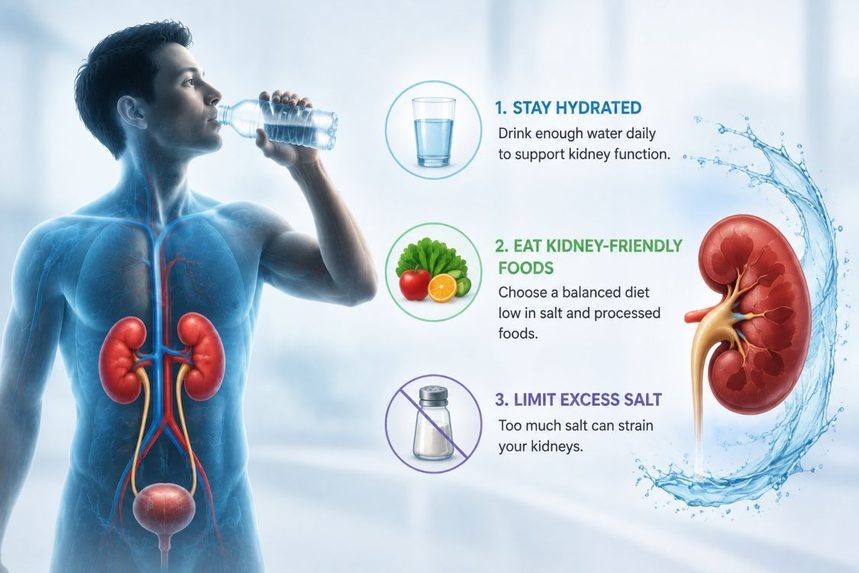
Your kidneys are not a sponge waiting to be filled. They are a regulator, and a remarkably good one. Their entire job is to hold the composition of your blood steady no matter what you do to it, which includes deciding minute by minute how much water to keep and how much to send out.
That distinction matters, because most hydration advice quietly assumes the opposite. It treats water as a substance you can accumulate for credit, where more is always better, and the kidneys benefit in proportion. The reality is closer to this: your kidneys handle a very wide range of fluid intake without difficulty, and what actually causes them trouble sits at the two ends, not in the middle.
This is a look at where hydration genuinely changes kidney outcomes, where the evidence is thinner than the headlines suggest, and how to think about fluids without either underdoing it or turning water into a competitive sport.
What Your Kidneys Are Doing All Day
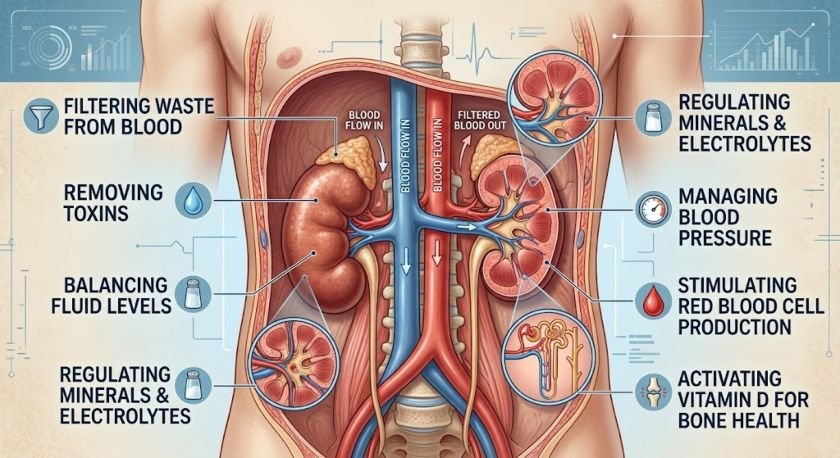
The scale of the operation is easy to underestimate. Each kidney contains roughly a million microscopic filtering units called nephrons, and according to NIDDK’s explanation of how the kidneys work, the pair of them filter about 150 quarts of blood every single day.
Almost none of that leaves your body. Only one to two quarts become urine. Everything else- the water, the minerals, the nutrients- gets reabsorbed and returned to the bloodstream by the tubules.
Look at those two numbers together, and you can see the real work. Filtration is the easy part. The hard part is reabsorption, the constant decision about what to keep, and it is happening across an enormous volume with a very small margin for error. When people say water “helps the kidneys flush toxins,” they are describing something the kidneys do regardless. What water changes is how concentrated the final product ends up being.
Where Hydration Clearly Matters: Kidney Stones
If there is one place the evidence is unambiguous, this is it.
Concentrated urine means dissolved minerals sit closer to the point where they crystallize. Calcium, oxalate and uric acid all become likelier to precipitate out and clump together. Dilute the urine, and you push that chemistry back away from the edge.
NIDDK is direct about this, calling adequate fluid the single most important thing a person can do to prevent stones. Clinical guidance for people who have already formed one generally targets a urine output of at least 2.5 liters a day, which usually means drinking somewhat more than that to account for what is lost through sweat and breathing.
Notice how that target is framed. It is stated as urine volume, not as glasses consumed, because output is the thing that actually governs the chemistry. Two people drinking identical amounts in different climates and jobs will not produce the same urine volume.
Where the Story Gets More Complicated
Here is the part that rarely makes it into hydration articles.
The intuition that drinking more water protects kidney function over time has been tested directly, and it did not hold up. The CKD WIT trial, published in JAMA in 2018, randomized 631 adults with stage 3 chronic kidney disease either to coaching that increased their water intake by roughly a liter a day or to maintaining their usual intake. After a year, the increased water intake did not slow the decline in kidney function. The intervention worked in the sense that people genuinely drank more and their vasopressin levels fell. The kidney function decline was simply the same in both groups.
This does not mean hydration is irrelevant. It means something more specific and more useful: for people already drinking a reasonable amount, adding more water is not a treatment for kidney disease, and it should not be sold as one. The observed benefits in earlier population studies may largely reflect what happens at the low end, among people who drink very little, rather than a dose-response relationship that keeps paying out the higher you go.
The honest summary is that avoiding chronic underhydration is worth doing. Pushing well past adequate is not a second lever.
Electrolytes, and the Risk Nobody Mentions

Water alone is not the whole system. Sodium, potassium, magnesium and calcium determine how fluid distributes between the inside and outside of your cells, and your kidneys spend the day adjusting how much of each to retain or excrete. That is a large part of how blood pressure and blood volume stay stable.
Which brings up a genuine danger that gets left out of most hydration content: you can drink too much water, and the mechanism is electrolyte dilution rather than kidney overload.
Exercise-associated hyponatremia occurs when someone consumes large volumes of hypotonic fluid faster than their kidneys can excrete it, diluting blood sodium below safe levels. The clinical literature on this condition describes symptoms running from nausea and headache through confusion and seizures, and in severe cases it is fatal. It shows up in marathon runners, in military training, and occasionally in people who were following aggressive drinking advice.
One correction worth stating plainly, because the opposite is widely believed: reaching for a sports drink does not solve this. Commercial electrolyte drinks are still hypotonic relative to blood, so they do not prevent hyponatremia in someone who is overdrinking. The protective factor is volume, not flavor. Drinking to thirst, rather than to a schedule or a target, is what current guidance emphasizes for endurance activity.
Who Should Not Simply Drink More
General hydration advice assumes healthy kidneys, and a fair number of readers do not have them.
People with advanced chronic kidney disease, heart failure, or certain liver conditions are frequently placed on deliberate fluid restrictions, because retaining fluid is the problem rather than losing it. Some blood pressure medications and diuretics also change the calculation.
Electrolyte supplementation carries its own caution. In reduced kidney function, the body loses its ability to clear potassium efficiently, and the National Kidney Foundation notes that levels above 6.0 mmol/L are considered a danger zone because of the effect on heart rhythm. Salt substitutes and electrolyte powders are often potassium-based for most people; that is unremarkable. For someone with declining kidney function, it is not.
None of this is a reason for a healthy person to worry about a glass of water. It is a reason that “drink more, add electrolytes” should never be blanket advice.
What Happens When You Lose Fluid Suddenly
Rapid fluid loss triggers a fast and fairly elegant response. Your hypothalamus signals the pituitary to release vasopressin, also called antidiuretic hormone, which tells the kidneys to hold on to water and cut urine production. At the same time, blood vessels constrict slightly to keep blood pressure from dropping. It is a good system, built for exactly this.
It also explains why the recovery advice you hear is what it is. Replacing fluid gradually, over a few hours, lets absorption keep pace and lets the hormonal signals wind down on their own schedule. Drinking a liter in one go mostly produces a trip to the bathroom, because you have overwhelmed the reabsorption capacity rather than restored anything.
Plasma Donation Question
It is worth separating two things that often get lumped together, because the difference is large.
A routine blood test takes a few milliliters. It is not a meaningful fluid event, and your body barely registers it. A plasma donation is a different order of magnitude. Several hundred milliliters of plasma are collected, and since the American Red Cross notes that plasma is about 92 percent water, that is a real volume shift your body then works to replace.
This is why the question is donating plasma bad for you comes up so often, and why hydration status turns out to be the practical variable for most healthy donors who meet screening criteria. Arriving well hydrated supports stable blood pressure during collection, which is what makes the difference between a comfortable donation and a lightheaded one. Drinking steadily afterward supports the plasma volume rebuild, which for healthy people happens over the following day or so.
Two caveats belong here. Hydration affects how a donation feels and how quickly you bounce back, which is not the same as claiming it protects your kidneys from harm. And anyone with existing kidney disease, or on fluid restriction, should raise donation with their own physician rather than reasoning from general advice.
Practical Habits, Without the Mythology
There is no universal daily number, and the widely quoted eight glasses has no strong evidence behind it. Mayo Clinic points to adequate intake figures of roughly 2.7 liters daily for women and 3.7 liters for men. Still, those are totals from all sources, including food, and they are population averages rather than personal prescriptions. For context, CDC data show US adults average about 44 ounces of plain water per day on top of everything else they consume.
A few things that hold up:
- Use urine color as a rough gauge, not a verdict. Pale yellow generally suggests you are fine. Consistently dark suggests you are running low. It is genuinely useful, with the caveat that B vitamins, beets, and various medications can throw the color off entirely, and first-morning urine is normally darker regardless.
- Let food do some of the work. Fruits and vegetables carry substantial water plus potassium and magnesium in a form your body handles easily. This is a more sensible route to electrolytes than powders for most people.
- Spread intake out. Sipping through the day keeps urine dilute more effectively than drinking large volumes at intervals, because the excess in a large volume largely leaves as urine rather than staying available.
- Go easy on alcohol and sugary drinks. Alcohol suppresses vasopressin, which is precisely why it increases urine output and leaves you short. Sugar-sweetened drinks bring their own problems, including a fructose load associated with higher stone risk.
- Drink more when circumstances demand it. Heat, hard physical work, fever, vomiting and diarrhea all raise requirements considerably. This is where genuine underhydration actually happens, far more than during an ordinary desk-bound day.
Short Version
Your kidneys are better at managing water than most hydration advice gives them credit for. The goal is not to maximize intake. It is to stay out of the ditches on either side: not chronically underhydrated, which raises stone risk and makes concentrated urine the norm, and not aggressively overhydrated, which is its own hazard.
If you have had a kidney stone, fluid intake is one of the highest-value things you can change. If you have kidney disease, your fluid and electrolyte targets are a clinical question, not a lifestyle one. And if you are healthy, the useful habit is unglamorous: drink reasonably, drink regularly, pay attention when conditions change, and stop treating a water bottle as a medical intervention.
This article is general information and is not medical advice. Anyone with kidney disease or on fluid restriction should follow guidance from their own clinician.