

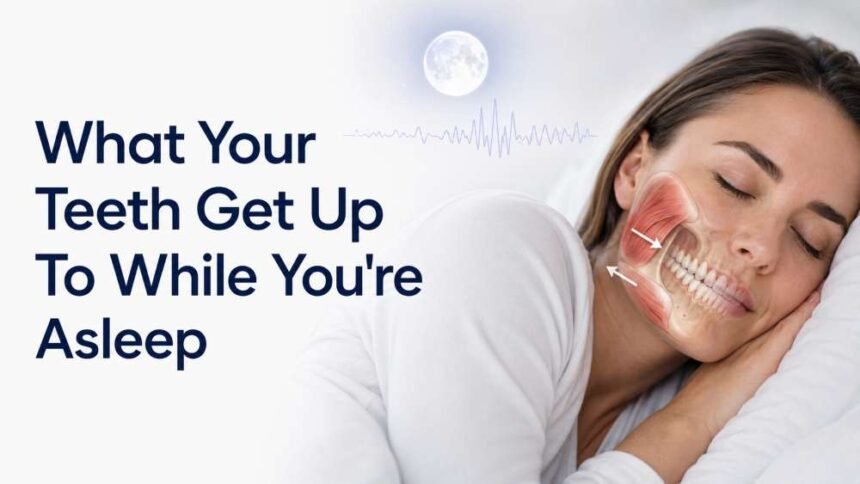
Somewhere in the small hours, without asking your permission, your jaw may be doing a job you never assigned it. It closes. It holds. It slides sideways. It releases. Then, some minutes later, it does the whole thing again.
Teeth grinding, or bruxism, is one of the most common things the human body gets up to without consulting us first. A 2024 systematic review pooling two decades of studies put the global prevalence of sleep bruxism at around 21%, rising to roughly 43% when the counting was done in a sleep lab rather than by questionnaire. That gap is the interesting part. Labs find far more grinders than surveys do, which tells you something uncomfortable: a great many people are doing this and have no idea.
If you have arrived here because your partner said something, or because you woke with a tight jaw and a headache you cannot account for, this is what the evidence actually shows, what it does not, and what is genuinely worth doing about it. The short version, before we go any further, is that this is usually less alarming than it sounds.
Seven Seconds, And Rather A Lot Of Force
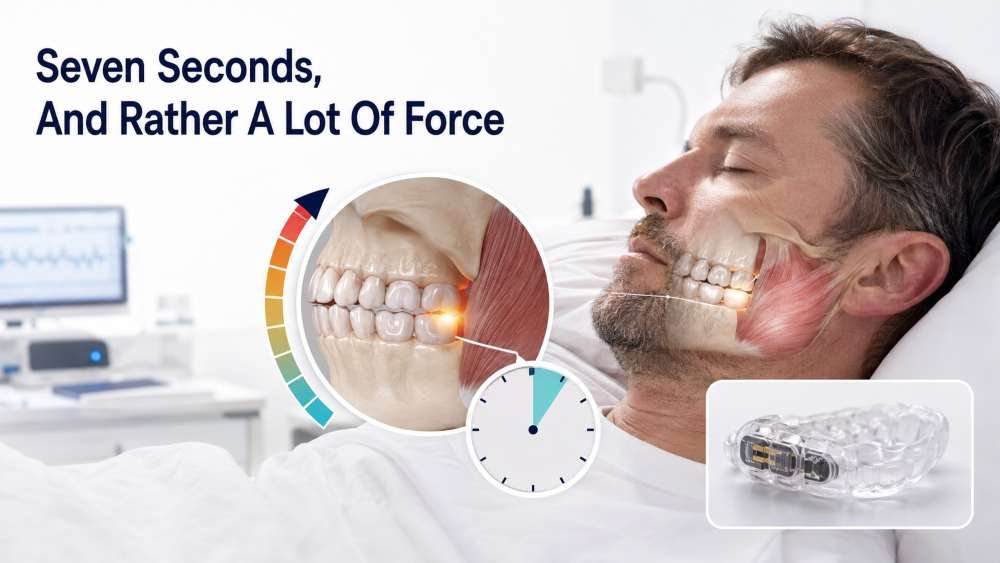
In 2001, a team at the University of Tokushima did something pleasingly direct about all this. They built miniature strain gauges into hard acrylic appliances, fitted them to ten volunteers, and sent everyone home to sleep in them for three nights. Nearly 500 grinding events later, they had numbers instead of impressions.
The average episode lasted about seven seconds and produced roughly 22 kilograms of force at the first molars. The same rig measured each volunteer’s maximum voluntary daytime bite for comparison. On average, night-time force came to about half of what people could manage deliberately, while awake, and actively trying their hardest.
In one participant, it came to more than all of it. While unconscious, he was biting harder than he could on purpose.
Two caveats, because they matter. Ten people is a very small study, and the acrylic appliances themselves alter how the teeth meet. Nobody has repeated the experiment at scale. What survives is the shape of the finding rather than the decimal point: sleep can produce loads in the region of a hard, deliberate bite, held for several seconds, several hundred times a month, on teeth that were never asked.
Why You Never Wake Up For The Main Event
Chewing, while you are awake, is closely supervised. Nerve endings in the periodontal ligament, the fibrous sling that suspends each tooth in its socket, report load continuously. That supervision is why you stop dead when you find a stone in a cherry mousse. The reflex gets there before you consciously do.
During sleep, that oversight is turned down and awareness is absent entirely, so the jaw carries on without either.
The timing is not random, either. When researchers matched ten people with sleep bruxism against ten without and looked closely at the seconds before each episode, they found a consistent running order: cortical activity rising about four seconds before the jaw muscles fired, then heart rate accelerating one cardiac cycle before onset. The grinding is the last step in a brief arousal, not the first step in anything.
Which quietly reframes the entire business. It looks less like a dental event that happens to occur at night and more like a sleep event that happens to involve teeth.
How To Tell, Given That You Are Asleep For It
Most people find out secondhand. The usual signals:
- A partner mentioning the noise, though plenty of grinding is silent, so quiet nights prove nothing
- A jaw that feels tired or tight on waking and loosens through the morning
- A dull ache at the temples first thing, fading by mid-morning
- Teeth going flat or glassy where they used to have ridges and points
- New sensitivity to cold, or one tooth that objects when you bite on it
- Scalloped indentations along the edge of the tongue, or a pale ridge along the inside of the cheek
Your dentist can see wear patterns you cannot, and read them against your age, which is the genuinely useful bit. A degree of wear is entirely normal by fifty. The question is only whether yours is running ahead of schedule.
It Is Not, Technically, A Disorder
An international expert panel concluded in 2018 that in otherwise healthy people, bruxism should not be classed as a disorder at all. It is a behaviour. A muscle activity that may be a risk factor for certain outcomes and, quite possibly, a protective factor for others.
The same group revisited the definitions in 2025 and went further. They dropped the “in otherwise healthy individuals” qualifier, restated bruxism plainly as a motor behaviour, and spelled out the practical consequence: clinicians assess it rather than diagnose it, and manage its consequences rather than the behaviour itself, taking care not to suppress whatever the behaviour might be doing for you.
That last clause is doing real work. Protective against what, exactly?
Airway Question
One line of thinking is that jaw movement helps reopen a narrowing airway and triggers a swallow. It fits the company grinding tends to keep. Breathing amplitude rises measurably in the breaths immediately before an episode. And in a polysomnographic study of 914 adults with obstructive sleep apnoea, 49.7% met the criteria for sleep bruxism, with 85.7% of grinding time linked to arousals.
Handle that carefully, though. The same study found no direct statistical association between grinding and apnoea severity, and a 2024 meta-analysis of fourteen studies found no significant difference in the odds of sleep bruxism between people with apnoea and controls. Co-occurrence is well documented. Causation, in either direction, is not settled, and anyone telling you otherwise is ahead of the evidence.
The practical point survives the uncertainty intact. If you grind and you also snore heavily, wake unrefreshed, or have been told you stop breathing at night, that combination deserves a conversation about sleep rather than only about teeth. Untreated apnoea matters a great deal more than enamel does.
What This Means When A Tooth Needs Replacing
For a long time the assumption was that grinders destroy ceramic work. This used to be considerably more true than it is now. Older crowns had a strong core with a softer porcelain layer fired over the top for appearance, and that boundary was where they chipped. Milling the whole restoration from a single block, as with a zirconia crown, removes the seam that used to fail. Grinding is no longer an automatic reason to expect a crown to break, though it remains a good reason to discuss the material rather than accept whatever is standard.
Implants pose a different problem, and it is worth understanding why. An implant fuses directly to bone. There is no periodontal ligament, which means no cushioning and, just as importantly, no load sensors. Whatever your jaw does at 3am, the implant absorbs in full and reports nothing.
That reasoning is part of why some clinicians have moved toward connections with fewer threaded components, including screwless dental implants, where the crown is retained by friction fit or cement rather than by a screw. The logic is sound enough: fewer threaded parts, fewer things to loosen or fatigue under repeated load. The long-term comparative evidence in heavy grinders specifically is still thin, so treat it as a design rationale worth asking your dentist to walk you through, not a settled verdict.
What Actually Helps
Less than you would hope, and it is better to say so than to dress it up.
A night guard first, since it is what everyone is offered. The Cochrane review of occlusal splints found insufficient evidence that they reduce sleep bruxism itself, while allowing that they may help with tooth wear. Where trials have measured muscle activity directly, any reduction tends to fade within a fortnight as the system adapts. A guard is a good bumper and a poor brake. It is still a sensible purchase, provided you know which of the two you are buying.
One safety point on guards, and it is not a small one. Have yours made by a dentist. Poorly fitting appliances can move teeth or irritate the gums, and soft boil-and-bite types make some people clench harder, which is precisely the opposite of the intention.
Lifestyle next. Evening alcohol, heavy caffeine and smoking all appear repeatedly as associated factors. Cutting back helps some people and does nothing at all for others, but the cost of a four-week experiment is low. The NHS self-help guidance points the same way, and adds the unglamorous basics: a consistent bedtime, some wind-down before it, and a wrapped ice pack or ordinary painkillers for a sore jaw.
Stress management is the same story. Genuinely useful for some people, irrelevant for others. If your grinding tracks your worst weeks at work, that itself is information worth having.
Medications deserve a paragraph of their own. Bruxism is a recognised adverse effect of serotonergic antidepressants, and a systematic review of published cases found fluoxetine, sertraline and venlafaxine most frequently implicated. If your grinding began within weeks of a new prescription, raise it. Do not stop or reduce a prescribed medication on your own to test the theory. There are usually options, including dose adjustment or an added agent, and they belong to whoever wrote the prescription.
Botulinum toxin comes up a lot. It reduces the force the masseter can generate, which is not the same thing as stopping the behaviour, and repeated use carries trade-offs for muscle bulk and function. It is not a first move, and it should not be presented as one.
When To Get Seen Sooner
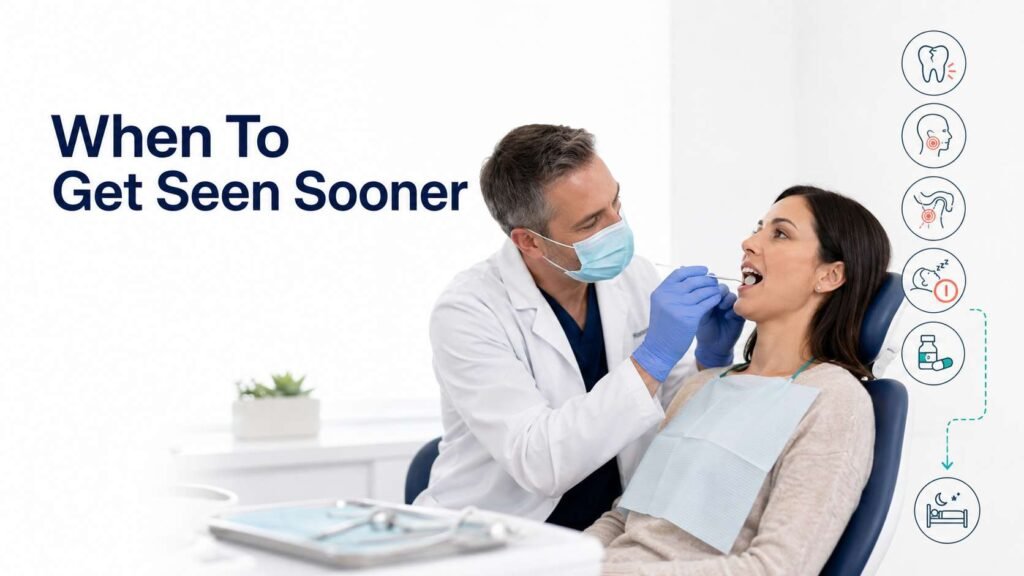
Book rather than wait if you notice a tooth that has cracked or gone sharp, pain that has shifted from tired to constant, a jaw that catches or locks or will not open fully, grinding alongside loud snoring or witnessed pauses in breathing or daytime sleepiness, or grinding that started shortly after a change of medication.
Grinding in children is common and usually settles on its own. It is worth mentioning to a dentist or GP mainly when it arrives with snoring or persistent mouth breathing.
Night Shift
Your jaw works a shift you will never meet. Most of the time that is fine. Rhythmic jaw activity turns up in a clear majority of ordinary sleepers who have no symptoms, no wear, and nothing whatsoever to worry about. Nobody is trying to abolish it.
What is worth doing is noticing whether yours is costing you anything, and checking once a year whether the answer has changed. Get the wear looked at before it becomes structural, and mention the snoring while you are there.
Disclaimer
This article is for general information only and is not medical or dental advice. It cannot account for your individual circumstances, and nothing here should replace an assessment by a qualified dentist, doctor or sleep specialist. Do not start, stop or alter any prescribed medication on the basis of what you have read here. If you have persistent facial pain, a jaw that locks, cracked teeth, or symptoms suggesting a sleep-related breathing problem, please seek professional care.
References
- Nishigawa K, Bando E, Nakano M. Quantitative study of bite force during sleep associated bruxism. Journal of Oral Rehabilitation. 2001;28(5):485-491. doi:10.1046/j.1365-2842.2001.00692.x
- Kato T, Rompré P, Montplaisir JY, Sessle BJ, Lavigne GJ. Sleep bruxism: an oromotor activity secondary to micro-arousal. Journal of Dental Research. 2001;80(10):1940-1944. doi:10.1177/00220345010800101501
- Lavigne GJ, Rompré PH, Poirier G, Huard H, Kato T, Montplaisir JY. Rhythmic masticatory muscle activity during sleep in humans. Journal of Dental Research. 2001;80(2):443-448. doi:10.1177/00220345010800020801
- Lavigne GJ, Kato T, Kolta A, Sessle BJ. Neurobiological mechanisms involved in sleep bruxism. Critical Reviews in Oral Biology & Medicine. 2003;14(1):30-46. doi:10.1177/154411130301400104
- Huynh N, Kato T, Rompré PH, Okura K, Saber M, Lanfranchi PA, Montplaisir JY, Lavigne GJ. Sleep bruxism is associated to micro-arousals and an increase in cardiac sympathetic activity. Journal of Sleep Research. 2006;15(3):339-346. doi:10.1111/j.1365-2869.2006.00536.x
- Khoury S, Rouleau GA, Rompré PH, Mayer P, Montplaisir JY, Lavigne GJ. A significant increase in breathing amplitude precedes sleep bruxism. Chest. 2008;134(2):332-337. doi:10.1378/chest.08-0115
- Ohayon MM, Li KK, Guilleminault C. Risk factors for sleep bruxism in the general population. Chest. 2001;119(1):53-61. doi:10.1378/chest.119.1.53
- Lobbezoo F, Ahlberg J, Raphael KG, Wetselaar P, Glaros AG, Kato T, et al. International consensus on the assessment of bruxism: report of a work in progress. Journal of Oral Rehabilitation. 2018;45(11):837-844. doi:10.1111/joor.12663
- Verhoeff MC, Lobbezoo F, Ahlberg J, Bender S, Bracci A, Colonna A, et al. Updating the bruxism definitions: report of an international consensus meeting. Journal of Oral Rehabilitation. 2025;52(9):1335-1342. doi:10.1111/joor.13985
- Zieliński G, Pająk A, Wójcicki M. Global prevalence of sleep bruxism and awake bruxism in pediatric and adult populations: a systematic review and meta-analysis. Journal of Clinical Medicine. 2024;13(14):4259. doi:10.3390/jcm13144259
- Li D, Kuang B, Lobbezoo F, de Vries N, Hilgevoord A, Aarab G. Sleep bruxism is highly prevalent in adults with obstructive sleep apnea: a large-scale polysomnographic study. Journal of Clinical Sleep Medicine. 2023;19(3):443-451. doi:10.5664/jcsm.10348
- Błaszczyk B, Waliszewska-Prosół M, Więckiewicz M, Poręba R, Niemiec P, Przegrałek J, Martynowicz H. Sleep bruxism (SB) may be not associated with obstructive sleep apnea (OSA): a comprehensive assessment employing a systematic review and meta-analysis. Sleep Medicine Reviews. 2024;78:101994. doi:10.1016/j.smrv.2024.101994
- Macedo CR, Silva AB, Machado MAC, Saconato H, Prado GF. Occlusal splints for treating sleep bruxism (tooth grinding). Cochrane Database of Systematic Reviews. 2007;(4):CD005514. doi:10.1002/14651858.CD005514.pub2
- Garrett AR, Hawley JS. SSRI-associated bruxism: a systematic review of published case reports. Neurology: Clinical Practice. 2018;8(2):135-141. doi:10.1212/CPJ.0000000000000433
- National Health Service. Teeth grinding (bruxism). NHS, reviewed 8 April 2026. https://www.nhs.uk/symptoms/teeth-grinding/