

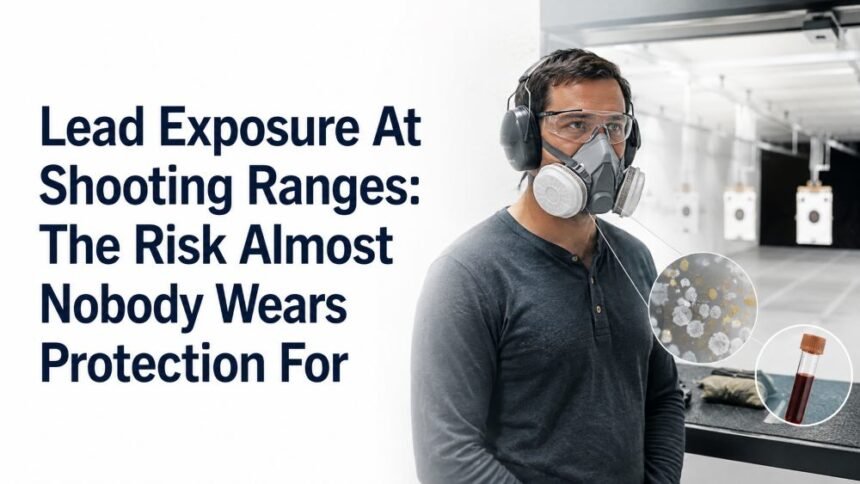
Walk onto any firing line, and you will see two things on every shooter: ear defenders and eye protection. Both hazards are obvious. One is loud, and the other is visible, and nobody needs convincing.
The third hazard makes no noise, has no colour, and produces no symptoms on the day you are exposed to it. It is lead, and the evidence that shooters are absorbing meaningful amounts of it has been sitting in the occupational health literature for decades without ever really reaching the people standing on the line.
This is not an argument against shooting. It is an argument for understanding a risk that is genuinely manageable once you know it exists, and that is almost entirely unmanaged when you do not.
What The Evidence Actually Shows
A review published in the journal Environmental Health compiled 36 studies of firing range users from around the world, covering range employees, police trainees, and recreational shooters. The findings were consistent across settings and countries: nearly every blood lead measurement in the reviewed studies exceeded the reference level then recommended by US health authorities. The authors concluded that firing ranges, regardless of type or user classification, represent a significant and largely unmanaged public health problem, and noted pointedly that recreational shooters and their families receive none of the legal protections extended to occupational users.
The gap between those two groups matters. If you are a range employee, an instructor, or a police firearms trainer, you are covered by occupational health law, with air monitoring, medical surveillance, and mandatory controls. If you are a member of the public who shoots twice a week, you are covered by nothing at all. Your exposure is determined entirely by decisions the range made about ventilation and cleaning, and by whatever precautions you take yourself.
NIOSH estimates that 16,000 to 18,000 firing ranges operate in the United States, and that some do not have sufficient environmental and occupational health controls to protect the health of shooters and staff.
Where The Lead Actually Comes From
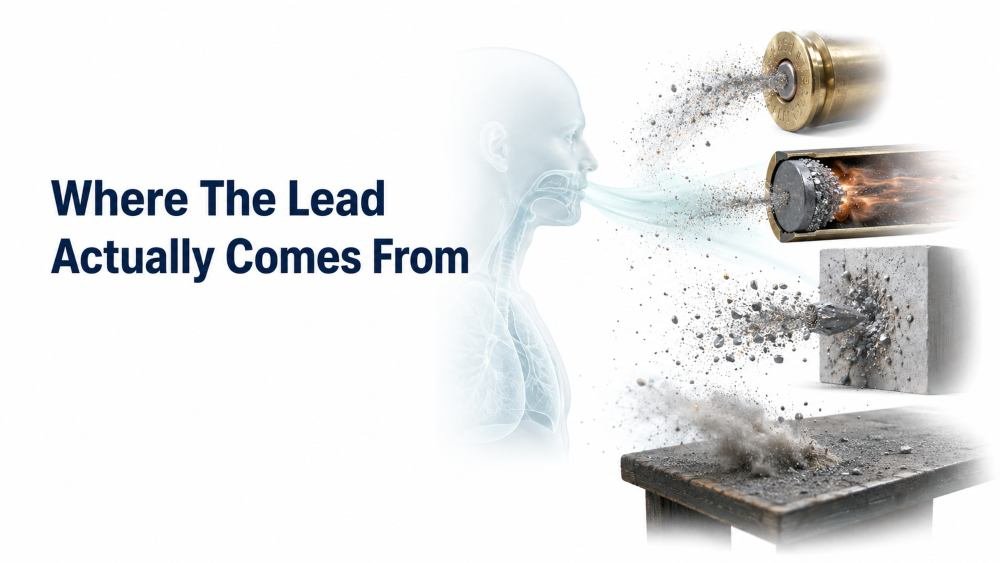
Most shooters assume the Lead comes from the bullet. It is a reasonable guess, and it is only partly right.
- The primer is the dominant airborne source in most indoor ranges. Conventional primers contain lead styphnate. At the moment of ignition, it burns, and Lead is released as an ultrafine aerosol directly into the shooter’s breathing zone. This happens on every round, including rounds with fully jacketed or non-lead projectiles. Primers also contain barium nitrate and antimony sulphide, which is why range air analyses routinely find all three metals together.
- The base of the bullet contributes more than people expect. In a conventional jacketed round, the lead core is exposed at the base. Hot propellant gas at several thousand degrees hits that exposed lead directly as the round travels down the barrel, vaporising a portion of it. A jacketed bullet is not a sealed bullet.
- Impact fragmentation adds a third source. When a lead-core projectile strikes a steel backstop, a bullet trap, or a hard berm, it fragments and throws fine particulate back into the air. Range design matters enormously here, and older facilities with degraded traps produce noticeably more.
- Settled dust is the most underestimated source of all. Lead accumulates on floors, benches, shelving, and equipment across years of operation. Sweeping, brass collection, walking around, or a poorly chosen cleaning method puts it straight back into the air. A NIOSH health hazard evaluation of an indoor range found that airborne Lead during filter changes and bullet trap maintenance was high enough that even a powered air-purifying respirator would have been insufficient under NIOSH selection criteria. Housekeeping is not a minor task at a range. It is the highest-exposure task in the building.
Outdoor ranges are meaningfully safer, but not exempt. Covered firing lines, still air, and a shooter positioned downwind of the line all reduce the advantage.
What Lead Does To The Body
Lead is a cumulative toxin, and no safe level of exposure has been identified. It is absorbed by inhalation and by ingestion, circulates in blood, and is then stored in bone, where it can remain for decades and leach slowly back into the bloodstream long after the exposure stops.
In adults, elevated blood lead is associated with fatigue, headache, irritability, difficulty concentrating, memory problems, abdominal pain, joint and muscle pain, raised blood pressure, reduced kidney function, and peripheral nerve damage. Chronic exposure is linked to cardiovascular disease, chronic kidney disease, and cognitive decline.
The reproductive picture deserves specific attention. Lead is associated with reduced fertility in men, and in pregnancy with miscarriage, preterm birth, reduced fetal growth, and impaired neurological development. The American College of Occupational and Environmental Medicine advises that women who are or may become pregnant avoid occupational lead exposure that would raise blood lead to 3.5 micrograms per decilitre or above. Health authorities list firing range shooting among the lead-related hobbies pregnant people should avoid outright.
Take-Home Pathway Deserves Its Own Section
This is the part that changes how people behave once they understand it.
Lead dust does not stay at the range. It travels home on your hands, hair, clothing, shoes, range bag, and gun case. It transfers to your car seats, your front door handle, your sofa, and your carpet. Then it reaches the floor, where small children spend their time and where hand-to-mouth behaviour is constant.
Children absorb lead far more efficiently than adults and are far more vulnerable to it. In 2021, the CDC lowered its blood lead reference value for children from 5 to 3.5 micrograms per decilitre, precisely because effects are measurable at levels once considered unremarkable. There is no threshold below which Lead is known to be harmless to a developing brain.
The firing range literature includes documented cases of elevated blood lead in the spouses and children of range users who never fired a shot. If you shoot regularly and you live with young children or a pregnant partner, take-home contamination is probably a bigger deal than your own exposure, and it is the easiest part of the problem to fix.
Respiratory Protection: What Actually Counts
Inhalation is the dominant exposure route, and it is the one that hand washing cannot touch. So respiratory protection is the highest-value intervention available to you. It is also the area where the most confident misinformation circulates, so it is worth being precise.
- Cloth and surgical masks do nothing here. They are not filters in any meaningful sense for this particle size, and they do not seal. Wearing one on a firing line offers reassurance and no protection.
- What you want is a certified particulate respirator. In the United States, that means a NIOSH-approved filter under 42 CFR 84, and P100 is the sensible choice, capturing at least 99.97 percent of particles at the most penetrating particle size. In the UK and Europe, the equivalent is an FFP3 respirator certified to EN 149, filtering at least 99 percent with tightly limited inward leakage. OSHA’s guidance for indoor firing ranges is specific on this point: employers must provide appropriate, NIOSH-approved respirators, and must run a respiratory protection programme including fit testing.
- Ignore the “filters down to 0.05 microns” claim. It appears constantly in mask marketing, and it misrepresents how filters work. Filtration efficiency is not a sieve. It dips to a minimum at roughly 0.3 microns, the most penetrating particle size, and improves again for smaller particles because Brownian motion drives them into the fibres. That is exactly why P100 and FFP3 are tested at 0.3 microns rather than at some smaller number. A mask advertising performance at 0.05 microns is quoting the easy end of the curve.
- Fit is not a detail. Fit is the whole thing. A P100 filter with a two millimetre gap at the cheek is a P100 filter attached to an open airway. OSHA’s respiratory protection standard requires fit testing precisely because seal failure is invisible to the wearer. Three practical consequences follow: perform the manufacturer’s positive and negative pressure seal check every single time you put the mask on, keep spectacle arms and straps off the sealing surface, and understand that facial hair crossing the seal will defeat any respirator regardless of its rating. That last point is not negotiable, and no amount of silicone or memory foam changes it.
- Know what a particulate filter cannot do. It captures particles. It does not remove carbon monoxide, and indoor ranges with poor ventilation can accumulate it. An activated carbon layer helps with solvent odours and some organic vapours, but it is not a rated gas cartridge, and it is not carbon monoxide protection. Ventilation is what deals with gases. If a range gives you a headache within twenty minutes, the answer is a different range, not a better mask.
Comfort Problem Is A Real Problem
Here is the uncomfortable truth about respirators: the best-rated mask in the world protects you for exactly as long as it is on your face and sealed. A mask that fogs your shooting glasses, digs into your cheekbones, or makes a two-hour training block feel like work will end up around your neck by the second magazine. Compliance is not a soft factor. It is the factor that determines your actual dose.
This is the gap that consumer, shooting-specific masks are trying to fill, prioritising low breathing resistance, eyewear compatibility, and a profile that does not interfere with a cheek weld. The shooting mask R-PUR is the most visible example, a French brand offering a multi-layer filter with an activated carbon layer in a form factor designed around range use rather than industrial work. Be aware, though, that at the time of writing, the manufacturer describes its shooting mask as delivering FFP3 and N100 equivalent performance with certification pending, rather than as a certified respirator. If you are a range employee or instructor covered by workplace lead regulations, that distinction is a compliance issue and not a preference, and you need certified equipment. If you are a recreational shooter, treat comfort-focused options as a step up from nothing and a step down from a fit-tested certified respirator, and choose accordingly.
Everything The Mask Cannot Do For You
Ingestion is the second exposure route, and no respirator addresses it.
- Wash properly, and know that plain soap is not enough. NIOSH researchers developed a dedicated hand-wipe method for Lead specifically because field studies found workers still had significant Lead on their skin after washing with soap and water. Wipes formulated with citric acid and a surfactant outperformed ordinary soap in controlled testing. Notably, the same research found that not every product marketed for heavy metal removal actually works, so choose based on evidence rather than packaging. Wash hands, forearms, and face before you eat, drink, or leave.
- No eating, drinking, smoking, or vaping on the line. Every one of those is a direct hand-to-mouth transfer. Chewing gum and fingernail biting count too.
- Treat your clothes as contaminated—change before you travel home if you can. Wash range clothing separately from household laundry, and run an empty cycle afterwards.
- Stop the Lead at the door. Shoes off outside. Range bag, gun case, and cleaning kit stored in a sealed container in a garage or utility area, never in a bedroom, never in a living room, and never anywhere a child plays.
- Do not vacuum with a domestic vacuum cleaner. A standard household unit will pass ultrafine Lead straight through the exhaust and redistribute it. A HEPA-filtered unit, or wet wiping, is what the task requires.
How To Read A Range’s Ventilation
You are largely at the mercy of the facility, so it is worth learning to assess one.
A well-designed indoor range moves clean air from behind the shooter, past the firing line, and downrange at a consistent laminar flow, so contaminated air is always travelling away from your face. Signs that this is not happening include visible haze hanging over the line, a strong propellant smell, smoke drifting back toward the shooters, and lingering headaches or a metallic taste after a session.
Ask the range directly when their ventilation system was last tested and balanced, how often they conduct air monitoring, and how they clean the floors. A well-run facility will answer without hesitation because they have invested in it. A defensive or vague answer tells you what you need to know.
Ammunition: What Reduces Exposure And What Does Not
Switching to non-lead projectiles is often recommended, and it helps, but there is an important catch. If your ammunition still uses a conventional lead styphnate primer, you are still generating airborne Lead on every shot. A copper bullet with a lead primer removes the fragmentation source and the bullet base source, and leaves the biggest one untouched.
Meaningful reduction requires both a non-lead projectile and a lead-free primer, which are usually sold together as “lead-free” or “clean fire” training ammunition. It costs more, and it is not available in every calibre, but for regular indoor training it is the single most effective engineering-level change available to an individual shooter.
Frangible ammunition is a separate consideration. It reduces ricochet and splash-back, which is a genuine safety benefit, but frangible does not automatically mean lead-free. Check the specification rather than the marketing.
Reloading and bullet casting deserve their own warning. Both are higher-exposure activities than shooting, casting especially, because molten Lead produces fumes and the work is often done in a garage with poor ventilation and no protection at all.
Getting Tested, And Reading The Result Properly

If you shoot frequently, work at a range, reload, or cast, ask your doctor for a blood lead level test. It is an ordinary blood draw, and it turns an abstract worry into a number.
Two things help when interpreting it. First, a blood lead level reflects recent exposure over roughly the past few weeks, not your lifetime burden, most of which sits in bone. A single normal result during a quiet month is not a clean bill of health if you shoot heavily in winter. Second, the regulatory thresholds are not health targets. The occupational medical removal levels in workplace lead standards were set decades ago and sit far above the levels at which health effects are now recognised. Public health reference values are considerably lower, and lower is better with no known floor.
If your result is elevated, the treatment is not a drug. It is removing the exposure, which means changing your protection, your hygiene, your ammunition, or your range.
Bottom Line
Lead exposure at shooting ranges is a well-documented, well-understood, and highly preventable problem that most shooters have simply never been told about. The interventions are not exotic. A certified respirator that actually fits, disciplined hand and clothing hygiene, a range with functioning ventilation, and a hard boundary between your range gear and your home will remove most of the risk for most people.
The two groups who should act rather than think about it are anyone who lives with young children or a pregnant partner, and anyone who works at a range and has never been offered a fit test. In the first case, the exposure you are managing is not really your own. In the second, you have protections you are legally entitled to and may not be receiving.
Everyone else: add a proper respirator to the bag next to the ear defenders, wash before you eat, and book a blood test. That is close to the whole of it.
Medical Disclaimer
This article is provided for general information and education only. It is not medical advice, occupational health advice, or a substitute for assessment by a qualified professional. Blood lead testing and interpretation should be arranged and reviewed by a clinician. Employers and range operators should refer to the applicable occupational health regulations in their jurisdiction, which impose specific and binding duties regarding exposure monitoring, respiratory protection programmes, fit testing, and medical surveillance. Respirator selection and fit testing should be carried out under a competent respiratory protection programme. If you have symptoms you believe may be related to lead exposure, consult a healthcare professional.
References
- Laidlaw MAS, Filippelli G, Mielke H, Gulson B, Ball AS. Lead exposure at firing ranges: a review. Environmental Health. 2017;16:34. doi:10.1186/s12940-017-0246-0
- National Institute for Occupational Safety and Health. Take Aim at Protecting Yourself: Solutions for Preventing Lead Poisoning and Hearing Loss at Indoor Firing Ranges. NIOSH Science Bulletin. Atlanta, GA: CDC. Available at: https://www.cdc.gov/niosh/bulletin/2009/firingrange.html
- Occupational Safety and Health Administration. Protecting Workers from Lead Hazards at Indoor Firing Ranges. OSHA Publication 3772. Washington, DC: US Department of Labor. Available at: https://www.osha.gov/sites/default/files/publications/OSHA3772.pdf
- Occupational Safety and Health Administration. 29 CFR 1910.1025, Lead. Washington, DC: US Department of Labor. Available at: https://www.osha.gov/laws-regs/regulations/standardnumber/1910/1910.1025
- Occupational Safety and Health Administration. 29 CFR 1910.134, Respiratory Protection. Washington, DC: US Department of Labor. Available at: https://www.osha.gov/laws-regs/regulations/standardnumber/1910/1910.134
- National Institute for Occupational Safety and Health. Blood Lead Level Guidance. Atlanta, GA: CDC. Available at: https://www.cdc.gov/niosh/lead/bll-reference/index.html
- Centers for Disease Control and Prevention. CDC Updates Blood Lead Reference Value. Childhood Lead Poisoning Prevention Program. Atlanta, GA: CDC. Available at: https://www.cdc.gov/lead-prevention/php/news-features/updates-blood-lead-reference-value.html
- National Institute for Occupational Safety and Health. Evaluation of Lead and Copper Exposure at an Indoor Shooting Range. Health Hazard Evaluation Report No. 2018-0124-3351. Atlanta, GA: CDC. Available at: https://www.cdc.gov/niosh/hhe/reports/pdfs/2018-0124-3351.pdf
- National Institute for Occupational Safety and Health. Reducing Exposure to Lead and Noise at Outdoor Firing Ranges. DHHS (NIOSH) Publication No. 2013-104. Atlanta, GA: CDC. Available at: https://www.cdc.gov/niosh/docs/wp-solutions/2013-104/pdfs/2013-104.pdf
- Esswein EJ, Boeniger MF, Ashley K. Handwipe method for removing Lead from skin. Journal of ASTM International. 2011;8(3). Research conducted at the National Institute for Occupational Safety and Health.