


Navigating the healthcare system can be complex, and securing approval for treatments or medications through insurance prior authorizations often adds another layer of challenge. If you’re an Aetna member or provider, understanding their specific requirements is essential. Without proper authorization, you could face unexpected costs for crucial services. We know this process can be daunting and time-consuming.
This comprehensive guide is designed to simplify “How to Get a Prior Authorization for Aetna the Easy Way.” We will walk you through every critical step. From understanding what prior authorization means and which services require it, to submitting requests, navigating review timelines, and even handling denials and appeals, we cover it all. For those seeking to further streamline this intricate process and enhance workflow efficiency, dedicated medical prior authorization support can make a significant difference. Our goal is to empower you with the knowledge and actionable steps to manage Aetna prior authorizations effectively in October 2026 and for the foreseeable future.
Prior authorization, often referred to as precertification or preapproval, is Aetna’s process for confirming that a proposed medical service or prescription drug meets their criteria for medical necessity and will be covered by a member’s plan. This preapproval criteria is crucial because it ensures that treatments are appropriate, effective, and align with established clinical guidelines. Aetna employs a robust utilization management system to review these requests. This process involves evaluating the submitted clinical information against their Clinical Policy Bulletins (CPBs), which outline the medical necessity review standards for a vast array of services and medications.
For providers, understanding Aetna’s specific plan coverage for each member is paramount before initiating any service that might require prior authorization. This proactive approach helps prevent unexpected denials and ensures patients receive timely, covered care. The ultimate goal of prior authorization is to ensure that healthcare resources are used effectively and that members receive care that is both medically appropriate and covered under their benefits.
Services and Medications Subject to Precertification
A wide range of services and medications require prior authorization from Aetna to ensure they meet medical necessity criteria. These often include high-cost treatments, elective procedures, and specialty services. As of October 2026, some of the common categories that typically require precertification include:
- Inpatient Admissions: Any planned hospital stay, including acute care, rehabilitation, or skilled nursing facilities, generally requires prior authorization. This helps Aetna confirm the necessity and appropriate length of stay.
- Elective Surgeries: Procedures such as arthroplasty (joint replacement), spinal procedures, bariatric surgery, certain reconstructive procedures, and gender affirmation surgery usually need preapproval.
- Advanced Radiology and Imaging: High-tech diagnostic tests like MRI, CT scans, and PET scans often require prior authorization, especially in outpatient settings.
- Specialty Pharmaceuticals: Many high-cost or complex medications, particularly those used for conditions like cancer, autoimmune diseases, or rare disorders (e.g., oncology drugs, enzyme replacements, immunologics, CAR-T therapy, blood-clotting factors), are subject to prior authorization. These are typically managed through Aetna’s pharmacy benefit manager, CVS Caremark, or through the medical benefit.
- Behavioral Health Services: Certain intensive behavioral health treatments, such as inpatient admissions or specific outpatient programs, may also require precertification.
- Home Health and Post-Acute Care: Authorizations for services like home health and post-acute care are managed through specific portals. For instance, as of January 1, 2026, Home Health authorizations for Aetna Medicare members shifted to the CareCore National portal, and Post-Acute Care authorizations began using the MedSolutions portal.
- Site-of-Service Rules: For commercial plans, some elective procedures require prior authorization not only for the service itself but also for the specific location where the service will be provided (e.g., outpatient hospital vs. ambulatory surgical center). This helps manage costs and ensure appropriate care settings.
- Step Therapy: For certain medications, Aetna may require members to try less expensive or alternative drugs first before approving coverage for a more costly option. This is a common utilization management tool for prescription drugs.
It’s important to always consult the member’s specific plan documents and Aetna’s current precertification lists, which are updated regularly (typically in January and July each year), to verify which services and medications require approval.
Commercial Plans vs Medicare Advantage Guidelines
While the core concept of prior authorization remains consistent, there are notable differences in requirements and processes between Aetna’s commercial plans and its Medicare Advantage plans. These distinctions are primarily driven by regulatory guidelines set by the Centers for Medicare & Medicaid Services (CMS) for Medicare plans.
| Feature | Aetna Commercial Plans | Aetna Medicare Advantage Plans |
| Regulatory Body | State regulations, ERISA (for self-funded plans) | Centers for Medicare & Medicaid Services (CMS) |
| Decision Turnaround | Standard: Up to 15 calendar days | Standard: 14 calendar days |
| Expedited Decision | Within 72 hours | Within 24 hours (expedited) or 72 hours (standard) |
| Appeal Window | 180 days from denial notice (first level) | 60 days from denial notice (first level) |
| Coverage Determination | Aetna CPBs, MCG guidelines | CMS NCDs/LCDs, Aetna CPBs, Medicare Part B Drug Criteria |
| Specific Terminology | Prior Authorization, Precertification | Organization Determination |
| Part B Medications | Managed under medical benefit PA | Specific Medicare Part B drug policies and criteria apply |
| Site-of-Service Review | Applies to certain elective procedures | Less emphasis on site of service for PA, but coverage rules apply |
As you can see from the table, Medicare Advantage plans often have more stringent and faster timelines for prior authorization decisions due to CMS regulations. For example, while commercial plans typically have up to 15 calendar days for a standard pre-service decision, Medicare Advantage standard decisions are often made within 14 calendar days, and expedited cases within 24 to 72 hours. This expedited process for Medicare members is crucial when delays could seriously jeopardize the member’s life, health, or ability to regain maximum function.
For Medicare Part B medications, Aetna Medicare plans follow specific guidelines and criteria that may differ from commercial medical benefit drug policies. Providers should always check the relevant Medicare Part B drug policies on Aetna’s provider portal for detailed requirements.
Step-by-Step Guide to Submitting an Aetna Prior Authorization
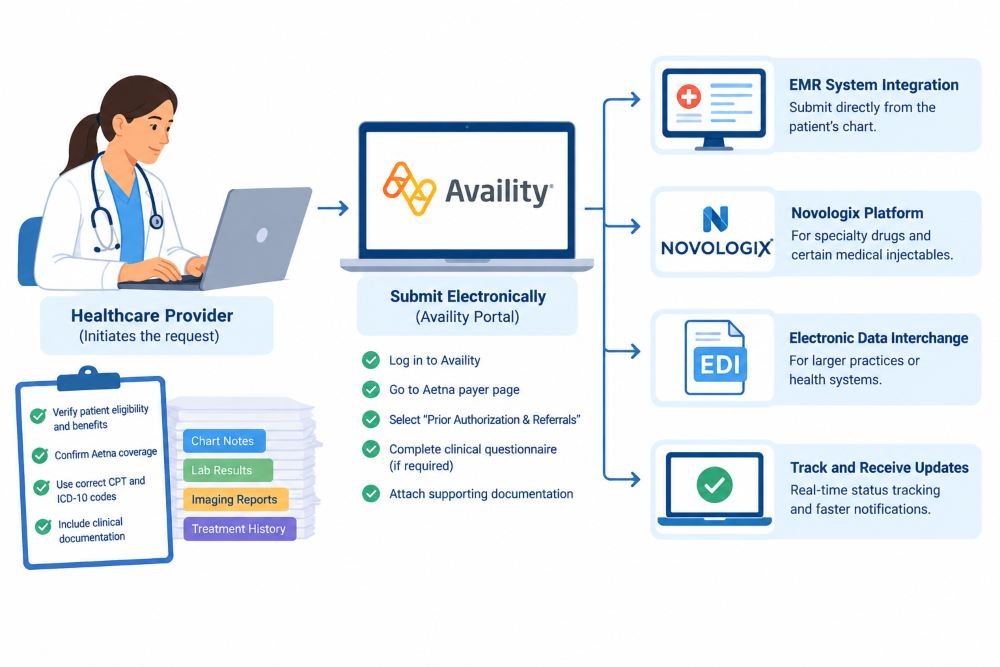
Submitting an Aetna prior authorization request requires meticulous attention to detail and adherence to specific protocols. The process is typically initiated by the healthcare provider’s office, not the patient, to ensure all necessary clinical documentation is included. Before submission, verify the patient’s eligibility and benefits to confirm Aetna is their primary or secondary payer and that the requested service is covered. Accurate CPT coding for the procedure and ICD-10 diagnostics for the patient’s condition are fundamental to a successful request.
Electronic Submission via Availity and EMR Portals
Aetna strongly encourages electronic submission of prior authorization requests, as this is often the fastest and most efficient method.
- Availity Portal: For most medical prior authorization requests, providers should use the Availity portal. This secure online platform allows direct submission of requests to Aetna.
- Access: Log in to Availity, navigate to the Aetna payer page, and select “Prior Authorization & Referrals.”
- Clinical Questionnaires: For selected procedures and services (e.g., bariatric surgery, certain orthopedic procedures), Availity may prompt you to complete a short clinical questionnaire. These questionnaires are designed to gather specific information required by Aetna’s CPBs and can often lead to instant approval if all criteria are met.
- Documentation: Ensure all supporting clinical documentation (chart notes, lab results, imaging reports, previous treatment history) is attached electronically.
- EMR System Integration: Many electronic medical record (EMR) systems offer direct integration with payers like Aetna, allowing providers to submit prior authorization requests directly from the patient’s chart. This streamlines the workflow and reduces manual data entry.
- Novologix Platform: For specialty drugs and certain medical injectables, requests may need to be submitted via the Novologix platform, which is also accessible through Availity.
- Electronic Data Interchange (EDI): Some larger practices or health systems may use EDI for bulk submissions.
Electronic submissions offer real-time tracking capabilities, allowing providers to monitor the status of their requests and receive notifications more quickly.
Standard Review Timelines and Expedited Requests
Understanding Aetna’s review timelines is critical for managing patient expectations and scheduling care.
- Standard Review: For most non-urgent prior authorization requests under commercial plans, Aetna’s standard review process can take up to two weeks, or 15 calendar days, from the date of receipt of all necessary information. For Medicare Advantage plans, the standard decision timeline is typically 14 calendar days.
- Expedited Requests: In situations where delaying care could seriously jeopardize the member’s life, health, or ability to regain maximum function, an expedited review can be requested.
- Criteria: The request must meet urgent criteria, meaning a delay would cause severe harm or unmanageable pain.
- Timelines: For commercial plans, expedited requests are typically decided within 72 hours. For Medicare Advantage members, expedited decisions are often made within 24 hours.
- Notification: Once a decision is made, Aetna will provide a written notification to both the provider and the member. This notification will include the decision, the clinical rationale if denied, and instructions on how to appeal.
- Tracking Numbers: Always keep the tracking number assigned to your prior authorization request. This number is essential for checking the status, submitting additional information, or initiating an appeal.
It’s a best practice to submit prior authorization requests at least two weeks in advance of the planned service date to allow ample time for review and to address any potential requests for additional information.
Streamlining Approvals with Medical Prior Authorization Support
The prior authorization process can be a significant administrative burden for healthcare practices, diverting valuable staff time away from direct patient care. The complexity of Aetna’s varied requirements across different plans, coupled with frequent updates to Clinical Policy Bulletins, often leads to delays, rework, and even denials. This is where specialized medical prior authorization support can play a transformative role. By leveraging external expertise, practices can enhance their efficiency, improve clinical documentation accuracy, and proactively work towards denial prevention.
Dedicated support teams are equipped to navigate the intricacies of Aetna’s system, ensuring that requests are submitted correctly the first time. This significantly reduces the administrative load on internal staff, allowing them to focus on core clinical responsibilities. Such support can be invaluable in ensuring that patients receive timely access to necessary care without unnecessary administrative hurdles.
Integrating Technology and Medical Prior Authorization Support
Effective medical prior authorization support services often integrate seamlessly with existing practice technologies to optimize workflows. These services can:
- Leverage EMR Integration: By working within or alongside a practice’s EMR system, support teams can efficiently gather the necessary patient data, including comprehensive chart notes, lab results, and diagnostic imaging, directly from the source.
- Automated Status Checks: Advanced systems can perform automated status checks on submitted authorizations, providing real-time updates and flagging any requests that require immediate attention or additional information.
- CPB Criteria Alignment: Expert support teams are well-versed in Aetna’s current Clinical Policy Bulletins (CPBs). They ensure that every submission meticulously aligns with the specific medical necessity criteria outlined in the relevant CPB, significantly increasing the likelihood of approval.
- Staff Delegation and Workflow Optimization: By delegating the time-consuming tasks of prior authorization research, submission, and follow-up, practice staff can be reallocated to other critical areas, leading to overall workflow optimization and improved patient satisfaction.
This technological integration ensures that the prior authorization process is not just outsourced, but optimized for speed, accuracy, and compliance with Aetna’s guidelines.
How Medical Prior Authorization Support Resolves Denials
Even with the most diligent submission, denials can still occur. This is where specialized prior authorization support truly shines in its ability to navigate the complex landscape of dispute resolution. When a denial is received, these teams can:
- Perform Root Cause Analysis: They meticulously review the denial notice to understand the specific unmet clinical criteria or documentation deficiencies that led to the rejection.
- Prepare for Peer-to-Peer Coordination: If a peer-to-peer (P2P) review is necessary, the support team can assist in preparing the clinical justification and a concise chart summary, ensuring the treating physician is well-equipped to discuss the case with Aetna’s medical director.
- Adhere to Appeal Timelines: They ensure that all appeal processes are initiated and completed within Aetna’s strict appeal timelines (e.g., 180 days for commercial plans, 60 days for Medicare Advantage plans), preventing the loss of appeal rights.
- Craft Strong Clinical Justification: Based on the root cause analysis, they help compile comprehensive supporting evidence, including updated clinical notes, new test results, and relevant medical literature, to build a compelling case for medical necessity during the appeal.
By providing this expert assistance, medical prior authorization support can significantly improve the chances of overturning a denial, ensuring patients receive the care they need without undue delays or financial burden.
Navigating Aetna Denials, Appeals, and Peer-to-Peer Reviews
Despite best efforts, prior authorization requests can sometimes be denied. Receiving a denial notice can be disheartening, but it’s crucial to understand that this is not necessarily the final word. Aetna’s denial notices will clearly state the reason for the denial, typically citing specific unmet clinical criteria from their Clinical Policy Bulletins. Understanding these reasons is the first step in formulating an effective response. For commercial plans, if internal appeals are exhausted, there may be options for external review, and for employer-sponsored plans, ERISA guidelines might apply.
Initiating Peer-to-Peer Clinical Reviews
One of the most effective avenues for overturning a prior authorization denial is through a peer-to-peer (P2P) clinical review. This process allows the treating physician to directly discuss the case with an Aetna medical director or another physician reviewer.
- Purpose: The P2P review provides an opportunity to present additional clinical information, clarify details, and explain the medical rationale for the requested service or medication that may not have been fully captured in the initial submission.
- Scheduling: It’s important to act promptly. Aetna typically requires P2P reviews to be scheduled within a specific timeframe, often around 30 calendar days from the denial date. The denial letter will usually provide the contact information and instructions for scheduling.
- Preparation: Before the call, the treating physician should prepare a concise chart summary highlighting the patient’s condition, previous treatments, and why the requested service is medically necessary and appropriate, specifically addressing the unmet criteria cited in the denial. Having all relevant clinical documentation readily available is essential for a productive discussion.
A well-prepared P2P review can often lead to an approval, as it allows for a direct clinical dialogue that can resolve misunderstandings or provide context that written documentation might miss.
Filing Formal Appeals and Level Determinations
If a peer-to-peer review is unsuccessful or not pursued, the next step is to file a formal appeal. Aetna’s appeal process typically involves multiple levels.
- First-Level Internal Appeal:
- Timeline: For commercial plans, you generally have 180 days from the date of the denial notice to file a first-level appeal. For Medicare Advantage plans, this window is typically 60 days. Always refer to the specific denial letter for exact timelines.
- Submission: The appeal should be submitted in writing, clearly stating that you are appealing the decision. It should include the patient’s information, the service denied, the date of denial, and a detailed explanation of why you believe the service is medically necessary.
- Supporting Evidence: Crucially, this appeal should include any new or additional supporting evidence, such as updated medical necessity letters from the physician, new diagnostic test results, relevant clinical literature, or a more comprehensive review of the patient’s medical history. Address the specific reasons for the initial denial directly.
- Written Determination: Aetna will review the appeal and provide a written determination. For commercial plans, Aetna typically responds within 30 days for pre-service standard appeals.
- Second-Level Internal Appeal (if applicable): Some plans may offer a second level of internal appeal if the first appeal is denied. The process and timelines will be outlined in the first-level appeal denial letter.
- External Review: If all internal appeals are exhausted and the denial stands, members of commercial plans may have the right to an independent external review. This involves an outside third party reviewing the case to determine medical necessity. The process and eligibility for external review are governed by state and federal laws (like ERISA for self-funded plans). Medicare Advantage plans have their own specific multi-level appeal process that includes review by an independent review entity (IRE).
Thorough documentation, adherence to timelines, and a clear, evidence-based argument are paramount for a successful appeal.
Frequently Asked Questions About Aetna Prior Authorization
We understand that the prior authorization process can raise many questions. Here, we address some of the most common inquiries to provide clarity and guidance.
How long does Aetna take to approve a prior authorization request?
The time Aetna takes to approve a prior authorization request depends on the type of plan (commercial vs. Medicare) and the urgency of the request.
- Standard Requests (Commercial Plans): For non-urgent requests, Aetna typically takes up to two weeks (or 15 calendar days) to process a standard prior authorization request. This timeframe allows for a thorough review of all submitted clinical documentation.
- Standard Requests (Medicare Advantage Plans): For Medicare Advantage members, standard prior authorization decisions are generally made within 72 hours (3 calendar days) for standard cases, but can take up to 14 calendar days depending on the specific service.
- Expedited Requests: If a delay in care could seriously jeopardize the member’s life, health, or ability to regain maximum function, an expedited review can be requested. For commercial plans, these are typically decided within 72 hours. For Medicare Advantage members, expedited decisions are often made within 24 hours.
Aetna will send a written determination notice once a decision has been made. It’s always best practice to submit requests well in advance to avoid any delays in patient care.
What documentation is required to avoid an Aetna prior authorization denial?
To maximize the chances of an Aetna prior authorization approval and avoid denials, comprehensive and accurate documentation is essential. The specific documentation needed will vary based on the service or medication requested, but generally includes:
- Comprehensive Chart Notes: Detailed clinical notes from the treating physician outlining the patient’s diagnosis, symptoms, medical history, physical exam findings, and the rationale for the requested service.
- Laboratory Results: Relevant lab tests that support the diagnosis and the medical necessity of the treatment.
- Diagnostic Imaging Reports: Copies of imaging reports (e.g., X-rays, MRI, CT scans) and, in some cases, the actual images, if they are pertinent to the request.
- Prior Trial Records: Documentation of previous treatments, therapies, or medications that have been tried and failed, or were contraindicated, especially for services with step therapy requirements.
- Consultation Reports: Reports from specialists if the patient has been referred for the requested service.
- Aetna CPB Documentation Requirements: Always refer to the specific Aetna Clinical Policy Bulletin (CPB) for the requested service or drug. The CPB will outline the precise clinical criteria and documentation required for approval. Aligning your submission directly with these criteria is crucial.
Incomplete or insufficient documentation is a leading cause of prior authorization denials, so ensuring all relevant information is provided upfront is key.
How long is an approved Aetna prior authorization valid?
Once an Aetna prior authorization is approved, it typically has a validity period. For many services, including those listed in the participating provider precertification list, approvals are valid for six months.
However, there are important caveats to this:
- Continuous Member Eligibility: The approval is contingent upon the member maintaining continuous eligibility and plan coverage with Aetna. If the member’s plan changes or their coverage terminates, the prior authorization may no longer be valid.
- Procedural Re-certification: For ongoing treatments or long-term care plans, periodic re-certification may be required. This means that after the initial six-month period, a new prior authorization request might be necessary to continue coverage.
- Site-of-Care Consistency: If the prior authorization included a site-of-service review, the approval is typically valid only for the approved location. Any change in the site of care might necessitate a new or updated prior authorization.
- Specific Service Variations: Some specific services or medications may have different validity periods. Always check the approval letter for the exact expiration date and any specific conditions.
It’s crucial for providers to monitor the expiration dates of approved authorizations and initiate new requests as needed to ensure uninterrupted patient care and coverage.
Conclusion
Navigating the Aetna prior authorization process, while intricate, is a manageable aspect of healthcare administration when approached with knowledge and strategic planning. By understanding the preapproval criteria, identifying which services and medications require authorization, and adhering to Aetna’s submission protocols and timelines, healthcare providers can significantly streamline their workflows.
The emphasis on proactive submission, diligent electronic portal tracking, and meticulous clinical guideline adherence cannot be overstated. Leveraging available resources, such as Aetna’s online tools and, where beneficial, specialized medical prior authorization support, can further enhance efficiency and reduce the administrative burden on practices. A thorough and informed approach to Aetna prior authorizations ensures that patients receive timely access to medically necessary care, fostering care continuity and positive health outcomes.
Disclaimer: This article is for general information only and is not legal, medical, billing or insurance advice. Aetna’s prior authorization requirements, precertification lists, review timelines and appeal deadlines change regularly and can differ by plan, state and member, and federal rules for Medicare Advantage plans are also updated from time to time. Always confirm the current requirements with Aetna through the provider portal or the member’s plan documents before submitting a request or appeal.